Showing posts with label funding. Show all posts

Friday, 16 February 2018

Creative Scotland's U-Turn

Following the announcement by Creative Scotland, Scotland's public arts funding body, that they were to cut funding to twenty organisations, a number of key figures in the Art world voiced their concerns and launched several petitions urging Creative Scotland to reverse its decision. This coincided with Ruth Wishart and Maggie Kinloch, two members of the Creative Scotland board making the decision to resign.

Thursday night's episode of Front Row on BBC Radio 4 included an interview with Robert Softly Gale and David Leddy, two artistic directors, who discuss how their organisations have been caught up in the funding storm.

Ten days after Creative Scotland announced cuts to the theatre, disabled arts and music groups, an emergency board meeting was held during which they decided to reverse the cuts. Birds of Paradise, Catherine Wheels, the Dunedin Consort, Lung Ha and Visible Fictions will now be given three-year funding deals.

"The £2.6m required for the funding reversal is to be found from ‘targeted funds’, a pot of money which Creative Scotland set aside for specific tasks.

This could mean money taken from the traditional and Gaelic arts, money for its Arts Strategy, cross-border touring or literature translation."

http://www.bbc.co.uk/programmes/b09r3nx5

http://www.heraldscotland.com/news/15924468.Creative_Scotland_to_revamp_funding_after_U_turns_on_controversial_cuts/

https://www.thetimes.co.uk/article/creative-scotland-funding-restored-to-five-groups-after-protest-d9g0fkb6z

Friday, 9 February 2018

The lack of funding for Glasgow Art Gallery Transmission

As a member of the Glasgow Art Gallery, Transmission, I was disappointed and shocked to hear that the arts funding body Creative Scotland has dropped the gallery from its 2018-21 portfolio of regularly funded organizations (RFOs). The impact that this is likely to have for the artistic community is significant. The following article by CHRIS SHARRATT featured in Frieze magazine, examines the situation.

Why Did Creative Scotland Defund Storied Glasgow Art Gallery Transmission?


The gallery argues that the funding body is no longer supportive of institutions that maintain a principled refusal of professionalization


For many Transmission gallery is synonymous with contemporary art in Scotland, an artist-run Glasgow institution that epitomizes the DIY attitude that has helped establish the city as an international centre for art. Judged on its recent actions, you could be forgiven for thinking that the arts funding body Creative Scotland favours a different view. It has dropped the gallery from its 2018-21 portfolio of regularly funded organizations (RFOs), a move that, based on its award for 2015-18, will lose Transmission guaranteed support of GBP£210,000 over three years. It is a decision that has left artists, curators and gallerists expressing anger and disbelief.

Transmission was founded in 1983 by graduates of Glasgow School of Art and has had a key role in the city’s visual arts ecology ever since. It has remained a vital, continually evolving force, in large part because of the way it is run. With a membership of more than 300, it is led by a rolling voluntary committee – typically consisting of six people, although at present it is four – with committee members usually staying in the role for no more than two years, occasionally more and often less. It’s a model that ensures a continual process of renewal and, by its nature, dispenses with the usual arts establishment hierarchies of CEOs, deputy directors and chief curators. Past committee members have gone on to become internationally-known artists and gallerists, and include: Claire Barclay, Christine Borland, Douglas Gordon, Jim Lambie, Tanya Leighton, Carol Rhodes, Eva Rothschild, Lucy Skaer, Simon Starling, and Modern Institute founding director Toby Webster.

The Glasgow-based artist Martin Boyce was on the Transmission committee from 1991-93; The Modern Institute, which represents him, is just around the corner from the King Street venue. ‘Transmission was and is an outsider,’ Boyce says. ‘It allows artists to be responsible for cultivating their own ecosystem that then develops outwards into the city and beyond. It becomes part of the DNA of the artists themselves.’ Remembering his involvement as a recent graduate of Glasgow School of Art, he adds: ‘For me, Transmission was a lifeline, a school, a salon, a gathering place, an invitation, typewriter and a photocopier, an excuse to reach out to other artists, self-determining, responsible, tentative, self-perpetuating, open. It was the first port of call when artists and friends arrived off the train.’

Katrina Brown, director of Glasgow’s Common Guild gallery and a former director of Glasgow International, was a Transmission committee member at the same time as Boyce. She echoes his point about Transmission’s importance to the city and its artists. ‘It’s such a fundamental and foundational component of the [Glasgow] ecology that it’s impossible to imagine the landscape without it.’ While accepting that ‘not everything should necessarily exist for ever just because it has existed once,’ she describes what the gallery offers as ‘rare, special and important’, believing it ‘fosters a strong sense of both individual and collective agency which has undoubtedly fuelled the now legendary DIY spirit in Glasgow’.

Brown also points out that the Transmission model has been copied by other artist-run spaces in many countries. This is undoubtedly the case, although aspects of its approach have in recent months been put under close scrutiny by the Transmission committee itself. In June 2017, it took the surprise step of postponing the gallery’s annual members’ show, citing ‘multiple burnouts’ amongst the committee due to the pressures of fulfilling their unpaid roles while also holding down paid work. The committee’s decision was accompanied by a pledge to strive ‘towards an alternative’ model that doesn’t rely on free labour and all the stresses and social barriers this creates. It seems that Creative Scotland concluded that an organization in such a constant state of flux does not belong in its portfolio of RFOs. Amanda Catto, Head of Visual Arts at Creative Scotland, puts it differently, stressing that the decision: ‘was not taken with any intention to damage Transmission. We respect and value their very long and quite exceptional history in terms of being an artist-run space’. Citing Creative Scotland’s Visual Arts Sector Review, which was published in October 2016, she tells me: ‘There are many artist-run spaces across Scotland, it’s a different landscape to 35 years ago. What we wish to do is create a targeted fund that will support many artist-run initiatives across the country, including Transmission, and create a much more considered and strategic response to their needs.’ She adds that the gallery has transitional funding in place up to October, ‘and then we will work with them to see where that leaves us’.

Transmission was aware of the still to be confirmed artist-run fund when it issued its robustly-worded statement in response to the Creative Scotland decision. It expresses the view that Transmission was considered ‘too messy and unpredictable’ and ‘subject to quick change’ for Creative Scotland to continue investing in it: ‘Transmission believes that Creative Scotland has chosen to cut our funding because they are no longer prepared to invest in an institution that refuses professionalization, and yet by virtue of its unique history operates at a scale comparable to more professionalized institutions.’

Paradoxically, this rejection of professionalization makes the certainty of regular funding all the more crucial, offering continuity as the organizing committee keeps changing. And while Catto states that her organization is ‘very aware of the vulnerability and precarity of all these [artist-run] spaces’, to remove Transmission’s existing route to funding before any new strategy has been developed seems – whether by accident or design – to be perversely destructive. As Kirsty Ogg, director of New Contemporaries and another former Transmission committee member, puts it: ‘It’s crazy to think that the voluntary committee structure could sustain the gallery’s activity through project-by-project funding applications – they [Creative Scotland] clearly have no sense of the pressures that younger artists are under as members of the precariat. The incredible, cooperative membership-based structure that has lasted for 35 years needs at least one cornerstone of stability.’

The backlash over the decision to drop Transmission is just one aspect of a wider crisis that is enveloping Creative Scotland following its recent regular funding announcement, which included the defunding of three performance companies working with people with disabilities. Two board members – the journalist Ruth Wishart and Professor Emerita of the Royal Conservatoire of Scotland, Maggie Kinloch – have resigned over the lack of time and information they had to consider the decisions, with Wishart stating that Creative Scotland ‘finds itself a family at war with many of those it seeks to serve.’ In total, 20 organizations have been dropped. Other visual arts bodies that have lost their RFO status include the Glasgow-based public art producer NVA and Edinburgh’s Dovecot Foundation. (There have also been 19 additions, with Stills Gallery in Edinburgh becoming an RFO for the first time.) As for Transmission, Boyce captures the feeling of so many artists, curators and others in the visual arts who are perplexed by the Creative Scotland decision. ‘Transmission introduced me to the idea of a supportive network that has always stayed with me. It is unfathomable to me to understand why this ethos is no longer considered relevant.’

Monday, 25 December 2017

Christmas Greetings


Wishing you a very Happy Christmas and hoping that 2018 is filled with happiness, good health and creativity.


As I reflect on what has been a challenging but exciting year, I would like to take this opportunity to thank you for your continued support and interest in what I am doing in the studio.

Here are some of my highlights from 2017

RAISE A MUG TO NEWBRIDGE!


I collaborated with NewBridge studio holder Holly Wheeler to make an artwork celebrating the relocation of The NewBridge Project from NewBridge Street West to Carliol House.


The stress and hassle of the move has been worthwhile as I now enjoy working in my wonderful studio.

After devoting the initial few months of the year to writing proposals and submitting applications, the work paid off as I was awarded funding from Arts Council to support my year-long project, Voices : Within and Without.


In April I was fortunate enough to participate in the one-of-a-kind Spoken Word residency at The Banff Centre for Arts and Creativity in Canada. It was an amazing experience where I learned a great deal and made some incredible friends.


My four-channel audio installation, Everything Will Be Alright, was exhibited in the Stables Gallery at Cheeseburn Sculpture during the May Open Weekend.


Artist Melinda McGarry invited me to work towards an exhibition to take place in her barn in Hexham next year.


In July I delivered 'A lot can happen in a day', a day-long writing and performance workshop, which culminated in hosted a performance evening at Turf Projects in London.


I was asked by Juliet Fleming to write about her solo exhibition Something Coquettish at The House of Blah Blah in Middlesbrough.


I exhibited in Reality Check, the inaugural exhibition at The NewBridge Project:Gateshead.


The Drone Ensemble, the 'group' that I perform with, have had a number of gigs, one of which was at The Sage as part of TUSK music festival.


I have enjoyed increasing my skills through a risograph and a camera-less film workshop.


I also enjoyed developing a Spoken Word and performance workshop which I delivered at Newcastle University. It was a huge success with the students, and I intend to deliver more of these workshops at other educational establishments.


2018 is set to be a busy year as I already have a number of exhibitions lined up:* March 2018 - Bitter Sweet Group Exhibition - Assembly House, Leeds* April 2018 - Voices: Within and Without Solo Exhibition - The Word, South Shields* TBA shortly - Top secret for now! Press announcement expected in January


Hope you enjoy the festive period and that 2018 is a cracking good one for all.

Wednesday, 12 November 2014

Loans for postgrad study is not the answer

Six Russell Group universities reject government loans for postgrad study

Think tank’s proposal for £10,000 state loan wouldn’t help students from less well-off backgrounds, UK universities argue

Dominic Smith

Guardian Professional
Monday 10 November 2014 

‘Undergraduate alumni have said that while they’d like to do a postgraduate course they don’t want to add to their debt burden.’

A consortium representing six of the country’s top universities has urged the government not to adopt a state-backed loan system as a solution to the social mobility crisis in postgraduate education.

A recent report from the Institute for Public Policy Research (IPPR) outlined a “workable and affordable” model where postgraduate students could borrow £10,000 to cover the cost of tuition. This would be paid back at 9% of earnings between £15,000-£21,000.

Chancellor George Osborne has said there will be an announcement on postgraduate funding in next month’s autumn statement. IPPR’s model – which is based on a 2011 proposal by Tim Leunig, who now works as an advisor to the Department for Education – is likely to be considered by the Treasury.

The numbers of those enrolled in UK taught master’s programmes has steadily declined from a peak of 160,000 in 2009-10 to the current level of 140,000 students a year.

Two thirds of those who say they are unlikely to take up postgraduate study cite expensive course fees as the reason, and admit more financial support may help change their mind.

But the chair of a consortium of six Russell Group universities, which was given £3m as part of a Higher Education Funding Council for England project to widen access to postgraduate education, has said a state loan system won’t help those from less well-off backgrounds.

Tony Strike, director of strategy, planning and change at the University of Sheffield said: “The majority of postgraduate students are in the fortunate position that they can and do pay, so the first problem with a state loan scheme is that it’s not very efficient – it would simply displace with taxpayers money the private investment that most postgraduate students are putting in.

“The second issue is that a third of our undergraduate alumni have said that while they’d like to do a postgraduate course they don’t want to add to their debt burden.”

The consortium consists of the universities of Sheffield, Leeds, Manchester, Newcastle, Warwick and York.

Strike said that the consortium’s research shows that students from less well-off backgrounds are more likely than average to say they wish to go onto postgraduate study, but are discouraged by debt.

Still, the loan system has won support from many university chiefs. Sir Steve Smith, vice-chancellor at the University of Exeter and member of IPPR’s commission on the future of higher education, said: “This proposal has the very real potential to help break down the financial barriers that a significant number of students face when pursuing postgraduate studies.

“It is imperative that all students, no matter what their background or circumstances, should have a clear and affordable route to postgraduate education. This recommendation would be affordable to government and, equally importantly, to the students themselves.”

The consortium, which consists of Russell Group universities – led by the University of Sheffield – says scholarships, which are joint-funded by government, institutions and employers, would be a better option. The group also offered the country’s largest-ever scholarship package to 430 students earlier this year.

“If the state was to offer universities funds that institutions would be expected to match to create targeted scholarships, that would have a much more beneficial effect on the widening participation group than offering them a further credit facility,” said Strike.

But Rick Muir, author of the IPPR report, said a mass scholarship programme would be unaffordable. His report claims the postgraduate loan non-repayment rate would be only 7%, much lower than the 40-45% of undergraduate loans which go unpaid.
He said: “I’m in favour of scholarships but there’s a limit to how many we could afford.

“We’re saying give anyone doing a master’s course a £10,000 loan – and the initial outlay is about £1bn. But the government can afford that because it can get 93% of the money back.”

He added: “If you say we’ll have £1bn that won’t be paid back, then that’s £1bn George Osborne will have to find from somewhere else. That is just not going to happen because there’s no money to do that.”

Tuesday, 20 May 2014

Gallery withdraws unpaid installation 'opportunity' in response to protests - a-n article

Edinburgh's Fruitmarket Gallery has responded to widespread criticism from artists and withdrawn an advert for unpaid volunteers to help install a forthcoming exhibition by Glasgow artist Jim Lambie.
BY: CHRIS SHARRATT


http://new.a-n.co.uk/news/single/gallery-withdraws-unpaid-installation-opportunity-in-response-to-artists-protests

Fruitmarket Gallery in Edinburgh has responded to comments from artists and withdrawn what was advertised as an unpaid ‘one-off opportunity’ to install Jim Lambie’s Zobop floor piece at the gallery. The Glasgow artist's solo exhibition, which opens 27 June, is part of the Scotland-wide Generation programme, celebrating the last 25 years of artists’ practice in the country.


A statement sent to a-n from the gallery said: “The Fruitmarket Gallery pays its information assistants, installation teams and all artists working in our learning programmes, the Edinburgh Living Wage or above. In this instance, we thought in good faith that we could offer a one-off short term opportunity that might interest people in our audience who have some free time and are interested in joining in with an installation for a few days.


“We have listened to comments, wholeheartedly support a-n's Paying Artists Campaign, and withdraw the offer. We will use paid installers to install the piece.”


Originally posted on its website and Facebook page on Monday, the advert asked for up to eight people to commit to working a minimum of six days each over a 12-day install period. The volunteers, who were to work a 9-5 day alongside the gallery’s installation staff and artist’s assistants, were offered lunch, an exhibition catalogue and an invite to the show’s private view ‘as a thank you’.


Immediate response


The response on Twitter and Facebook to the advert was immediate. ArtistMorgan Cahn wrote: “I just can’t fathom why Jim and the Fruitmarket wouldn’t want to pay some young artists for this. That would be an excellent opportunity for THEM to put money and knowledge into their community.”


Glasgow artist Janie Nicoll said: “It seems like really bad practice dressed up as an opportunity.” Edinburgh-based artist and lecturer Alan Holligan added: “The immediate problem with these kinds of unpaid opportunities is who is available to take them up. One of the wonderful things about paying people is that it democratizes the opportunity by opening it up to those who cannot afford to work for nothing.”


Artist Kevin Harman, a graduate of Edinburgh College of Art, recalled being paid for installing a Lambie floor piece during his second year at college: “We got paid £6 an hour, it was a good experience, which I wouldn’t have been able to participate in if it was unpaid as I had to earn some dosh to pay for rent, materials, etc…”


Commenting on Twitter, Joanne Tatham said: "Payment for such work sustains artists and the communities now celebrated by the #generation project." Glasgow-based writer and artist Fiona Jardine (@fdjardine) wrote: “This kind of work underscores the Glasgow scene we've heard so much about... Why can't #Generation @fruitmarket support it?”


Asked by a-n to respond to this specific question, the gallery, which is one of Creative Scotland's regularly funded venues with a grant in aid for 2013-14 of £666,600, said: “The Fruitmarket Gallery has received £3,000 from Generation towards our exhibition. This is in addition to our regular funding from Creative Scotland, which is the only regular public funding we receive, and accounts for around 50% of our costs. The rest we raise.


“Our entire existence and programme supports artists and audiences in Scotland and beyond. We are proud to pay the Edinburgh Living Wage or above to all our staff, and entrance to our exhibitions is always free.”


Creative Scotland comment


Asked to comment on the issue of unpaid volunteers, a spokesperson for Creative Scotland said: “Creative Scotland is supportive of the Paying Artists Campaign. This campaign reflects the principle laid out in our 10 Year Plan of encouraging better levels of remuneration for artists, in order to ensure that Scotland is a country where they can live and work and that their contribution to all or lives is recognised.


“Voluntary positions do have an important role to play and can often present genuine opportunities for people to gain valuable experience in the art, screen and creative industries, to learn and to make a contribution on their own terms.


"In parallel to this, we will be working to encourage the organisations that we fund to develop clear policies around volunteering and to ensure that trained, practicing artists and creative practitioners are always paid fairly.”

Thursday, 1 May 2014

Arts lottery funding imbalance 'requires urgent address', say arts leaders

Arts lottery funding imbalance 'requires urgent address', say arts leaders
Lottery funds have disproportionately benefited most prosperous and arts engaged communities in England, report reveals

The Guardian's Culture Professionals Network explains...

http://www.theguardian.com/culture-professionals-network/culture-professionals-blog/2014/apr/28/arts-lottery-funding-imbalance-place-report?CMP=new_1194


Last Friday The Place Report was launched. It argues that arts lottery funds are fundamentally different from grant-in-aid funding – those provided to maintain the core national cultural infrastructure – and it questions Arts Council England's (ACE) stewardship of those lottery funds, provided for different purposes and for far wider public benefit.

The report draws particular attention to five of the directions issued by DCMS for the lottery (pdf):

"Arts Council England shall take account of the following in distributing national lottery funds:

• The need to increase access and participation for those who do not currently benefit from the cultural opportunities available in England

• The need to foster local community initiatives which bring people together, enrich the public realm and strengthen community spirit

• The need to support volunteering and participation in the arts and community arts

• The need to involve the public and local communities in making policies, setting priorities and distributing money

• The desirability of ensuring equality of opportunity, of reducing economic and social deprivation and ensuring that all areas of England have access to the money distributed"

Other lottery distributors in England have acted upon similar directions to prioritise disadvantaged communities. ACE appears, at best, to have given the directions no priority and at worst, systematically ignored them, placing at serious risk of failure the local infrastructure of facilities, organisations and programmes that are the bedrock of national cultural life.
The Place report shows that the arts lottery has disproportionately benefited the most prosperous and "arts engaged" communities in England, often also those contributing least to the lottery. At the same time, some of the least "arts engaged" and poorest communities, contributing most heavily to the arts good cause, receive the least return.

Of England's 326 local authorities, the 33 where people are least engaged with the arts (10% of the total with a combined 6 million people) have received £288m arts lottery funds since 1995 or £48 per head of population (php). The 33 areas with the highest levels of arts engagement (4.8 million people) have received £1.33bn over the same period – over £1bn more and at £275 php.

Lottery proceeds are increasingly supporting organisations and regular programmes of work that were previously funded through grant-in-aid. That's a vital point when you consider additionality, the guiding principle that arts lottery funds should be for "new and additional" activity and not a substitute for grant-in-aid.

The largest recipients of ACE grant-in-aid are now among the largest recipients of arts lottery funds and many of these organisations are also the largest beneficiaries of private philanthropy and sponsorship of the arts. Arts funding has become a closed system.

ACE has argued that "subsidy per attendance" is a "more representative measure" of benefit from public funding, as opposed to measures of geographical distribution. What we've found is that affluent people who live within easy reach of major cultural institutions and who can afford regular attendance derive by far the most benefit from funds sourced from taxpayers and from lottery players.

Arts lottery funding to the five largest London recipients (The Royal Opera House, Royal National Theatre, English National Opera, Sadler's Wells and the Southbank Centre) totals £315m since 1995. This is in addition to annual funding of over £80m that between them they receive from taxpayers. These five organisations have received more arts lottery funding than the 33 local authority areas whose communities are least engaged with the arts.

In a time of austerity, cultural organisations with very substantial public funding and with the greatest capacity to raise resources from paid attendances, sponsorship and philanthropy might be expected to make a lower call on public funds.

The sheer scale of these imbalances in the distribution of arts lottery funds across the country and between beneficiaries requires urgent address. But how? The report offers a simple illustrative proposition of a tripartite framework for the arts lottery.

Respecting the directions, the proposed framework would operate through three programmes focused differentially on: the social priority of engagement with areas of disadvantage; the economic priority of dispersed cultural production; and the artistic priority of support for artists' practice across all disciplines. Decision-making would be devolved to appropriate structures operating at regional or multi-authority level with weighted allocations that recognised advantage and disadvantage in terms of geographical, economic and social factors.

Peter Stark, David Powell and Christopher Gordon are co-authors of The Place Report

ACE have responded to the PLACE report, and this can be read at

http://www.artscouncil.org.uk/what-we-do/research-and-data/our-response/

Friday, 11 April 2014

Creative Scotland launches 10-year plan to 'unlock potential'


http://www.bbc.co.uk/news/uk-scotland-26943163

A 10-year plan and revamped funding approach for Scotland's creative industries have been announced.

Creative Scotland said the new model would "unlock the potential" of the country's arts, screen and creative industries.

Funding processes have been made simpler, with just three streams for applications rather than 300.

More than 1,000 leading artists and organisations were asked for their input on the scheme.

The vision sets out "clear ambitions" for the future, according to the agency's chief executive Janet Archer.

New phase

Information sessions will be held across the country to explain the details of the plan.

The high-profile announcement was billed as being a new phase for Creative Scotland.

It follows complaints that the funding body was over-complicated and bureaucratic and a public row about funding, which resulted in the resignation of the previous chief executive.

Named Unlocking Potential, Embracing Ambition the new scheme sets out five targets that will frame the work of Creative Scotland over the next 10 years, underpinned by a set of 15 priorities which will be immediate targets for the next three years.

Janet Archer, Creative Scotland's chief executive, said: "Today marks an important moment for the arts, screen and creative industries in Scotland.

"I'm delighted to launch the 10-year plan which sets out a vision and a set of clear ambitions for arts and creativity in Scotland.

"I'm particularly pleased that the plan has effectively been 'crowdsourced' - bringing together more than 1,000 voices from across the arts, screen and creative industries."

She added: "Our plan is bold and it is vital that we work in partnership with people and organisations across Scotland to deliver its ambition."

The agency has also outlined a funding programme to deliver "stable" three-year support for organisations and a simplified website has been designed to make it easier for artists to apply for funding.

Culture secretary Fiona Hyslop said the plan "sets out a vision and ambition for the arts, screen and creative industries that we can all work towards".

She added: "Importantly, the plan has not been developed in isolation - nearly 1,000 people and organisations from across Scotland and from across the arts, screen and creative industries contributed to its development through open consultation and dialogue."

Creative Scotland will host a series of nine information sessions across the country to help anyone in the arts hear about the strategy and learn about funding.

The sessions will be in Inverness, Glasgow, Edinburgh, Stornoway, Birnam in Perthshire, Dundee, Shetland, Aberdeen and Peebles.

Monday, 4 November 2013

New figures reveal the true extent of the London/regions divide

http://www.artsprofessional.co.uk/news/new-figures-reveal-true-extent-londonregions-divide

An ongoing funding bias towards London is denying huge proportions of England’s population fair access to the arts, according to a new independent report by three senior arts figures.

Central Government spending per head on culture in London was nearly fifteen times greater than in the rest of England in 2012/13, and successive governments and Arts Council England (ACE) have failed to deliver on their own policy rhetoric about redressing the balance between London and the regions, according to a new report, ‘Rebalancing our Cultural Capital’. Last year 51% of ACE’s £322m public funding budget was spent on London, and of the further £450m used by the DCMS to direct-fund 16 major cultural organisations, an estimated 90% went to London. As a result, Londoners benefited from £69 of cultural spending per head, compared with just £4.50 in the rest of England. In addition, ACE committed 45% of its £317m arts Lottery funding to London, meaning that Lottery players across the country funded the arts to the tune of £17.41 per person in London, but only £3.90 in the rest of England.

Report authors Christopher Gordon, David Powell and Peter Stark, all senior arts professionals with both UK and international experience in research and cultural policy, insist that a balance needs to be struck “between the inevitable attractions for talent in all spheres of what a great global capital city can offer, and its function as the capital for a whole nation.” Calling for “stronger and more sustainable production resources for cultural production” to be based in the regions, they propose that a process of redressing the balance should begin with a fair 'per capita' share of arts Lottery funding being spent in the regions over a five year period, and that a £600m budget should effectively be ring-fenced for “a National Investment Programme to support the arts outside London.”

The report is based on a detailed analysis of figures dating back over twenty years, and points out that 75% of public funding of the arts is in the hands of ACE and the DCMS – a proportion that is set to increase as local authority spending on culture is squeezed in response to public funding cuts. The allocation of central Government money is seen to be at the heart of the national arts funding imbalance, but the distribution of Lottery funding to the arts has done little to improve the picture. Since Lottery distribution began in 1995, ACE has favoured London significantly more than have the equivalent distributors for heritage, sport and the Big Lottery, and the average value of an arts Lottery grant in London has been double that of the average for the rest of the country.

The uneven playing field described in the report is exacerbated by other factors. The £69m invested in the arts by the City of London and the London boroughs is supplemented by the Mayor’s expenditure on cultural and creative projects totalling over £27m; around 90% of giving to the arts by individual philanthropists goes to London-based organisations; and over two-thirds of business sponsorship is in London, as is nearly three-quarters of support from trusts and foundations. 61% of the first £30.5m of arts endowment funding under ACE’s Catalyst Programme is also going to London. Couple this with the significant contribution of the commercial arts sector in the capital, and the impact of the specialist institutions for professional art, music, dance, film and drama training, 90% of which are London based, then the bias towards London is all the more evident. David Powell commented: “As a Londoner, my instinct has long been that there was inequity between London and the rest of England, but on close inspection, the historical and current record looks pretty shocking even when making due allowance for the additional investment in national and international infrastructure proper to a capital which is one of the world’s great cities.”

Rejecting the arguments that London-based cultural organisations are in a position to benefit the rest of the nation, the report argues that the travel and accommodation costs of attending arts activity in London “render access unaffordable for a very high proportion of England’s more distant populations.” And the arguments that digital developments redress the London funding bias are similarly dismissed: “Digital access… is a two-way street and should be considered as such in national policy and investment decisions. If the Lindisfarne Gospels can be adequately accessed digitally from the North East (where they belong and where well over 95,000 people paid to see them ‘on loan’ during the summer of 2013), then such digital access to them from London – were they to be returned to the North East – would also be ‘adequate’ and the added value to these dispersed locations would be immense.”

The research and report have been self-funded by the authors, with the aim of stimulating policy debate on the issue of regional imbalance. Christopher Gordon told AP: “…the UK’s combination of local government with few effective constitutional guarantees, and cultural funding being predominantly decided by ‘arm’s length’ bodies, results in both strategy and equity being off the political agenda in England. Who takes responsibility for, or makes sense of, ‘the big picture’? Answer: nobody. Having no policy is not a justifiable policy.” Peter Stark believes the lack of debate on the issue is partly due to the public silence of those who are or aspire to be funded: “That is why this research is self-funded and independent of any interest group. That is why we have sought to make it sufficiently authoritative for it to require debate.” Both Melvyn Bragg and David Puttnam have already signalled their approval of the report, which Lord Bragg described as “timely, urgent and damning of an increasingly centralised funding process.” He said: “London is simply eating up the resources which are limited and therefore starving the rest of the country. This is wrong, short-sighted and undoubtedly unfair. I think it is time that the rest of England fought back…”. Lord Puttnam said that the report: “leaves no doubt about the wholly unjustifiable scale of bias towards London in the distribution of public and lottery funding of the arts… at a time when there is rising anger about policies that allow London – most especially affluent Londoners – to be underwritten at the expense of the rest of the country."

The authors are offering to make themselves available to the regional What Next? meetings and appropriate national forums to answer questions and engage in discussion

Tuesday, 25 June 2013

What are artists really worth? Funding, friction and the future of art


As artists find themselves at the end of the cultural food chain, Susan Jones suggests a new activism to reaffirm their status

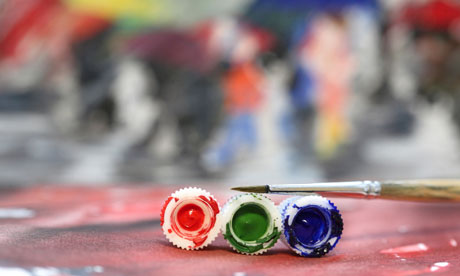
Three coloured tubes of acrylic paint 
 

The so-called golden age of arts funding has given way to debilitating austerity, particularly for artists who find themselves at the end of a long food chain, divorced from arts funding and policy decision making. But when did these divisions start and how can artists use activism to create meaningful change for the future?

The millennium saw arts funding increased through imaginative strategies and policies. Artists and the artist-led flourished. With the lottery-financed arts buildings came a new wave of curatorial positions – and in 2006, the advent of cultural leadership roles designed to "nurture and develop dynamic and diverse leaders to equip them for the challenges of the 21st century" (although scant few of these went to practitioners). Divisions between artists and the public were apparent too.

In 2013, the widening divide between rich and poor is manifesting itself clearly in the arts. Contributing to debates on more imaginative ways to measure cultural value, Louis Barrabas says: "The creative sector is full of scuttling scavenging bottom-feeders." What he's describing are the middle people whose infrastructural preferences over recent years have by default resulted in a steady nibbling away at budgets, resources and recognition factors – things that used to be the territory of artists.

In the arts infrastructure developed since the early noughties, artists weren't invited around the table with the curators, directors and consultants. Peer review was abandoned by Arts Council England as it was deemed too expensive, long-winded and subjective. In the arts ecology of today, it's almost as if artists have to be held in suspended animation, waiting for someone to need them.

Where has all the money gone?

In 1989 the salary of an artform officer in what was then a regional arts association pretty much matched the sum offered for an artist's fellowship, which in those days tended to be for a year. By 2004, the salaries of arts officers in the funding system (when index-linked) were 41% higher than those in 1989/90. Advertised in May 2013, an Arts Council England salary for a relationship manager in its London office is £31,623 – 8% higher than the equivalent pay in 2004 when index-linked. Consider this against an example of an artist's fellowship, such as the Stanley Picker Fellowship in Design & Fine Art 2013, which is paying £12,000.

Published in May 2013, Arts Council England's economic impact report by the Centre for Economics and Business Research shows that full-time earnings in the arts have risen by 6.8% in the past five years, while part-time earnings – one might surmise these to include freelancers and artists – have decreased by 5.3%. As Mark Robinson, a former ACE director and now arts consultant, asks: "Are we squeezing our key nutrients – the artists and creative freelancers – and widening inequality in our own sector?"

Our own a-n research indicated that in 2004, the exhibition fee for artists holding a solo exhibition in a major gallery was £1,000. In 2013, a new survey from AIR indicates that less than a third of artists exhibiting in publicly-funded flagship galleries in Arts Council portfolios are getting any fee at all – with £200 being the most likely figure. While the majority want to share their work with the public, nearly half the artists surveyed reported that it's simply too expensive to exhibit.

Another of our surveys, this time on openly offered jobs and opportunities for artists in 2012, revealed a steady decline in the volume of paid work for artists. In 2012, the overall value of work on offer to artists was £5m (20%) less than in the pre-recession year of 2007. Only 39% of jobs and opportunities in 2012 offered to pay anything to artists, in comparison with 57% in the recession year of 2008. And the value of residencies has dropped to an all time low, amounting to just over 1% of the value of all work offered in 2012. These paid an average fee of £2,600, in contrast to a £7,354 average in 2011 and £6,342 in 2007.

Art feeds the soul but who feeds the artist?

Artists are at the very end of the arts food chain. For artists and their practice, the future is littered with uncertainty for a variety of reasons:

• The variable length and terms of contracts and commissions
• The unpredictability of work offers and variable income
• The short notice of engagements and commissions
• The delays in the start of a production
• The sequential stop/start patterns of employment
• Managing concurrent projects and contracts
• The need to be available at all and/or unsociable hours for work
• Unpredictable locations of work
• Changes in fashion, cultural trends and market preferences

Artists seemingly love their practice so much that it's assumed they will be delighted with any opportunity they get to gift it to others. Increasingly, artists find themselves shoe-horned (through financial necessity or the arts PR machine) into making art or delivering projects, the efficacy of which are measured in terms of their instrumental powers – how well they serve the needs of others (achieve social improvement such as regeneration; uplift the lives of disadvantaged people; fill the 'arts gap' in school curricula; contribute to the economy).
As Hans Abbing commented in Why are artists poor?: "Although the arts can operate successfully in the marketplace, their natural affinity is with gift-giving rather than with commercial exchange. People believe that artists are selflessly dedicated to art, that price does not reflect quality and that the arts are free."

Negotiating your status and practice

So how might artists prepare for a different kind of role in determining the status of their art and their profession? Researching the conditions for collaboration, Chris Fremantle comments: "Artists very often see themselves without much power – is collaboration the context for a new dynamic between artists and those they seek to have relationships with, or at least a signal of hope for that?"
A symposium held in Stoke-on-Trent in 2011 explored working contexts for artists in an age of austerity. A manifesto was drawn up by artists and arts workers present, designed to create strength of purpose and solidarity amongst practitioners. The manifesto stated:

1) Be active: support each other
2) Be active: be an activist
3) Be active: be an artist.
4) Value yourself, your time and your skills
5) Share your knowledge and resources
6) Focus, strategise and plan.
7) Be critical, be fair
8) Know your rights

Reporting on the event, artist Nikki Pugh said: "It was notable that all the rules seemed to be independent of the current economic climate. The issues of prime concern to us were to keep making work of high quality; to be rewarded (financially or otherwise) fairly for our work; and to be part of wider, mutually and innovatively generous networks."

When only extended by the artist , however, this generosity can result in exploitation. Artists continually report lower or no fee offers from commissioners and employers. But institutional budgets exist to enable arts programmes to deliver 'great art' to audiences. Surely how they are constructed can be open to review, negotiation and reallocation?

For the sake of future arts, we really do need to demonstrate how much we value artists. The following statement (though made more than three decades ago and many miles from the UK) sums up why mutuality is vital: "Artists stand at the centre of all arts practice. Without the artist's ability to practice his/her own art, there is no literature, no music, no dance, no painting, no theatre, no film-making – no art of any kind."

http://www.guardian.co.uk/culture-professionals-network/culture-professionals-blog/2013/jun/24/pay-artists-funding-friction-future?INTCMP=ILCNETTXT3487

Thursday, 11 October 2012

Creative SCotland 'must be pulled apart' say campaigners


LEADING figures in the campaign against the management of Creative Scotland have urged culture secretary Fiona Hyslop to begin moves to “unpick” the flagship arts funding body.
A dramatic overhaul of the fledgling organisation led by former Standard Life chief ­executive Sir Sandy Crombie has been demanded by key cultural figures – with Ms Hyslop insisting she was taking the criticism levelled at it “very seriously”.

Despite Creative Scotland ­having “arm’s-length” status, Ms Hyslop was forced to make the latest in a series of interventions last night, declaring: “It is imperative that these issues get sorted.”

It has emerged an internal review was triggered last month after Ms Hyslop called for action to be taken to “strengthen relationships and build trust”.

But critics insist she needs to do much more to tackle unhappiness and distrust with Creative Scotland, which has an budget of more than £83 million. Sir Sandy, who has offered to meet leading figures in the campaign, has fuelled anger by insisting “they who provide the money have a right to ask what will result from that investment”.

Playwright David Greig condemned the official response to a letter of protest from 100 artists as “totally inadequate” and said artists were being treated like pupils being summoned to see the headmaster.

He said there was a growing clamour for Ms Hyslop to order a proper review into the running of the agency, saying it should be stripped of key responsibilities to focus on the funding of core arts.

Mr Greig accused Sir Sandy of using “emollient” and “patrician” language to dismiss the complaints from the 100 artists.

He added: “The key issue is that Creative Scotland is not the providers of this funding, they are merely the administrators of it. They are running it like it is a business when it is not.
“Creative Scotland is now completely bound up with the so-called creative industries and we have an industrial quango. It has got to the point where somebody within the Scottish Government needs to start to unpick Creative Scotland. Fiona Hyslop could ensure some good comes out of this crisis.”

Janice Galloway, winner of the Scottish Book of the Year award, said: “Sir Sandy’s response to our letter was a masterpiece of resentful condescension and showed how little Creative Scotland understand the concerns.

“Nobody is asking Fiona ­Hyslop to interfere in artistic decisions, this is purely about policy. This letter from Sir Sandy is an exemplar of the kind of change needed in Creative Scotland. It’s not their money they are demanding a return on, it is public money. And they still refusing to accept the scale of the problem by trying to use bigger words and insisting artists simply don’t understand them.”

Ms Hyslop said: “I am taking very seriously the criticism of Creative Scotland. That is why I have asked the board to engage directly with the sector, to ­address the point
s raised and communicate what action is already being taken.

“The concerns raised relate to internal workings and wider relationships that need to be dealt with. The government cannot and does not interfere in Creative Scotland’s artistic decisions.

“Sir Sandy and I have had constructive exchanges and I know he understands what I expect of the organisation.”

Meanwhile, Creative Scotland said it is producing a “plain English” guide for staff after being accused of using too much “business-speak and obfuscating jargon”. A spokesman said the guide had been in the pipeline for months following repeated criticism of official guidelines and application forms.

Creative Scotland 'must be pulled apart, say campaigners'

http://www.scotsman.com/news/arts/creative-scotland-must-be-pulled-apart-say-campaigners-1-2567606


Saturday, 21 July 2012

July Newsletter

Every month or so I send an electronic newsletter to contacts on my mailing list. The newsletters give information such as current exhibitions I am exhibiting in, events I am involved in, awards I have received, and my ongoing work.

Here is my July newsletter:


If you would like to be on my mailing list, please send me an email:

helen(dot)shaddock(at)yahoo(dot)co(dot)uk

Friday, 3 December 2010

I emerge from the paperwork!

It seems like i have spent the past month writing various applications, reports and proposals - all part and parcel of being an artist, but, oh how i am looking forward to focusing on my studio work again.

Having gained Professional Development funding from the Scottish Arts Council last year, I was required to produce a report detailing how i used the money, what was/were the outcomes, the benefits of having the funding, the audience of the work etc.

Taking the place of the SAC, Creative Scotland have a similar fund for artists, and so many hours were spent pouring over this application. I even took a special trip to Edinburgh especially to drop off my application at Creative Scotland - no offense Royal Mail, but I just couldn't take the risk of late delivery.

The following week was the deadline for the Glasgow Visual Artist Grant Scheme, and so another application was submitted for this fund. Fingers crossed.

A while ago I was approached by Here Gallery in Bristol, and encouraged to submit a proposal for a solo exhibition in 2011. So, I ended the month of November by submitting an exhibition proposal.

It's back to the studio tomorrow!