Showing posts with label Arts Council England. Show all posts

Monday, 16 July 2018

Report submitted

The final day of my exhibition THEMSELVES HERE TOGETHER at The Word marked the end of my project, Voices: Within and Without. This year long project has been supported by Arts Council England. 

I have been working on the end of project evaluation report and have been reflecting on the various aspects of the project. It has been a really productive and rewarding year, and I look forward to following up all the interesting and exciting things that have emerged as a result.

Here is a reminder of some of the outcomes from my Voices: Within and Without project.


Spoken Word Residency at Banff Centre for the Arts and Creativity, Canada
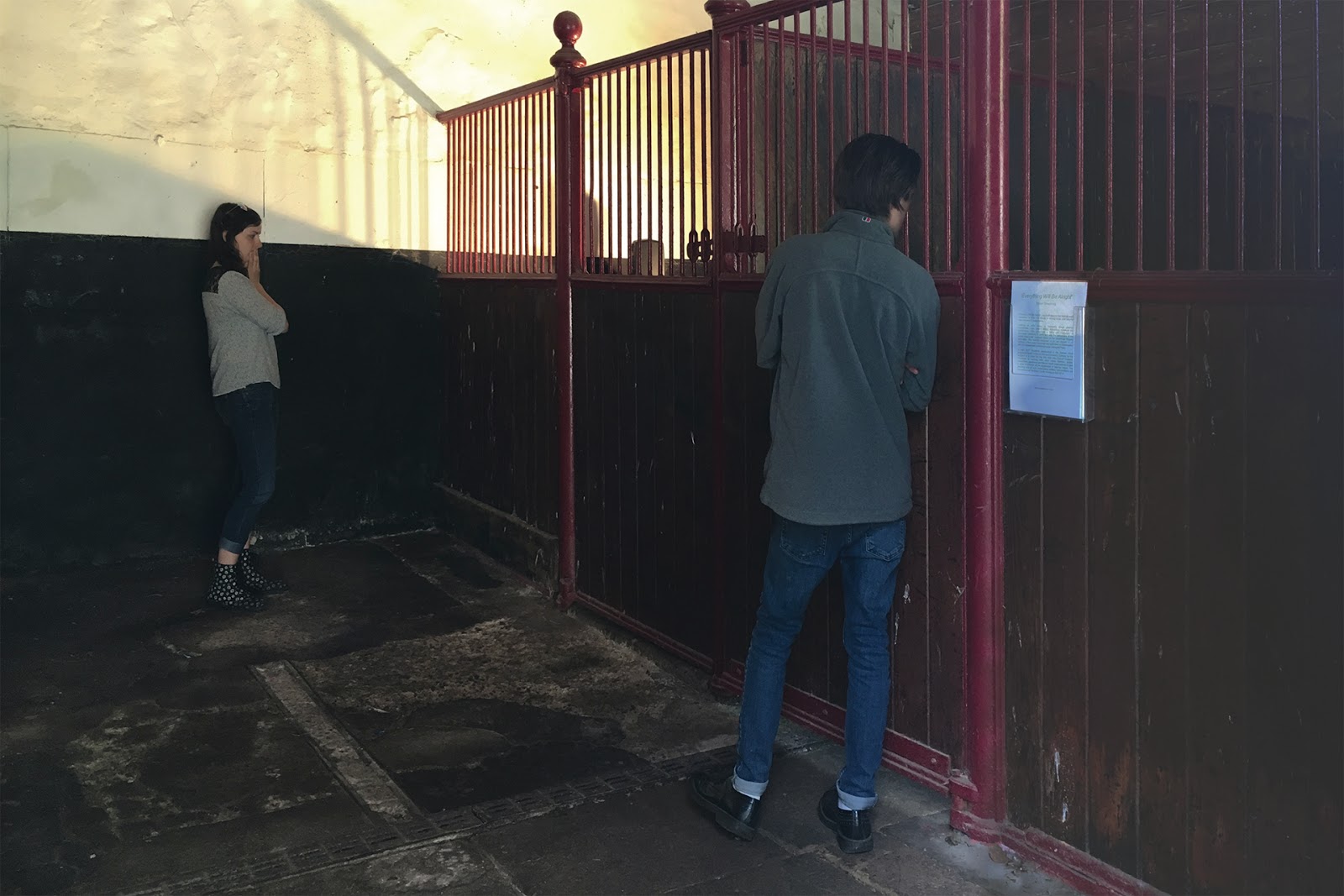


Everything Will Be Alright sound installation at Cheeseburn


Portion Control publication exhibited as part of REALITY CHECK at The NewBridge Project: Gateshead


A lot can happen in a  performance workshop at TURF, London


THEMSELVES HERE TOGETHER performance at The Word, South Shields


THEMSELVES HERE TOGETHER audio-visual installation at The Word, South Shields

I would like to thank all the project partners and people involved in my project.

Plus huge thanks to Arts Council England for supporting me


Wednesday, 27 June 2018

Documentation of THEMSELVES HERE TOGETHER audiovisual installation at The Word, South Shields

Documentation of THEMSELVES HERE TOGETHER, an audiovisual installation by Helen Shaddock exhibited at The Word, South Shields is now available to watch on YouTube.


https://youtu.be/CSQHdq0ool0


THEMSELVES HERE TOGETHER is the culmination of a project funded by the Arts Council England Grants for the Arts. Helen Shaddock worked with artists, researchers, academics, Mental Health organisations and a range of individuals to investigate visual and auditory hallucinations.

Following an intense period of research and reflection, Shaddock gathered a collection of words from which a soundtrack was created through a collaboration with artist/musician Sarah Grundy. Using a loop pedal, Grundy formed a range of rhythmic patterns from the words. Shaddock edited these further to create the soundtrack for the audio-visual installation, integrating field recordings and sounds produced by Drone Ensemble. Drone Ensemble is an experimental sound group in which Shaddock is a member, that uses handmade acoustic instruments to emit vast, deep, sonorous drones.        
For the preview of the exhibition, Sarah Grundy performed a re-working of the installation soundtrack (see separate video documentation available on YouTube).

Friday, 11 May 2018

Thanks to those who helped with THEMSELVES HERE TOGETHER

I'm still buzzing from last night's preview of THEMSELVES HERE TOGETHER. The whole exhibition and preview would not have been such a success without the assistance of a number of special people and the amazing staff at The Word.

I could easily spend hours thanking all those involved in the develop of the work, but there are a few specific people who deserve an extra-special mention.

Firstly, Sarah Grundy for being an excellent person to collaborate with. The process has been wholly positive and enriching. Lets do more work together!


Edwin Li has been a huge support. He provided us with access to a range of his equipment, including his loop pedal, helped transport kit to and from The Word, manned the merchandise table as well as documenting the performance - talk about multi-tasking!


Drone Ensemble for producing such wonderful sonorous sounds and allowing me to edit them to be part of THEMSELVES HERE TOGETHER.

Leah Millar at Hands On Film Lab for introducing me to the joys of 16mm cameraless film animation. This was the technique I used to create the visuals for the installation, and although it is incredibly time consuming and fiddly, I have grown very fond of what this way of working enables me to create.

Mark Rowden at The Word for being the technical whizz behind the StoryWorld. Despite the numerous technological problems we faced throughout the install, Mark remained calm and continued to find ways to reach a solution.

Richard Barber for his continued support and assistance from the first day that I submitted my exhibition proposal to The Word.

Emma and Gemma at The Word who have helped with the marketing and promotion of the exhibition. 

Suzanne, a member of library staff at The Word who came to the rescue last night during the preview when she was able to get the audio to start playing again after it had mysteriously stopped. We still don't know what she did to solve the problem, but her magical finger did the trick and the show went on!

Matthew Pickering for his assistance with AfterEffects, the new software that I had to learn in order to map the videos to the walls so that the projections did not spill onto the floor and ceiling.

Arts Council England, for providing funding to enable me to realise the whole project.

Apologies to anyone I have forgotten to give a specific mention to.

Monday, 25 December 2017

Christmas Greetings


Wishing you a very Happy Christmas and hoping that 2018 is filled with happiness, good health and creativity.


As I reflect on what has been a challenging but exciting year, I would like to take this opportunity to thank you for your continued support and interest in what I am doing in the studio.

Here are some of my highlights from 2017

RAISE A MUG TO NEWBRIDGE!


I collaborated with NewBridge studio holder Holly Wheeler to make an artwork celebrating the relocation of The NewBridge Project from NewBridge Street West to Carliol House.


The stress and hassle of the move has been worthwhile as I now enjoy working in my wonderful studio.

After devoting the initial few months of the year to writing proposals and submitting applications, the work paid off as I was awarded funding from Arts Council to support my year-long project, Voices : Within and Without.


In April I was fortunate enough to participate in the one-of-a-kind Spoken Word residency at The Banff Centre for Arts and Creativity in Canada. It was an amazing experience where I learned a great deal and made some incredible friends.


My four-channel audio installation, Everything Will Be Alright, was exhibited in the Stables Gallery at Cheeseburn Sculpture during the May Open Weekend.


Artist Melinda McGarry invited me to work towards an exhibition to take place in her barn in Hexham next year.


In July I delivered 'A lot can happen in a day', a day-long writing and performance workshop, which culminated in hosted a performance evening at Turf Projects in London.


I was asked by Juliet Fleming to write about her solo exhibition Something Coquettish at The House of Blah Blah in Middlesbrough.


I exhibited in Reality Check, the inaugural exhibition at The NewBridge Project:Gateshead.


The Drone Ensemble, the 'group' that I perform with, have had a number of gigs, one of which was at The Sage as part of TUSK music festival.


I have enjoyed increasing my skills through a risograph and a camera-less film workshop.


I also enjoyed developing a Spoken Word and performance workshop which I delivered at Newcastle University. It was a huge success with the students, and I intend to deliver more of these workshops at other educational establishments.


2018 is set to be a busy year as I already have a number of exhibitions lined up:* March 2018 - Bitter Sweet Group Exhibition - Assembly House, Leeds* April 2018 - Voices: Within and Without Solo Exhibition - The Word, South Shields* TBA shortly - Top secret for now! Press announcement expected in January


Hope you enjoy the festive period and that 2018 is a cracking good one for all.

Friday, 29 September 2017

//// The NewBridge Project is setting up shop in Gateshead ////


Charlie Gregory, Director, The NewBridge Project, (left) with David Butler, Senior Lecturer in Fine Art at Newcastle University at The NewBridge Project : Gateshead (Image: Mike Urwin)


A pioneering new graduate development programme based in a new space on Gateshead High Street aims to develop the next generation of artists and creatives in the region.

The Collective Studio is a collaboration between Newcastle University’s Institute for Creative Arts Practice (NICAP) and The NewBridge Project.

It will see a formerly vacant shop unit on Gateshead High Street transformed into a base for 20 artists, photographers, curators, architects, filmmakers, musicians and writers as they begin their careers.

The Collective Studio will support the development of creative talent in the North East region and equip practitioners with the necessary skills to manage their creative practice, bridging the gap between University, studio-based practice, the gallery and the workplace.

Alongside The Collective Studio graduate programme, The NewBridge Project : Gateshead will also provide studios & workspace for artists at any stage of their career, a new home for NewBridge Project Space with a programme of contemporary exhibitions & commissions, as well as co-work and event space.


Julie Sanders, Pro-Vice Chancellor for the Faculty of Humanities and Social Sciences at Newcastle University said: “Our graduates play a vital role in the cultural economy of the North East and this programme demonstrates the University’s commitment to furthering their contribution to our region’s unique cultural ecology.

“We are delighted to work with The NewBridge Project. Their development from a pop-up initiative to Arts Council National Portfolio Organisation in seven short years is testimony to the strength of talent our Universities produce and to the value of collaboration between higher education and the creative sectors.”

The Collective Studio will give participants the chance to be part of a vibrant and supportive community, shape their own programme of training and development events and provide opportunities for exhibiting and showcasing their work.

The NewBridge Project’s Director, Charlie Gregory, said: “The Collective Studio demonstrates our joint ambition to work together to support early-career artists to transition from education into professional practice.

“We are excited to be launching The Collective Studio with Newcastle University, who have shown invaluable support for NewBridge, our programme and artist-led approach as well as generating new forms of graduate support.

“The upcoming programme will see us working with a diverse group of practitioners focusing on peer-led development, radical approaches to programming and an alternative support framework helping encourage artists to live and work in the North East and develop new forms of practice.”

The year-long, cross-disciplinary programme will offer graduates subsidised shared studio and work space, helping generate a supportive and dedicated community of artists, makers, writers, architects, filmmakers, photographers, musicians and curators. Graduates will take part in professional practice workshops led by leaders in their respective fields, and peer-led events, such as workshops, talks, field-trips, performances, exchanges, one-to-one sessions and discussion groups will take place.

In addition, those on the programme will have access to a mentor and will be able to draw on expertise within Newcastle University and the region’s wider cultural sector. The programme will culminate with a showcase of work by The Collective Studio in September 2018.

/////

The Collective Studio is funded by Newcastle University Institute for Creative Arts Practice.

The Collective Studio has developed from a successful pilot trialled in 2016 and forms an integral strand in The NewBridge Project’s wider Practice Makes Practice, artist development programme which is supported by Arts Council England and Newcastle Culture Investment Fund at Community Foundation for Tyne & Wear and Northumberland.

The NewBridge Project : Gateshead has been made possible by the support of Gateshead Council, TILT Workshop and Design Office at Newcastle University.

Monday, 11 September 2017

Tick Box Art on BBC Radio 4


Is it possible, or desirable, to measure the quality of an artwork?

In a world of shrinking resources, the question of how we decide which art should receive finance is ever more pressing. Rosemary Laryea asksif, when putting money into good quality art is the goal, it's possible to set criteria to judge what makes "good art".

Rosemary talks to members of the public looking at - and arguing about - artwork, and discusses questions of artistic taste and judgement. She also hears from the jazz musician and rap artist Soweto Kinch, playwright Simon Stephens and filmmaker Destiny Ekaragha. Tiffany Jenkins makes the case for critics and Barry Smith, a philosopher of the senses, and the art critic Lynda Neade explore the idea of taste, subjective pleasure and expertise.

Arts Council England has trialled a method of measuring quality in the art it funds, called Quality Metrics. Audiences, artists and arts organisations are invited to assess artworks - exhibitions, dance pieces, digital art, poetry, theatre, music events and more - across a range of criteria, and become part of a conversation about what constitutes quality. Rosemary wonders whether this might be a way of finally answering the question of how we know something is good, while Dr Sarah Garfinkel shows that it might be our hearts, or rather our heartbeats, that hold the clue to understanding and mapping our aesthetic response.

http://www.bbc.co.uk/programmes/b0938p7s

Wednesday, 29 March 2017

Sir Nicholas Serota speaks on Front Row prior to delivering his inaugural speech as the Chair of Arts Council England

As Sir Nicholas Serota delivered his inaugural speech as the new Chair of Arts Council England, the former director of the Tate art galleries spoke to Front Row about his vision for his new role, and to what extent he intends to change the focus of the London-based institution.


Some key points from the speech include:


The Arts and Culture are lagging behind organisations and industries such as the Banks when it comes to diversity within those who in positions of leadership


The pressure on Local Authority funding is the biggest challenge to the Arts


There is a need for the Arts Council to take the Arts to communities and places that currently do not encounter art


The Arts Council are investing in the future as well as the present


There is a need to provide opportunities and encourage young people to engage in the arts


The Arts Council needs to support the organisations that are making the arts inclusive


To listen to Sir Nicholas Serota talk to John Wilson on Front Row visit
http://www.bbc.co.uk/programmes/b08k19rr


Sunday, 7 August 2016

Chronicle Live take a look at the new artworks that have arrived among the trees at Kielder

http://www.chroniclelive.co.uk/whats-on/arts-culture-news/w-take-look-new-artworks-11667292

Chronicle Live take a look at the new artworks that have arrived among the trees at Kielder

16:00, 29 JUL 2016
BY DAVID WHETSTONE

London-based artist Fiona Curran found a dark side to Kielder after being commissioned to make a new piece of art


Fiona Curran with her artwork 'The grass seemed darker than ever'


Glimpsed through the trees near Kielder Castle, a flash of kingfisher blue. You blink and blink again, but it’s still there, more distinct now among the muddy and purplish brown of the trunks.

Like much of the art at Kielder, it can take you by surprise – but this piece is quite surprising even when you know it’s there.

Artist Fiona Curran and Peter Sharpe, who has overseen the art and architecture programme at Kielder Water & Forest Park for many years, are leading a tour around some of the latest additions to this renowned outdoor ‘gallery’.

We follow the woodland path, occasionally stepping over branches and other moss-covered obstructions, and marvel at the natural beauty and tranquillity of the place.

It’s dry and the sun is shining – which helps.

Fiona, who grew up and studied in Manchester but now lives in London, has been visiting Northumberland every couple of months for the past year, having won a commission to create a new piece of work here.

Describing the experience at Kielder Castle before we headed off on an art trail, her eyes really did seem to shine.

For five or six days at a time, she had explored the landscape and talked to the people who lived and worked there.

She recalled being awe-struck by the vastness of the countryside viewed from the vantage point of Deadwater Fell and “the way the landscape constantly shifts as you change perspective”.


Being Here by JJ Lloyd

The weather, it seemed, had been kinder than might have been expected. Fiona enthused about “the blue of the sky which really hits you as you emerge from the darkness of the forest”.

Now she has added this flash of blue to that very darkness with a piece called The Grass Seemed Darker than Ever.

It was inspired partly by the English poet John Clare (1793-1864), who wrote about nature and rued the enclosure of common land.

She picked up on his reference to the only sense of containment in the landscape being the “encircling sky” – and she found out about the so-called Black Act of 1723.

“It came out of the Enclosure Acts which meant people who had previously had common access to the land suddenly couldn’t get access to something they had taken for granted for years.

“It meant that anyone found with a blackened face (the night-time disguise of the poacher) could be sentenced to death.”

A landowner’s poaching, of course, was a peasant’s means of feeding his family – a growing challenge as Clare’s beloved England was carved up and claimed by the well-heeled for personal enrichment.

So we come to Fiona’s addition to the Kielder art portfolio, an enclosure of blue-painted stakes with the forest floor within painted black.

It is, as the descriptive board explains, a piece of art “designed to keep you out”.

It is certainly a reminder to the many people who now travel to Kielder for recreational purposes – walking, cycling, art viewing – that there is a darker history to this place of beauty and tranquillity.

Kielder, as Fiona reminds me, is not just a place you escape to from urban life but a working forest. “Plantations can be there one year and then gone the next – and the landscape changes.”


A Long Wait by Mirela Bistran

The same goes for the art. Peter Sharpe, Kielder curator, points out a group of budgies perched high in a tree.

They’re not real budgies, of course. They are the survivors of Andrea Wilkinson’s 1997 Kielder artwork, Flock.

It used to consist of 72 of the little birds, but is now down to just 13. “We found out people had been taking them,” says Peter with a laugh.

You’d be hard pressed to reach this remaining baker’s dozen – or even to find them amid Kielder’s vast expanse – but if they go, they go.

Peter says much of the Kielder art was intended to be ephemeral, there for as long as nature – or people – allow.

He takes us on a tour of new work created by Newcastle University fine art students as part of a collaborative project called Onsite/Offsite. “Most of the work you see at Kielder is by professional artists who are well into their careers and respected,” he says.

“But this was an opportunity for people learning to be professionals to get some experience. There is work here by first, second, third or even fourth year students.”

Displayed along the Duchess Trail leading from Kielder Castle, these student artworks are made of various materials and invite different responses.

While Anthony Hensman’s Pyramidal Edifice looks as if could be there forever, others already seem to be bowing out. Eve Kossmann’s Forest Clock, a mushroom ring of unfired clay, has a thoroughly realistic air of crumbling decay.


Forest Clock by Eve Kossmann

Some of the students used abundantly available natural materials while others opted for the man-made. It makes for an interesting contrast. Not far from chairs made of tree stumps (Mirela Bistran’s A Long Wait), you’ll find suspended traffic lights (Stop When Light Shows Red by Oliver Hoffmeister and Harry Pickup).

Simon Court tells us the idea for his floating sculpture, Waveform, began on Waiheke Island off the coast of New Zealand. On the other hand, JJ Loyd’s Being Here, a literal 3D representation of the spot indicating its location on the map, references only itself.

Finally, who could resist Rochus Braun’s Hansel and Gretel Trail which leads to a vending machine dispensing miniature gingerbread sculptures?

These and other established works of art and architecture are one good reason for visiting Kielder over the summer.

Products of Kielder Water & Forest Part Development Trust’s art and architecture programme, all were made possible thanks to support from the Foresty Commission, Northumbrian Water and Arts Council England.

Find details on www.kielderartandarchitecture.com

Thursday, 14 January 2016

After the Spending Review, the campaigns continue

As the analysis of the Spending Review comes in, campaigning for the arts is set to continue, writes Julie McCalden.


Having been told to plan for 20% or 40% cuts, the arts are breathing a collective sigh of relief after the chancellor George Osborne’s Spending Review and Autumn Statement on Wednesday.

Had a 40% cut been implemented, Arts Council England’s budget would have been decimated to just £186m, compared to £453m in the final year of the Labour government and £325m at the end of the coalition.

In an unexpected move, Arts Council England were not only spared but promised a modest increase in cash (£10million per annum). National galleries and museums will also see increased budgets and free entry will be protected.

The Department for Culture, Media and Sport will still receive cuts of 20% to be targeted at its core administration budget (yet to be specified) and further cuts to local authority budgets of £6.1bn by 2019-20 will complicate matters.

If Arts Council England and National Portfolio Organisations have come out relatively unscathed, the picture is not so rosy for those at the bottom of the food chain.

While many artists, who are largely self-employed and low-paid, will be celebrating the u-turn on changes to tax-credits, concerns about the introduction of Universal Credit remain. In a joint statement released ahead of the spending review, the Scottish Artists Union (SAU) and Artists’ Union England (AUE) said: “We believe that the stringent enforcement conditions of Universal Credit will result in far greater hardship and debt for artists and makers in receipt of top-up benefits.”

The new conditions include a minimum level of assumed earnings based on hours worked and the minimum wage.Claimants are also required to submit monthly accounts, which is inconsistent with the variable frequency of artists’ paid work opportunities and the often lump-sum nature of their payments.

Creative education

The deterioration of creative education in schools is another concern for the sector. While Osborne promised increased funding to attract new teachers, this will be largely aimed at STEM subjects (Science, Technology, Engineering and Mathematics) to help implement plans for an English Baccalaureate (EBacc).

The EBacc requires pupils to study a minimum of seven GCSEs, but includes no creative subjects; risking art, dance, design, drama, music and other creative subjects disappearing from children’s education altogether. The Bacc for the future campaign aims to challenge plans for the EBacc, which risks eroding access to the arts for young people, increasing inequality of opportunity when it comes to experiencing culture and further diminishing entryways to working in the arts.

For those just embarking on their careers, changes to student loan repayments and housing benefit caps will add to the difficulties faced by artists when trying to establish their practices.

All of this will negatively impact on the lack of diversity that already characterises the arts. The findings of the recent Panic!survey into social mobility in the sector confirmed that class, gender and ethnicity still have a major influence on a person’s ability to enter, progress and succeed in the arts.

The survey revealed that it is becoming increasingly difficult for those without other means of financial support to break into the sector, with young people from less well-off backgrounds being at a particular disadvantage. This inequality inevitably results in the production of cultural forms that are mainly reflective of a small, and privileged, spectrum of human experience. The majority of people remain excluded both from arts production and consumption.

Greet with caution

So although on the face of it positive for the top rung of the arts, Osborne’s announcement should be greeted with caution. Not least because it has been based on a dramatic reassessment of economic forecasts by the Office of Budget Responsibility (OBR), which landed Osborne a windfall of £27billion in time for his announcements.

His proposed budget allows no room for error on predictions wildly different to those made just five months ago. From an organisation without a great success rate in accurate forecasts this throws considerable doubt on the deliverability of Osborne’s promises.

However, it is good news that the chancellor acknowledged the economic benefits that the arts bring to Britain, commenting that a quarter of a £1trillion added to the economy from a £1billion investment was ‘not a bad return’. He went as far to say that “deep cuts in the small budget of the Department for Culture, Media and Sport are a false economy” – a point the sector has been arguing since 2010.

It is important that the sector now galvanises around these remarks, not just to hold Osborne to account in the event of adjustments to this budget impacting on the arts, but to begin to make bolder demands for increased funding. The Show Culture Some Love campaign supports the case for greater investment in arts and culture. Its main aims are to campaign for an end to the cuts in arts budgets caused by the pro-austerity policies of the current government and to make the case for increased investment.

Cultural campaigns

Paying Artists campaign
The Paying Artists campaign aims to secure payment for artists who exhibit in publicly-funded galleries. We believe paying artists for the work they do will mean that, in years to come, we’ll still be able to access quality art that reflects the broadest possible spectrum of human experience.

Whether you’re an artist, curator, gallery visitor, art student, policy maker or run a gallery, sign up to the campaign. You can join the debate by following @AIR_artists and using the hashtag #payingartists.

SAU / AUE on Universal Credit
A campaign has been launched by Scottish and English artists’ unions, with the aim of helping freelance and self-employed workers who will be affected by changes to the taxation and benefits system through the introduction of Universal Credit.

Supporters of the campaign can get involved by doing a number of things. This includes: downloading the campaign statement and forwarding to local MPs; arranging a meeting with your MP; and asking your MP to take the issue to the Department for Work & Pensions.

Bacc for the future
The Bacc for the future campaign aims to challenge the implementation of the English Baccalaureate (EBacc) which currently includes no creative subjects and is expected to be undertaken by at least 90% of pupils.

As an individual, you can support the campaign by signing the petition and spread the word by telling your colleagues, friends and family as well as through social media using the hash tag #baccforthefuture.

Show Culture Some Love
The Show Culture Some Love campaign believes there is a powerful case against austerity and supports the case for greater investment in arts and culture.

You can support the campaign and their 6 pledges by liking the facebook page and inviting your friends to join, as well as following them on twitter.


http://www.payingartists.org.uk/2015/11/after-the-spending-review-the-campaigns-continue/

Wednesday, 30 September 2015

Culture Matters

The Arts Council have made the following film as a reminder of the breadth of arts and culture emerging from England over the years.


https://www.youtube.com/watch?v=OwqRGiA_T5Q

Thursday, 1 May 2014

Arts lottery funding imbalance 'requires urgent address', say arts leaders

Arts lottery funding imbalance 'requires urgent address', say arts leaders
Lottery funds have disproportionately benefited most prosperous and arts engaged communities in England, report reveals

The Guardian's Culture Professionals Network explains...

http://www.theguardian.com/culture-professionals-network/culture-professionals-blog/2014/apr/28/arts-lottery-funding-imbalance-place-report?CMP=new_1194


Last Friday The Place Report was launched. It argues that arts lottery funds are fundamentally different from grant-in-aid funding – those provided to maintain the core national cultural infrastructure – and it questions Arts Council England's (ACE) stewardship of those lottery funds, provided for different purposes and for far wider public benefit.

The report draws particular attention to five of the directions issued by DCMS for the lottery (pdf):

"Arts Council England shall take account of the following in distributing national lottery funds:

• The need to increase access and participation for those who do not currently benefit from the cultural opportunities available in England

• The need to foster local community initiatives which bring people together, enrich the public realm and strengthen community spirit

• The need to support volunteering and participation in the arts and community arts

• The need to involve the public and local communities in making policies, setting priorities and distributing money

• The desirability of ensuring equality of opportunity, of reducing economic and social deprivation and ensuring that all areas of England have access to the money distributed"

Other lottery distributors in England have acted upon similar directions to prioritise disadvantaged communities. ACE appears, at best, to have given the directions no priority and at worst, systematically ignored them, placing at serious risk of failure the local infrastructure of facilities, organisations and programmes that are the bedrock of national cultural life.
The Place report shows that the arts lottery has disproportionately benefited the most prosperous and "arts engaged" communities in England, often also those contributing least to the lottery. At the same time, some of the least "arts engaged" and poorest communities, contributing most heavily to the arts good cause, receive the least return.

Of England's 326 local authorities, the 33 where people are least engaged with the arts (10% of the total with a combined 6 million people) have received £288m arts lottery funds since 1995 or £48 per head of population (php). The 33 areas with the highest levels of arts engagement (4.8 million people) have received £1.33bn over the same period – over £1bn more and at £275 php.

Lottery proceeds are increasingly supporting organisations and regular programmes of work that were previously funded through grant-in-aid. That's a vital point when you consider additionality, the guiding principle that arts lottery funds should be for "new and additional" activity and not a substitute for grant-in-aid.

The largest recipients of ACE grant-in-aid are now among the largest recipients of arts lottery funds and many of these organisations are also the largest beneficiaries of private philanthropy and sponsorship of the arts. Arts funding has become a closed system.

ACE has argued that "subsidy per attendance" is a "more representative measure" of benefit from public funding, as opposed to measures of geographical distribution. What we've found is that affluent people who live within easy reach of major cultural institutions and who can afford regular attendance derive by far the most benefit from funds sourced from taxpayers and from lottery players.

Arts lottery funding to the five largest London recipients (The Royal Opera House, Royal National Theatre, English National Opera, Sadler's Wells and the Southbank Centre) totals £315m since 1995. This is in addition to annual funding of over £80m that between them they receive from taxpayers. These five organisations have received more arts lottery funding than the 33 local authority areas whose communities are least engaged with the arts.

In a time of austerity, cultural organisations with very substantial public funding and with the greatest capacity to raise resources from paid attendances, sponsorship and philanthropy might be expected to make a lower call on public funds.

The sheer scale of these imbalances in the distribution of arts lottery funds across the country and between beneficiaries requires urgent address. But how? The report offers a simple illustrative proposition of a tripartite framework for the arts lottery.

Respecting the directions, the proposed framework would operate through three programmes focused differentially on: the social priority of engagement with areas of disadvantage; the economic priority of dispersed cultural production; and the artistic priority of support for artists' practice across all disciplines. Decision-making would be devolved to appropriate structures operating at regional or multi-authority level with weighted allocations that recognised advantage and disadvantage in terms of geographical, economic and social factors.

Peter Stark, David Powell and Christopher Gordon are co-authors of The Place Report

ACE have responded to the PLACE report, and this can be read at

http://www.artscouncil.org.uk/what-we-do/research-and-data/our-response/