Showing posts with label 2018. Show all posts

Sunday, 30 December 2018

Leap of Faith project at Yorkshire Sculpture Park

The Domestic Armoury within Bobby Baker's Great and Tiny War artwork is a good example of how contemporary art can fully embrace the involvement of others and how outreach work (in this case with women in the West End of Newcastle who have experienced of abuse, war or conflict) can be an integral part of the artwork. 


I recently found out about another 14-18 NOW project and how this has prompted Leap of Faith, another project involving women who have experience of trafficking, domestic violence or mental ill health. 

© Danny Lawson/PA Wire

Leap of Faith at Yorkshire Sculpture Park (YSP), responds to contemporary artist Katrina Palmer’s The Coffin Jump (2018) – a major co-commission with 14-18 NOW, the UK’s arts programme for the First World War centenary, and YSP. It reflects the courageousness of the First Aid Nursing Yeomanry (FANY). This extraordinary group emerged at a transformative period for women – moving out of passive domestic confinement to enter the battlefield on horseback and administer first aid – and inspired the creation of the artwork.


Led by YSP’s Art & Wellbeing Coordinator, Rachel Massey, Leap of Faith brings together participants from two local authority areas that border the Park, in partnership with Ashiana Sheffield, Kirklees WomenCentre, with Heidi Dawson from Glint [Horse Assisted Development].


Leap of Faith aims to help participants gain the confidence to express themselves, to develop positive relationships, and to build positive new memories. Activity includes creative sessions devised by the participants themselves in conjunction with lead artist Kate Genever and Palmer as well as equine therapy, which has been found to enhance positive behaviour and wellness. Further therapeutic support is provided by group analyst Jacinta Kent, and opportunities for reflection and evaluation have been offered by Dr Harriet Rowley, Lecturer in Education and Community at Manchester Metropolitan University.
© Jonty Wilde

Massey says: “At YSP, we use a range of approaches to help people engage with the art. We are interested in exploring ways to support people to engage with their own creativity and self-expression. This is a unique opportunity to work with women, therapists and artists and create something together, inspired by The Coffin Jump and other art at YSP.


“Throughout the project, we have explored themes of love, loss, friendship, loneliness and connection. The individual moments of breakthrough are too numerous and too personal to describe, but it’s true to say that this project will stay with all the participants for a long time to come”.


Heidi Dawson from Glint says: “Our horses are the true educators in our work. They don’t do role play, so noticing how they respond to our behaviour and energy offers us a unique insight into ourselves and our relationship to the world”.


Leap of Faith is part of YSP’s Arts & Wellbeing programme, which takes inspiration from the New Economics Foundation’s ‘Five Ways to Wellbeing’ and is informed by work with experts including artists, mindfulness practitioners, musicians, yoga teachers and others.

Wednesday, 26 December 2018

Festive greetings

I'd like to take this opportunity to thank you for your support over the past year. It is a pleasure to share my artistic pursuits with you, and I really appreciate the comments and interest in what I do.

Long may it continue!


Here's to a wonderful festive period and a very Happy New Year.

Wednesday, 19 December 2018

Introducing marginendeavour

Fellow NewBridge Project studio artist David Foggo and I are working collaboratively as marginendeavour to explore our affinities with text and design. 

Documentation of our recent exhibition, Doing Fine, at The NewBridge Project is now online via this link


Tuesday, 4 December 2018

Art on prescription on Front Row

Last Thursday's episode of Front Row on BBC Radio 4 included a feature about Art on prescription. 'Earlier this month Health Secretary Matt Hancock said that "arts on prescription" is an indispensable tool in tackling loneliness, mental health and other long-term conditions. 

https://www.bbc.co.uk/sounds/play/m0001bqn

The programme features Wellcome Research Fellow Daisy Fancourt, Gavin Clayton, head of the Arts and Minds charity and GP Dr Simon Opher, and they discuss arts and healthcare.


It is based on the thought that changing people's environment can have a positive effect on mental wellbeing. Although ideas like this have been around for some time now, it is believed that about 20% of GP's are now making use of "arts on prescription." Sometimes artists are based in the doctors surgery and the GPs refer the patient directly to the artist, and other times the patient is directed to an organisation such as Arts and Minds that are based in museums and run workshops for groups that involve making art inspired by the heritage artifacts.

Something worth noting is that the government seem to acknowledge the importance of the arts for health, but its status within the school curriculum and in libraries and museums are under threat.

Monday, 3 December 2018

Move over Britannia, Bobby Baker rules!

For the past three months I have been immersed in the world of Bobby Baker's Great and Tiny War, a project that is very close to my heart. I have been working for Wunderbar as a host, guiding visitors around the house, talking to them about the artworks, operating any equipment, making lots of cups of tea and coffee and providing hospitality. Being involved in this project and working with such a supportive team has been an absolute joy and I am really going to miss it. Along the way there have been plenty of challenges to keep us on our toes such as the time when the mechanics behind the surprise element in room 3 broke, and I had to phone Steve, the Technical Director of Great and Tiny War (based in London) and follow his problem diagnosis and damage limitation instructions or the time that the venue for one of the workshops was changed due to an emergency situation, and so we had to change to a space without an oven (pretty essential for a bread-making workshop), resulting in me going back and forth between Nunsmoor Park (where the workshop was) and 133 Sidney Grove where the unbaked bread sculptures were put in the oven and the baked bread sculptures were returned to the workshop and reunited with their respective creators.

There have been some amazing stories gathered throughout the exhibition, and I have plenty of fond memories to take away.

My final day of tours brought with it lots of happy memories. On one of the tours in the morning I was host for a couple of Sidney Groovers (people who live/have lived) on Sidney Grove one whom carried her young son with her. The baby was really well behaved and the women loved the exhibition. When we were talking in the kitchen, one of the women, Olivia, told me how her other (3 year old) child, Frida, walks past the house every day and gets very excited by the sign outside 133 Sidney Grove, pointing at it and exclaiming "It's Bobby Baker'. Unfortunately Olivia did not think that Frida would have enough patience to go on the tour, and so she had explained that she would not be able to see inside Bobby Baker's house. I couldn't bear the thought of her little girl having her dream shattered, and so tried to think of a way that it would be possible to tailor the tour to her. We were fully booked for the rest of the day, but proposed a way that Frida could get a magical experience. I asked Olivia whether she would like to bring her child at the end of my last tour and I would do a special little viewing in a few of the rooms. She thought this was a great idea, and said it would fit in with their bedtime routine. Indeed, when I was in the kitchen at the end of my final tour, the doorbell rang and I opened it to find Olivia with Frida in her arms, dressed in her pj's all ready for bed. I took them to the room of bread sculptures and the room with all the peppermint sculptures, and talked about the work. After we had used the pictures on the wall to identify all the peppermint sculptures, we went to the kitchen for Frida to choose herself a biscuit as a treat. She asked if Bobby Baker was there, and as I explained where Bobby was, I showed them the photo of Bobby Baker wearing the bread antlers that she made for a previous performance. These were hung on the wall, and I asked if Frida would like to wear them and be like Bobby Baker. The result was an extremely happy 3 year old with the biggest grin on her face, an incredibly grateful Olivia, and a very happy Helen! I could not have asked for a better way to end my Great and Tiny War hosting duties.


The following day I received a message from Olivia thanking me for engineering the opportunity for Frida to visit the installation. She reported that Frida had been talking about Bobby Baker all day!

I've met lots of very special people and made some life-long friends. The other hosts and the Wunderbar team have been such a support to one another and we have shared our experiences and thoughts via a Hosts Book. I'd like to thank all involved for making the experience so powerful, nourishing and stimulating. I really hope that the project continues to live on in some form, and that the hosts and Wunderbar team keep in touch and work together again.

Wednesday, 28 November 2018

Should all art students learn to paint and draw?

In a new paper, What Happened to the Art Schools?, the painter and art critic Jacob Willer claims that today’s fine art degrees do not offer the necessary teaching to produce exceptional artists. Painting and drawing have come to be seen as “no more than art’s old ceremonial vestments”, he writes.
Willer, who visited art schools around the country, says that while the odd talented student stood out for him, the general standard was “depressingly low”. “I would encourage you to look back through the UCL collections to see the quality of paintings that students at the Slade were routinely making in the first half of the last century and you will see for yourself how things have changed,” he says.
Willer goes on to suggest that in order to restore standards, higher art education ought to focus once again on craft and life drawing. But, he says, since current teachers would mostly not be capable of teaching painting and drawing – “because most of them know nothing about it” – the best way for students to develop would be to spend time appreciating old masters such as Titian and Rembrandt. 


https://commons.wikimedia.org/wiki/File:B320_Rembrandt.jpg
Teaching practices at art schools have indeed changed over the past few decades. The foundations of today’s schools were laid in the 60s, when local colleges merged to create tertiary-level art schools and polytechnics, where students could receive a diploma in art and design and were increasingly treated more like artists than pupils. But there have been significant political and cultural shifts since. The 1992 Further and Higher Education Act, which saw polytechnics and independent colleges become universities, left formerly independent art schools to grapple with the same issues universities do – most notably the rise in tuition fees. Variety became necessary in a crowded market.
Unlike Willer, many believe that these changes have not been for the worse. For Michael Archer, professor of art at Goldsmiths University, art schools’ approaches have become less prescriptive, drawing on a growing range of traditions and cultures. A return to a technical focus on painting and drawing would be restrictive, he says – and “completely misguided”.
Richard Talbot, head of fine art and professor of contemporary drawing at Newcastle, says weekly life drawing classes are held for any student who wishes to go, “but it’s important to expose students to a wide range of staff and practices”. Talbot models the course on his experience at Goldsmiths during the “70s heyday”, when he and his contemporaries were free to explore their interests without any restrictions. He follows this open-ended approach while offering his students a variety of practical workshops on specific skills such as developing your colour palette, priming a canvas and applying paint. “We’re not saying ‘you have to know this’ but instead, ‘this could be really useful for some of you’.”
Tutors point out that an exposure to various media and traditions shouldn’t come at the expense of a technical education. 
Courtesy of Guardian News & Media Ltd

Saturday, 24 November 2018

A live discussion on the current state of arts education

"Arts education has become the focus of a great deal of passion and concern recently, since the core, knowledge-based subjects took precedence over the creative subjects when the EBacc was introduced in England by the then Education Minister Michael Gove, announced in 2010.
With the arts not being a requirement in the GCSE syllabus for the English Baccalaureate (the EBacc), leaders in the arts and the lucrative creative industries have been very vocal in their criticism of government policy."


Last Wednesday evening in a special edition of BBC Radio 4's Front Row, Stig Abell chaired a live discussion on the subject from a Soar Valley College secondary school in Leicester with leading figures in arts and education.
On the panel were:
Deborah Annetts, the Chief Executive of the Incorporated Society of Musicians or the ISM
Trina Haldar, graduate in chemistry and engineering, and subsequently director and founder of Leicester-based Mashi Theatre
Branwen Jeffreys, the BBC’s Education Editor
Mark Lehain, interim head of the New Schools Network, a free schools advocacy charity, and the Founder (and former headteacher) of one of the first secondary Free Schools. He also leads the Parents and Teachers for Excellence campaign
Julie Robinson, the headteacher of Soar Valley College in Leicester
Carl Ward, Chief Exec of the City Learning Trust, which is a partnership of schools teaching a combined total of 6000 pupils in Stoke on Trent

The episode can be accessed here

https://www.bbc.co.uk/programmes/m00013vs

Monday, 19 November 2018

Bobby Baker on what it takes to make an exhibition accessible

Great & Tiny War is the most ambitious show I’ve ever made. Or maybe I’ve said that before?!


How to Live where I launched my own Therapy Empire at Barbican Theatre in 2004 was really massive. When I had the idea of 2,000 ‘pea patients’ dancing the Mexican wave as a finale, accompanied by a choir and full on light show, I hadn’t quite thought through how much work (and money) and pure skill by the production team it would take to pull off. But we did. Which I suppose encourages you to be optimistic you can do it again with the next big plan…

Great & Tiny War takes a whole house and transforms it into a complex art installation where people come in groups of 4 and go on an audio guided tour from room to room with a host. It opened on 9 September and has proved to be so popular that we are keeping it open 3 weeks longer than planned until 28 November.


The team

The most important part of any show, and why it succeeds or not, is the people in the team and their assorted talents and skills. The Great & Tiny team are exceptional – mainly due to Ilana Mitchell and the amazing Wunderbar team. Their strap line is “extraordinary projects conceived by artists and made by audiences.”

Wunderbar has a long track record of creating great art in unusual places, and we share a passion and belief in doing what we can to reach people where they are, and to make the art as easy as possible for everyone to see.

It takes a lot of technical skill to achieve this so having a good team is vital.

I’ve worked with Steve Wald, technical director, and Miranda Melville, production designer, for many years – their skill and experience is the reason the dancing peas worked so wonderfully for How To Live. Each of the 5 rooms in Great & Tiny poses complex design and technical challenges.

Wunderbar recruited talented local artists and technicians to help install the show and host the tours. Lots of them have been drawn to the project because of what it’s about – transgenerational trauma, feminism and the politics of domestic labour and health care. Many of us have experienced hard times and felt excluded. So it’s been great working together and really fun too. And it’s definitely meant everyone shares a focus on the ethos of fairer access.

Inclusion and equality consultant Sarah Pickthall has been part of the team from the start – helping plan and budget the work needed and oversee the brief. And for the first time we used the opportunity now provided by Arts Council Grants for Arts to receive extra funding for extra support for me.


Great & Tiny War access resources

Here’s a list of what we’ve done to try and make the show accessible to all:
https://wunderbar.org.uk/wp-content/uploads/GTW-EasyRead-full-res.pdf
  • A captioned film showing what’s upstairs. The house is on two floors so some people, including older people, can’t see the whole show without some sort of digital package. The film we’ve produced is shown on a tablet in the comfort of the kitchen downstairs.
  • There’s a bespoke built accessible toilet in the yard at the back (the porta-loo Wunderbar ordered was denied access due to overhead telephone wires in the lane. The production team created a new one to fit.)
  • Audio descriptions for the blind or partially sighted
  • A portable hearing loop
  • A transcript of the audio guide
  • The option to listen to the audio tour on loud speaker
  • Bespoke visits tailored to your needs, including relaxed and BSL on request.

https://wunderbar.org.uk/gtw/access/

I’m pretty sure what we’ve set up is rare for a temporary art installation. We know we haven’t been able to do everything but, given our resources, we’ve done our best to make the show as accessible as possible.
And the best thing is that we have been able to be responsive to people and the tailoring of bespoke experiences – partly because we have the resources, but mostly because the hosts of the show are so welcoming and ready to adapt.

What we’ve learnt

Despite all our planning it’s been much harder than we thought to make this happen due to stuff we just hadn’t anticipated. So, for the record, here’s some top tips I would give myself when (hopefully) working on a massive project again and planning access work.

Time
Typically, and considering how complex the installation is, a team of about 10 of us worked right up to the last minute before the first preview to finish. What we hadn’t factored in was the time needed to also produce great quality digital access material.

The film, text, images and so much care went into making all this material. I mean, if you’re making a film of part of the show for people who can’t physically get round the installation then as much care needs to go into that as into the art work itself.

Filmmaker Alastair Cummings was brilliant . He worked around the crashing and banging of the installation but inevitably finished filming it all after the launch when quiet enveloped the house. So that took an extra week to get working on the tablets.

Producing the rest of the digital access work took longer still. Geography was challenging – Great Tiny War and Wunderbar are in Newcastle, Caroline Dawson, our access specialist from Daily Life Ltd, the sound producer and I are based in London and, after the launch, so was technician Steve Wald. Sarah Pickthall is in Brighton, Alastair is in North Shields. Communication and time and travel cost energy and cash… we hadn’t quite thought through the logistics of all that.

Comms
Sally Flemons, Wunderbar’s Communications Director, ran a really top class campaign for the project working with SFPPR and the 14-18 NOW team – hence the high audience level.
With Sarah Pickthall we had a plan for a special comms campaign to reach new networks – but didn’t make enough allowance for the extra time needed, including finding just the right people to reach. We could have done with local specialist help budgeted in.

Budget
How do you budget properly? It’s the most important thing surely? We did a pretty good estimate with Sarah Pickthall but what we hadn’t factored in was the extra time it took us all. Film, text, images, recordings, installing it on headsets, testing it required so much care and time. Next time we would budget for another local person on the team to help project manage the making of the access materials, as well as more time for comms.

And finally – Me
I’ve never tried to work out my own access needs and costs in advance for such a massive amount of work. I’m rather exhausted now with every joint in my creaky body aching. I’m seeing the doctor later today and the physio too, about pain management and recovering from it all. So I think reflecting on what I could have arranged better will take another blog…!
But despite all this we are so pleased with what we have achieved given all the challenges. Feedback from audience members has been very encouraging.

We’ve thought very hard about how we communicate our accessibility offer so as to be really clear (plain English) but not patronising and avoid ‘labelling’ – readers of my last DAO blog will know how I feel about this.

People have been getting in touch with bespoke access requests and we’ve been doing what we can to help support these. We are also very keen to listen to feedback and be dynamic in our approach so please do share with us any comments or suggestions.
There’s 2 more weeks to see the show… see what you think and let us know!

Tickets for Bobby Baker’s Great & Tiny War, an art installation in a house in Newcastle, are available until 28 November.

Friday, 16 November 2018

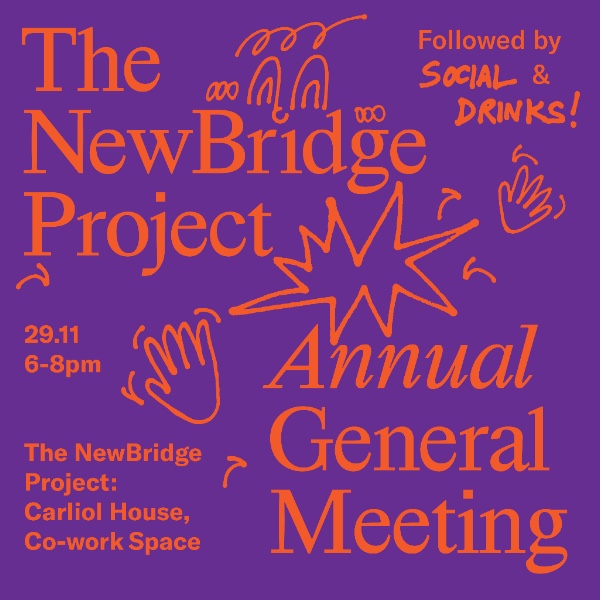
The NewBridge Project Annual General Meeting - 6-8pm - Thursday 29th November 2018

The NewBridge Project
Annual General Meeting

Thursday 29 November, 6-8pm
The NewBridge Project, Carliol House Co-Work Space


You are invited to The NewBridge Project’s Annual General Meeting on Thursday 29 November, 6-8pm in the Carliol House Co-work space. 


The AGM will be an opportunity to hear about NewBridge’s activities over the last year, to discuss plans for the future, and to hear more about some artist members work through a series of short presentations. I'll be talking about my Voices: Within and Without project that was funded by Arts Council England.

Staff, members, artists, volunteers, funders, partners and members of the public are invited to join the meeting.

There will be time at the end for drinks and socialising, and there will be cake!


Thursday, 15 November 2018

Forces News broadcasts video about Great and Tiny War

A couple of weeks ago Hannah King from Forces News visited 133 Sidney Grove to do some filming and interview Wunderbar Artistic Director, Ilana Mitchell about the installation. The film has now been broadcast and can be viewed here:

https://www.forces.net/news/womens-wartime-experiences-documented-exhibition

Newcastle exhibition in a terraced house is extended due to popularity

A museum exhibition is showcasing the role of women during the First World War.


The role of women in the First World War is being explored in an exhibition in Newcastle. It looks not at their part in the war effort - but rather their essential role in keeping households running.
'Great & Tiny War', by artist Bobby Baker, celebrates the women who stayed at home, bringing up children, feeding families and keeping households running while the Great War raged on.
Situated at 133 Sidney Grove, visitors are shown around the exhibition by an audio guide, telling stories about women's lives during the conflict.


Each room is dedicated to women’s domestic experiences during World War One –  an aspect of history Artistic Director of the project - Ilana Mitchell believes is often overlooked: "The focus very often on war is about the fighting, the politics.
"Very often work that is traditionally women’s work, housework, domestic work, is overlooked as something that is valued."
One downstairs room has been dubbed the 'Baked Armoury' and is filled with artistic sculptures, from a dove and a pineapple to barbed wire.
All the artwork has been baked by women with a diverse connection to warfare; some are refugees, whilst others are veterans.
"We started off with the idea of baked weapons," Ms Mitchell told Forces News.
"We worked with bread dough which is a very funny sculpture material because it’s very uncontrollable and also very domestic.
"Actually rather than weapons, most of the works are sort of amulets – sort of more protective, more gentle-seeming."


The final room contains 4,701 peppermint creams, designed to represent how many meals a family at home would have aimed to eat during the 1,567 days of the Great War.
Bobby Baker’s 'Great & Tiny War' will remain open to members of the public until 28 November 2018.

Tuesday, 13 November 2018

Nicola Singh Artist talk at Newcastle University

Woah, I feel I have just emerged from a really unique environment in which an established artist whose work I admire has shared with an audience her doubt about a performance she has then gone on to perform to us.

Initially Nicola Singh explained what she was about to perform and her reasoning behind her choice of artist presentation. She intended for there to be a discussion at the end of the performance.

This was a performance in itself that was about the performance at IMT Gallery, London as part of a group exhibition.

She had been unsure about the performance in the gallery (ethics, was it making her too vulnerable? was it the right time and place for it), and was unsure about the performance in the Lecture Theatre (what would the audience gain? was she in the right mental state? was the context right? would it be useful?) She did not apologise for her doubt.

The manner in which she delivered the text echoed, in some ways, the content of the text. It had been written as though it was being spoken, with the comments, pauses, distractions and tangential thoughts that would usually be edited out, included. Her voice was soft, and the pace was fairly slow; her manner was thoughtful and composed. At times she moved the weight of her body from one hip to the other, and would tilt her neck to one side as though she was releasing some tension that was making her uncomfortable. She listened to each word as she said them. 

I fully understand the reasons behind reading the text from a script as opposed to memorising it or speaking 'off the cuff'. It revealed that there had been a process of construction and editing prior to the delivery; it was practical; Firstly it included parts of writing that she had made during her time in London, and, secondly, she did not have enough time to learn it off by heart. Reading it also enabled her to focus on where the text came from within her - i.e. her performance came from the heart as opposed to the head, which is where it would have come from if she had memorised it. 

As she stood at the front of the Lecture Theatre, without any images on the screen behind her, my attention was drawn to her body language and my mind created its own imagery based on what I was hearing. 

She outlined what happened over the course of the 4 days prior to the private view of the exhibition;

She had 3 tinder dates in which each of her dates made a clay monkey from air dried clay

She gave a lack of specifics about the dates and the clay monkeys, but detailed her paths of thought, the context and the conversations that she had outside of the dates themselves.

The audience were then invited to pose questions and start a discussion.

I felt that, given that the content of the performance was so rich with a wide range of relevant issues and problems, it was a shame that she would not perform it in a gallery. 

When asked why, she highlighted that her previous experience has lead her to believe that an audience in a gallery would not be likely to enter into a discussion about a performance that they had just witnessed. She also spoke about her need to take care of herself as a performer, and the fact that doing the same performance in a gallery would expose her in a way that she avoided when doing it in the Lecture Theatre in an institution where she was in company with people that she knew and a city that she called home. This has left me thinking about my current experience as a host at Bobby Baker's Great and Tiny War installation. In my experience with this installation, despite the difficult issues within the work, in the kitchen at the end of the tour, visitors are most often happy to enter into deep discussions with strangers over a cup of tea and a biscuit. 


Tuesday, 23 October 2018

The White Pube - One of the best 'Creative' Talk's I've ever been to!

I'm just out of the weekly Artist / Curator / Writer Talk at Newcastle University and am totally buzzing and fired up. This week was 'The White Pube' "the collaborative identity of Gabrielle de la Puente and Zarina Muhammad under which [they] write criticism and (sometimes) curate. 


It is based at thewhitepube.com and also on Instagram and Twitter as @thewhitepube. 

[They] publish a new text every Sunday, mostly exhibition reviews but every so often baby essays filed under art thoughts

[They] started writing about art because [they thought] everything else was boring/overly academic/white nonsense////and male. 

Every review is a personal reaction, and a record of an encounter with an aesthetic experience. [They] wanna write GOOD ~ have politix ~ n call out the general bullshit that stops a lot of us even wantin 2 go to galleries."

Their presentation was equally as entertaining as their writing is, and it was a pure joy to listen to them freely discuss matters that simply many other creatives are too scared to approach. I'm thinking in particular of the fact that they share their accounts with readers and thus highlight the institutions that simply fail to pay a fair wage. 

It is too common that artists / writers / musicians / curators are paid a minimal fee without travel expenses and accommodation. If we all shared our accounts online it would show which institutions are good and bad at paying artists.


I feel there is a bigger conversation that needs to happen here, so please watch this space!


Monday, 22 October 2018

Drone Ensemble Performance at Workplace -3:15pm, Saturday 27th October

Hear Drone Ensemble perform within their installation Lyres of Lemniscate for the last time at Workplace Foundation, Gateshead.


The performance will feature a range of new instruments made during the preceding workshop (see separate event - booking necessary)

https://www.facebook.com/events/255006225202343/

Lyres of Lemniscate was commissioned by Workplace Foundation and Tusk Festival supported by the Digital Cultures Research Group in CultureLab at Newcastle University.

FREE ADMISSION, ALL WELCOME

image: 
Drone Ensemble Performance for TUSK FESTIVAL 2018 at Workplace Foundation. Photo: Rob Blazey

Friday, 12 October 2018

Monday, 8 October 2018

A Poetry Remedy

Last week I was fortunate enough to have my first 1:1 poetry consultation with Newcastle University Teaching Fellow Sue Spencer.

Following in the steps of local poets Julia Darling & Cynthia Fuller and ‘The Emergency Poet’, Teaching Fellow Sue Spencer believes that poetry can help in troubled times.


On National Poetry Day Sue was in the Walton Library offering students and staff a unique opportunity to interact with poetry via a 1:1 consultation. Sue listened to you and discussed whatever topic you wanted to talk about. Based on this conversation, she carefully selected a poem that might help clarify, illuminate, soothe and comfort you. 


I found this experience to be meaningful, helpful and stimulating. The poem that she chose for me resonates deeply with me and is highly appropriate given my situation and the conversation we shared. I hope for, and look forward to, more Poetry Remedies in the future.                                                 


Sue Spencer is a teaching fellow in Combined Honours and an alumna of the MA Creative Writing (Poetry). She has over 10 years of experience using poetry to facilitate wellbeing in education and health care. She has worked alongside The Emergency Poet and has developed a passion for creative approaches to reflective practice and personal development.

Friday, 7 September 2018

Press launch of Bobby Baker's Great & Tiny War

After years of planning and hard work, Bobby Baker's Great & Tiny War opened its doors to the press today. I was honoured to be giving the first few tours, and was delighted to hear visitors being so complementary and positive about the project. 


It's still not quite sunk in that this amazing project is taking place so close to where I live, 133 Sidney Grove. Talk about being on my doorstep!

To come and experience the work for yourself book online 
You've got until 9th November, but be warned - tickets are selling fast!