Showing posts with label experimentation. Show all posts
Thursday, 24 August 2017
Wednesday, 23 August 2017
Tuesday, 22 August 2017
Animation setups
I tend to find it useful to have several different projects or pieces of work going on at any given time. This means that if I am not in the correct state of mind to work on one piece, I can work on something else. However, it can be problematic to have too many things on the go at the same time as it becomes difficult to be able to concentrate on any of them properly. As ever, getting a balance is the key, but that seems to be my life mission!
At the moment I am working on some writing, and given the textual emphasis and that it requires a particular mentality, I am finding that I need to have something more colourful and visual to work on simultaneously. Hence my recent drawings and collages that I have been animating.
Wednesday, 5 July 2017
Some studio experiments with Melinda McGarry
Artist Melinda McGarry and I spent a productive afternoon in my studio drawing and experimenting with some found materials.
We had been discussing our approaches to making work, identifying the similarities and differences and strengths and weaknesses. We agreed that it would be useful to spend some time in the studio together, responding to each other, working with each other and supporting each other in the creation of some new work.

Melinda's background is in painting, and it is only recently that she has begun incorporating sculptural elements in her work. I really admire her drawings, her use of colour and line.

After the month of paperwork that I have just had, it was particularly good to get drawing and playing with materials again.
Tuesday, 19 April 2016
It's what you make of it - Ex Libris Gallery - Collaborative experimentation by Anna MacRae and Helen Shaddock
Between Monday and Friday last week fellow MFA student, Anna, and I were given access to the Ex Libris Gallery. Our aim was to work collaboratively, producing new work in the space for the space. We did not have a fixed outcome in mind and were unsure as to whether we would have an exhibition at the end of the week. Our focus was on the collaborative making process.

On the Monday, while I was in Glasgow dismantling the Circus Between Worlds site, Anna moved lots of our materials into the Ex Libris Gallery and began familiarising herself with the space. She then did a large charcoal drawing.
When we met on Tuesday morning we began by deciding on the position of the three moveable screens/walls. Changing this made a huge difference to the space, and as we tested out multiple options, it became clear that we were both wanting to create the same kind of atmosphere in the gallery, and it felt like the collaborative had begun. We opted for a relatively unbalanced arrangement, where no walls aligned with one other and there was not one single point for viewing the work, prompting the audience to fully explore the space in order to see all the artwork.
We tended to schedule each day as follows:
Morning - Anna in the gallery
Between 12pm - 3pm - both in the gallery
Afternoon/evening - Helen in the gallery

We used our time effectively, ensuring that we did the work at height when we were together. When we were on our own in the gallery we were able to reflect on what the other person had done, and respond to this.


The process seemed extremely natural and we both learned from, and nurtured each other. As we had been using the gallery as a studio space all week, there came a point when we decided to have a tidy up and look at the space without any clutter. This dramatically changed things; the work was given space to breathe and it became far less cluttered. The connections that we had made became more obvious.

We were really pleased with our use of the space, height, colour, materials and the experience of working together. I really benefitted from seeing some of my previous sculptures made from food exhibited in a different context alongside different materials. They became something else and were much less identified with advertising and consumerism (two readings that I had previously been unhappy with).

Friday, 15 April 2016
It's what you make of it - X Libris Gallery - Friday 15th April - 12:30-1:30pm
Labels:
2016,
Anna MacRae,
april,
April 2016,
art exhibition,
collaboration,
collage,
drawing,
Ex Libris Gallery,
exhibition,
experimentation,
experimenting,
installation,
painting,
sculpture,
X Libris Gallery,
XL gallery
Thursday, 17 September 2015
Shellsuit
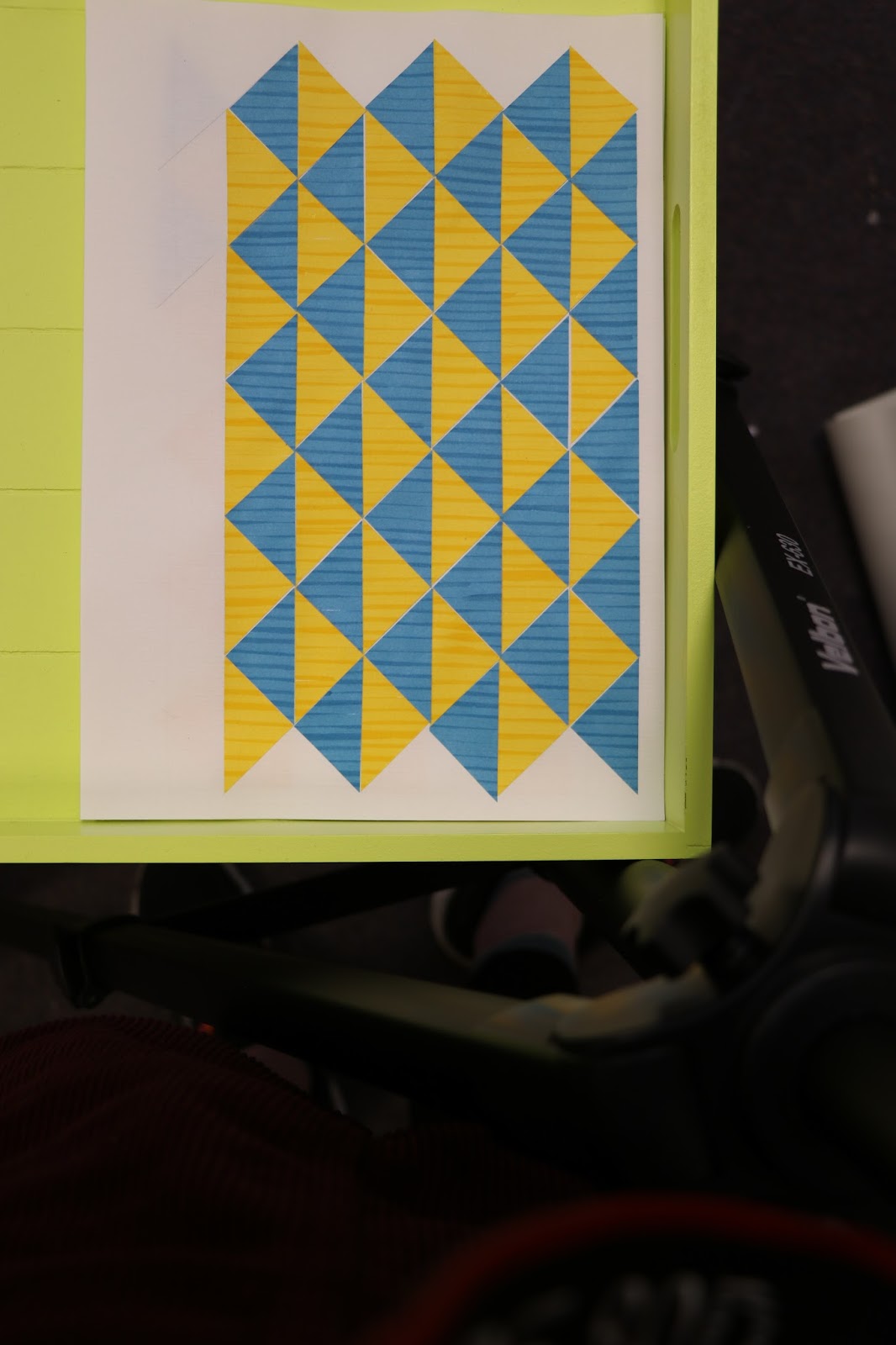
This work began as an experimentation into screen printing.
I had produced some drawings from silicone, and scanned them before exposing them to a screen. I then created a number of screen prints on various papers in a range of colours.
As the prints were drying, I saw them layered on top of one another, creating depth and forming interesting colour relations.
The colours of the prints remind me of a specific item of clothing that my Mum owned in the 1980s/ early 1990s.
The item of clothing in question was a Reebok shellsuit. I vividly remember Mum wearing it every Monday evening when she went to the sports centre to play badminton.
I recall the rustling sound it made and how the fabric felt to the touch. Just seeing the combination of colours in the screen prints brought back many memories.
Wednesday, 16 September 2015
Bruce Mau's An incomplete manifesto for growth
A friend recently reminded me of Bruce
Mau's 'An incomplete manifesto for growth'. It is my intention to read it regularly, and take the advice on board.
- Allow events to change you.
You have to be willing to grow. Growth is different from something that happens to you. You produce it. You live it. The prerequisites for growth: the openness to experience events and the willingness to be changed by them. - Forget about good.
Good is a known quantity. Good is what we all agree on. Growth is not necessarily good. Growth is an exploration of unlit recesses that may or may not yield to our research. As long as you stick to good you’ll never have real growth. - Process is more important than outcome.
When the outcome drives the process we will only ever go to where we’ve already been. If process drives outcome we may not know where we’re going, but we will know we want to be there. - Love your experiments (as you would an ugly
child).
Joy is the engine of growth. Exploit the liberty in casting your work as beautiful experiments, iterations, attempts, trials, and errors. Take the long view and allow yourself the fun of failure every day. - Go deep.
The deeper you go the more likely you will discover something of value. - Capture accidents.
The wrong answer is the right answer in search of a different question. Collect wrong answers as part of the process. Ask different questions. - Study.
A studio is a place of study. Use the necessity of production as an excuse to study. Everyone will benefit. - Drift.
Allow yourself to wander aimlessly. Explore adjacencies. Lack judgment. Postpone criticism. - Begin anywhere.
John Cage tells us that not knowing where to begin is a common form of paralysis. His advice: begin anywhere. - Everyone is a leader.
Growth happens. Whenever it does, allow it to emerge. Learn to follow when it makes sense. Let anyone lead. - Harvest ideas.
Edit applications. Ideas need a dynamic, fluid, generous environment to sustain life. Applications, on the other hand, benefit from critical rigor. Produce a high ratio of ideas to applications. - Keep moving.
The market and its operations have a tendency to reinforce success. Resist it. Allow failure and migration to be part of your practice. - Slow down.
Desynchronize from standard time frames and surprising opportunities may present themselves. - Don’t be cool.
Cool is conservative fear dressed in black. Free yourself from limits of this sort. - Ask stupid questions.
Growth is fueled by desire and innocence. Assess the answer, not the question. Imagine learning throughout your life at the rate of an infant. - Collaborate.
The space between people working together is filled with conflict, friction, strife, exhilaration, delight, and vast creative potential. - ____________________.
Intentionally left blank. Allow space for the ideas you haven’t had yet, and for the ideas of others. - Stay up late.
Strange things happen when you’ve gone too far, been up too long, worked too hard, and you’re separated from the rest of the world. - Work the metaphor.
Every object has the capacity to stand for something other than what is apparent. Work on what it stands for. - Be careful to take risks.
Time is genetic. Today is the child of yesterday and the parent of tomorrow. The work you produce today will create your future. - Repeat yourself.
If you like it, do it again. If you don’t like it, do it again. - Make your own tools.
Hybridize your tools in order to build unique things. Even simple tools that are your own can yield entirely new avenues of exploration. Remember, tools amplify our capacities, so even a small tool can make a big difference. - Stand on someone’s shoulders.
You can travel farther carried on the accomplishments of those who came before you. And the view is so much better. - Avoid software.
The problem with software is that everyone has it. - Don’t clean your desk.
You might find something in the morning that you can’t see tonight. - Don’t enter awards competitions.
Just don’t. It’s not good for you. - Read only left-hand pages.
Marshall McLuhan did this. By decreasing the amount of information, we leave room for what he called our "noodle." - Make new words.
Expand the lexicon. The new conditions demand a new way of thinking. The thinking demands new forms of expression. The expression generates new conditions. - Think with your mind.
Forget technology. Creativity is not device-dependent. - Organization = Liberty.
Real innovation in design, or any other field, happens in context. That context is usually some form of cooperatively managed enterprise. Frank Gehry, for instance, is only able to realize Bilbao because his studio can deliver it on budget. The myth of a split between "creatives" and "suits" is what Leonard Cohen calls a ‘charming artifact of the past.’ - Don’t borrow money.
Once again, Frank Gehry’s advice. By maintaining financial control, we maintain creative control. It’s not exactly rocket science, but it’s surprising how hard it is to maintain this discipline, and how many have failed. - Listen carefully.
Every collaborator who enters our orbit brings with him or her a world more strange and complex than any we could ever hope to imagine. By listening to the details and the subtlety of their needs, desires, or ambitions, we fold their world onto our own. Neither party will ever be the same. - Take field trips.
The bandwidth of the world is greater than that of your TV set, or the Internet, or even a totally immersive, interactive, dynamically rendered, object-oriented, real-time, computer graphic–simulated environment. - Make mistakes faster.
This isn’t my idea — I borrowed it. I think it belongs to Andy Grove. - Imitate.
Don’t be shy about it. Try to get as close as you can. You’ll never get all the way, and the separation might be truly remarkable. We have only to look to Richard Hamilton and his version of Marcel Duchamp’s large glass to see how rich, discredited, and underused imitation is as a technique. - Scat.
When you forget the words, do what Ella did: make up something else … but not words. - Break it, stretch it, bend it, crush it, crack
it, fold it.
- Explore the other edge.
Great liberty exists when we avoid trying to run with the technological pack. We can’t find the leading edge because it’s trampled underfoot. Try using old-tech equipment made obsolete by an economic cycle but still rich with potential. - Coffee breaks, cab rides, green rooms.
Real growth often happens outside of where we intend it to, in the interstitial spaces — what Dr. Seuss calls "the waiting place." Hans Ulrich Obrist once organized a science and art conference with all of the infrastructure of a conference — the parties, chats, lunches, airport arrivals — but with no actual conference. Apparently it was hugely successful and spawned many ongoing collaborations. - Avoid fields.
Jump fences. Disciplinary boundaries and regulatory regimes are attempts to control the wilding of creative life. They are often understandable efforts to order what are manifold, complex, evolutionary processes. Our job is to jump the fences and cross the fields. - Laugh.
People visiting the studio often comment on how much we laugh. Since I’ve become aware of this, I use it as a barometer of how comfortably we are expressing ourselves. - Remember.
Growth is only possible as a product of history. Without memory, innovation is merely novelty. History gives growth a direction. But a memory is never perfect. Every memory is a degraded or composite image of a previous moment or event. That’s what makes us aware of its quality as a past and not a present. It means that every memory is new, a partial construct different from its source, and, as such, a potential for growth itself. - Power to the people.
Play can only happen when people feel they have control over their lives. We can’t be free agents if we’re not free.
Subscribe to:
Posts (Atom)