Showing posts with label painting. Show all posts

Monday, 18 November 2019

Katie Watson Studio Visit

Entering somebody's studio can be like getting a glimpse into their brain. One's studio can be a place for making, experimenting, playing, producing and testing but it can also be a place to contemplate, think and reflect.


When I visited Katie Watson's studio she said that it had been a really good exercise for her to treat my visit as an opportunity to organise her work and form a display of the things she had been working on.


There was an exciting vibe - not an exhibition, but a working process. Some work in progress, some work finished, some research giving an insight into ideas behind the work.


I am drawn to such shapes, patterns, the repetition and the colours within Katie's work. I enjoy the sculptural nature of the paintings as she works on wooden boards rather than canvas. 


Katie is interested in the language of instructions and building. Signage, flat pack instructions, warning and safety notices. She uses the shapes and colours from such things.


I couldn't help notice (perhaps because I also am guilty of this) that Katie's use of colour within her work is mirrored in the things around her. Her blue desk lamp alongside the orange mug with blue lid is surprisingly similar in colour to the work on her wall directly above. Art and life really do blur!


Monday, 30 September 2019

Yorkshire Sculpture International at Leeds City Art Gallery

2019 saw the launch of Yorkshire Sculpture International, a festival of sculpture taking place across Leeds and Wakefield from June to September. 


In addition to the exhibitions at the four main galleries; Yorkshire Sculpture Park, Leeds Art Gallery, The Henry Moore Institute and The Hepworth, there programme also includes a number of outdoor sculptures and new commissions.


Rachel Harrison draws upon a wide range of influences, fusing art historical references with references from pop culture. Her choice of materials is similarly eclectic, with nods to art history and contemporary society.


Joanna Piotrowska selected a number of artworks from the Leeds collection and displayed these alongside her series of black and white photographs investigating social structures. Piotrowska asked local people in Lisbon, Rio de Janeiro, Warsaw and London to create makeshift structures in their homes. 


Although it is not part of Yorkshire Sculpture International, my visit afforded me the opportunity to reconnect with Lothar Goetz's vibrant wall painting which dominates the main staircase. Goetz is interested in how colour interferes with our perception of space and form. 


Tuesday, 26 February 2019

Ongoing studio experiments - dotted paper

I have been experimenting with using pre-existing patterns and structures to provide me with a basic framework to work with.

I used a sheet of dotted paper to as the basis for this watercolour. 


Monday, 25 February 2019

Ongoing studio experiments

I have been experimenting with using pre-existing patterns and structures to provide me with a basic framework to work with.

I used a sheet of gridded paper to as the basis for this watercolour. I left the gridded lines unpainted.


Friday, 14 September 2018

In Every Dream Home - David Foggo - System Gallery

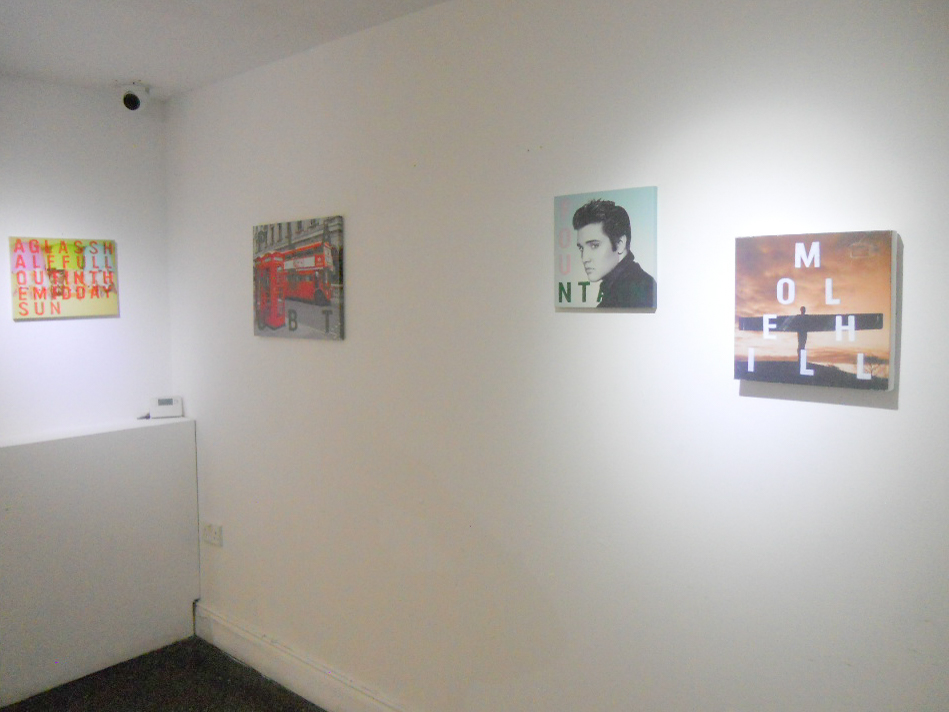
It is not uncommon to find less than tasteful wall art in pubs, and that makes System Gallery an appropriate venue for David Foggo's current exhibition. 


In Every Dream Home is a text/image series that utilises a cross-section of wall art archetypes/stereotypes, encompassing, amongst others, representations of love, spirituality, nature, patriotism, gender, food, music and film, travel, animals, sport and childhood. 


David usefully provides a definition of Wall art in the gallery:

Wall art noun. Bland, decorative, reproduction canvases, normally acquired from household furnishing stores by individuals or organisations with no taste or imagination and then hung in their homes or place of business. Often used as a way of covering up the cracks...


But these are no ordinary examples of Wall art. Foggo has worked onto each of the canvases, subverting their decorative function by overlaying them with a variety of unsettling texts. The alterations are minimal so that the canvases maintain their commonplace identity.


"This process could be seen as an act of reclamation, where the ornamental is transported into the realm of fine art.

The self-authored texts; simultaneously pithy and poetic, and underpinned by the use of word play, incorporate skew-whiff philosophies, dystopian statements, aphorisms and repetitive narratives.

The canvases are all sourced from charity shops, where their once idealised purpose has been dismantled by being discarded and offered up for recycling." 

David Foggo 

The exhibition has been carefully curated so that the images relate to, or take some meaning from their positioning. 


For example, the 'Bound' canvas is constrained between two windows, barely having enough room to breathe.


An iconic image of Elvis has 'fountain' painted on, and is positioned slightly above and to the left of an image of the Angel of the North which bears the word 'molehill'. Could this be a playful take on the familiar saying "make a mountain out of a molehill"?


The exhibition is open until 15th September, so I encourage you to pop along tomorrow to ensure you see it. It certainly put a smile on my face! 


Wednesday, 15 August 2018

Land Sand Strand by Suki Seokyeong Kang at Bluecoat as part of Liverpool Biennial

'Conceived as a visual translation of the Korean musical notation ‘Jeongganbo’, Land Sand Strand is a new multi-part installation by Suki Seokyeong Kang. The work transforms the exhibition space into a grid. 


Building on the concept of the hwamunseok – a traditional Korean woven mat, interpreted as the minimum space provided for each individual in society – it is activated by performers and the audience. 


The choreography, inspired by the Spring Oriole Dance and traditionally performed on the hwamunseok, is shared with visitors. 


The movements on the mat serve as the blueprint for the wider installation consisting of painting, sculpture and video.'


I found Suki Seokyeong Kang's installation at Bluecoat a visual delight. 


I took pleasure from the formal qualities in the work; the subtle use of colours and the combination of traditional Korean materials along with painting, sculpture and video. 


I appreciated the way that the video transformed my understanding of the work presented in the gallery space; static elements are activated through movement and sound.


'Suki Seokyeong Kang (b. 1977, Seoul, South Korea) lives and works in Seoul. Kang deploys various media including installation and video to seek a synesthetic expansion of painting. 


Through movement and rhythm, she creates an environment that guides the direction of her painting, which she uses like a visual musical score. 


Her practice is situated between the abstract and figurative, the organic and geometric, creating a visual language of balance and harmony.'