Wednesday, 18 December 2013

RGI Winter exhibition extended

The Royal Glasgow Institute of the Fine Arts (RGI) has extended the duration of its current exhibition; The Winter Postcard exhibition, in which I have a work exhibited.

The exhibition will now run until the end of January.


The exhibition features a selection of small work by RGI's and RGI artist members.

The gallery is closed 22nd Dec - 7th Jan.

ROYAL GLASGOW INSTITUTE OF THE FINE ARTS
-
KELLY GALLERY  118 DOUGLAS STREET  GLASGOW  G2 4ET 

OPEN: TUESDAY - SATURDAY 10AM - 5PM

GALLERY@ROYALGLASGOWINSTITUTE.ORG

Tuesday, 17 December 2013

Running out of polymer

In order to achieve the vibrant, strong colours of the plaster, I add polymer to the plaster, water and pigment mix. The polymer has two functions; one is to strengthen the cast and the other is to retain the intensity of the colour.

Also, once a cast has been removed from its mould, I dilute some polymer with water and dip the cast into the liquid, turning it round to ensure that all sides have been covered in the polymer dilution.

The rate at which I have been going through plaster, polymer and pigment has surprised me, and while I wait for my next delivery of materials, I have had to reduce the amount of polymer and pigment I have been using.

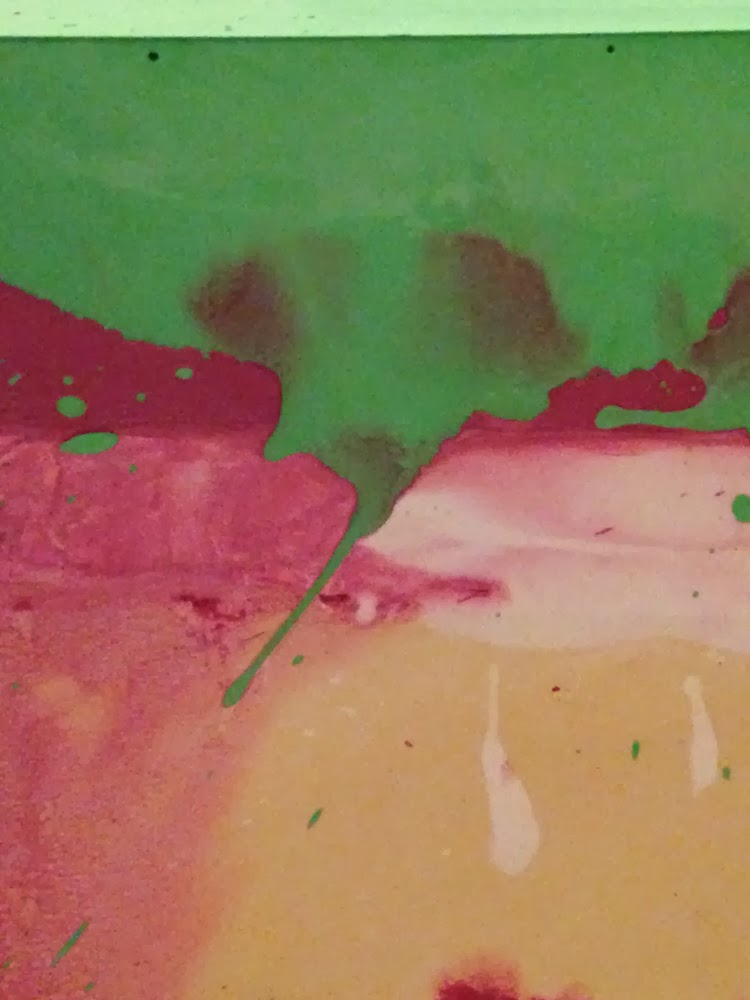
As one can see from the latest batch of casts, this reduction in polymer and pigment produces chalky, pale colours. These are the tones that are often associated with plaster.


Hopefully my order of materials will be delivered tomorrow, and I can go back to creating bold colours.


Monday, 16 December 2013

The latest batch

These are the forms that I cast yesterday.


These are some of the moulds that I've filled with plaster today.


Saturday, 14 December 2013

Action plan made

This morning I met with Petter from the 1 Royal Terrace committee to discuss practical and technical issues related to the work I am making. It was really good to talk through my ideas with him and get his technical advice about, amongst other things, vector files.


I developed a kind of action plan:

1. Make enough casts to fill the bookshelves
- simplify the number of colours used in these casts so they can act as breaks in between the highly chaotic casts

2. Make as many single coloured floor tiles as possible

3. Use photos of the patterns of splashes on the casts as references from which to develop vector image files
- get these laser cut rather like jigsaws and print

4. Do wood cuts, applying a ordered grid pattern such as the parquet flooring onto the organic pattern of the wood
- grid pattern of the bookshelves

5. A series of drawings of the framework of the bookshelves

6. Screenprinting through simple stencils


In the afternoon I cast more floor tiles and blocks for the bookshelves

Testing the forms on the shelves

I have moved the majority of the casts onto the shelves, and tested some different installation possibilities.


I positioned these casts staggered on the shelves so that the outer surface is not flat, and their sculptural nature is visible.


These casts are all aligned up to the edge of the shelf, but by leaving a few gaps between some of the casts, one can see some of the edges of the casts and therefore get a sense of their three dimensionality.

I am still debating whether having a combination of horizontal and vertical layers works, or whether this is over-complicated.


Thursday, 12 December 2013

Exhibition invite


HELEN SHADDOCK

BRIMMING

Preview: Sunday 12.01.14 from 4pm to 8pm.
Open: 18-19.01.14 and 25-26.01.14, Sat-Sun from 12pm to 5pm
Further viewings arranged by appointment.

1 Royal Terrace are proud to present our premier exhibition; a solo show by Glasgow-based artist, Helen Shaddock.

Shaddock is known for her colourful and playful installations in which she explores form, colour and texture, using processes that allow order and chaos to collide. Adopting a hands-on approach to the use of materials, Shaddock’s work moves effortlessly between painting and the three-dimensional while being mindful of the work’s context and audience.

For her exhibition at 1 Royal Terrace, Shaddock is producing sizable site-specific work. To accompany the exhibition an 'artist in conversation' event will be held on 19.01.14, at 2pm (numbers limited, please email 1royalterrace@gmail.com to book a space). 

Helen Shaddock received her BA(Hons) in Fine Art:Sculpture and Environmental Art from Glasgow School of Art in 2008. She regularly exhibits her work in both solo and group exhibitions, and earlier this year she completed a residency at Market Gallery. As an active member of the Glasgow Visual Art community, Shaddock has considerable experience of working within different art organizations in a number of capacities.


Tuesday, 10 December 2013

The floor tiles are growing

Yesterday I made a few more casts that are the size of the floor tiles. I made 2 monochrome forms, and one multi-coloured form. I think that there will be enough happening in the bookshelf that to also have multi-coloured and multi-layered forms on the floor would be too much, so think I will keep each floor tile cast a single colour. When a single colour is used for each cast, the focus becomes the pattern on the floor and the shape of the cast as opposed to the pattern of colours within the form.


I also removed some of the bookshelf casts made yesterday from their moulds.


As you can see from the following photos, the gallery is quickly filling up, so tomorrow I plan a bit of a cleaning/sorting session to give me a little more room!


Sunday, 8 December 2013

Coloured floor tiles

Yesterday I cast a couple of forms that are the exact shape of a floor tile from the gallery. Whereas the other casts that I have been making for the bookshelves are multicoloured, I made the floor tile casts as single colours. 


Today I removed these from the moulds, and tested out the idea to put the floor tile on the top of the cast so as to extend the floor vertically. I aim to create lots of coloured floor tiles at different heights, and install them on the parquet flooring in the gallery.

Yesterday I also cast from a mould I had not used yet. This pillar-like mould is for the bookcase. When pouring the plaster into the mould, I noticed that, due to the tall and thin shape of the mould, the plaster was splashing high up the edges. This can be seen in the resulting form.


Saturday, 7 December 2013

Horizontal cast

Up until now all the casts to go in the installation have had layers going in the same direction- vertically when placed in the bookshelves. I recognise that this may be a little predictable, and seek to disturb this slightly by introducing a few casts with horizontal layers onto the shelves. I hope this will encourage the viewer to look more carefully at the work as the pattern is not quite as easy to read.


This is the first cast with horizontal layers, and I tried to keep it relatively simple so as to add more variation in the rhythm of the work.

I want for there to be areas of concentrated activity and less intense areas within the composition, again, making for more interesting viewing.


I experimented with the positioning of a horizontal cast next to a couple of vertical casts:


As well as producing casts for the bookshelves, today I began casting some bricks that are the same dimensions of the tiles in the parquet flooring.


Wednesday, 4 December 2013

Casts are polymered

I'm pleased with how the casts are turning out, and am liking the colour combinations and the mixture of hard lines separating the different layers and blurrings of the boundaries. It is always exciting when removing the casts from the moulds as I do not know what to expect. When I am working on numerous casts at the same time it is hard to keep a track of which colours I have added to each mould, and so it really is a surprise when the casts are revealed.

I am conscious that the casts are rather delicate and, when positioned next to each other, they easily mark and pick up bits of plaster from the other cast. The nature of the installation means that I will be testing out placing different casts next to each other and moving them around. In order to make the casts more durable and reduce the chances of them marking when butted next to each other, I am going to coat each cast in a diluted polymer solution. This will seal the surface of the cast, making it less crumbly. It also helps the colours retain their vibrancy and tone, preventing them from becoming 'chalky' and pale. The polymer gives the surface a slight sheen, but as I will be using a diluted polymer mix, it shouln't be too obvious.

I will mix the polymer dilution in a bucket and then dip each cast into the solution. I will then submerge the other end of the cast in the polymer, ensuring that the whole cast has been coated in polymer. By dipping the casts into the polymer, I do not add any brush marks or texture on the surface.


I set up my production line with buckets of polymer and tracklines to rest the casts on once polymered, and one by one, covered each cast.


Another cast removed from its mould

Another cast removed from its mould...


Tuesday, 3 December 2013

Exhibition title decided

This afternoon I met with Petter and Ruth from the 1 Royal Terrace committee to work on the marketing material for my exhibition.

A few weeks ago a basic template for the exhibition posters was decided upon. The design will be consistent throughout all of the 1 Royal Terrace programme, but it also allows for each poster to have its own identity and be reflective of the exhibiting artist and their practice.

We looked at the range of images that I had selected, and after doing a few mock ups of the poster, agreed on the type of image to be used. I have taken some beautiful surface photographs of the casts, but I want the poster to indicate the three-dimensional nature of the work, and therefore decided that the poster image will be a corner of one of the casts. I need to take some more photographs of the casts in the daylight, and then select one to be used for the poster.

We then had a great brainstorming session around possible exhibition titles. Anyone who knows me well will be able to vouch for the fact that titling work is not my forte. Usually, titles come from conversations I have had, and this one was no exception. After much discussion we decided on the title...


Monday, 2 December 2013

Batch 2 of casts released from moulds

Removing the casts from their moulds is exciting as I do not know what lies within each mould. The moulds are made of pieces of contiboard held together by screws. To release the cast one has to unscrew the contiboard pieces.


I will clean the moulds, screw the contiboard pieces together again, and they can be used to make more casts.