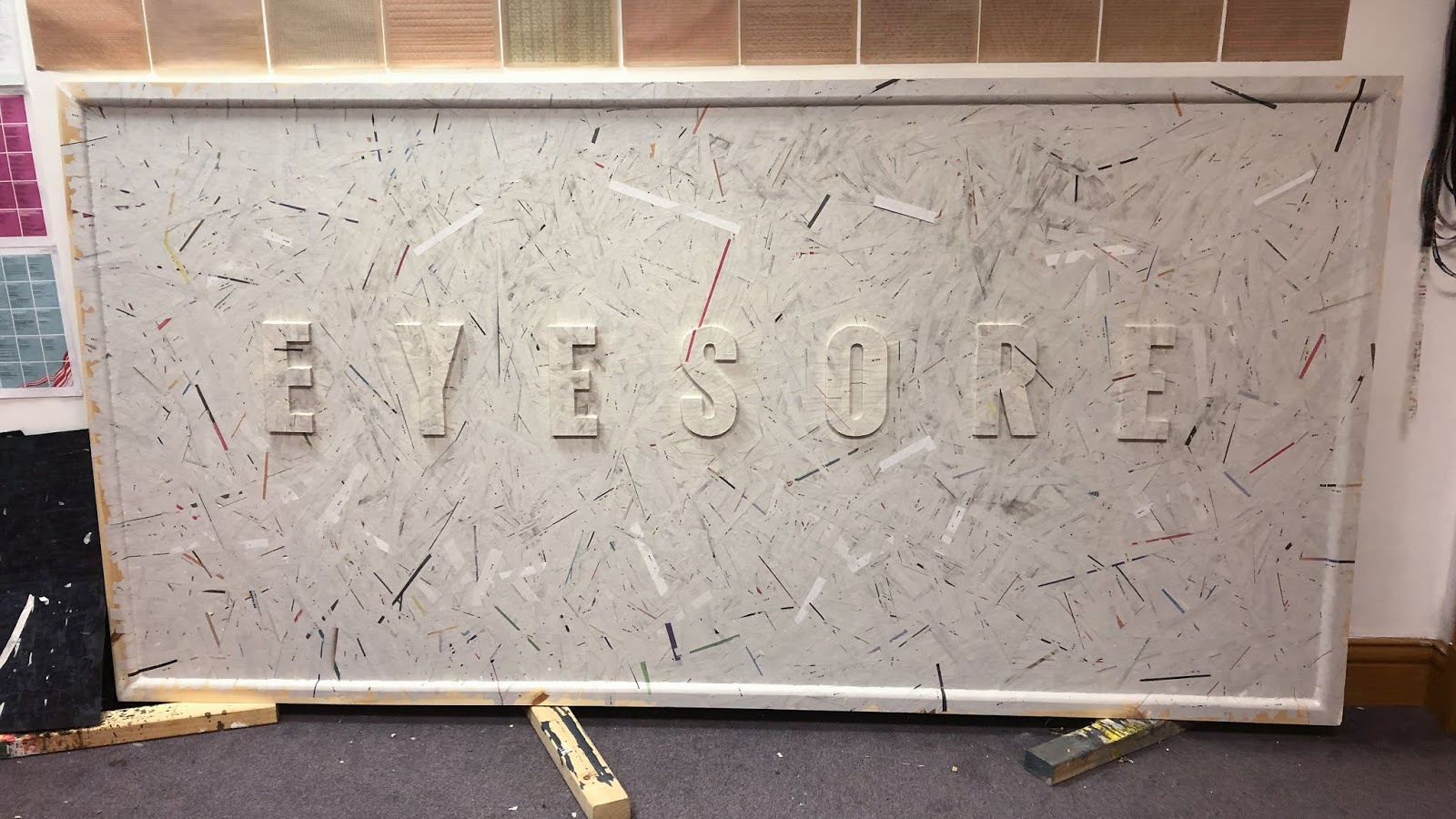
When we began collaging Eyesore at the beginning of July, we could only hazard a guess at how long it would take for us to cover the entire billboard with the hundreds of different margins that we had cut off newspapers. It seems a little unbelievable that this momentous occasion (for marginendeavour, at least) were to happen on New Years Eve 2019, during our final marginendeavour session of the decade!
When we next meet up we will turn the board around and begin wrapping the margins round the rim of the billboard and onto the back. We want to differentiate between the front and the back of the artwork, and so do not intend to collage over the entire back surface.
Showing posts with label December. Show all posts
Thursday, 2 January 2020
Monday, 30 December 2019
So Many Books, So Little Time - BBC Radio 4
Since my Mum is a retired Librarian and my Dad is a self-declared book hoarder, it is hardly surprising that I am also fond of books. One of the things I was most excited about when moving into my current flat, was the possibility of being able to have a bookcase on which all my books could be united and housed. I took great pleasure from gathering all my books together, measuring them and designing my very own bookcase in which they would fit (with a little room for expansion, of course!)
I am drawn to the book as a physical object, hence my decision not to have a kindle or other electronic book device. I have many books that are more than their contents, there is a story behind getting the book - such as if it was bought for me and has a note inside. There's something about owning a book, being able to look back at it, refer to it when you have forgotten something, or being reminded of the time of your life when you first read the book.
Yet I hold my hands up high and admit that there are many books on my bookcase that I have yet to read. But I intend to read them.
I enjoyed listening to Mark Hodkinson discuss his relationship with books and the act of collecting books in this Radio 4 programme, 'So Many Books, So Little Time'.
Mark Hodkinson ponders the nature of our personal book collections, why and how we gather books, what it says about us, and how we ever expect to find time to read them all.
Author Mark had just moved house. By far the most difficult task was carrying, storing and alphabetising his collection of 3,500 books. It made him stop to think. If it took, say, four days of solid reading to finish a book, he’d need 38.3 years to go through his collection. He would have to make his way through 315 million words. And that’s if he didn’t take time off to sleep, eat and have the occasional night out.
Clearly, it was a challenge too far.
So Many Books, So Little Time is an autobiographical, impressionistic audio odyssey. Mark considers that he might be afflicted by bibliomania and visits consumer psychologist Lisa Edgar to see whether owning thousands of books is normal. He calls at his local bookshop and meets its owner, George Kelsall, who has ten times as many books as Mark and has bought a large house solely to accommodate them.
He visits fellow writers, such as Austin Collings who tells Mark he is in grave danger of becoming merely an aggregate of all his books and will eventually lose his own writing voice. Trevor Hoyle tells Mark that he views books as time capsules and, pulling copies down from the shelves, he can tell Mark when he bought them, what was happening in his life at the time. Joanne Harris, the million-selling author of Chocolat, tells Mark she has filled her house full of books because she can’t bring it upon herself to throw any away.
Practical concerns are not forgotten – Mark visits a carpenter, Ashley Deakin, who previously made a bookcase a week but now does one or two a year. ‘‘People don’t want to put books on their walls any more. They just want these bloody huge televisions,’’ he says. Ashley then remembers that he built a shelving unit just a few weeks ago.
"But it was for shoes,’’ he says.
A 7digital production for BBC Radio 4
Yet I hold my hands up high and admit that there are many books on my bookcase that I have yet to read. But I intend to read them.
I enjoyed listening to Mark Hodkinson discuss his relationship with books and the act of collecting books in this Radio 4 programme, 'So Many Books, So Little Time'.
Mark Hodkinson ponders the nature of our personal book collections, why and how we gather books, what it says about us, and how we ever expect to find time to read them all.
Author Mark had just moved house. By far the most difficult task was carrying, storing and alphabetising his collection of 3,500 books. It made him stop to think. If it took, say, four days of solid reading to finish a book, he’d need 38.3 years to go through his collection. He would have to make his way through 315 million words. And that’s if he didn’t take time off to sleep, eat and have the occasional night out.
Clearly, it was a challenge too far.
So Many Books, So Little Time is an autobiographical, impressionistic audio odyssey. Mark considers that he might be afflicted by bibliomania and visits consumer psychologist Lisa Edgar to see whether owning thousands of books is normal. He calls at his local bookshop and meets its owner, George Kelsall, who has ten times as many books as Mark and has bought a large house solely to accommodate them.
He visits fellow writers, such as Austin Collings who tells Mark he is in grave danger of becoming merely an aggregate of all his books and will eventually lose his own writing voice. Trevor Hoyle tells Mark that he views books as time capsules and, pulling copies down from the shelves, he can tell Mark when he bought them, what was happening in his life at the time. Joanne Harris, the million-selling author of Chocolat, tells Mark she has filled her house full of books because she can’t bring it upon herself to throw any away.
Practical concerns are not forgotten – Mark visits a carpenter, Ashley Deakin, who previously made a bookcase a week but now does one or two a year. ‘‘People don’t want to put books on their walls any more. They just want these bloody huge televisions,’’ he says. Ashley then remembers that he built a shelving unit just a few weeks ago.
"But it was for shoes,’’ he says.
A 7digital production for BBC Radio 4
Sunday, 29 December 2019
Saturday, 28 December 2019
Friday, 20 December 2019
Thursday, 19 December 2019
Tuesday, 17 December 2019
Sunday, 15 December 2019
Recent drawing - Number series - 0
Following my series of drawings of the alphabet, I have decided to do a series of number drawings from 0-9.
Labels:
0,
2019,
December,
December 2019,
drawing,
grid,
number,
obsessive,
pattern,
repetition,
series
Tuesday, 10 December 2019
Seven Failure Principles from Elizabeth Day's How to Fail Live with Reni Eddo-Lodge
https://www.elizabethdayonline.co.uk/
Seven Failure Principles from Elizabeth Day's How to Fail Live with Reni Eddo-Lodge
1. Failure is a fact but you are not defined by it
"Just because you fail does not make you a failure"
2. You are not your anxious brain
The brain tells us something is a danger when it isn't
We are not defined by our thoughts
3. Almost everyone feels they have failed in their 20s
4. Break ups are not a tragedy - your ex-partner has taught you something
5. Failure is data acquisition
6. There is no such thing as a future you
7. When we choose to share our vulnerabilities is when we feel most satisfaction
A couple more nuggets of wisdom that Day shared include
When times get too tough and you feel like giving up, cling on because the biggest failure may be not finding out what will happen
Anxiety doesn't want you to enjoy life
Seven Failure Principles from Elizabeth Day's How to Fail Live with Reni Eddo-Lodge
1. Failure is a fact but you are not defined by it
"Just because you fail does not make you a failure"
2. You are not your anxious brain
The brain tells us something is a danger when it isn't
We are not defined by our thoughts
3. Almost everyone feels they have failed in their 20s
4. Break ups are not a tragedy - your ex-partner has taught you something
5. Failure is data acquisition
6. There is no such thing as a future you
7. When we choose to share our vulnerabilities is when we feel most satisfaction
A couple more nuggets of wisdom that Day shared include
When times get too tough and you feel like giving up, cling on because the biggest failure may be not finding out what will happen
Anxiety doesn't want you to enjoy life
Some notes from How to be a public author with Cash Carraway, Paul Ewen and Carmen Marcus
Say the unsaid and taboo
Share the things that you are scared of
When procrastinating, "just write the shit version" - Dennis Kelly
A useful exercise is to distill the work to a single line
Fine the core of the book before offering it up for feedback so you can retain the core
Read your work out loud and sense the reaction
All writers need to be readers
Treat your story like it is a house - where are the public /private places?
Stick to your own voice
Don't wait for inspiration to hit
Writing is reading, walking, researching etc - try something new with your writing
Share the things that you are scared of
When procrastinating, "just write the shit version" - Dennis Kelly
A useful exercise is to distill the work to a single line
Fine the core of the book before offering it up for feedback so you can retain the core
Read your work out loud and sense the reaction
All writers need to be readers
Treat your story like it is a house - where are the public /private places?
Stick to your own voice
Don't wait for inspiration to hit
Writing is reading, walking, researching etc - try something new with your writing
Cash Carraway: Skint Estate - Cash Carraway in conversation with Tina Gharavi
Cash Carraway is a single mum living in temporary accommodation. She’s been moved around the system since she left home at sixteen. She’s also been called a stain on society. And she’s caught in a poverty trap.
Skint Estate is the hard-hitting debut memoir about impoverishment, loneliness and violence – set against a grim landscape of sink estates, police cells, refuges and peepshows.
https://www.goodreads.com/en/book/show/41955385

It is clear from the moment that Cash Carraway opens her mouth that sitting in front of me is a woman with an enormous amount of determination and passion for sharing what it is to live in a working class community, and highlighting the challenges that face such communities on a daily basis. I'm reminded of what Bernardine Evaristo spoke about last night, and believe that Carraway has chosen to manage her anger and frustration at the situation by channelling it into her creativity.
Carraway speaks with a knowing rather than self-pitying voice.
"In general, the working class are not allowed to create art, they are only allowed to capitalise on their bleak situation."
Her transgressive writing is not therapy.
Therapeutic writing is not creative writing.
Her book, Skint Estate, does not solve a problem.
She doesn't want to write stories of victims.
She does want to write stories of power.
The power of her spoken word is evidenced when she reads aloud a passage from Skint Estate. Talk about giving me goosebumps. This is an example of when the sound of the human voice can elevate words off the page and into another realm.
She ends with a plea to the audience:
"Go and buy the book and please read the pages out loud and preferably to someone who didn't want to listen."
Bernardine Evaristo and David Olusoga in conversation
The synopsis of Bernardine Evaristo's Booker Prize winning novel reads
Girl, Woman, Other follows the lives and struggles of twelve very different people. Aged 19 to 93, they span a variety of ages, cultural backgrounds, sexualities, classes and occupations as they tell the stories of themselves, their families, friends and lovers, across the country and through the years.
Perhaps unsurprisingly given it's recent Booker Prize Award, the majority of the conversation is spent discussing this particular publication. I found it fascinating to hear about the structure of the book and how she has constructed it so that each chapter focuses on one character, and links form between the chapters.
Discussion regarding the politics around the Booker Prize, the judging panel and the source of funding for the Prize highlighted the sheer importance and level of achievement reached by Evaristo at becoming the first black woman to win the award.
Evaristo explained how she felt like she needed to represent a group of people whose stories had not been told. When asked to discuss her thoughts on writing a non-binary character when she does not identify as non-binary, she recognises that she was very careful in doing so, and conducts and uses her research so as to try to limit any misrepresentation or offence caused. She acknowledges that she never tries to pretend to be non-binary, and as the novel is a work of fiction, feels as though she has the right to be creative and include things that are not necessarily true. In a recent newspaper article she was quoted as saying
"This whole idea of cultural appropriation, which is where you are not supposed to write beyond your own culture and so on, is ridiculous. Because that would mean that I could never write white characters or white writers can never write black characters."
Following another question about how she manages her anger, Evaristo clearly stated that she did not think it was at all healthy or beneficial to carry anger around with her and therefore any anger she does feel is turned into energy. She then tries to channel this energy into something positive that can make a difference and force change. She recognises that there are things that one has to leave to others to deal with. She knows that her talent is for writing and her passion is to change the way that black women are represented.
I found it refreshing to hear her talk about her life as an author. She has no set routine, and emphasised the importance of fitting in her writing in and amongst her usual daily activities. She cycles, watches daytime TV, socialises with friends, but her main focus remains her writing.
Tuesday, 3 December 2019
Thursday, 27 December 2018
Saturday, 15 December 2018
Steve Reich's Music For 18 Musicians
The current series of Radio 3's The Essay features authors talking about a piece of music that has been significant to them and their creative development. They explore how pieces inspire creativity through mood, narrative or structure, inviting us to step into the music – and the author’s – inner world. In this episode, New York based author and journalist Hermione Hoby discusses Steve Reich’s Music For 18 Musicians, a piece of music that she has listened to almost every day for the last seven years. In this short radio essay she reveals how this classic piece of minimalism helps her write.
This is one of my favourite pieces of music, and I was fortunate enough to be able to see it performed at Glasgow City Hall. I was utterly mesmerized and in awe of the performers who maintained full concentration throughout the performance. To listen to Music For 18 Musicians is to have an experience, you do not just hear it, you feel it, it has a physical impact.
Hoby describes the work as "music that sounds like what it feels like to write well." She continues, " The opening xylophone notes- are optimistic, clear, urgent, devoid of panic, full of confidence and clarity, - How i want to feel when writing. The pulses are hypnotic and the piece sounds like an experiment that is alive, exploratory, a living construction, built on repetitions, striking enough to drive you ahead, but also distant enough to be able to fade into the background when your own creative juices begin to flow."
Like Hoby, I find it fairly easy to work at the same time as listening to the music. One of the factors that makes it easy for me to do this is that it features no words. It also helps that there is no solo piece, no musician that dominates and therefore it all seems to work together.
Sunday, 31 December 2017
Alfredo Jaar - The Garden of Good and Evil at Yorkshire Sculpture Park
Having studied Architecture, Alfredo Jaar turned to social engaged art as he enjoyed the freedom it gave him. “I am free to speculate, I am free to dream a better world, and I can only do that in the art world”.
Jaar's work questions humanitarian issues such as the refugee crisis and grief. His exhibition at Yorkshire Sculpture Park spans the Underground Gallery and the open air space in front of the gallery.

Outside, in the gravel path leading up to the Underground Gallery, Jaar has installed 101 trees in a grid with walkable passageways between. Masked by, and positioned within the grid of trees there are nine stainless steel frames structures. These are said to reference ‘black sites’, the secret detention facilities operated by the United States Central Intelligence Agency (CIA) around the world where human beings are being tortured and killed.
"I will not act on the world if I do not understand the world." ALFREDO JAAR
In the first room in the gallery the audience meets a wall of bright light forming one of the sides of an installation booth in which visitors are invited to sit and watch a film. The film, The Sound of Silence (2005), reveals the story of a young victim of the 1993 Sudanese famine. Nearing the end of the film, a sudden flash of light reinforces the drama within the narrative.

Jaar's play on light and dark is continued in another room in which a full colour image taken by photographer Koen Wessing of two grieving daughters morph into black and white silhouettes. Shadows (2014) continues in the adjacent space where six additional images taken on the same day show the family's trauma after the murder of a farmer.
"Generally we are taught how to read, but we are not taught how to look." ALFREDO JAAR

A Hundred Times Nguyen (1994) is a work that is based on an experience that Jaar had when he was visiting ‘refugee detention centres’ in Hong Kong in 1991. In the centre of the gallery there is a vitrine containing the story that lead to the work. Jaar had requested permission to photograph a girl, Nguyen Thi Thuy, who later became emotionally attached to him. Jaar photographed her five times at five-second intervals. Out of the hundreds of images he took while he was in Hong Kong, it was these five images that Jaar was most drawn to. It is these that he has replicated and displayed in various orders in A Hundred Times Nguyen. Personally, I do not think that the images need to be shown 100 times for it to be powerful. It was actually the story that I was moved by, and I felt that the images were unnecessary.
Jaar's work questions humanitarian issues such as the refugee crisis and grief. His exhibition at Yorkshire Sculpture Park spans the Underground Gallery and the open air space in front of the gallery.

Outside, in the gravel path leading up to the Underground Gallery, Jaar has installed 101 trees in a grid with walkable passageways between. Masked by, and positioned within the grid of trees there are nine stainless steel frames structures. These are said to reference ‘black sites’, the secret detention facilities operated by the United States Central Intelligence Agency (CIA) around the world where human beings are being tortured and killed.
"I will not act on the world if I do not understand the world." ALFREDO JAAR
In the first room in the gallery the audience meets a wall of bright light forming one of the sides of an installation booth in which visitors are invited to sit and watch a film. The film, The Sound of Silence (2005), reveals the story of a young victim of the 1993 Sudanese famine. Nearing the end of the film, a sudden flash of light reinforces the drama within the narrative.

Jaar's play on light and dark is continued in another room in which a full colour image taken by photographer Koen Wessing of two grieving daughters morph into black and white silhouettes. Shadows (2014) continues in the adjacent space where six additional images taken on the same day show the family's trauma after the murder of a farmer.
"Generally we are taught how to read, but we are not taught how to look." ALFREDO JAAR

A Hundred Times Nguyen (1994) is a work that is based on an experience that Jaar had when he was visiting ‘refugee detention centres’ in Hong Kong in 1991. In the centre of the gallery there is a vitrine containing the story that lead to the work. Jaar had requested permission to photograph a girl, Nguyen Thi Thuy, who later became emotionally attached to him. Jaar photographed her five times at five-second intervals. Out of the hundreds of images he took while he was in Hong Kong, it was these five images that Jaar was most drawn to. It is these that he has replicated and displayed in various orders in A Hundred Times Nguyen. Personally, I do not think that the images need to be shown 100 times for it to be powerful. It was actually the story that I was moved by, and I felt that the images were unnecessary.
Thursday, 21 December 2017
The Drone Ensemble Score for An Artistic Encounter at The Great North Museum:Hancock
Each Drone Ensemble performance is unique and we respond intuitively to each other and improvise. However, we usually follow a rough score to help us all keep on time and to give us a degree of structure.
This is the score that we followed when performing in An Artistic Encounter at The Great North Museum:Hancock.
Wednesday, 13 December 2017
My latest batch of film strips
I've been really enjoying preparing some film strips. Perhaps I have been influenced by the Christmas baubles, the festive lights and the colours of wrapping papers?
Thursday, 7 December 2017
Frank Ormsby's poems used to help others understand Parkinson's Disease
Malachi O'Doherty writes,
"The Belfast writer, who suffers from hallucinations and twitching, is defiantly upbeat about his condition. He has turned his experiences into a new pamphlet which is being used as a teaching resource for student nurses learning about the degenerative disease.

The poet Frank Ormsby lives with hallucinations and with the prospect of the earth opening up and swallowing him. That is how he describes Parkinson's Disease in a pamphlet of new poems to be launched tomorrow night in Belfast at the famous No Alibis bookshop on Botanic Avenue.
One poem includes the lines: 'Who is that girl I sense at my shoulder? Who is that dancing lazily/on my table until I look up?'
He is surrounded by ghosts. They are no bother to him. He remarks on their lack of energy in one of the poems Hallucinations 3: 'They have the fearsome patience of invalids. Whatever it is they are waiting for, they will wait forever.'
Frank was hospitalised seven years ago with heart failure and diagnosed with diabetes. So he has two afflictions to deal with.
His response to Parkinson's in his poems is a mix of humour and horror. He says: "It is hard to beat humour as an instrument against disease or unhappiness. I suppose as a writer I have always had a strong sense of the absurd."
You might think he would be deeply pained at having to live with hallucinations. In fact, he seems more bemused than bothered. He writes about taking these ghosts for a walk every day round the Waterworks on the Antrim Road, near where he lives. He wonders if the dogs there will sense their auras.
He says: "I think that people just naturally have a certain disposition or temperament and I seem to have the kind of temperament that sets considerable store by jokes and what you call whimsy. I am very glad to have this approach to life. It certainly helps to make negative experience a lot more bearable."
But the story is a sad and shocking one.
"From time to time I would think of the limitations of having this temperament. In these poems there is a certain amount of humour but you could go through them and pull together an awareness of the darker side."
But Frank says he is looking forward to the day Billy Connolly makes his Parkinson's the subject of a stage act. "I think there was always a part of me that wanted to be a stand-up comic."
But is there not a danger that others who have Parkinson's might not appreciate this humour, might find it insensitive to their own experience?
He admits: "I've got certain niggling doubts about that. I could imagine somebody who had Parkinson's say for 10 years or 20 years more than I have had it might listen sceptically to poems like these and say he knows nothing about it.
"Ten years from now, if he survives, let's see if he's laughing then.
"It's not as if I am putting myself forward as the laureate of Parkinson's but I am aware that it could seem like that, especially to someone who had suffered and really suffered for it for much longer than I have."
People who haven't met Frank in recent years but maybe knew him as their teacher when he was head of English at the Royal Belfast Academical Institution will see that he has slowed down, that he speaks much more softly, and that his left arm twitches. He hasn't lost the whimsicality they will be familiar with but they might feel instinctively a bit more protective towards him.
Parkinson's does not kill but it erodes a person progressively.
And the damage shows.
Yet he says: "Funnily enough, I wouldn't describe it as a bad time. That would seem to me to be an exaggeration. I think if I am going to have a bad time it is going to be in the future at some point.
"At the moment, I suppose I have a tremor in my left arm, I have certainly got a lot clumsier when it comes to doing or undoing buttons or tying shoelaces or the ordinary little things that you do in the course of the day. I certainly got slower there.
"Neither of the diseases - I'm talking about the diabetes and Parkinson's - that I have got involve pain, or at least they haven't so far. I suppose the real damage that they do is that they soften you up for heart attacks and strokes and so on, but it's about seven years since I have come out of hospital and in that time I haven't had a single day's illness.
"So I suppose, I feel lucky because of that and maybe that is something that feeds the optimism."
Poets often talk of their ideas coming to them rather than them going out looking for them. They don't sit down in the morning like a working journalist with a job to finish before lunch; though some journalists might think that some poets would be more productive if they did.
Frank says: "I'm always surprised that there are certain subjects that almost put a pressure on you to write about them and there are other subjects that don't. In 2009, I spent three weeks in hospital with heart failure and I went home fully expecting to get a quarter of a book of poems out of this experience but, in fact, I never wrote about it at all.
"Yet when it emerged that I had Parkinson's disease I found myself reading articles watching material about it on TV, discussing it with a few people I knew who were my age and writing this sequence of poems and they came quite quickly over about a month or so."
A psychologist might ask at this point if the poems helped him cope, might assume they were therapeutic.
"I suppose I had some kind of half idea (that they would help me to cope with Parkinson's) but only a half idea.
"I think to sit down with some sort of intention to help yourself or of writing poems as a form of therapy I think would be detrimental to the poems themselves.
"You'd end up with something forced, something jerry built, something that didn't come naturally or had no lightness of touch about it. As it turned out these poems did come fairly easily and I didn't allow myself to become too conscious of them as therapy but I have no doubt that they helped."
In the poems he reflects on the changes in him.
In Side Effects 2 he writes, 'Gone my teacherly gulder. …The voice that broke at thirteen has again broken.'
His former Inst pupils remember him as a teacher who could take charge of a class and be a commanding presence in it. Several senior figures in the Northern Ireland media have sat in front of him while he explained poetry to them. They include BBC NI's Stephen Nolan, the music writer Stuart Bailie and Peter Rainey, who is picture editor at the Belfast Telegraph.
The new poems are already being used in Scotland to train nurses who will be working with patients with Parkinson's, for they bring to life the internal experience of the person you see shuffling and shaking, the arm twitching, the distracted look on the face.
He says: "It all began with a poetry reading I did at the Scottish Poetry Library in Edinburgh and two things happened as a result of that reading. One was that the two people who were on Mariscat Press, Hamish White and Diane Hendry, offered to do this pamphlet of the Parkinson's poems and one look at the beautiful pamphlets they had previously done and I was accepting the offer immediately.
"The other, to me, surprising development was that a teaching nurse from the Queen Margaret University approached me. She was teaching a class about neurological diseases and she had the idea previously that she might be able to use poems as a teaching aid. It would be a way of stimulating interest and emphasising certain priorities."
That nurse gave her class the poems "to read and discuss and to explore the various themes and apply them to their own work". She then challenged the student nurses to write poetry in response, using the Japanese haiku form that Frank writes a lot in himself, where each poem has only 17 syllables.
How did that go down with students who were expecting a more practical and scientific education?
Frank says: "I suddenly in the mail had 16 haiku poems arrive. And it was pleasingly evident that they had responded to the main points in the poems and I could suddenly realise how the poems might teach them something."
The connection with the hospital is ongoing.

The poet Frank Ormsby lives with hallucinations and with the prospect of the earth opening up and swallowing him. That is how he describes Parkinson's Disease in a pamphlet of new poems to be launched tomorrow night in Belfast at the famous No Alibis bookshop on Botanic Avenue.
One poem includes the lines: 'Who is that girl I sense at my shoulder? Who is that dancing lazily/on my table until I look up?'
He is surrounded by ghosts. They are no bother to him. He remarks on their lack of energy in one of the poems Hallucinations 3: 'They have the fearsome patience of invalids. Whatever it is they are waiting for, they will wait forever.'
Frank was hospitalised seven years ago with heart failure and diagnosed with diabetes. So he has two afflictions to deal with.
His response to Parkinson's in his poems is a mix of humour and horror. He says: "It is hard to beat humour as an instrument against disease or unhappiness. I suppose as a writer I have always had a strong sense of the absurd."
You might think he would be deeply pained at having to live with hallucinations. In fact, he seems more bemused than bothered. He writes about taking these ghosts for a walk every day round the Waterworks on the Antrim Road, near where he lives. He wonders if the dogs there will sense their auras.
He says: "I think that people just naturally have a certain disposition or temperament and I seem to have the kind of temperament that sets considerable store by jokes and what you call whimsy. I am very glad to have this approach to life. It certainly helps to make negative experience a lot more bearable."
But the story is a sad and shocking one.
"From time to time I would think of the limitations of having this temperament. In these poems there is a certain amount of humour but you could go through them and pull together an awareness of the darker side."
But Frank says he is looking forward to the day Billy Connolly makes his Parkinson's the subject of a stage act. "I think there was always a part of me that wanted to be a stand-up comic."
But is there not a danger that others who have Parkinson's might not appreciate this humour, might find it insensitive to their own experience?
He admits: "I've got certain niggling doubts about that. I could imagine somebody who had Parkinson's say for 10 years or 20 years more than I have had it might listen sceptically to poems like these and say he knows nothing about it.
"Ten years from now, if he survives, let's see if he's laughing then.
"It's not as if I am putting myself forward as the laureate of Parkinson's but I am aware that it could seem like that, especially to someone who had suffered and really suffered for it for much longer than I have."
People who haven't met Frank in recent years but maybe knew him as their teacher when he was head of English at the Royal Belfast Academical Institution will see that he has slowed down, that he speaks much more softly, and that his left arm twitches. He hasn't lost the whimsicality they will be familiar with but they might feel instinctively a bit more protective towards him.
Parkinson's does not kill but it erodes a person progressively.
And the damage shows.
Yet he says: "Funnily enough, I wouldn't describe it as a bad time. That would seem to me to be an exaggeration. I think if I am going to have a bad time it is going to be in the future at some point.
"At the moment, I suppose I have a tremor in my left arm, I have certainly got a lot clumsier when it comes to doing or undoing buttons or tying shoelaces or the ordinary little things that you do in the course of the day. I certainly got slower there.
"Neither of the diseases - I'm talking about the diabetes and Parkinson's - that I have got involve pain, or at least they haven't so far. I suppose the real damage that they do is that they soften you up for heart attacks and strokes and so on, but it's about seven years since I have come out of hospital and in that time I haven't had a single day's illness.
"So I suppose, I feel lucky because of that and maybe that is something that feeds the optimism."
Poets often talk of their ideas coming to them rather than them going out looking for them. They don't sit down in the morning like a working journalist with a job to finish before lunch; though some journalists might think that some poets would be more productive if they did.
Frank says: "I'm always surprised that there are certain subjects that almost put a pressure on you to write about them and there are other subjects that don't. In 2009, I spent three weeks in hospital with heart failure and I went home fully expecting to get a quarter of a book of poems out of this experience but, in fact, I never wrote about it at all.
"Yet when it emerged that I had Parkinson's disease I found myself reading articles watching material about it on TV, discussing it with a few people I knew who were my age and writing this sequence of poems and they came quite quickly over about a month or so."
A psychologist might ask at this point if the poems helped him cope, might assume they were therapeutic.
"I suppose I had some kind of half idea (that they would help me to cope with Parkinson's) but only a half idea.
"I think to sit down with some sort of intention to help yourself or of writing poems as a form of therapy I think would be detrimental to the poems themselves.
"You'd end up with something forced, something jerry built, something that didn't come naturally or had no lightness of touch about it. As it turned out these poems did come fairly easily and I didn't allow myself to become too conscious of them as therapy but I have no doubt that they helped."
In the poems he reflects on the changes in him.
In Side Effects 2 he writes, 'Gone my teacherly gulder. …The voice that broke at thirteen has again broken.'
His former Inst pupils remember him as a teacher who could take charge of a class and be a commanding presence in it. Several senior figures in the Northern Ireland media have sat in front of him while he explained poetry to them. They include BBC NI's Stephen Nolan, the music writer Stuart Bailie and Peter Rainey, who is picture editor at the Belfast Telegraph.
The new poems are already being used in Scotland to train nurses who will be working with patients with Parkinson's, for they bring to life the internal experience of the person you see shuffling and shaking, the arm twitching, the distracted look on the face.
He says: "It all began with a poetry reading I did at the Scottish Poetry Library in Edinburgh and two things happened as a result of that reading. One was that the two people who were on Mariscat Press, Hamish White and Diane Hendry, offered to do this pamphlet of the Parkinson's poems and one look at the beautiful pamphlets they had previously done and I was accepting the offer immediately.
"The other, to me, surprising development was that a teaching nurse from the Queen Margaret University approached me. She was teaching a class about neurological diseases and she had the idea previously that she might be able to use poems as a teaching aid. It would be a way of stimulating interest and emphasising certain priorities."
That nurse gave her class the poems "to read and discuss and to explore the various themes and apply them to their own work". She then challenged the student nurses to write poetry in response, using the Japanese haiku form that Frank writes a lot in himself, where each poem has only 17 syllables.
How did that go down with students who were expecting a more practical and scientific education?
Frank says: "I suddenly in the mail had 16 haiku poems arrive. And it was pleasingly evident that they had responded to the main points in the poems and I could suddenly realise how the poems might teach them something."
The connection with the hospital is ongoing.

"I am writing an essay about their responses to the poems. The essay may or may not be published in a journal of nursing research. All this was unexpected but exciting as well."
https://www.belfasttelegraph.co.uk/life/features/therapeutic-no-but-writing-about-it-definitely-has-helped-frank-ormsby-on-how-he-used-his-struggles-with-parkinsons-to-inspire-his-latest-collection-of-poems-35023793.html
Monday, 4 December 2017
How opening our ears can open our minds: Hildegard Westerkamp
"Soundscape composer Hildegard Westerkamp hears the world differently than most people. Where many of us might hear noise, she uncovers extraordinary beauty and meaning. It's all in how we listen to our environment.
In this interview, Paul Kennedy joined Hildegard Westerkamp on a sound-walk through Vancouver's downtown eastside, and explored how opening our ears to our surroundings can open our minds.

Westerkamp uses environmental sounds her instruments. She refrains from using any effects, and feels it is important to do her own field recording as opposed to using pre-recorded sounds and it encourages her to listen actively. When in the studio, re-listening to her field recordings, Westerkamp often picks up on other sounds that she had not previously heard because she does not have as many other sounds competing for her attention.
"To be in the present as a listener is a revolutionary act. We absolutely need it, to be grounded in that way."
She comments that people no longer practice listening to the environment, are afraid of silence and so turn to music to fill the perceived void.
"People are afraid of silence, because it's perceived as a vacuum. It's not perceived as a source of inspiration…. The tools to search out the environmental sounds that heal us have been lessened as a result."
"Listening will help us reconnect to the environment. If we can understand what listening can do to reconnect us to our environment, we can understand what's happening to our environment... we would be enriched, hugely."
To listen to the interview and sound walk visit:
http://www.cbc.ca/radio/ideas/how-opening-our-ears-can-open-our-minds-hildegard-westerkamp-1.3962163
To find out more about Hildegard Westerkamp, visit:
https://www.sfu.ca/~westerka/

Westerkamp uses environmental sounds her instruments. She refrains from using any effects, and feels it is important to do her own field recording as opposed to using pre-recorded sounds and it encourages her to listen actively. When in the studio, re-listening to her field recordings, Westerkamp often picks up on other sounds that she had not previously heard because she does not have as many other sounds competing for her attention.
"To be in the present as a listener is a revolutionary act. We absolutely need it, to be grounded in that way."
She comments that people no longer practice listening to the environment, are afraid of silence and so turn to music to fill the perceived void.
"People are afraid of silence, because it's perceived as a vacuum. It's not perceived as a source of inspiration…. The tools to search out the environmental sounds that heal us have been lessened as a result."
"Listening will help us reconnect to the environment. If we can understand what listening can do to reconnect us to our environment, we can understand what's happening to our environment... we would be enriched, hugely."
To listen to the interview and sound walk visit:
http://www.cbc.ca/radio/ideas/how-opening-our-ears-can-open-our-minds-hildegard-westerkamp-1.3962163
To find out more about Hildegard Westerkamp, visit:
https://www.sfu.ca/~westerka/
Subscribe to:
Posts (Atom)