Showing posts with label video installation. Show all posts

Tuesday, 9 January 2018

John Akomfrah - Vertigo Sea at The Talbot Rice Gallery, Edinburgh

The Talbot Rice Gallery is currently exhibiting two video installations by John Akomfrah, namely ‘At the Graveside of Tarkovsky’ (2012) and ‘Vertigo Sea’ (2015). Both installations "elegise the sea and use it as a metaphor for those lost to both recent and historic memory." 

The Georgian Gallery has been filled with pebbles reminiscent of being at the coast. Audience members have to walk over the pebbles in order to be able to view the work well. Having felt the smooth pebbles on the balls of my feet, and heard the sound of pebbles knocking together as people walk through the exhibition, I felt like I had been transported to the scene. I felt much more immersed ‘At The Graveside’ as a consequence.


"Created with long-time collaborator Trevor Mathison, the work builds upon extracts from various Andrei Tarkovsky films to create a tapestry of sound memories from the islands of Skye (in the Hebrides) and Maui (in Hawaii). A meditation on disappearance, memory and death, the work is at once a personal lament – Akomfrah suffering loss at this time of his first visits to the islands – and an ode to the great Russian director who inspired Akomfrah as a young filmmaker."

‘Vertigo Sea’ (2015) is a three-screen installation that highlights the beauty and danger of the sea.


"Weaving together narratives of slavery, whaling and the current refugee crisis it is comprised of new footage, archival footage – with breath-taking selections from the BBC Natural History Unit – and literary sources, including Heathcote Williams’ ‘Whale Nation’ (1988) and Herman Melville’s ‘Moby Dick’ (1851). Initially prompted by a radio interview with a group of young Nigerian migrants, who had survived an illegal crossing of the Mediterranean, it expresses the feeling of what it is like to be at the mercy of something vast. Overwhelming, ever changing, and with unfathomable depths, the film represents both the physical and intellectual sense of ‘vertigo’ embodied by the sea."


John Akomfrah Vertigo Sea Trailer from Arnolfini on Vimeo.

This is spectacular. Unfortunately I didn't have enough time to watch the footage in its entirity (it's around 50 minutes long), but it is definately something I would like to go back and see. The footage is stunning, both beautiful and haunting. The three screens are edited to correspond with each other at times, the outer two may mirror each other but on the other hand, they may operate seemingly separately, focusing on different scenes. The pace of the different types of footage on the screens is well balanced. There is footage of the whaling process which viewers could find very distressing. Despite being pretty squeemish, I was able to continue to look as it was as though the whale meat was being treated as a sculptural material, and I almost forgot that I was looking at flesh.


Tuesday, 5 July 2016

Welcome to my studio (currently a film set!)

Over the past week I have been experimenting with filming in front of a green screen and a black background. This has been in order to be able to project my image against a surface so that it appears as if my image is in the space itself.


It has taken a lot of testing with different lighting conditions, camera settings, materials, and the continual adjusting of the distance between the figure and the background. Thank goodness that the room is big!

At the weekend I managed to shoot some good footage in decent lighting conditions, so now I am ready to commence with editing the animation. 

Thursday, 30 June 2016

Reshooting spinning animation

Over the past few days I have been learning how to use the green screen and chroma keying in order remove a specific colour from a video scene and replace it (keyed) with a different element. This is what broadcasters use when they replace the original background with an alternative background.

I want to create an animation of a figure spinning, and for it to be projected into a space so that it appears that the figure is in the space where the work is being played.

I used the green screen to record me spinning, but when editing the footage it was not possible to remove all the green as there was a green halo around me.

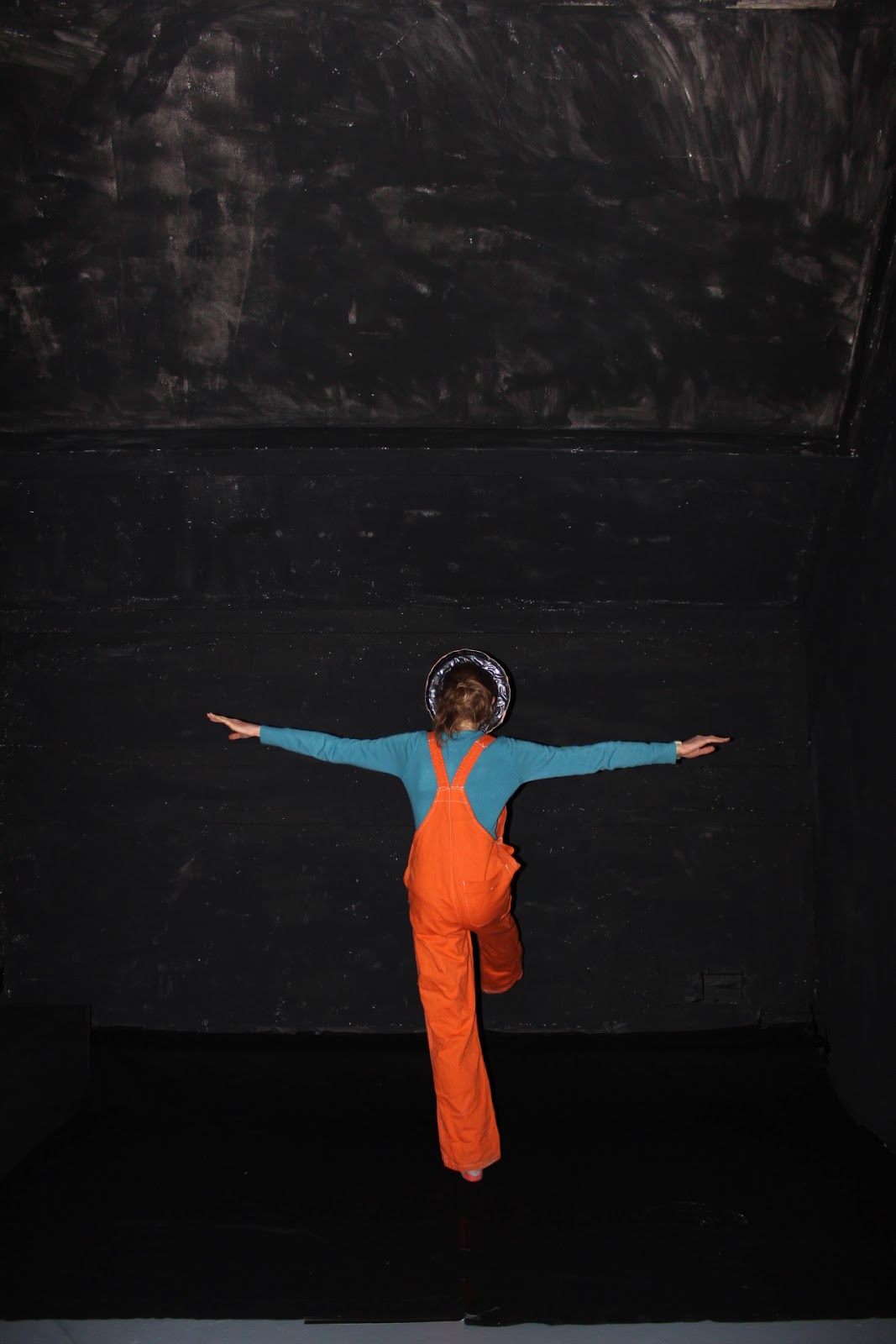
My next trial was recording me spinning in front of a black background and floor. The colour black cannot be projected, and so in theory, when I project the footage of the figure spinning against a black background, it should seem like the figure is spinning against a transparent background (and hence it would look like the figure was in the space where it is being viewed).


It is surprising how much black fabric is needed in order for the whole of the figure to remain in front of the black for the duration of the spinning. I used 2 different types of black fabric and found that one was too reflective but the other worked well as it was matt black.

I then tried setting up in a room with black walls, and covered the floor with the matt black material. This was successful, but the black walls were not quite black enough to produce the effect that I need.

I also tried wearing a different outfit. Rather than wearing black clothing which could appear rather dull and serious, I wore my orange dungarees and a teal blue jumper as well as the orange funnel I made for a previous performance. I wanted to try to avoid the video being read as a comment on body image and the female figure, and changing my outfit helped with this. The bright colours and sculptural cone also added to the aesthetic of the work. Wearing the funnel on my head is extremely disorientating because my sight is restricted. This makes it even harder to maintain my balance when I am spinning, and I think this is apparent in the footage. I like that the footage references a certain type of struggle, but does so with a sense of lightheartedness.

I am now going to source some more matt black material and cover the wall and floor in this. I will then record me spinning and will wear the orange cone and outfit.

Tuesday, 5 January 2016

Bill Viola at Yorkshire Sculpture Park

Simply put, the Bill Viola exhibition at Yorkshire Sculpture Park is exquisite. 

The underground gallery has been transformed into a series of dimly lit spaces in which the eight different videos are housed. The atmosphere is solemn, and there is a sense of calmness. One cannot help adopting a slower pace. Although many of the video works have individual soundtracks, they are similar, meaning that they tend to blur into each other as one travels on a journey through the gallery.

"Considering universal themes of life, death, love and spirituality, Viola gives tangible visual form to abstract psychological and metaphysical experiences. He explores facets of the human condition and holds a stark and intimate mirror to our strength, fragility, and the impulses and inevitabilities that unite us. The eight works installed in the Underground Gallery continue Viola’s investigations of the unseeable, the unknowable, and the place between birth and death."

The exhibition features new and old work, and is dominated by works involving water.


 "His new work, The Trial (2015), features a young woman and a young man, both bare-chested and on separate screens. Each are doused with a sudden and unexpected succession of different coloured liquids. Their ordeal intensifies then wanes as the cycle progresses and changes, from despair to fear to relief and then purification."


As with The Trial, other works have an element of duality, for example, The Innocents (2007) consists of one screen showing a figure moving away from the camera, and the other showing a figure moving towards the camera. As the figure walks into the cascade of water, the image turns from its grainy black and white state into high definition colour. Similarly, as the figure moves out of the water, the image quality reverses. 


It is hard not to be impressed with the immensely clear and rich footage within all of the works. Man Searching for Immortality / Woman Searching for Eternity (2013) is a life-sized video diptych of the naked elderly man and woman projected onto two separate slabs of black granite that are leant against the wall of the gallery. This is video as sculpture. The detail is immaculate, with every wrinkle visible. Viola deals with the content with honesty, and in no way do the performers seem unnatural or staged. 

It is rare that I visit an exhibition consisting purely of video installations, yet alone that I am captivated by each and every one of them enough to watch each for its full duration. Bill Viola's exhibition at Yorkshire Sculpture Park is the exception to the rule, and I enjoyed every minute of it.


Friday, 24 April 2015

Waiting for Los Angeles - A video installation by Uta Kögelsberger - Ex-libris Gallery - University of Newcastle

Ex-libris Gallery
Fine Art
University of Newcastle
The Quadrangle NE1 7RU


Waiting for Los Angeles is a new video installation by Uta Kögelsberger. The project grew out of the artist’s fascination with Los Angeles as the quintessential post–modern city; a city that defines itself through its tendency to ignore any form of coherence, its idiosyncratic city-image, its horizontal structure and its cultural diversity; all of which make up its attraction as much as they make any form of representation an impossibility. In spite of this resistance to representation, people all over the world have a mental image of Los Angeles.
The work is shot on a seemingly non descript natural platform located in Griffith Park – one of the few truly democratic public spaces in the city that attracts people from all walks of life. Griffith Park was donated to Los Angeles with the proviso that it was to remain untouched, uncultivated, and open to the public. Shot over a two year period, and edited down from 360 hours of footage, Kögelsberger’s video builds on the premise that if you stand in one spot in the park long enough, you no longer need to move through Los Angeles to see it; instead Los Angeles will move past you. The platform acts as a stage for the city to perform itself. People enter and exit like performers in a play with non-scripted conversations and actions: a 21stcentury Waiting for Godot in Los Angeles, where nothing is really said but where all the little nothings add up to paint a portrait of this city that leaves so much up to the imagination.
Uta Kögelsberger is based in London and lectures at the University of Newcastle and most of her work is developed in the United States. She has previously been awarded the Stanley Picker Fellowship, the Berwick Gymnasium Fellowship, the EAA Award for Art in Architecture and the SPD silver medal for editorial photography. Her photo essays have been published in Wired (USA, UK, Italy), Esquire (Spain), Quo Magazine (Mexico), GQ (South Africa) and selected for American Photography. Her work has been exhibited at the Architectural Association, London; CGP, London, the Barbican, London; Bluecoat, Liverpool; Spacex, Exeter; Laurence Miller Gallery, NYC and the Glassell Project Space MFAH, Houston amongst others.