Showing posts with label newspaper article. Show all posts

Tuesday, 17 July 2018

Why we should learn to embrace failure by Elizabeth Day in The Guardian

As an artist, one has to be able to cope with criticism and let-downs. After spending hours/days/weeks/months working on a proposal for an exhibition or toiling over accurate estimates of income and expenditure for a funding application, one has to be prepared for that devastating email or phonecall offering commiserations on the unsuccessful submission. It was only last week that I was in this position, and couldn't help but feel like a failure. As often as it happens, it never gets any easier to deal with. That's why it is useful to be reminded that there is no such thing as a failure. 


The following article was published in The Guardian on Sunday 15 July 2018

Divorce, miscarriage, career knock-backs – the big moments in life often come through crisis and make us who we are, so don’t airbrush them out, says Elizabeth Day

A few months ago, I spent an evening sitting on the sofa in my flat, cropping my head out of a series of wedding photographs. It was a fairly surreal experience excising my smiling face from the pictures taken outside the chapel. It was not something I had ever anticipated, because you don’t think about divorce when you’re walking down the aisle. You don’t imagine it will happen to you. You don’t believe that one day, you will be digitally altering your wedding photographs so that you can sell your mermaid-style gown and long-sleeved lace bolero to a stranger on eBay.

And yet this is where I found myself. The dress had been hanging in my wardrobe for three years since the end of my marriage. It had been pressed up against the winter coats, shrouded in its dry-clean carrier, and although I tried to forget about it, I never could. The dress took up residence like an unwanted tenant, a constant reminder of my failure.

As I posted details of the dress online, I began to think about failure and its shadow-twin, success. If I listed the achievements of my life, on paper, without emotion, I would have to concede that on some level I am doing OK. I have published four novels. I make a decent living as a journalist. I have a good degree, a wide friendship group and I pay my rent promptly each month.

I am, I suppose, objectively successful. But it doesn’t always feel that way. I still hadn’t grown out of the habit of walking into bookshops and rearranging my novels so they were on the top of the display table piles. Surely no truly successful author does that.

The more I thought about it, the more I realised that the biggest, most transformative moments of my life came through crisis or failure. They came when I least expected them, when I felt ill-equipped to deal with the fallout. And yet each time, I had survived.

Into this category I put the fact that I had got married at the age of 33, but divorced three years later. I had tried to have children, but failed despite two rounds of IVF and a natural pregnancy that ended in miscarriage at three months. I had been in and out of relationships that never seemed to last.

Professionally, too, there had been some knocks. I had written a heartfelt second novel about war and its impact, loosely based on the death of a former boyfriend in Iraq. It had been an important book to me, but when it was published it barely seemed to register. The few people who read it were kind and I got used to deflecting my wider sense of rejection with humour: “It’s a beach read,” I told tiny literary festival audiences, “if the beach is Dunkirk.”

I called that book Home Fires. When Kamila Shamsie won the Women’s prize this year for her critically acclaimed novel, Home Fire, it was hilariously ironic: in my head, the success of her work highlighted the failure of my own. But the truth was, I grew from the experience. Afterwards, I put what I’d learned about writing into two more books. The latest, The Party, became a bestseller. Was it, I wondered, that I had unwittingly become successful as a by-product of failure? Had I, to paraphrase the words of the late American playwright Edward Albee, succeeded interestingly precisely because I’d failed interestingly first?

It was a topic that interested me enough to start asking other people the same questions. In my day job as a journalist, I’m in the privileged position of interviewing a lot of celebrities whose fame is a distinctive marker of a certain type of success. Yet they all had their own tales about life going awry. The actress Natalie Dormer, 36, recently told me that her 20s had been a decade of “self-doubt and anxiety”. She said she was relieved to reach her 30s because “You’ve fucked up. When you’ve fucked up a number of times, hopefully the idea is you don’t fuck up as badly the next time when you’re presented with the same or a similar situation. I’m strong because I’ve been weak, I’m wise because I’ve been stupid.”

This seemed to me to be at the root of it: how one becomes strong because of weakness; how one is more likely to succeed if one has learned from failure. In recent years, the notion of “failing well” has gained considerable currency. Books such as Adapt: Why Success Always Starts with Failure by Tim Harford and The Art of Failing by Anthony McGowan (which describes itself as “a chronicle of one man’s daily failures and disappointments”) have added grist to the notion that failure can be distilled into something more positive if the right alchemy is applied. Harford argues that improvising rather than planning is the way to tackle everything from terrorism, climate change, poverty and innovation to the financial crisis, and that trial and error is the best way of achieving long-term solutions to complex problems. “No plan survives first contact with the enemy,” he writes. “What matters is how quickly the leader is able to adapt.”
Advertisement

It was an idea worth exploring. So I began a podcast series called How to Fail. The idea was for me to do eight one-to-one interviews over eight weeks with highly successful people about what failure had taught them.

The rise of social media means we now live in an age of positive curation, where Instagram feeds and Pinterest mood boards are designed to give the most glowing impression of our lives. In this context, failure doesn’t get much airplay. But, I thought, wouldn’t it be refreshing if we stripped back the carefully crafted layers of our supposedly perfect selves, and revealed ourselves to be vulnerable?

To my delight, people seemed to warm to the concept. Soon, I had a wonderful roster of participants, plucked from friends and contacts, including the actor and writer Phoebe Waller-Bridge, the novelist Sebastian Faulks, the political activist Gina Miller and the writers Olivia Laing, David Nicholls, Dolly Alderton and Sathnam Sanghera.

Before each recording, I asked my interviewees to come up with three examples in their life when they felt they had failed and that they were willing to talk about. The failures cited ranged from humorous accounts of flunked exams to the big, life-altering crises of divorce and serious illness.

It was fascinating to see how men and women had different attitudes. Many of the men I approached balked at the idea they had failed at anything. They cited lost tennis matches, unrisen soufflés and the inability to play a musical instrument. The women routinely responded that they would have trouble whittling down their myriad failures to just three instances.

“There are so many to choose from!” said Olivia Laing. “Women are so socialised to be self-deprecating, to not claim their successes… I think it’s much easier for women to say, ‘I didn’t do well at this,’ than to say, ‘I did marvellously at it.’ Which is a bit depressing really, isn’t it?”

It is. But I was touched by how openly the women I interviewed were willing to delve into their failures. Gina Miller, the woman who took on the government over Brexit and won, wanted to talk not about that victory but about surviving an abusive marriage, raising a daughter with special needs and failing to graduate from a law degree.

Coping with these twists in life, said Miller, “taught me that you mustn’t make such a rigid plan for your life that when it doesn’t work out, you’re so sad and you then just live feeling this sense of disappointment, because that ruins the rest of your life. You have to let go. It’s like a mourning. You have to grieve and put it aside and bury it and then move on, and that’s what I learned to do.”

The consequence of all of this was that she was forced to be honest about her own mistakes and weaknesses and, by confronting them, she built up the emotional resilience necessary to tackle the next challenge. Success, she explained, was not about getting things right the first time, but stemmed from being able to look at one’s past honestly and then to correct missteps or errors of judgment. That, in turn, gave her more confidence to make brave choices. “In life we’re all going to fail,” she said. “So you might as well have a strategy for how you deal with failure, and then once you’ve got that in your back pocket, you can go out in life and really take risks.”

Laing admitted that she saw the whole of her 20s as a failure – she struggled to find her way, trying out several versions of herself, as a road protester, a medical herbalist, a cleaner and the deputy literary editor of this newspaper before she left and stepped into an unknown future. Not knowing what else to do, she funnelled her distress into the proposal for a book about Virginia Woolf, weaving in elements from her own life.

That book became To the River, which was shortlisted for the Ondaatje prize, and Laing has since gone on to become one of our foremost writers and cultural commentators, who often uses her own experiences of alienation and loneliness as a means to get to some essential, connecting truth. Her failures have, in this way, become her art.

Sebastian Faulks, the author of 16 books including the international bestseller Birdsong, at first felt he wouldn’t have much to contribute to the podcast. His attitude towards failure was that it was a matter of how one perceived it, and he felt his life thus far had been blessed rather than cursed. He gave me three, deliberately playful examples of failure including “once getting out [at cricket] when I had made 98 and chipped a return catch to the bowler” and the occasion on which he came second in a prestigious Italian literary prize. It was awarded, instead, to the brother-in-law of the chairman of the judges.

“Is that a failure?” he mused. “I mean, I wouldn’t have thought so, I thought it was rather a success to be going to Milan to be celebrated in a country not your own for a book with no Italian connection.”

But Faulks had also experienced periods of depression in his life, most notably at university where he “struggled to adapt… I was extremely confused and very fragile and it took quite a lot of time to get over that. I wouldn’t say I have got over it really.”

Many of my interviewees’ failures stemmed from doomed romantic relationships, but they often credited those experiences with providing stimulation for creativity. Phoebe Waller-Bridge, who won a Bafta for writing and starring in the feminist sitcom Fleabag, found a certain “glory in failure [because] fighting so hard to be so in love with someone with all that passion in your 20s and teens and then throwing everything at it and it’s not working, or there being so much pain – that is the stuff that so much creativity comes out of. So it’s out of those painful break-ups or miscommunications – or just horrible sticky one-night stands – that you grow in those moments, and so I value them all.”

With so much of my time being spent asking other people about their failures, it was only natural that my thoughts would wander to my own.

If I had to list my three major failures, right up at the top would be the failure of my marriage. Part of the reason my marriage ended (and this will only ever be a subjective assessment) was that I think I tried too hard to please. I forgot, in the rush to appear flawless and irreproachable, that it was far more important to be real than perfect. Like many women I know, I spent my 20s desperately wanting to be loved in order to shore up a shaky sense of self. If I placed no demands on my spouse, the internal reasoning went, if I did everything right, then there would be no excuse not to love me.

It’s terrible logic and, inevitably, it fell apart. The divorce catapulted me into a different sort of life from the one I had imagined. Here I was, in my late 30s, single, without children, and navigating uncharted waters. Despite never having thought of myself as a particularly unconventional person, it struck me I was living an unconventional life. My failure to have children at the time when all my contemporaries were having babies and moving closer to good schools made me reassess what I could get from the life I already had. If motherhood wasn’t going to be part of the future I had always imagined for myself, where else would I find fulfilment?

Life crises have a way of doing that: they strip you of your old certainties and throw you into chaos. The only way to survive is to surrender to the process. When you emerge, blinking into the light, you have to rebuild what you thought you knew about yourself.

It dawned on me that I had my work. I was lucky in the sense that being a writer means you never feel fully alone – you always have the company of the characters you create. I also had my friends and family, from whom I get a great deal of love and compassion. And, actually, if I looked at the failure in a different way, it could also double up as an opportunity: I was free of responsibility. I was no longer living my life in a misguided attempt to please other people. So I could live in a more agile, flexible way. If I wanted to move to Los Angeles for three months and live in an Airbnb, then I could (and did).

I think what I’ve learned from failure is that things not turning out the way you’d planned gives your time on this earth a lot more texture and meaning. I’m now oddly grateful for all the losses – the miscarriage, the divorce, the subsequent break-up of another relationship – because without them I wouldn’t be who I am or where I am, and I wouldn’t have seen the richness in a different kind of life.

Besides, no failure is all-consuming. A nice woman in Shropshire bought my wedding dress on eBay and I put the money into funding the first couple of episodes of the podcast. As I folded the dress into a box, wrapping it carefully in layers of tissue paper, I thought to myself that this wasn’t a failure at all. It was a part of my life. I had learned from it. And now I was letting it go.


https://www.theguardian.com/lifeandstyle/2018/jul/15/divorce-miscarriage-jobs-learn-to-embrace-failure-elizabeth-day

Saturday, 25 March 2017

Storytelling: how reading aloud is back in fashion

Following my blog post yesterday about Jenny Richard's lecture, 'Voices and books: a new history of reading', I came across this article in The Observer, published in 2013.

https://www.theguardian.com/books/2013/jan/06/storytelling-back-in-fashion

At a weekly book club, Elizabeth Day has found that even in an age of social networking, the direct, oral tradition can still reach out to a new audience


"The last time someone told Thomas Yeomans a story, he was a child. Last week he wandered into a storytelling session for adults without quite knowing what lay in store. "For me, reading has become more formal over the years; it's something I do on my own," explained Yeomans, a 26-year-old artist. "So I swept into this at the last minute, not knowing what to expect."

Yeomans happened to find himself in one of the weekly storytelling sessions that I have been running over the past month in an art gallery in central London. When I developed the idea with gallerist Simon Oldfield, the premise was simple: we both felt that the tradition of reading aloud and sharing stories with each other was something that had been lost in modern times. In an era of social networking and electronic gadgetry, when friendships are conducted via computer screen and culture is increasingly savoured in isolation through a pair of noise-reducing headphones, we have neglected the pleasures of direct experience.

Many of us used to be told stories as children. But as we grow older, we seem to lose the knack. Yet there is undoubtedly an appetite for it: revenue from downloaded audiobooks has risen by 32.7% since last year, while The Reader Organisation, a charity that aims to engage people through the shared reading of great literature, now has 350 weekly shared reading groups across the country.

"What happens with shared reading is that people experience a very intense thing together, but everybody has their own personal, private, inner response to it," says Jane Davis, founder of The Reader Organisation. "A lot of people don't understand how poor literacy is in our country. For many, reading aloud gives you access to things you would simply never read otherwise."

Like Davis, it struck me that, while there had been a welcome resurgence of book groups and literary festivals over the past decade, there was little chance for adults to engage in group reading without some sort of self-improving literary discussion at the end of it, or a nagging sense that one should really be buying the author's newest work as part of an unspoken commercial transaction. Which is how I came to be reading Anne Enright's short story, Here's To Love, in the week before Christmas when Yeomans wandered through the door. "What I liked about it was that this was an informal setting and a gentle, welcoming environment where my defences were down," Yeomans said after the session. "It really pulled at my heart strings. I felt like a defenceless child again."

Helen Ervin, a 38-year-old marketing executive from New York, agreed: "There's an intimacy that happens when you get a whole bunch of people together… There was a moment in today's story where I thought I might cry. There's an emotion brought to the surface when you're reading aloud because it's being performed."

Another attendee said he had come because "the idea of reading is hard work to me. I'm dyslexic, so I prefer to listen to radio plays and things like that. I was completely sucked in today. It was really engaging."

For Doris Julian, 70, the experience "took me right back to being a child and being read to in the library. I like to listen to le Carré audiobooks and things like that, but there's nothing better than the real version. It's very descriptive and I love it. I can't think of a nicer way to spend an afternoon."

By this time I'd been running the storytelling sessions for a month and had been bowled over by the response. More and more people came in each week to listen to short stories by authors as diverse as Dorothy Whipple and Jon McGregor in a room hung with striking works of contemporary art. Local businesses were keen to get involved: Majestic gave us free wine to serve and a rug company, Bazaar Velvet, loaned us a beautiful Anatolian carpet for everyone to sit on, engendering a real community feel and invoking the true childhood spirit of Jackanory.

A handful of regulars came to every session. It seemed to tap into something – a kind of long-forgotten tradition that we still felt in our bones. Reading aloud has a noble history. Before the invention of the movable-type printing press in the 1430s, oral storytelling was a means of cementing community bonds and passing folk narratives on to the next generation. In medieval times, storytellers were honoured members of royal courts. From 1500 storytelling continued to be popular in an era of widespread illiteracy, when books were still too expensive for the common man.

"Often a neighbour would have a Bible and would read aloud from it," says Jennifer Richards, a professor of early modern literature and culture at Newcastle University. "Or there would be rhetorical training for boys at grammar school, [but] the appeal of reading aloud is not about education; it's about being social, part of a community."

In the 18th and 19th centuries, reading aloud continued to be a form of entertainment. "People didn't have recorded music or films or television, so books had to be everything; they needed to be dramatic, entertaining, comic and sentimental," explains Dr Abigail Williams, a lecturer in English at Oxford University. "One of the things about reading aloud is that you have to do it in small bits. You can't just do it for hours on end, so that brings out qualities in the text you might otherwise miss. People become the characters in a way they don't if you are reading flatly for yourself. You get more of the comedy and the dialogue works differently because it becomes the spoken voice, rather than a transcription of the spoken voice."

But none of this can entirely convey the intensity and intimacy of the experience. I was surprised by how many people who came to the storytelling sessions were visibly moved by the experience – I would glance up from the text and see someone's eyes gleaming, on the brink of tears. Others would look away, lost in their own private universe. One man came up to me afterwards and admitted that he thought a character in one of the stories was suffering from post-traumatic stress disorder – a condition that he too had been diagnosed with.

It is a sensation familiar to Davis, who runs reading groups for a cross-section of society – from young doctors without the time to read, to prisoners or groups of pensioners in economically deprived areas. "These little private bombs go off in your head, something strikes a chord [because] with the shared reading experience you are not an observer or discusser; you're going through the experience with everyone else," she says.

"There are a lot of people out there whose connection to the world is through TV and things like I'm A Celebrity. Lots of people don't have a chance to have a serious, intellectual, meaningful experience, and that's what humans are for. We need that… A book provides a wonderful anonymity for personal feelings and responses."

The Reader Organisation has case studies on its website that pay testament to the power of shared reading. A woman in her 60s from Birkenhead is quoted as saying: "For many years I have had a lot of pain in my body, but when I am in the group the reading and sharing of stories helps me to focus my mind away from the physical pain and forget about it for a couple of hours... It kind of lifts you out of the pain."

A survey by the same charity of 214 people who had attended storytelling groups found that 96% enjoyed meeting people they wouldn't normally meet, while 80% left feeling "more positive" about life.

I can't speak for all those who came to our sessions, but I certainly left feeling more positive about lots of things – about the power of literature to engage, the special kind of intimacy gained from a communal experience and the ability to communicate with so many different people without any kind of ulterior motive.

We weren't trying to sell anything. We weren't pretending to improve anyone's mind. All we wanted to do was to share a story. And in the end, it was not just about reading out loud, but also about reading ourselves."

Friday, 8 January 2016

Super slides are the slippery slope into art's babyish new era

Some evidence that my dissertation topic is timely 

From London’s looping Orbit slide to a giant Czech mountain ride, art is becoming a theme park for the selfie generation 

Jonathan Jones, The Guardian
Tuesday 5th January 2016


"I went sliding on a mountain in the holidays. In mud. My family and I set out for a gentle Christmas walk in Wales that became an unplanned mudbath after we climbed a rocky riverbed in search of fossils and ended up stranded and soaking on a steep mountainside. We were trying to pull ourselves up by tree trunks but kept sliding down again and again as the sun started to set.


A new attraction in the Czech Republic offers a similar experience – but one that is planned and safely designed and won’t leave you covered in mud. The Dolní Morava Skywalk on the Králický Sněžník mountain includes a giant slide that’s clearly inspired by the artist Carsten Höller. Not only can you see spectacular vistas of the surrounding peaks while making your way nervously along a glass-bottomed skywalk, but you can slide in the sky. 

It’s a big year for art slides, it seems. Höller himself is wrapping a giant slide around the spiralling Orbit tower in east London. He was invited to do so by its co-creator Anish Kapoor. Doubtless it is hoped that an exciting art slide will help increase visitor numbers at the attraction, where it has been claimed low ticket sales led to losses of £520,000 in 2015.

If in doubt, install an art slide. From the Czech mountains to Stratford, slides are now defined as both fun and cultural. Art is turning into play, and play now seen as a noble cultural goal for adults as well as children.

But the rise of the art slide (last summer also saw Höller’s creations turn the South Bank into a funfair) shows how some of our deepest cultural values are changing. High art has always been an introspective affair, from looking silently at paintings in a museum to sitting quietly to listen to a symphony. It is about contemplation and absorption. Two people can read the same book and talk about it afterwards, but the act of reading will still be a solitary experience.

Today, we seem to fear such solitude. Art slides are typical of the age of oversharing. It’s not enough to look quietly at art. We need to slide on it, climb over it or talk to it, then share selfies of the experience with as many online friends as possible. The privacy or shared tranquility of artistic contemplation is being trashed by an age that can’t stand being alone. 


Going into nature for real, or sitting in the Rothko room at Tate Modern, are the kinds of cultural adventures that take us to new planes and new places. They can be shared, but mustn’t be overshared. When all our most intense experiences are reduced to art slides and skywalk selfies, I’d rather be lost in the woods."

Read the full article here

Friday, 3 April 2015

Mersey ferry gets the dazzle treatment from Sir Peter Blake

As part of commemorations for the first world war, the noted British artist has repainted a passenger boat in homage to anti-submarine ‘dazzle camouflage’

http://www.theguardian.com/uk-news/2015/apr/02/mersey-ferry-peter-blake-dazzle-treatment-first-world-war

Mark Brown Arts correspondent

Thursday 2 April 2015

The Guardian


Seven ship painters spent 10 days covering a Mersey ferry in the reds, oranges, blues, yellows, pinks, greens, blacks and whites carefully specified by Sir Peter Blake and the one obvious thing now is that no one’s going to miss it.

“It is a crazy concept,” said Blake on board the ship he has now “dazzled” with wild colours and patterns. “They’ve done it so beautifully and it looks fantastic. It is very exciting to see it.”

The Mersey ferry Snowdrop has become the third vessel to be painted in this way in homage to the artists 100 years ago who painted British ships in “dazzle camouflage” to mislead German U-boat captains.

The organisation 14-18 Now, responsible for five years of art commissions marking the first world war centenary, estimate that 8 million people haveseen two contemporary dazzle ships that were unveiled last year on the Thames in London and on Liverpool waterfront. The Snowdrop is now the only one that will actually go anywhere.
Blake was chosen in part because of his long association with Liverpool, one that extends beyond his design for the Beatles album Sergeant Pepper’s Lonely Hearts Club band in 1967.

On Thursday Blake recalled his first visits to Liverpool 63 years ago when he was stationed in Belfast for his national service. “I used to get the ferry from Liverpool. It was an old cattle ship and one had recently sunk so people were nervous, obviously.

“I remember coming back from Belfast on a New Year’s Eve and it was really rough – it was full of Irish Guards, all very drunk, and lots of nuns terrified of the soldiers.”
In 1961 Blake won the prestigious Liverpool-based John Moores Painting Prize – “junior section”, he stressed – ahead of artists including David Hockney and Lucian Freud.
“I’m very proud of it,” he said. “I remember coming up on the train and having a party in my room at the Adelphi and meeting the Liverpool poets. It was pre-Beatles, they hadn’t broken yet, but there was a definite vibe in the city and great music going on.
“I do feel like an adopted son.”


The artwork, called Everybody Razzle Dazzle, is the biggest of Blake’s long career, but creating it was similar to doing a small watercolour, he said.

Working on a computer, he initially planned it all in monochrome but quickly realised it needed colour. “It has to be cheerful: it would have been dour in black and white really.
“I was slightly nervous that there might be some diehards who’d think I’d messed it up, they preferred the old livery. But I was very respectful of it: I checked things like whether I was okay to change the funnel.”

The plan is for the Snowdrop to have its Blake livery for two years. It set off for its first newly dazzled journey on Thursday with Bill Haley and the Comets’ Razzle Dazzle playing on a loop.

Not far away from its setting-off point is is a static vessel, the Edmund Gardner, dazzled by the the Venezuelan artist Carlos Cruz-Diez last year.

Liverpool’s mayor, Joe Anderson, said the city was proud to have great things in pairs: two great cathedrals, two great football teams. “We’ve got two ferries and I hope the other one will be painted as well ... I was told not to say that.”

The dazzle ship project shines light on a story largely forgotten today. During the first world war, professional artists would paint wild patterns on British ships to confuse the enemy. The idea was that U-boat captains would spot the ship but have no idea of what class it was, or if it was coming or going.

It was, Blake said, the invention of optical art and he had a great time following in the original dazzle artists’ footsteps.

Blake praised the painters at the Cammell Laird shipyard in Birkenhead who had done the hard work. “We came up about a month ago when they were still working on it. To see it today when it’s all beautifully cleaned and polished is terrific.”

Arthur Hardacre, who led the team of painters, said it had been a bit like a very big paint-by- numbers exercise. “It was no big problem really, it’s all paint.”

The result is magnificent though. “It is absolutely fantastic and it’s great that visitors to the Mersey will see such a colourful ship.”


The project was commissioned by the Liverpool Biennial, 14-18 Now and Tate Liverpool. 

Friday, 30 January 2015

Ball pool for adults opens in London

Because being an adult is rubbish and all anyone really wants to do is thrash around in a soft play area, a bunch of heroes have opened a pop-up ball pit in Hammersmith.

The pit is free to visit and contains 81,000 balls, which can entertain up to 30 people at one time.

It is the brainchild of creative agency Pearlfisher, who will donate £1 to the charity Right to Play for every person that visits.


They've shunned the traditional multi-coloured balls, instead going for a nice calming, utopian white.

The installation follows a similar one from Turner prize-winning artist Martin Creed last year, who filled a room with white balloons.

Friday, 19 December 2014

Nick Forbes: we were whistleblowers for what austerity meant for the arts

Nick Forbes: we were whistleblowers for what austerity meant for the arts 

After the Newcastle upon Tyne council leader dealt with cuts, the city’s theatre companies have been forced to adapt or die


“We live in an age of cuts … We are a working-class town, that’s our strength – and in the current climate, our weakness.” So said the deputy leader of the council as he addressed the press conference. His task is to decide how and where to save £64m: Sure Start, the museum, libraries, disabled care, street lighting ...

This is not a scene from real life but from Hope, Jack Thorne’s close-to-the-bone play about local-authority cuts, which recently opened at the Royal Court in London. But Nick Forbes, the leader of Newcastle upon Tyne council, sounded uncannily like the drama’s main character when we met in his grand, 1960s panelled office in the city’s Civic Centre – its bold modernist architecture a remnant of a more confident age, before cuts of 44% from central government sent a chilly blast through its elegant courtyards.

“We’ve cut our play service and youth service,” Forbes said. “We have had to reduce the libraries. We have cut sport and leisure. We have reduced support for older people; we’ve cut bin collections; we’ve cut street cleaning. We have lost our flower programme in the city. We’ve cut graffiti removal. We’ve lost getting on for 1,200 cuts from the council.” Newcastle lopped £37m from its spending in 2013-14, £38m this year, and more is to come.

It also cut its cultural budget. In the autumn of 2012, the council published a draft three-year – instead of the usual one-year – budget, which projected a cut to funding for arts organisations of 100% from 2015.
Tommy Knight (Jake) and Tom Georgeson (George) in Hope by Jack Thorne. Photograph: Tristram Kenton/Tristram Kenton

Arts leaders in the rest of the country looked on anxiously: would other Labour councils “do a Newcastle” and declare culture an unaffordable luxury?

Cuts to local-authority grants felt like a last straw, for they came on top of a 30% reduction in Arts Council England’s budget, delivered in the 2010 comprehensive spending review by the then culture secretary Jeremy Hunt. The keynote of the coalition’s cultural policy has been this: austerity measures, combined with injunctions by Hunt (and his successors Maria Miller and Sajid Javid) for the arts to find more financial support through philanthropy.

Among those affected by Newcastle’s draft budget were Northern Stage, Tyneside Cinema and Live Theatre, where Lee Hall, the writer of Billy Elliot and The Pitmen Painters, learned his craft as a youngster. They were furious. Culture was being disproportionately targeted, they felt. Furthermore, a total cut could have meant Arts Council England pulling out of Newcastle, since its policy is that it will not act as a sole public funder in any area – a move that would have led to the collapse of most of the city’s main cultural organisations. A vocal campaign from the north-east’s artistic diaspora – Lee Hall, Neil Tennant, Sting and Pat Barker among them – swung into action with open letters and attacks on the council’s stance.

Two years on and the council has indeed removed culture from its budget, effective from April 2015. But, after an intervention from the shadow culture secretary, Harriet Harman, it found about £600,000 a year (skimmed off from interest on loans and dividends from Newcastle airport) to put into a new charitable Culture Investment Fund, to which arts organisations in the city can apply for grants. It is only 50% of the old budget, but better than what Alison Clark-Jenkins of Arts Council England has called “the symbolically and practically disastrous 100% proposal”, which would have meant “the closure of some of the best-known institutions in the country”. The new fund also aims to raise money from donations from individuals – following the thrust of Conservative cultural policy, which encourages arts organisations to aggressively pursue philanthropic donations.

Unusually for a Labour politician, Forbes is comfortable talking about his cultural hinterland; he told me how much he was looking forward to performing a baritone solo in a concert with a local choir (“singing keeps me sane”). But despite his personal attachment to the arts, when we met two years on he said he had no regrets about the row. “We were the whistleblowers for what the government’s austerity programme means for a range of services, but particularly arts and culture ... As often happens with whistleblowers, people didn’t believe us, didn’t believe the scale of the cuts. We faced abuse and criticism. [But] I still think it was the right thing to do.”
Maria Crocker (L) and Meghan Doyle from the Letter Room theatre company at Northern Stage.Photograph: Craig Connor/NNP/North News & Pictures Ltd

On the ground, it has been a case of adapt or die. Lorne Campbell is the artistic director of Northern Stage. One of his means of diversifying has been by harnessing the notion that “creativity” is itself a commodity. Over a pre-rehearsal coffee, he told me he hires himself out to lead workshops on creative management for business executives, raising about £50,000 a year, or around half a production budget. He would like to see the new Culture Investment Fund work – but pointed out gently, as did others, that his organisation has been energetically fundraising for years now.

He believed, he said, that a fundamental part of his job was providing a conducive environment for artists who want to make work in the north-east – their presence in turn enriching Newcastle’s civic life. But, he said: “That ecosystem is in danger of collapse. We are not many salami slices away from having to make a dramatic change to what we do.” What would that change consist of? He shrugged. “Producing a Christmas show every year cast with people who aren’t from here, and acting as a receiving house for productions from elsewhere the rest of the year. An utterly pointless exercise.”

Northern Stage provides, at present at least, support for young theatre companies. One such, Camisado Club, is made up of eight young performer-writers, all fairly fresh out of college, all “hellbent on staying in the north-east and making work”, according to company member Caroline Liversidge.

For these 20-something artists, the notion of a well-funded arts environment is, said Liversidge, “a myth – like: ‘In days of yore there was funding.’ ” She works five zero-hours-contract jobs to make ends meet, and fits her artistic work around them. Camisado Club’s first show, Send More Paper, about murderous wives in Hungary after the first world war, was a success, and had a short tour, including to London, but making it work was a struggle – they crowdfunded to get themselves to London, called in favours, sought support from friends and family. Getting the eight company members in a room together – when they are all working shifts to pay the rent – is an achievement in itself. Fellow company member Jamie Tansley said: “We are looking at ways we can sustain ourselves by charging for education projects. You not only have to make it work but become a business, and that’s a little scary. But we will find a way, because we have the hustle.”

Jim Beirne of Live Theatre. Photograph: Mark Pinder/Mark Pinder

Meghan Doyle and Maria Crocker are part of another young theatre company, the Letter Room, which has performed at Latitude, Bestival and the Edinburgh fringe. According to Doyle: “We made our last show on no budget and no sleep.” All accomplished musicians, they perform as a band to make money to support their main work. “It is hard,” she added, “devising, producing, making the website, performing, working our other jobs.” They are a determined pair, committed to staying in the north-east – where the flipside of the lack of funding is cheap rent and a feeling of shared artistic enterprise with their peers. “It feels like something is brewing in Newcastle,” said Crocker. But, said Doyle: “We can’t continue making work for no money. There is a point where you have to say, you’ve got to live.”

A spirit of enterprise is also at work at Live Theatre. When I visited in early 2013, I saw how the work of the 150-seat theatre was supported by a gastropub, the Broad Chare, and rental income from a set of offices converted from a schoolhouse. Its chief executive, Jim Beirne, had used his own “hustle” to make money. The Broad Chare makes Live £100,000 a year, enough for an entire production budget. The schoolhouse makes £35,000, enough for an education project.

Since then, Beirne has masterminded the purchase of more buildings clustered around the theatre, including a vacant plot that faces the Tyne. With the help of European funds and loans from the council, he is now running a £10m project that includes building a new office block to rent, creating an outdoor stage and park, and converting an almshouse into a children’s literary centre. The piling for the new offices is complete; the steel framework is due to rise in January and the structure should be built by September. “The point is to create an asset on our balance sheet that provides an income to spend on our mission,” said Beirne. Initially, the yield is expected to be £150,000-£200,000 per annum.

I asked Beirne what his background was – expecting him to tell me of an MBA or a career in business. He laughed. “I trained as a lute player and composer,” he said. Was Live in danger, I wondered, of being buffeted by competing values? Would its business concerns conflict with its artistic ambitions? Would Live become, to misquote an unfortunate advertising slogan adopted by the V&A in the 1980s, “an ace gastropub with quite a nice theatre attached”? He said: “It’s just a tool to deliver what we do. Of course we have to be robust about what we stand for and what our values are. If we didn’t do this, what the fuck else would we do?”

Thursday, 11 December 2014

Romanesco

There are certain shapes and forms that I instinctively find pleasing to the eye, romanesco being a good example of one of these. The following article gives an explanation of why this may be so.


I would like to work with this kind of form, or create forms that fit into each other. These would not necessarily be the identical, but could be of different sizes and proportions.


Wednesday, 12 November 2014

Loans for postgrad study is not the answer

Six Russell Group universities reject government loans for postgrad study

Think tank’s proposal for £10,000 state loan wouldn’t help students from less well-off backgrounds, UK universities argue

Dominic Smith

Guardian Professional, 
Monday 10 November 2014 

‘Undergraduate alumni have said that while they’d like to do a postgraduate course they don’t want to add to their debt burden.’

A consortium representing six of the country’s top universities has urged the government not to adopt a state-backed loan system as a solution to the social mobility crisis in postgraduate education.

A recent report from the Institute for Public Policy Research (IPPR) outlined a “workable and affordable” model where postgraduate students could borrow £10,000 to cover the cost of tuition. This would be paid back at 9% of earnings between £15,000-£21,000.

Chancellor George Osborne has said there will be an announcement on postgraduate funding in next month’s autumn statement. IPPR’s model – which is based on a 2011 proposal by Tim Leunig, who now works as an advisor to the Department for Education – is likely to be considered by the Treasury.

The numbers of those enrolled in UK taught master’s programmes has steadily declined from a peak of 160,000 in 2009-10 to the current level of 140,000 students a year.

Two thirds of those who say they are unlikely to take up postgraduate study cite expensive course fees as the reason, and admit more financial support may help change their mind.

But the chair of a consortium of six Russell Group universities, which was given £3m as part of a Higher Education Funding Council for England project to widen access to postgraduate education, has said a state loan system won’t help those from less well-off backgrounds.

Tony Strike, director of strategy, planning and change at the University of Sheffield said: “The majority of postgraduate students are in the fortunate position that they can and do pay, so the first problem with a state loan scheme is that it’s not very efficient – it would simply displace with taxpayers money the private investment that most postgraduate students are putting in.

“The second issue is that a third of our undergraduate alumni have said that while they’d like to do a postgraduate course they don’t want to add to their debt burden.”

The consortium consists of the universities of Sheffield, Leeds, Manchester, Newcastle, Warwick and York.

Strike said that the consortium’s research shows that students from less well-off backgrounds are more likely than average to say they wish to go onto postgraduate study, but are discouraged by debt.

Still, the loan system has won support from many university chiefs. Sir Steve Smith, vice-chancellor at the University of Exeter and member of IPPR’s commission on the future of higher education, said: “This proposal has the very real potential to help break down the financial barriers that a significant number of students face when pursuing postgraduate studies.

“It is imperative that all students, no matter what their background or circumstances, should have a clear and affordable route to postgraduate education. This recommendation would be affordable to government and, equally importantly, to the students themselves.”

The consortium, which consists of Russell Group universities – led by the University of Sheffield – says scholarships, which are joint-funded by government, institutions and employers, would be a better option. The group also offered the country’s largest-ever scholarship package to 430 students earlier this year.

“If the state was to offer universities funds that institutions would be expected to match to create targeted scholarships, that would have a much more beneficial effect on the widening participation group than offering them a further credit facility,” said Strike.

But Rick Muir, author of the IPPR report, said a mass scholarship programme would be unaffordable. His report claims the postgraduate loan non-repayment rate would be only 7%, much lower than the 40-45% of undergraduate loans which go unpaid.
He said: “I’m in favour of scholarships but there’s a limit to how many we could afford.

“We’re saying give anyone doing a master’s course a £10,000 loan – and the initial outlay is about £1bn. But the government can afford that because it can get 93% of the money back.”

He added: “If you say we’ll have £1bn that won’t be paid back, then that’s £1bn George Osborne will have to find from somewhere else. That is just not going to happen because there’s no money to do that.”

Wednesday, 1 October 2014

You can get a lot from looking at someone's book collection

As part of the London Art Book Fair, the Whitechapel asked the UK’s best artists to share their ‘shelfies’. They offer a fascinating insight into their work

Iwona Blazwick
Thursday, 25 September 2014
http://www.independent.co.uk/arts-entertainment/books/features/london-art-book-fair-some-of-britains-best-artists-share-their-shelfies-9754099.html?printService=print

Books have been important to artists as an artistic medium and rich source of inspiration for centuries.

You have only to look at examples such as the Book of Kells or William Blake’s illustrated book Songs of Innocence and Experience. Books deliver a microcosm of the artists’ work and through the writings of those who know and are passionate about art, we can better understand it. They are also beautiful objects.

Covers, margins, double page spreads, sequences of pages are all empty stages for artists to tell stories using images or texts. Pushing beyond merely reproducing their works of art, artists have taken every publishing convention – from science to literature – and turned it upside down. Books give artists a way of sharing their work with the widest possible audience. Unlike an exhibition, a book is for ever. And artists often create books as works of art in their own right – which is why they are a great investment that gains enormous value over time.

Shelf life: Selfies of some of the nations finest artists

Who better to showcase art books than artists themselves? London’s Whitechapel Gallery was inspired to reach out to the vast network of artists that we have exhibited, to get a glimpse into the books that prompt, provoke and enrich their practice.

Artists often turn to books, either as inspiration or as sources of research. The works on their shelves often contain the kernels of their artistic ideas. Artists also have a tendency to have very particular (and often peculiar) tastes and collections. A glimpse into these is always tantalizing.

The studio library is a private space – rather than invade it, we asked artists to do what everyone in the world is doing – take a selfie. The screen shots we received were like glowing miniatures. Ironically, we are taking pictures of something that is ardently pre-screen. It’s a strange combination of the instantaneity of the screen, and the slow time of the book. I think books – and art – ask their audience to slow down and spend time with them. This slowness is refreshing.

The Whitechapel Gallery established the London Art Book Fair in 2009 to both celebrate and incubate art book publishing. The concept was to present a snapshot of the wide scope of art book publishing; to represent every manifestation of the contemporary art book, from museum catalogues and coffee-table monographs on the one hand to artists’ books, scholarly publications, and ’zines on the other. It’s also a platform for amazing design and thrilling new ideas about our visual culture and what it means.

Art book publishing is not exempt from many of the challenges facing the publishing world today, but as an experimental and highly versatile art form, it is in some ways in a unique position to respond to these challenges. As such, it is today more relevant than ever. Many of these issues will be discussed in talks, performances, conferences and other events. As a former library and one of the UK’s primary centres for contemporary art, the Whitechapel Gallery is ideally placed to bring this community together and engage in these discussions.

It’s worth noting that we don’t choose books for the Fair, we choose publishers. Part of our interest is in creating a lively gathering that will bring together interesting people who are as captivated by publishing as we are. One of the major aims for the London Art Book fair is to be a setting that offers an opportunity for, and to foster exchange between the various publishers, practitioners, and collectors. Art books, and artists’ books especially, tend to have a wholly different distribution model than mass-market books, and book fairs are one of the primary ways that artists’ books can be discovered and exchanged. We feel privileged that we can be a part of this mechanism.

I’ve always been fascinated, personally, by Richard Prince’s vast library of first editions. Especially his collection of the various editions and translations of Nabokov’s Lolita (Prince even owns Nabokov’s own two-volume Olympia Press edition of Lolita, with his handwritten corrections). You can see how he is as excited about the look of a cover as its contents, how it conveys the spirit of its age.

The London Art Book Fair, Whitechapel Gallery, London E1 (020 7522 7888) tonight to 28 September. See more on Instagram @WhitechapelGallery or Twitter @TheLABF

Iwona Blazwick is director of the Whitechapel Gallery

http://www.londonartbookfair.org/

Books: What do the stars think?


Damien Hirst

“As a kid growing up in Leeds, books and postcards were my way into art. The Brutality of Fact book of Francis Bacon interviews was published when I was about 16 and it was the most important thing I’d ever read. I couldn’t believe how visceral his words were, I hadn’t read anything like it. I’ll never forget him talking about the smell of fear coming off the cows at a slaughterhouse, the universal fear of death. It changed how I thought about art. I’ve made my own books ever since I’ve been fortunate enough to be able to, I love how democratic they are and that they live for ever and that you can read them on the toilet. The Jeff Koons pocket handbook is another favourite of mine. It manages to capture Jeff’s extraordinary use of material and colour in a way that feels tangible, and his words crack me up and inspire me in equal measure. They are both books that made, and continue to make me fall head over heels in love with art.”


Tracey Emin

“My first art book was a book on German Expressionism. My Mum bought it for me when I was 17. I was ill. She asked me what I would like. I lay in bed staring into every image. Egon Schiele... Käthe Kollwitz. That book influenced my entire career as an artist. I still have it.”


Liam Gillick

“I don’t organise books by artist, architect, writer or use any other system. I just put them together as they arrive and as I go through different phases and different thoughts. So sometimes it looks as if there is a system. I don’t know if I “love” books. Sometimes they sit there and taunt me. They remain unread and ignored. Some of them are not even very good but I have read them more than once. I am not sure why I do that.”


Simon Starling

“Here is a picture of my book shelves at home, or at least the non-fiction section. The cataloguing as you can see is a work in progress. It almost looks like you could play the book shelves as some kind of musical composition – pianissimo for the small ones, fortissimo for the massif monographs, adagio when they lean to the right, allegro when they lean to the left etc. One day, I’ll get around to giving the cacophony some harmony but in the meantime I always seem able to find the ones that matter.”

Monday, 2 June 2014

Why drawing needs to be a curriculum essential by Anita Taylor

Drawing has creative, expressive and educational value; it remains fundamental to translating and analysing the world


Drawing has seen something of a renaissance in the last twenty years in the UK. From the Campaign for Drawing to the Drawing Research Network, from the Drawing Room to the Rabley Drawing Centre, we've witnessed a proliferation of passion, effort and energy matched by increased museum exhibitions, dedicated degree courses, professors, publications and conferences.

All of the above have been established in pursuit of understanding, developing and promoting drawing, and many inside and outside the sector endure to evidence drawing as both the most sophisticated means of thinking and communicating, and an activity for all.

In the 1990s dedicated resources for drawing were much thinner on the ground. At Gloucestershire College of Art (now University) my team taught a structured programme that started with an intensive drawing course as the introduction to the underpinning systems and principles of visual language and painting in particular. The need for current exemplars was evident, more than anything to ensure the vitality of a student's application and his or her practices.

The Jerwood Drawing Prize grew in the face of this need, and developed in the wake of the Cleveland International Drawing Biennale that came to an end in 1996 after 23 years, and as the successor project for the nascent Malvern Open Drawing, founded in 1991. The project was a twin-headed opportunity: to facilitate an understanding of current drawing practice; and to provide students with professional experience as part of the curriculum to organise and understand the process of an open exhibition.

Our overarching aim was to affirm the value of drawing, and the reach of the project is more tangible than we could have imagined. We have received phenomenal support from a number of funders, champions and supporters of drawing in our establishment, joining the Jerwood Charitable Foundation family of projects in 2000 and redefining our scope as UK wide.

Having collectively raised the game and placed drawing back on the agenda – in schools, universities, in teaching and research, galleries and contemporary practices – perhaps it is time to deepen, extend and further evaluate its specific function.

Drawing remains a central and pivotal activity to the work of many artists and designers – a touchstone and tool of creative exploration that informs visual discovery. It fundamentally enables the visualisation and development of perceptions and ideas. With a history as long and intensive as the history of our culture, the act of drawing remains a fundamental means to translate, document, record and analyse the worlds we inhabit. The role of drawing in education remains critical, and not just to the creative disciplines in art and design for which it is foundational.

As a primary visual language, essential for communication and expression, drawing is as important as the development of written and verbal skills. The need to understand the world through visual means would seem more acute than ever; images transcend the barriers of language, and enhance communications in an increasingly globalised world.

Alongside a need for drawing skills for those entering employment identified by a range of industries in the creative sectors – animation, architecture, design, fashion, film, theatre, performance and the communication industries – drawing is also widely used within a range of other professions as a means to develop, document, explore, explain, interrogate and plan. This includes the fields of science, technology, engineering, mathematics, medicine and sport.

Surely, this should affirm drawing to be an essential part of the curriculum at all levels for all subjects, and something for which a clear commitment needs to be made. If we really want to move the STEM to STEAM agenda, drawing could be the connector at the heart of it all.

Anita Taylor is director of the Jerwood Drawing Prize and dean of Bath School of Art and Design

Saturday, 8 February 2014

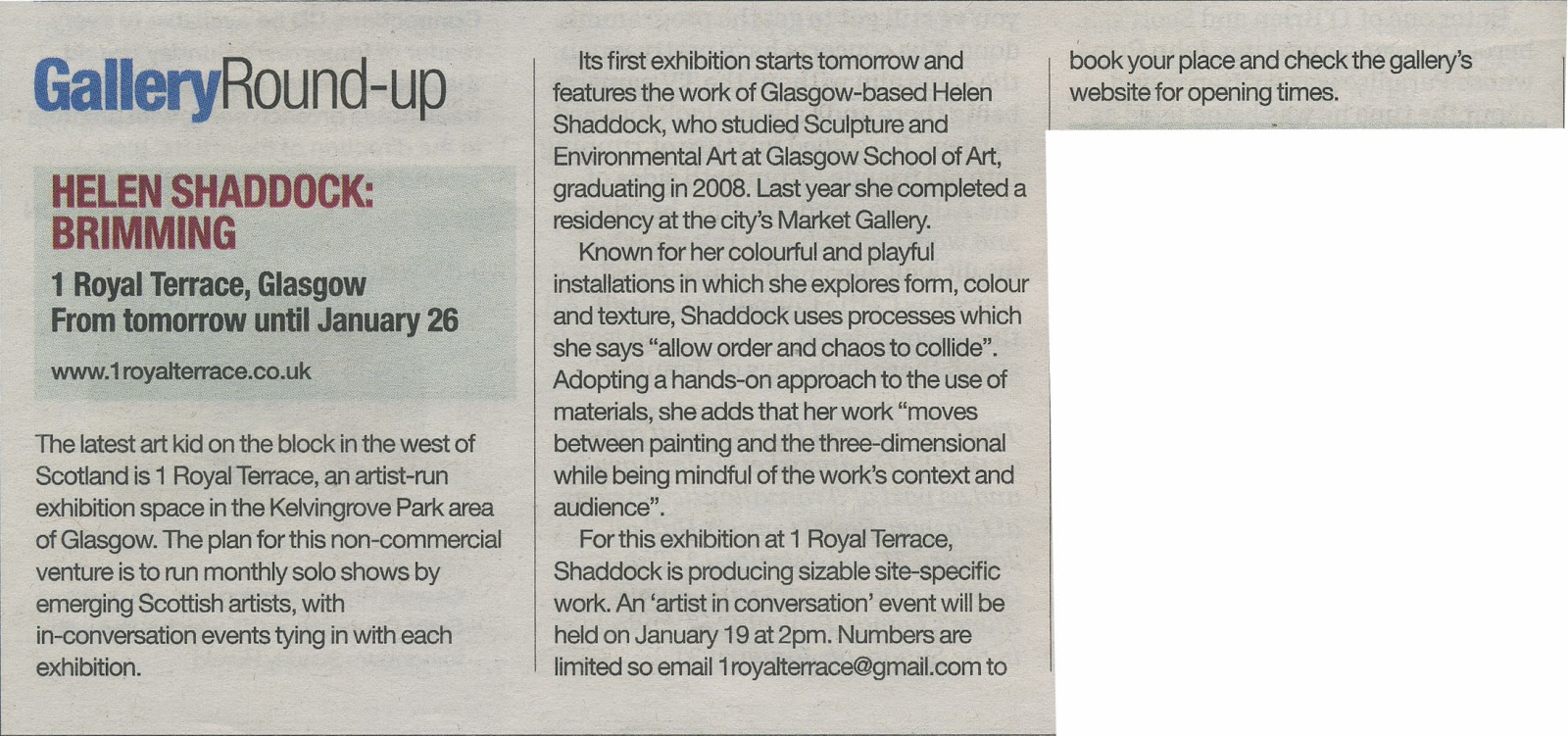
Better late than never...BRIMMING Preview in The Herald

So, I know that my BRIMMING exhibition at 1 Royal Terrace has been and gone, but I've only just managed to get my hands on a copy of the Preview that was printed in The Herald (Scottish newspaper) the Saturday before my exhibition opening on 12th January.


Monday, 4 November 2013

New figures reveal the true extent of the London/regions divide

http://www.artsprofessional.co.uk/news/new-figures-reveal-true-extent-londonregions-divide

An ongoing funding bias towards London is denying huge proportions of England’s population fair access to the arts, according to a new independent report by three senior arts figures.

Central Government spending per head on culture in London was nearly fifteen times greater than in the rest of England in 2012/13, and successive governments and Arts Council England (ACE) have failed to deliver on their own policy rhetoric about redressing the balance between London and the regions, according to a new report, ‘Rebalancing our Cultural Capital’. Last year 51% of ACE’s £322m public funding budget was spent on London, and of the further £450m used by the DCMS to direct-fund 16 major cultural organisations, an estimated 90% went to London. As a result, Londoners benefited from £69 of cultural spending per head, compared with just £4.50 in the rest of England. In addition, ACE committed 45% of its £317m arts Lottery funding to London, meaning that Lottery players across the country funded the arts to the tune of £17.41 per person in London, but only £3.90 in the rest of England.

Report authors Christopher Gordon, David Powell and Peter Stark, all senior arts professionals with both UK and international experience in research and cultural policy, insist that a balance needs to be struck “between the inevitable attractions for talent in all spheres of what a great global capital city can offer, and its function as the capital for a whole nation.” Calling for “stronger and more sustainable production resources for cultural production” to be based in the regions, they propose that a process of redressing the balance should begin with a fair 'per capita' share of arts Lottery funding being spent in the regions over a five year period, and that a £600m budget should effectively be ring-fenced for “a National Investment Programme to support the arts outside London.”

The report is based on a detailed analysis of figures dating back over twenty years, and points out that 75% of public funding of the arts is in the hands of ACE and the DCMS – a proportion that is set to increase as local authority spending on culture is squeezed in response to public funding cuts. The allocation of central Government money is seen to be at the heart of the national arts funding imbalance, but the distribution of Lottery funding to the arts has done little to improve the picture. Since Lottery distribution began in 1995, ACE has favoured London significantly more than have the equivalent distributors for heritage, sport and the Big Lottery, and the average value of an arts Lottery grant in London has been double that of the average for the rest of the country.

The uneven playing field described in the report is exacerbated by other factors. The £69m invested in the arts by the City of London and the London boroughs is supplemented by the Mayor’s expenditure on cultural and creative projects totalling over £27m; around 90% of giving to the arts by individual philanthropists goes to London-based organisations; and over two-thirds of business sponsorship is in London, as is nearly three-quarters of support from trusts and foundations. 61% of the first £30.5m of arts endowment funding under ACE’s Catalyst Programme is also going to London. Couple this with the significant contribution of the commercial arts sector in the capital, and the impact of the specialist institutions for professional art, music, dance, film and drama training, 90% of which are London based, then the bias towards London is all the more evident. David Powell commented: “As a Londoner, my instinct has long been that there was inequity between London and the rest of England, but on close inspection, the historical and current record looks pretty shocking even when making due allowance for the additional investment in national and international infrastructure proper to a capital which is one of the world’s great cities.”

Rejecting the arguments that London-based cultural organisations are in a position to benefit the rest of the nation, the report argues that the travel and accommodation costs of attending arts activity in London “render access unaffordable for a very high proportion of England’s more distant populations.” And the arguments that digital developments redress the London funding bias are similarly dismissed: “Digital access… is a two-way street and should be considered as such in national policy and investment decisions. If the Lindisfarne Gospels can be adequately accessed digitally from the North East (where they belong and where well over 95,000 people paid to see them ‘on loan’ during the summer of 2013), then such digital access to them from London – were they to be returned to the North East – would also be ‘adequate’ and the added value to these dispersed locations would be immense.”

The research and report have been self-funded by the authors, with the aim of stimulating policy debate on the issue of regional imbalance. Christopher Gordon told AP: “…the UK’s combination of local government with few effective constitutional guarantees, and cultural funding being predominantly decided by ‘arm’s length’ bodies, results in both strategy and equity being off the political agenda in England. Who takes responsibility for, or makes sense of, ‘the big picture’? Answer: nobody. Having no policy is not a justifiable policy.” Peter Stark believes the lack of debate on the issue is partly due to the public silence of those who are or aspire to be funded: “That is why this research is self-funded and independent of any interest group. That is why we have sought to make it sufficiently authoritative for it to require debate.” Both Melvyn Bragg and David Puttnam have already signalled their approval of the report, which Lord Bragg described as “timely, urgent and damning of an increasingly centralised funding process.” He said: “London is simply eating up the resources which are limited and therefore starving the rest of the country. This is wrong, short-sighted and undoubtedly unfair. I think it is time that the rest of England fought back…”. Lord Puttnam said that the report: “leaves no doubt about the wholly unjustifiable scale of bias towards London in the distribution of public and lottery funding of the arts… at a time when there is rising anger about policies that allow London – most especially affluent Londoners – to be underwritten at the expense of the rest of the country."

The authors are offering to make themselves available to the regional What Next? meetings and appropriate national forums to answer questions and engage in discussion