Showing posts with label The Tetley. Show all posts

Saturday, 28 September 2019

Nika Neelova - EVER - The Tetley Gallery, Leeds

EVER was a solo exhibition by the Russian-born artist Nika Neelova at The Tetley Gallery in Leeds. Neelova presented new and existing work that responded to, and was in dialogue with, the building's unique art deco architecture.


'At the centre of the exhibition is a new large-scale sculptural installation in The Tetley's atrium. Connecting with the building's past, it recalls the restoration and transformation of the atrium into a gallery space and incorporates original materials such as parquet floor tiles and oak panelling salvaged from The Tetley building.  Featuring these discarded architectural fragments, the installation creates a transitional space depicting, and derived from, places that once existed. For Neelova, it takes the form of a 'landscape in ruin', presenting different layers of reworked and reimagined architectural, sculptural and geological artefacts.'
 

In the old office spaces that surround the atrium space, Neelova installed a number of existing geological and architectural sculptures. The Lemniscate sculpture series is made from reclaimed wooden bannisters. Neelova has repurposed the bannisters and fitted them together so that they each become a continuous form.


Neelova's architecturally focused work benefits from being displayed in a gallery with its own unique architectural features and likewise the gallery benefits from her work as it naturally emphasises the context in which it is displayed. 


My criticism would be that there is too many repeated versions of the same idea. After seeing a couple of forms made from bannisters, I no longer gain from seeing a different variation of this theme. 


Wednesday, 9 January 2019

BBC Radio 4 Front investigates acoustics in architecture

The look of a building has always been an essential element in architectural design, but less conspicuous are its acoustic properties. Specialists in acoustic design are frequently engaged to enhance the aural experience of people in a room or a building. Their work ranges from blocking out unwanted noise, such as from passing trains, to providing the optimal sound for the audience and musicians in a concert hall. 


In Wednesday's episode of Front Row, Stig Abell visits Arup,
an independent firm of designers, planners, engineers, consultants and technical specialists, working across every aspect of today’s built environment.


Arup has a virtual sound laboratory which they use to inform the design of some of the world’s best arts and culture venues. A look at Arups website, in particular the projects section, 
reveals the wealth of incredible buildings that they have worked on. 


I am lucky enough to have worked in a variety of their buildings in the UK including Glasgow City Halls, RSNO Centre at Glasgow Royal Concert Hall and The Reid Building at Glasgow School of Art. I have also visited a number of their other projects such as Angel of the North, Gateshead, Tate Modern, London and The Tetley in Leeds. 


They demonstrate how the same piece of music can change according to where it is played, and explain that they use SoundLab’s sound simulations (auralisations) to demonstrate to clients the impact that major infrastructure projects such as HS2 will have on communities. These sounds can then be taken into consideration when designing the building.


Stig also talks to Trevor Cox, professor of acoustic engineering, about the history and importance of sound in building design.

https://www.bbc.co.uk/programmes/m0001ygw

Sunday, 4 October 2015

Symplaysium

Symplaysium

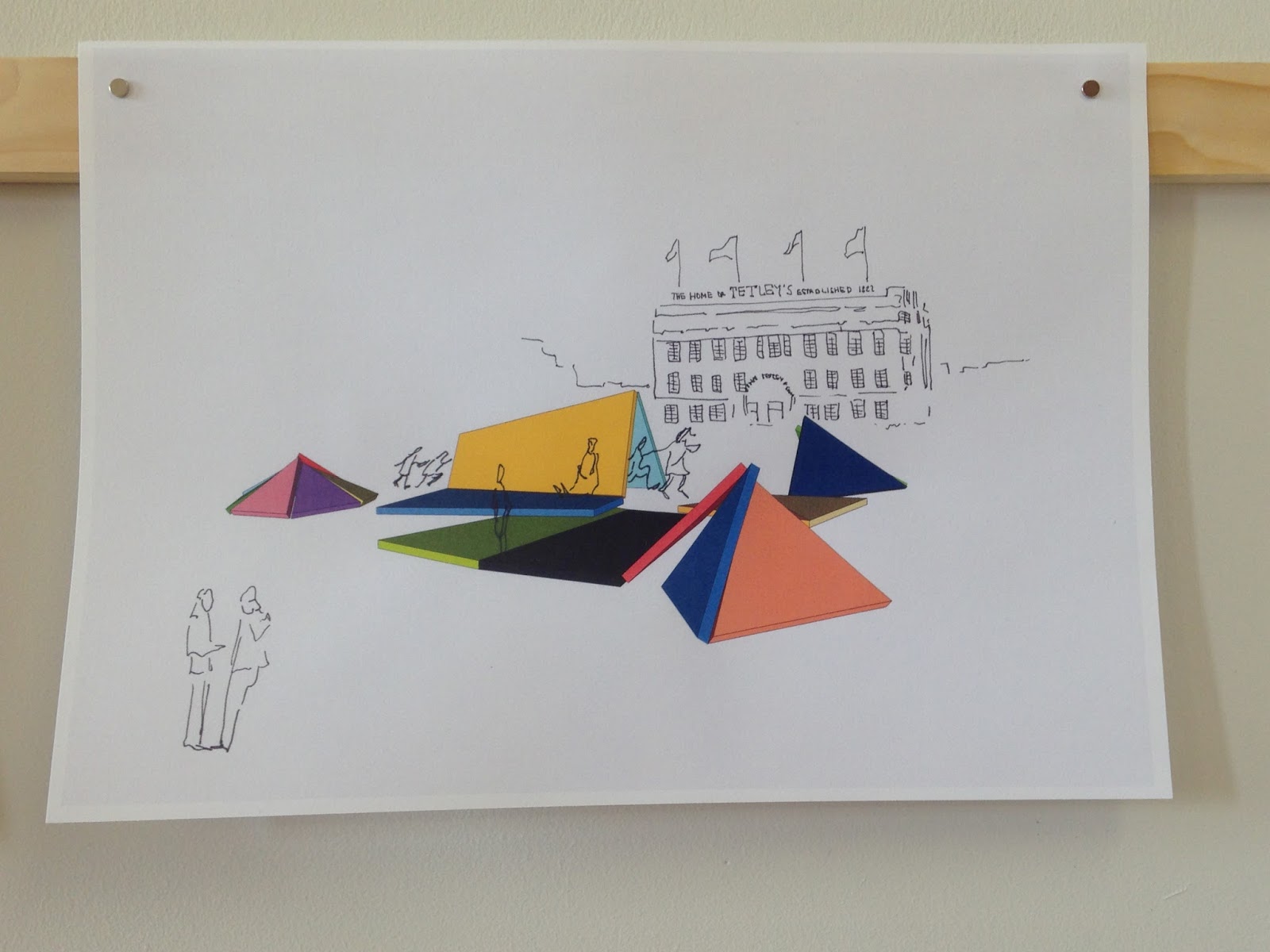
At the weekend I participated in Symplaysium, a one-day symposium on play, creativity and public space as part of the current exhibition Think.Play.Do. at The Tetley, Leeds.
The event began with an introduction by Zoe Sawyer, Curator at The Tetley, and Kenn Taylor, Participation Curator at The Tetley. They explained that the Think.Play.Do exhibition launched the gallery’s ambition to commission a play sculpture for Brewery Green. In the form of plans, sketches, maquettes and prototypes, the artists’ proposals will help ask the question ‘What if…?’ Working with a contemporary artist or artists’ group, The Tetley aims to commission the play sculpture as a contribution to the development of new public realm in the emerging ‘South Bank Leeds’, one of the largest regeneration projects in Europe.

The project has emerged in response to a lack of play facilities within Leeds’ city centre. The exhibition presents ideas from a range of artists interested in the public realm, sculpture, and intergenerational play.

The artists were invited to ‘start at the beginning’ and not to be constrained at this stage by real-world practicalities. Some of the projects have and will develop during the exhibition through a range of workshops and events devised by the artists. After the exhibition, some of the ideas will be taken to a design development stage in tandem with fundraising for the commission.


Nils Norman, an artist living in London, spoke about his practice as a whole and then specifically about his proposal for the play sculpture at The Tetley.


Norman “works across the disciplines of public art, architecture and urban planning. His projects
challenge notions of the function of public art and the efficacy of mainstream urban planning and large-scale regeneration. Informed by local politics and ideas on alternative economic, ecological systems and play, Norman’s work merges utopian alternatives with current urban design to create a humorous critique of
the discrete histories and functions of public art and urban planning. He exhibits and generates projects and collaborations in museums and galleries internationally.”


Norman’s website http://www.dismalgarden.com/ houses his archives, with playscapes being one of his main areas of research. He provided a brief history of playgrounds, which were introduced in the mid 1800s as a form of controlling children, and showed a variety of different playscapes from around the world.


He then gave an overview of his proposal for The Tetley’s play sculpture.

Nils Norman

Collaborative duo Robinson/Stirling (Dr Liz Stirling and Laura Robinson), delivered ‘Play is Powerful’ a collaborative action and talk with Jo Hassall and Ben Hall. Ben Hall and Laura Robinson delivered a slide presentation giving an insight into their work. Meanwhile, Liz Stirling and Jo Hassell, who had been sat in the audience, began to cake their faces in vaseline and what looked like dirt, donned scrappy wigs and began bounding round the room on all fours making unexpected growling and barking noises. We, the rather amused audience, were then encouraged to join them to explore the exhibition upstairs as dogs, sniffing, barking and crawling around the artworks. Unexpectedly for the artists, we all played game, and proceeded to alarm the other visitors in the gallery by crawling round the exhibition, throwing and chasing sticks and barking. It certainly provided an alternative way of viewing the exhibition!

http://robinsonstirling.blogspot.co.uk/


Simon and Tom Bloor
The group discussion was wide ranging and covered topics such as the importance of bringing play outside of defined play zones. When asked about the history of playscapes, Nils Norman explained that there has been a shift towards abstraction in playgrounds as opposed to playgrounds resembling castles, ships etc. This encourages children to use their imagination more. He discussed some of the different playscapes around the world, and how they vary and are valued differently. For instance, German playscapes are regarded as pedagogical areas – areas of learning.


Natalie Finnemore
Alice Withers and Lucy Courtney-Clegg from REETSO (Ben Boothman is the other member) began the afternoon session with a presentation covering a range of their projects that “aim to incite thought and play through creative projects that involve the general public.” Their “work manifests itself in a variety of forms including; installation, performance and workshops.”


They provided us with a taster, by giving us a sheet of foil each. We then formed pairs and were both instructed to face each other then close our eyes, pick up the foil and cover the other persons face with the foil. We carefully had to fit the foil around their face so as to create an impression of their face. What a wonderful way of getting to know your neighbour!


http://www.reetso.co.uk/


Matthew Houlding

Lesli Godfrey, a playworker and lecturer at Leeds Beckett University gave the final presentation.


She described some factors contributing to creativity:


- Divergent thinking

- problem solving

- flexibility

- access to emotions

- self confidence

- risk taking

- openness to experience


She also explained that play is

- Spontaneous

- Rewarding

- Intrinsically motivated

- Offers some protection

- Actions and thoughts are in novel combinations e.g. role reversals

- Involves performing repeated actions, or exaggerated or incomplete actions 

- Requires the individual to be free from stress or illness


In ‘The Needs of Children’ Pringle (1986) argues that children need:

- Love and security

- New experiences

- Praise and recognition

- Responsibility


In order to promote play, the following actions should be taken:

- Encourage free play

- Provide opportunities for exploration

- Promote divergent thinking

- Allow risk taking


When asked about changes in policy regarding play over the years, Lesli told us that the last Labour government wrote the first National Play Strategy. This was abolished by the coalition, and Michael Gove wanted no play in education. The Welsh government have a law to provide sufficient amount of play opportunities, and the Scottish Government are looking to establish a National Play Strategy.

Jem Finer: Spiegelei 

The summary at the end of the day was a chance for us to give feedback to the curators about the proposals for the play sculpture, and to share with each other some useful links. Here are a few:

http://www.happycity.org.uk/

http://www.leedsplaynetwork.org.uk/

http://opalexplorenature.org/aboutOPAL

http://popupadventureplay.org/

http://popupplayshop.org/

http://squashnutrition.org/

Monday, 6 July 2015

Painting in Time Symposium

Today's Painting in Time Symposium at The Tetley Gallery in Leeds proved to be an excellent way to pull together and scrutinise some of the thoughts behind, and issues surrounding the exhibition which ends tomorrow.

The exhibition has been co-curated by Sarah Kate Wilson and stems from her practice and PhD research at The University of Leeds.

Speakers for the symposium were drawn from a network of academics, curators and artists. Each presented their research on painting and its relationship to time. 


Dr. Joanne Crawford’s paper focused on American abstract art in 1952 where painting’s role became one of the deferred ‘revolutionary moment’.
Through her own painting practice Nadine Feinson discussed how a painting might be understood to be in motion, despite its material fixity. She spoke about Triboelectric Series 2, a site-specific work made for RIFF/T, an exhibition at the BALTIC Centre for Contemporary Art's project space BALTIC 39, Newcastle, 11th December 2013 - 2nd March 2014.
"The work explores and utilises the material properties of polythene dustsheets1 as a painting support and their ability to retain static charge - resulting in the contact-electrification of the painting. The thin plastic, electrostatically charged, is a responsive ‘film’ that clings, shifts and moves on the wall. It responds to touch, rubbing and buffing, to atmospherics in the exhibition space, gravity, and the weight of paint. Holes in the surface, drafts, and moisture – all these things shorten its ‘life-span’. As paint is applied, it stretches, puckers and falls into holes, so that paint is deposited on the wall underneath: the polythene creating its own repertoire of ‘gestures’ in the wake of painting activity.
A number of paintings on polythene are made, one after the other, in the same space. As each painting is finished, it is discarded, leaving behind paint marks and gestures on the wall where the plastic has torn – these then become reconstituted into the painting that follows."
California-based Curator, Sinead Finnerty-Pyne examined the act of viewing and exhibiting painting as a time-based experience, posing questions such as 'can artwork rebel against our fast nation society?' She spoke of the current exhibition, Expanding on an expansive subject, that she has curated at Armory Centre for the Arts, California. 
"Expanding on an expansive subject is a group exhibition that explores the expanded field of painting through nine artists’ investigations into painting’s range and potential as a cross-disciplinary medium. The exhibition presents a unique model, a group exhibition displayed as individual solo projects that unfold (or expand) over the course of time, offering the possibility of an exhibition as a temporal experience. Since May 2014, Expanding on an expansive subject has featured six-week projects by Margie LivingstonAnalia SabanJohn BurtleLiat YossiforJohn KnuthKendell Carter, and continues through November 2015 with shows by Kate Gilmore, Sarah Kate Wilson, and Constance Mallinson. While each artist’s approach to the discursive nature of painting is unique, the exhibition as a whole asks how painting today is distinct from its art historical predecessors."
Artist Kate Hawkins’ paper set out to explore durational modes of address and spectatorship in relation to contemporary painting. With reference to her work included in the exhibition, Hawkins discussed explorations of mourning in art from Picasso's Weeping Woman to Chris Ofilli's No woman, no cry.
She explained how her paintings in the exhibition were painted when she was pregnant, and struggling to come to terms with what she thought was going to be the end of life as she knew it. Hawkins believes that an artwork should exhibit tenderness and love to the viewer, and commented that the spectator should be treated as an equal.
The theatricality of the work is enhanced by the three-dimensional supplements that are added to the two-dimensional surfaces. 
Dr. Catherine Ferguson talked about how paintings make time in relation to history.
Natasha Kidd, used Huberman’s text ‘Take Care', 2011, to discuss how her new work in the exhibition Painting in Time was set loose in the world, what it wants and how it behaves or misbehaves.  She talked about how an instruction to attend to the work was essential in order to keep it alive and her curiosity around the word “care” in relation to the systems she makes. Kidd is interested in "unlocking the artwork as static". She used her contribution to the Test Run exhibition at Modern Art Oxford as an example of how an artwork can provide access to the creative process and to demonstrate her interest in learning.
Curator and artist Sarah Kate Wilson used the rainbow as a figure, and presented a case for painting as a time-based medium. She discussed how viewing paintings during World War 2 was an event as one artwork per week was removed from the mines where they were being kept for safe keeping, and made accessible to the public. Similarly, in his work Act III, Daniel Buren made an event of viewing an artwork as his positioned a painting on the  stage of a theatre and the audience were forced to pay attention to this artwork as nothing else happened on the stage. Wilson used Jutta Koether's 'Hot Rod' to illustrate how painting can be a social space, and cited Oscar Murillo's work as a way in which viewing painting can be a performance.

The symposium concluded with a question and answer session involving all of the days speakers, and was chaired by Dr Joanne Crawford.

It really was a fascinating event to complement the varied and exciting exhibition, with lots of very interesting and inspiring people both in the audience and as speakers. 

Saturday, 11 April 2015

Painting in time at The Tetley

PAINTING IN TIME
3 APRIL - 5 JULY 2015

CO-CURATED BY SARAH KATE WILSON


Given my interest in artists that work across disciplines and question the notion of medium specificity, this is definitely an exhibition I want to visit.


Exhibiting artists include Polly Apfelbaum, Claire Ashley, Kate Hawkins, Robert Chase Heishman and Megan Schvaneveldt, Natasha Kidd, Rob Leech, Lisa Milroy, Yoko Ono, Hayley Tompkins, Jessica Warboys and Sarah Kate Wilson.


This group show brings together an exciting array of works by international artists practicing within the expanding field of painting. Exploding ideas of what painting can be, these artists work across sculpture, performance, painting and film. The exhibition includes inflatable paintings, painting machines and paintings that can be handled and reassembled by visitors.


Painting in Time consists of works that are in a state of flux: pieces will constantly evolve and in some cases only exist for the lifespan of the exhibition. New commissions sit alongside existing works reconfigured for The Tetley’s unique gallery spaces.

This exhibition acknowledges the enduring popularity of the medium and asks ‘what constitutes painting today?’
__

A symposium, which focuses on painting and its relationship with time, will take place at The Tetley on 4 July 2015.

http://thetetley.org/painting-in-time/


Saturday, 28 December 2013

Trip to the new Tetley art gallery in Leeds

A new contemporary art gallery opened in Leeds about 3 weeks ago so I paid it a visit while in the area. The building, the old Tetley Brewery Headquarters, is beautiful. On the ground floor there is a bar, restaurant and exhibition space. The next three floors consist of art galleries, a workshop space, offices and studios.

The Tetley's first exhibition, ‘A ‘New Reality’, invites audiences to join artists in unraveling the history and future use of the former Tetley Brewery headquarters through a series of artist projects, exhibitions, events and residencies.

Part 1 of this 9-month programme features projects and exhibitions from artists Emma Rushton & Derek Tyman, James Clarkson, Simon Lewandowksi & Sam Belinfante, and Rehana Zaman.

‘A New Reality’ launches The Tetley as a permanent contemporary art space, taking the theme of ‘labour’, the telling of overlooked or fading history, and the cyclical process of change, as starting points for the space’s transformation. An intergenerational mix of contemporary artists have been invited to create cross-disciplinary interventions that are sensitive to the site’s past.

The work in the galleries seemed to be more like a museum survey of the history of the Tetley building than art exhibitions. Unfortunately there were no artists around at the time of my visit, and , but there was evidence of activity in the form of a stage like structure constructed by Rushton & Tyman for their project titled Fear of the Surplus.


A series of public discussions and events around the topics of work, labour and welfare will take place on this stage. An impressive line-up of invited speakers – authors, activists, academics, theorists, organisers and campaigners will debate ideas of work – what it is, why and how we do it, its values and rewards and the conflicting ideas and issues which surround it. As stated on the Tetley website "With current government rhetoric surrounding work and welfare, Fear of the Surplus is timely in providing a space where conflicting ideas about labour, work systems and possible alternatives can be voiced and debated.

Fear of the Surplus refers to those groups – unemployed, the elderly, migrant workers, the recently made redundant, single mothers, under employed, public sector workers – that are either used as scapegoats by those in power, or considered extra to requirement or ‘surplus’ to requirements, or both."

I look forward to following the development of this exciting new contemporary art space.

http://thetetley.org

http://www.creativetourist.com/articles/art/yorkshire/its-art-leeds-but-not-as-we-know-it-the-tetley-launches/

@The_Tetley