Scottish artists join exhibition to highlight
‘unjust’ jailing of Cubans. Exclusive by Andrew McLeod
John Byrne, Alasdair Gray, David Harding, John Keane, Sam Ainsley and
Sandy Moffat have contributed work to the Beyond the Frame exhibition,
which opens in Glasgow this week. Altogether, 20 artists based mainly in
Britain have joined 26 Cuban artists and photographers in donating
works to the cause.
"It's a very eclectic exhibition, with many different styles and
media," says Jan Pietrasik, Glasgow coordinator for Beyond the Frame,
which runs at The Lighthouse from May 7 to 13.
Twelve Nobel Prize winners have called for justice in the case,
including Desmond Tutu, Nadine Gordimer and Jimmy Carter.
"Amnesty International and other human rights organisations see their
trial as unfair," says Pietrasik, adding that sales of works would go
towards the campaign to free the men.
The Miami Five – Antonio Guerrero, Gerardo Hernández, Ramón Labañino,
Fernando González and René González – were arrested in 1998 on
espionage and terrorism charges and jailed in 2001 with sentences
ranging from 15 years to double life. Their defence has argued that the
five were not spying on the United States but had infiltrated Cuban
exile terrorist groups, such as Alpha 66 and Brothers to the Rescue, in
Miami to prevent attacks being carried out against Cuba.
These included a wave of bomb attacks on Cuban hotels and nightclubs
in the 1990s, which Cuba claims were masterminded by Luis Posada
Carriles, an exile with a CIA background.
Four of the Miami Five are held in separate US prisons, with some
families denied visiting rights. René González has been freed on parole
in Miami, but remains in hiding for fear of an attack by Cuban exiles.
The Five's relatives claim there could never be a fair trial in
Florida, which has a large Cuban exile population. In 2006 at least 10
Miami journalists opposed to the Cuban regime were revealed to have been
in the pay of the CIA or federal government. The relatives are now
seeking a new appeal.
Guerrero, who learned to paint behind bars, and Hernández are both
exhibiting works.
"There has been a very encouraging response to the exhibition," said
Lesbia Vent Dumois, an exhibiting artist and founding member of Cuba's
National Art School. "There are over 50 works, by prominent Cuban
artists but also by many artists of other nationalities, and by Cuban
photographers, some of whom began their careers in the early days of the
Revolución, while others are well-known contemporary photographers,
such as René Peña."
María Eugenia (Maruchi) Guerrero and Mirta Rodríguez, sister and
mother of Antonio Guerrero, told the Sunday Herald they were delighted
and surprised by the response to Beyond the Frame. "This display of
solidarity for my son has made me very happy," said Mirta Rodríguez.
Guerrero is in good health according to his sister Maruchi. "He looks
after himself, not least because he knows his family need him."
"I do not have a problem obtaining a visa to visit my son, but it is
cruel because I have only been able to see him once a year, and I am
going to be 80," said Mirta Rodríguez, adding however that she believed
she would soon be able to make two visits a year.
The Miami-born Guerrero was a year old when he and his parents
returned to Havana in 1959 following the overthrow of Cuban dictator
Fulgencio Batista. "Tony became a civil engineer," says Mirta Rodríguez,
"and was involved in the expansion of the airport in Santiago de Cuba.
He has always been interested in drawing. In Colorado he met a cellmate
who was an artist and taught him to paint. It has been a good way of
filling his time, doing something he loves."
Guerrero, in an occasional blog run on the Cuban website Cubadebate,
says that apart from painting, in which he is "totally absorbed", he is
teaching other prisoners, mostly Mexicans and Puerto Ricans, to read and
write. "Sometimes, when I am wandering about, in the dining room or in
the recreation room, a pupil or someone who doesn't remember my name
will call me teacher. Some just call me Cuba. When I can't remember
someone's name, I always call them friend."
A PAINTING by Guerrero of a guitar-playing figure riding a blue
unicorn, which is on display at the exhibition, is reminiscent of
Picasso's Guernica. In fact it is a tribute to Cuban Nueva Trova singer
Silvio Rodríguez, whose song Unicornio became famous across Latin
America after the 1980s collapse of right-wing military regimes in
Chile, Argentina, Brazil and Central America.
"My son has been working on a project with Silvio, who sends him
photographs from his concerts in Cuba, and Tony makes portraits or
paintings from them," said Mirta.
Said Maruchi of the exhibition: "We need to move forward with a new
appeal, even though it will be in the same court, before the same judge,
who will not admit mistakes. But international pressure can make a
difference: in art, there are no prison bars."
The other exhibiting member of the Miami Five, Gerardo Hernández, is a
cartoonist whose selection depicts what he sees as the international
media's portrayal of Cuba. "Someone once said that humour liberates – if
nobody said that, I will," says Hernández in a note on his work. "For
me it is something that gets us out, for at least a few moments, from
behind the walls where we have been unjustly imprisoned for almost 13
years."
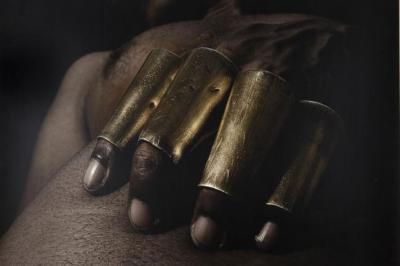
Other artists exhibiting include René Peña whose photographic
self-portraits, explore themes such as black identity and sexuality;
Gustavo Díaz Sosa, who will be at Beyond the Frame in person, and whose
work features diminutive human figures trapped in claustrophobic
landscapes; Eduardo Roca Salazar, known as Choco, who focuses on
portraits of farmers and Afro-Cuban women; and José Fuster, whose In the
Palm, includes several human figures which he says "maybe have been
saved from the terrorist action that Cuban people have suffered."
Beyond the Frame is sponsored by the Cuba Solidarity Campaign and the
Scottish Parliament's Cross Party Cuba Group
the lighthouse glasgow May 7-13




 Posts

