Scottish artists campaigning for "fair pay" from galleries are to challenge political candidates in an election style-hustings event this weekend.
Two artist membership organisations, A-N and the Scottish Artists Union (SAU) will host an event in Glasgow with representatives political candidates from major parties.
The cultural hustings will be held at The Whisky Bond on Saturday, May 2.
The event will be chaired by Jim Tough, executive director of the Saltire Society, alongside a cultural panel that includes Kyla McDonald, artistic director of Glasgow Sculpture Studios, artist Sukaina Kubba, academic Emma Flynn and a representative from the Scottish Artists Union.
The political panel will include Moira Crawford of the Green Party, Chris Young from the Liberal Democrats, Gordon McCaskill, Conservative, Brian Smith, Trade Union and Socialist Coalition, with an SNP and Labour candidate to be announced.
Janie Nicoll, an artist, said: "Some publicly-funded galleries pay artists fairly, others don't and getting them to be transparent and open about their payment policies is the first step to making sure we all get proper payment for the work we do.
"The hustings debate is about raising the awareness of election candidates so they understand the importance of the issue and use their influence to encourage galleries to spend tax payers' money in a way which supports fair payment."
The event is part of a nationwide campaign Paying Artists campaign based on research showing that 71% of artists do not get a fee for exhibiting in publicly funded galleries - with 63% of artists having to turn down gallery requests because they cannot afford to exhibit for nothing.
The event coincides with the artist-led city wide Glasgow Open House Festival in which artists will showcase new work or ideas within public and domestic locations.
This year the programme features 200 artists across 50 venues.
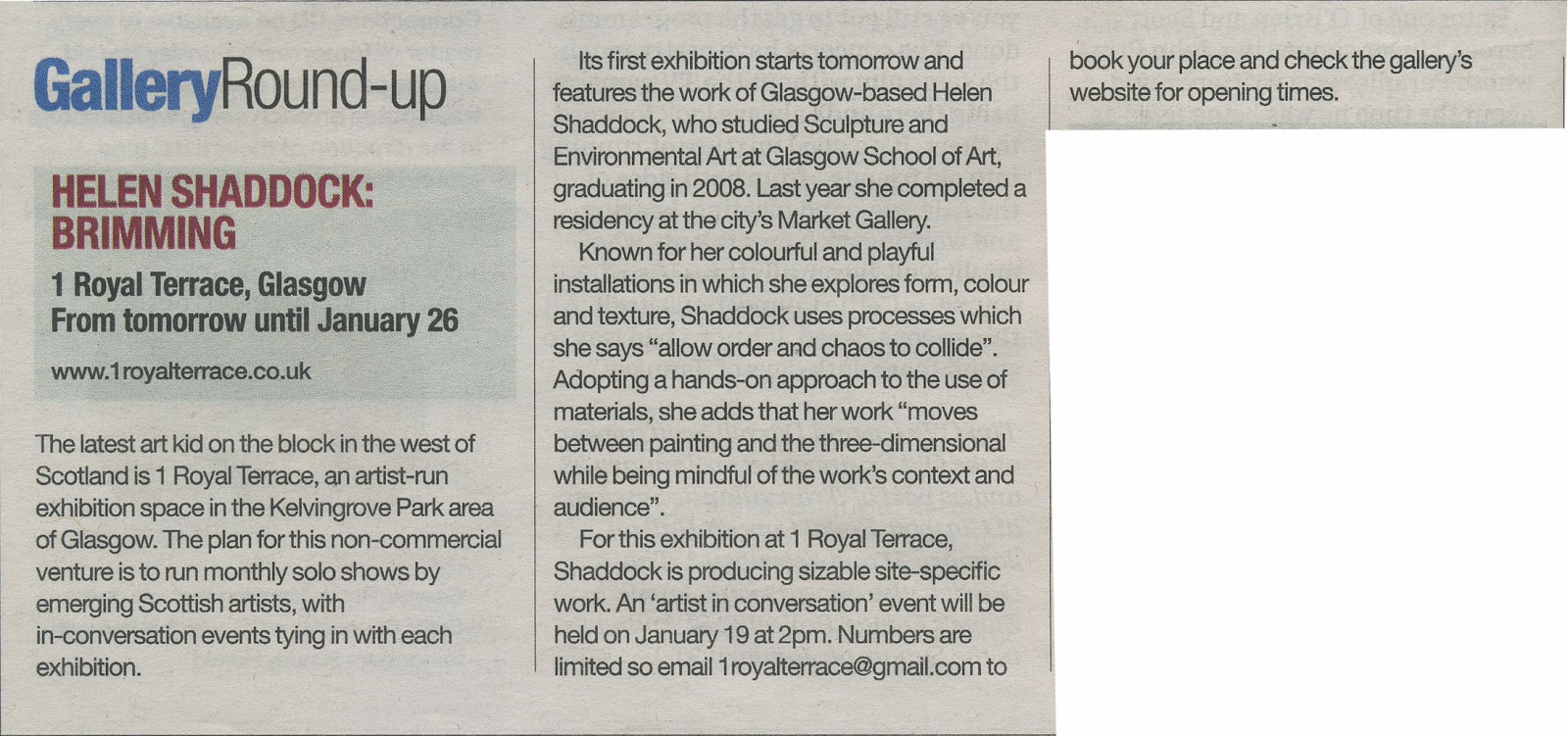
So, I know that my BRIMMING exhibition at 1 Royal Terrace has been and gone, but I've only just managed to get my hands on a copy of the Preview that was printed in The Herald (Scottish newspaper) the Saturday before my exhibition opening on 12th January.
By http://www.heraldscotland.com/news/home-news/creative-tensions.19138785 Russell Leadbetter
In The Herald, Sunday 14th October
A culture of materialism. Trapped in a Gulag of their own making.
Scottish artists and writers have levelled a fierce volley of complaints
at Creative Scotland, after more than 200 signed an open letter
protesting at what they view as the "deepening malaise" within the
national funding body.
Among the leading names who signed the letter last week criticising
the quango's "ill-conceived decision-making and unclear language" and
"lack of empathy and regard" for Scottish culture were playwright David
Greig, authors Ian Rankin and Alasdair Gray and poet Liz Lochhead.
Yesterday hundreds more Scottish artists added their voices to the
chorus of criticism after the Scottish Artists Union – which has nearly
1,000 members – called for more transparency in Creative Scotland's
work. The union claimed there was a feeling of "no confidence" in the
arts body, which has the task of spending more than £83 million of
public and lottery money on supporting the arts annually.
A key point of contention among many artists has been a change from
fixed-term funding to a more project-based approa
ch, while the
commissioning role and structure of the arts body have also been
criticised.
On Friday, Sir Sandy Crombie, chairman of Creative Scotland, admitted
that the body has a major problem in its dealings with artists. Two
inquiries, which will report before Christmas, have been set up to
examine the organisation's operations and its lottery funding.
In a statement, Crombie said: "I want to give my personal reassurance
that all matters brought to our attention will be thoroughly considered
and, where possible and necessary, that improvements will be made."
However, some prominent figures have lent support to Creative
Scotland. Among them is Michael Elliott, chief executive of the Royal
Scottish National Orchestra (RSNO), who said the "continuing relentless
public barrage of criticism" was unjustified and damaging to the
long-term interests of the arts in Scotland.
He said Creative Scotland had supported RSNO initiatives such as the
Astar project, which will offer a classical CD to babies born over the
next year in Scotland to inspire a love of music.
"I have found Creative Scotland to be responsive to creativity,
innovation and achievement, and to have a passion for enabling the arts
and culture across the whole of Scotland to flourish," Elliott said.
"The organisation has admitted mistakes, is learning from them, and is
taking action to improve."
Andrew Dixon, chief executive of Creative Scotland, acknowledged that
more needs to be done to listen to some of the concerns of artists.
However, he added: "We should point out that we have devolved funding
to bodies that work directly with artists across various disciplines,
including the Scottish Book Trust, Playwrights' Studio and Transmission
Gallery.
"While we're keen for artist-led organisations to take decisions
closer to the coal face, we also accept that we need to talk to artists
directly ourselves. Some artists who have voiced concerns are people who
we perhaps have not reached - We have to find lots of formats in which
we can talk to artists."
Dixon said the body had been in talks since June with agencies
including the Federation of Scottish Theatres and the Literature Forum
on how best to engage on policy issues with artists.
He said: "We have cut £1.5 million from our running costs and have
30% less staff in order to put more money into the cultural sector.
"So there are fewer of us, but we are out and about across Scotland."
Tam Dean Burn, actor:
IT was the strength of feeling from the artistic community that made
me sign the letter. I understand that a lot of people declined to sign
because they were understandably reluctant to jeopardise any funding,
even though they felt strongly about CS.
Personally, I've had a growing sense of disbelief and irritation
about the way CS has been operating. I see no need for it, because we
have a very successful Scottish arts community, whereas Andrew Dixon has
come in acting as if there's some big problem that he can solve, and
insisting that we have to learn to operate on a much more business-like
basis.
Some people have suggested this attitude is a Thatcherite or Blairite
hangover, but it is definitely from the era when the market was seen as
the answer to everything. Combine this with CS's dumbing-down approach,
which you can see most clearly in their awards. It's not the job of the
funding body to initiate awards ceremonies – especially when they
charge £110 for tickets. CS seem to think their job also involves
advoca
cy for the arts. That is not how artists see it.
Prof Willy Maley, author, professor of Renaissance Studies at the
University of Glasgow:
EVER since CS came into being, I have heard nothing but bad stories.
There have been stories about people who wanted to speak out and
complain but couldn't, or were not listened to, or were met with a brick
wall.
The situation is remarkably similar to what is happening in our
universities, where there is a tier of management that will not listen,
consult or communicate.
Artists and academics are in a similar, related position. There is
something profoundly un-Scottish about it; I like to think we have a
democratic ethos or principle. For a small, poor country we have an
extremely rich artistic and literary culture. To try to turn this into
something we are going to lose face, and faith, over is absolutely
disastrous.
It has something to do with a culture of managerialism, of
railroading things through, of using business-speak. In terms of the
signatories to the letter, I am something of an outlier: I was asked to
sign, but, from everything I have heard [about CS] I felt that, whatever
its original intentions, it is not working out.
David Harding, former head of sculpture at Glasgow School of Art, now
part of AHM collaborative group:
I HAVE no personal grievance with Creative Scotland but am opposed to
its very being because of the neo-liberal policies and attitudes it is
attempting to impose.
So this is not about its competencies, of trying to make it better,
but one of conflict with the whole ethos. Neither is it about
personalities. Andrew Dixon and Venu Dhupa [CS director of creative
development] may not be the best appointments that could have been made
to carry out the Scottish Government's wishes, but changing them will
not change what CS is being charged to do.
Creative Scotland is a New Labour construct supinely embraced by the
SNP. It should have been fought at the Bill stage, but artists have
little enough time and security to make work, let alone to be able to
take time to fight a Bill going through Parliament. However, since CS
has now shown its teeth, and the cuts bite, artists can react. CS is
damaged goods. As Ian Bell wrote: there are only two words needed –
"art" and "work".
Fiona Robertson, administrator of Sound Festival, Aberdeen:
Following the changes in the funding to Flexibly Funded
Organisations, Sound has been awarded £177,000 by CS over two years.
Under the present circumstances, we're happy to have been awarded that
grant for our projects, and it is slightly more than we had been awarded
for the two previous years.
However, during the review process we were encouraged to articulate a
vision for our development by CS, and this new funding level doesn't
invest enough to achieve that vision. We would have liked to have had a
fuller discussion with CS about our strategy and how their investment
would help us achieve this. We believe this lack of discussion is part
of the current problem, and there needs to be a re-think on how CS
engages with cultural organisations and artists. Creative Scotland has
also developed a business ethos, reflected in the language they use,
including within the application forms. Whilst this may be appropriate
for the creative industries, it feels at odds with the way arts
organisations and artists operate.
Corrina Hewat, harp player, principal Scottish harp tutor at the
Royal Conservatoire of Scotland:
I HAVEN'T had many dealings with CS since it changed from the
Scottish Arts Council, purely because it was becoming bad for my health.
Why? I don't understand the forms, and start to shrivel inside when I
think about having to do any forms. I'm more into writing, collaborating
with other musicians, taking the music to far-flung places, and
teaching.
I seem to be in a never-ending loop – must work to pay the bills,
need someone to help me, can't afford that, but if I just keep working
to raise enough money to get someone to help me ... and so it goes.
I also don't want to complain about CS. I am not a complainer by
nature and the whole ethos of supporting the arts is one I live by. I
want to see the good in everything, and art in all forms is essential
for life. So I'm happier stepping away from the forms and the business
speak.
I have received funding through many ventures – touring and
recording, many albums and many collaborations, none of which would have
happened had it not been for the support we received. The funding
enables us to tour larger groups to outlying areas, in venues that would
not normally have such gigs going on. It enables collaborations, and
enables workshops to be given to kids who are then inspired to keep
listening and learning music
Also I don't want to have to cut down on band members, take less time
rehearsing, or to change the show so it ticks all the boxes. Why should
my art be undermined, and why should I change the way I think to fit?
Shouldn't it fit with me?
I'm co-musical director of the Unusual Suspects. We started as a
32-piece, having to slim down to 22 for the tour as stages weren't big
enough. Getting the band on the road was always an expensive thing and I
was grateful the SAC supported us in those first years. There was a
feeling of trust within the community that the folk working in the
organisation had direct knowledge and interest in the field of expertise
they were funding. But each time we asked for help, it had to be bigger
and better, which was near impossible to do through lack of money.
Surely small arts organisations can be given some kind of assurance
for a two- or three-year funding plan? How can the arts survive if we
are in this constant short-term thinking mode? Art is not just for
Christmas, it's for life.
John Byrne, artist:
I simply signed the letter because I'd heard so many gripes from
people who run small theatre companies. You just pick up the vibe and
think, for God's sake. I have never had any truck with Creative
Scotland; I've no idea what Andrew Dixon or anyone else from the
organisation looks like. I'm self-sufficient, and self-financing, and
have been for many moons. I've no need to go cap-in-hand to them, but it
sounds as if others do. You almost get the impression that it's like
approaching the KGB – you have to queue up, and sign forms in
triplicate. CS don't get out and about much, do they? They almost seem
to be in a Gulag of their own making.
'We need to put artists in charge of the resources'
By Anne Bonnar, who helped to set up Creative Scotland
The current furore over Creative Scotland (CS) is the latest battle
in a long war between the arts community and cultural bodies.
Well-trammelled struggles over ideology and the control and management
of funds have taken on particularly Scottish characteristics since
devolution, with artists challenging funding bodies on fairness, trust,
respect and ethics. The current public intervention by leading artists
about the apparent lack of empathy from those who control the arts
resources has tipped the discontent expressed about changes to funding
streams over into a crisis.
Co-ordinated public intervention by eminent artists has been a
game-changer in every recent battle. Protests from artists when I was
Transition Director for CS influenced changes to the way that body was
set up. CS has had a difficult birth and many of the factors influencing
that have now been addressed. But the lack of a structure which
recognises eminent artists and their contribution to the cultural
leadership of Scotland means that many will continue to feel
marginalised and to limit their contributions to a public attack when
things go wrong.
State support for the arts and culture in Scotland has strengthened
during the last few years after a period of uncertainty. There has been
the appointment of a respected Culture Minister staying the course after
nine short-term predecessors, the legal establishment of Creative
Scotland through the Public Sector Reform Bill, and the appointment of a
board and an experienced and committed CEO.
CS has invested in the arts. The merging of Scottish Screen and the
Scottish Arts Council has reduced annual operating costs by more than
£1m and provided some protection from deeper cuts during this time of
reduced public expenditure.
However, board members of CS are appointed by Ministers and not
remunerated, in contrast with Scottish Enterprise or NHS. Not only does
this signal that culture is less important than enterprise but it
precludes applications from those artists who must prioritise work which
generates income. There is an artist on the board, musician Gary West,
and others who practice art in their spare time but in selecting a chair
closely associated with Scotland's financial services, Fiona Hyslop has
prioritised financial stewardship. Alternative structures involving
artists would signal government recognition of their importance and
reduce the singular focus on what is just one part of the cultural
landscape.
As Makar, Liz Lochhead occupies the sole official position for a
leading Scottish artist. Establishing a national artists' academy with a
role in national cultural leadership could bring artists in from the
cold and allow more balanced and considered setting of cultural policy.
In addition, increased fiscal autonomy could be used to provide a
time-limited allowance for artists and creative workers to develop their
work, either in tax incentives or a creative enterprise allowance. This
would loosen the singular dependence on CS and create a more balanced
system for artistic and cultural leadership in Scotland.
Anne Bonnar was Transition Director of Creative Scotland for the
Joint Board of the Scottish Arts Council and Scottish Screen, and is now
a director of Bonnar Keenlyside, an international arts-management
consultancy.
Published in The Herald, Saturday 13th October
Article by Phil Miller
Sir Sandy Crombie, chairman of Creative Scotland also revealed two
board meetings, on October 22 and December 6, will play a crucial role
in the future of the arts funding body.
Sir Sandy, responding
unexpectedly for the second time in a week to the damning letter from
more than 100 artists asking for change at the body, struck a notably
less combative tone than his letter earlier in the week, which was
described as "inadequate" by artists, with a tone of "patrician
emollience".
His first lengthy response to the artists had said that "in choosing
to be concise, you have of course sacrificed the provision of detail at a
level that my board colleagues and I can investigate" and also stated
"they who provide the money have a right to ask what will result from
that investment". Both phrases, among others, antagonised artists.
However, in his second letter, days after a brusque "sort it" message
from Culture Secretary Fiona Hyslop, Sir Sandy admitted: "A number of
artists and representative groups are taking issue with how we at
Creative Scotland do things and how we relate to them.
"The board and senior management team are hearing these concerns and
right now are taking stock and absorbing what has been said. I want to
give my personal reassurance that all matters brought to our attention
will be thoroughly considered and, where possible and necessary, that
improvements will be made."
Two inquiries, made up of board members, one led by journalist Ruth
Wishart, a columnist for The Herald's Society page, and the other led by
Barclay Price, chief executive of Arts and Business, will look into the
funding body's operations and its lottery funding.
The two committees will report before Christmas and major changes at
the organ
isation, including in personnel, are expected to be prompted by
their work.
Creative Scotland's problems have been prompted by not only the
removal of "flexible funding", or fixed-term funding, for more than 40
organisations, but also its use of business language, its commissioning
role, and its structure.
Creative Scotland is now also considering establishing a new
"consultative forum" to help inform on issues affecting artists and
organisations.
Sir Sandy, former chief executive of Standard Life, said: "It is also
my intention that we will take informal soundings from a range of those
who care deeply about our role, and how we discharge it, about possible
approaches to dealing with issues before final decisions are taken. I
do not want to put pressure on those we consult by calling them
representatives. However, I hope it will be possible to find approaches
that give us confidence the feedback we receive is representative."
Last night, the leading playwright, David Greig, responded: "This is a
very encouraging statement. I get that sense that the specific concerns
have been heard at Waverley Gate [Creative Scotland's offices in
Edinburgh] and a process of practical change is being put in place.
"Rebuilding trust with the sector will be a more difficult matter. It
will take time but, for the moment, this statement feels like a step in
the right direction."
Yesterday, Ms Hyslop told The Herald: "I strongly believe in direct
communication, that there will be a resolution and a way forward.
"I have made it clear to the board what I expect. They are taking it
very seriously and I expect to see results."
The chairman of Scotland's national arts funding body admitted in a
conciliatory letter it has a major problem in its dealing with artists.
SCOTLAND’S artists are to stage mass meetings in Edinburgh and Glasgow
next month after disquiet over the policies of Creative Scotland, the
national arts funding body.
The events will be the first organised and regular “open space”
rallies of artists from all genres who want their voices to be heard.
Criticism of the funding body’s actions was sparked in May following
the removal of Flexible Funding – fixed-term funding – from more than 40
organisations, and its replacement by Lottery-backed project funding.
However, until now, criticism and debate about Creative Scotland has
been confined to individuals putting their heads above the parapet or
comments and discussions on social media such as Twitter and Facebook.
Fiona Hyslop, the Culture Secretary, has written two letters to
Creative Scotland, stressing its need to communicate better with the
arts world.
Leading poet Don Paterson described the body as a “dysfunctional
ant-heap”, and playwright David Greig has added his criticism.
Now, with a meeting of around 100 artists and commentators at a space
lent by Creative Scotland at its Waverley Gate offices in Edinburgh on
October 26, and another of around 100 people at the Tramway in Glasgow
on October 31, organisers hope a more cohesive voice for artists and
arts companies will be heard in the debate over arts administration and
funding north of the Border.
The organisers of the meetings want artists to attend and provide a
counterweight to, and opinions about, Creative Scotland’s policies and
decisions.
Representatives from Creative Scotland are being invited to the
meetings in Glasgow and Edinburgh. Paterson and Greig are both invited
to the Edinburgh meeting.
Jen McGregor, the writer and director who has organised the Edinburgh
meeting, and Roanne Dods, the producer and former director of the
Jerwood Charitable Foundation, who has organised the Glasgow meeting,
hope the events will be the first of many.
Ms McGregor, who is not funded by Creative Scotland, said: “What I am
really hoping to achieve is to get artists to talk to each other, to
express themselves, and argue their case.”
The current exhibition on the top floor of the Lighthouse intends to raise awareness about the 'Miami Five'. There is a combination of work by Cuban artists and work by Britain-based artists, with an information section detailing the reason behind the exhibition.
Below is a recent article from The Herald about the exhibition:
Scottish artists join exhibition
to highlight ‘unjust’ jailing of Cubans. Exclusive by Andrew McLeod
Some of Scotland's most respected artists have contributed to
an exhibition which aims to attract international attention to the case
of five Cubans held for years in the United States on what many believe
to be trumped-up espionage and terrorism charges.
Scottish artists join exhibition to highlight
‘unjust’ jailing of Cubans. Exclusive by Andrew McLeod
John Byrne, Alasdair Gray, David Harding, John Keane, Sam Ainsley and
Sandy Moffat have contributed work to the Beyond the Frame exhibition,
which opens in Glasgow this week. Altogether, 20 artists based mainly in
Britain have joined 26 Cuban artists and photographers in donating
works to the cause.
"It's a very eclectic exhibition, with many different styles and
media," says Jan Pietrasik, Glasgow coordinator for Beyond the Frame,
which runs at The Lighthouse from May 7 to 13.
Twelve Nobel Prize winners have called for justice in the case,
including Desmond Tutu, Nadine Gordimer and Jimmy Carter.
"Amnesty International and other human rights organisations see their
trial as unfair," says Pietrasik, adding that sales of works would go
towards the campaign to free the men.
The Miami Five – Antonio Guerrero, Gerardo Hernández, Ramón Labañino,
Fernando González and René González – were arrested in 1998 on
espionage and terrorism charges and jailed in 2001 with sentences
ranging from 15 years to double life. Their defence has argued that the
five were not spying on the United States but had infiltrated Cuban
exile terrorist groups, such as Alpha 66 and Brothers to the Rescue, in
Miami to prevent attacks being carried out against Cuba.
These included a wave of bomb attacks on Cuban hotels and nightclubs
in the 1990s, which Cuba claims were masterminded by Luis Posada
Carriles, an exile with a CIA background.
Four of the Miami Five are held in separate US prisons, with some
families denied visiting rights. René González has been freed on parole
in Miami, but remains in hiding for fear of an attack by Cuban exiles.
The Five's relatives claim there could never be a fair trial in
Florida, which has a large Cuban exile population. In 2006 at least 10
Miami journalists opposed to the Cuban regime were revealed to have been
in the pay of the CIA or federal government. The relatives are now
seeking a new appeal.
Guerrero, who learned to paint behind bars, and Hernández are both
exhibiting works.
"There has been a very encouraging response to the exhibition," said
Lesbia Vent Dumois, an exhibiting artist and founding member of Cuba's
National Art School. "There are over 50 works, by prominent Cuban
artists but also by many artists of other nationalities, and by Cuban
photographers, some of whom began their careers in the early days of the
Revolución, while others are well-known contemporary photographers,
such as René Peña."
María Eugenia (Maruchi) Guerrero and Mirta Rodríguez, sister and
mother of Antonio Guerrero, told the Sunday Herald they were delighted
and surprised by the response to Beyond the Frame. "This display of
solidarity for my son has made me very happy," said Mirta Rodríguez.
Guerrero is in good health according to his sister Maruchi. "He looks
after himself, not least because he knows his family need him."
"I do not have a problem obtaining a visa to visit my son, but it is
cruel because I have only been able to see him once a year, and I am
going to be 80," said Mirta Rodríguez, adding however that she believed
she would soon be able to make two visits a year.
The Miami-born Guerrero was a year old when he and his parents
returned to Havana in 1959 following the overthrow of Cuban dictator
Fulgencio Batista. "Tony became a civil engineer," says Mirta Rodríguez,
"and was involved in the expansion of the airport in Santiago de Cuba.
He has always been interested in drawing. In Colorado he met a cellmate
who was an artist and taught him to paint. It has been a good way of
filling his time, doing something he loves."
Guerrero, in an occasional blog run on the Cuban website Cubadebate,
says that apart from painting, in which he is "totally absorbed", he is
teaching other prisoners, mostly Mexicans and Puerto Ricans, to read and
write. "Sometimes, when I am wandering about, in the dining room or in
the recreation room, a pupil or someone who doesn't remember my name
will call me teacher. Some just call me Cuba. When I can't remember
someone's name, I always call them friend."
A PAINTING by Guerrero of a guitar-playing figure riding a blue
unicorn, which is on display at the exhibition, is reminiscent of
Picasso's Guernica. In fact it is a tribute to Cuban Nueva Trova singer
Silvio Rodríguez, whose song Unicornio became famous across Latin
America after the 1980s collapse of right-wing military regimes in
Chile, Argentina, Brazil and Central America.
"My son has been working on a project with Silvio, who sends him
photographs from his concerts in Cuba, and Tony makes portraits or
paintings from them," said Mirta.
Said Maruchi of the exhibition: "We need to move forward with a new
appeal, even though it will be in the same court, before the same judge,
who will not admit mistakes. But international pressure can make a
difference: in art, there are no prison bars."
The other exhibiting member of the Miami Five, Gerardo Hernández, is a
cartoonist whose selection depicts what he sees as the international
media's portrayal of Cuba. "Someone once said that humour liberates – if
nobody said that, I will," says Hernández in a note on his work. "For
me it is something that gets us out, for at least a few moments, from
behind the walls where we have been unjustly imprisoned for almost 13
years."
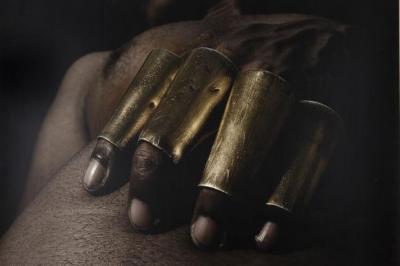
Other artists exhibiting include René Peña whose photographic
self-portraits, explore themes such as black identity and sexuality;
Gustavo Díaz Sosa, who will be at Beyond the Frame in person, and whose
work features diminutive human figures trapped in claustrophobic
landscapes; Eduardo Roca Salazar, known as Choco, who focuses on
portraits of farmers and Afro-Cuban women; and José Fuster, whose In the
Palm, includes several human figures which he says "maybe have been
saved from the terrorist action that Cuban people have suffered."
Beyond the Frame is sponsored by the Cuba Solidarity Campaign and the
Scottish Parliament's Cross Party Cuba Group
As you may know, I am Research Assistant for AHM, the wonderful Sam Ainsley, David Harding and Sandy Moffat.
AHM, Ray Mackenzie and Ross Birrell have voiced their concerns about the 'massive piece of art dubbed the Star of Caledonia' by Cecil Balmond which has been selected by the Gretna Landmark Trust to welcome travellers to Scotland.
The letter was published in the Herald on Wednesday 3rd August 2012
I am an artist making work that incorporates installation, video, sound, sculpture, performance, & writing to explore the human condition. I investigate ways to immerse the audience in multi-layered psychological & physical situations.
I trained at Leeds College of Art & Design (Foundation), Glasgow School of Art (BA (Hons) Fine Art: Sculpture & Environmental Art) and Newcastle University (Masters of Fine Art).
My lived experience of eating distress & obsessive compulsive disorder informs the work I create & the way I work. Some of the consequences of living with these conditions are that rigour, routine & attention to detail are fundamental to my way of life, all of which are integral to my creative practice; using the constraints of systems, I allow chance & playful elements to create unexpected results.
My work is regularly exhibited in solo & group exhibitions across the UK, USA, Canada & South Korea & is contained in various public collections. I have a number of public artworks, been commissioned to produce site-specific work & have taken part in national & international residencies, consistently since 2005.
2020-21
Awarded Arts Council England Developing Your Creative Practice funding for a printmaking residency with Charrington Editions
Byre-Group exhibition in which I created a site-specific installation alongside some creative writing
Everything Will Be Alright-an audio installation at Cheeseburn Sculpture, commission by curator Matthew Jarratt
Filling Time-a watercolour calendar-based work, currently exhibited at BALTIC centre for contemporary art
Lockdown Diary-a daily online process since March 2020, that has been acquired by the Wellcome Collection
Home Time-a creative tool for public, inspired by Lockdown Diary, commissioned by New Writing North
Inclusion in a new Alec Finlay publication.
I work in my studio at NewBridge Projects in Newcastle & as well as my solo work I collaborate with David Foggo as marginendeavour; I am often invited to speak to students, artists & facilitate workshops.
Website: www.helenshaddock.co.uk
Blog: https://helenshaddock.blogspot.co.uk/
Twitter: @hshaddock
Instagram: /helenshaddock
Facebook: /helen.shaddock
Vimeo: /hshaddock
YouTube: /helenshaddock
LinkedIn: /helen-shaddock
Education
Master of Fine Art, Newcastle University, 2016
BA (Hons) Fine Art: Sculpture and Environmental Art , Glasgow School of Art, 2008
Diploma in Foundation Studies (Art and Design), Leeds College of Art & Design, 2005






 Posts
Posts

