
Monday, 12 December 2016
Kate Stobbart : No Niceties contributing artist
Kate Stobbart exhibited a work called Fifteen minutes of picking at clay to the No Niceties exhibition.


No Niceties contributing artist - Edwin Li
I haven't forgotten about the remaining three artists who contributed to the 'No Niceties' exhibition that I have yet to blog about.

Not only did Edwin Li deliver his amusing interpretation of the 'A lot can happen in fifteen minutes' text in which he recited a number of alternative sentences that were constructed from rearranging the letters used in the 'Order of texts' page, but he also acted as an entertaining compare, introducing each of the performances to the audience.


Friday, 9 December 2016
Kayt Hughes - My Five Year Old Could Have Done That - Gallery North, Newcastle
The first prize is a year long £20,000 Fellowship, based in the Woon Tai Jee, studio located at BALTIC 39 in Newcastle’s city centre. It includes mentoring from staff from Northumbria University and the BALTIC Centre for Contemporary Art and a one person exhibition with catalogue at the end of the Fellowship.

My Five Year Old Could Have Done That is an exhibition of all new work by Kayt Hughes, the 2015-2016 Woon Tei Jee Fellow.
My Five Year Old Could Have Done That is an exhibition of new work by 2015-2016 Woon Tei Jee Fellow, Kayt Hughes. The work has been made as part of her year-long Fellowship.

"The building block is an object designed to take on a narrative; it can become many things and can perform many functions. The gallery evidences an interaction with the objects, using simple directions to instigate an action of chance, with consideration to the properties of the objects and their materials."
Downstairs, four different coloured blobs of plastercine sit on a table, each positioned in one quarter of a table. A long wooden plinth spans the back wall on which a selection of sculptures are placed. Each sculpture consists of a number of smaller wooden blocks, some with painted surfaces. Each sculpture takes a different shape, even though that are made from the same number of blocks.

Two sets of instructions for Gallery Assistants are written opposite the tables, one for the plastercine and one for the building blocks. The Gallery Assistants are asked to follow one instruction per shift. These include things such as "roll the plastercine to a thread as long as possible."

Upstairs, there are lots of wooden boxes in different arrangements. Again, some faces of the blocks and boxes are painted in cheerful, pleasant and complementary colours.
It's very simple, not that there is anything wrong with that, but the questions and statements on the wall in vinyl that accompany the different works seem patronising. I don't want to be told what to think in such a direct way, particularly because the work is so basic.

At first glance, the forms were aesthetically pleasing, but on closer inspection, I was disappointed to see that they were not particularly well made. When work is so minimal, one can hardly fail to notice the defects.

I must admit that I took pleasure from the colours and shapes, but I'm afraid that the work was lacking originality and risk. It was all very safe, very polite. There was not much to dislike (apart from the lack of polish in the way the boxes have been made), but for me, it was rather underwhelming.
Thursday, 8 December 2016
Our Colour Wheel

Colour Wheel, the forthcoming exhibition in the programme, features Georgina Starr, Liz West and Georgia Lucas-Going, a triptych of female contemporary artists who all studied at Leeds College of Art.
West is interested in human visual perception, particularly colour perception and how we all see and experience colour differently. For this exhibition she is asking Leeds College of Art alumni and staff to paint her their own interpretation of a traditional colour wheel (a pedagogical tool which has been at the foundation of her practice). Her aim is to illustrate our different perceptions of colour, how it is arranged and how we individually see and interpret colour. This series is part of her ongoing research into colour theory, human perception and light. The resulting collection of paintings will be exhibited together as a series in identical frames. After this exhibition West will open out this invitation to others.
The following instructions were given to the participants:
Paint your own interpretation of a traditional colour wheel.
Please use good quality white paper.
Please mix your own colour using only red, blue, yellow, black and white pigment
Use any type of paint or ink you wish
Annotate the painting if you feel suitable
Your colour wheel should fit the constraints of a 29.5cm x 29.5cm piece of white paper
A minimum diameter of 15cm for the colour wheel is necessary
Do not sign the artwork on the front I found the instructions quite limiting, particularly the rule that states that the colour wheel must be painted. I am very interested to see the range of responses that Liz has received.
Colour Wheel will open on Wednesday 14 December 5-7pm, and takes place at Vernon Street Gallery, Leeds College of Art.
The exhibition is open 15 December - 27 January 2017
For more information visit
http://www.leeds-art.ac.uk/news-events/events-exhibitions/2016/12/15/alumni-exhibition-colour-wheel/
http://www.liz-west.com/
Tuesday, 6 December 2016
A Bodyssey Odyssey Choir
At the weekend I participated in A Bodyssey Odyssey Choir, a singing workshop and performance led by artist Ditte Goard in response to A Bodyssey Odyssey, the current exhibition at BALTIC 39 by Pester & Rossi.

"The event was curated by Gayle Meikle as part of BxNU Respond, an ongoing dialogue between current Northumbria University post-graduate students and PhD researchers and the exhibitions in BALTIC’s Project Space, BALTIC 39.
Newcastle based Ditte Goard was asked to lead a singing workshop resulting in a performance to which members of the public could attend. Ditte works collaboratively with vocal performance and costume to explore ideas of 'folk' - especially folk song and storytelling. Going against our hierarchical and materialistic world, 'folk' traditions belong to no one and yet to anyone who claims it, without authority or regulation. Goard seeks to discover whether this autonomous activity can be used to give agency to both performer and audience, expand our engagement in political ideas and ultimately foster our sense of identity and independence."
There were about 20 people taking part in the workshop, a mixture of male and female, artists and non-artists, singers and non-singers. The presence of children in the group encouraged the adults to lose any inhibitions and enter in the playful spirit of the event.

We began the workshop with some warm-up exercises. Ditte had selected the song 'Women of the world' by Ivor Cutler for us to perform.
"Women of the world take over
'Cos if you don't, the world will come to an end
and it won't take long
and it won't take long"
Once we had learned the song, we decided on the actions that would accompany our singing.
We began stationary and low on the floor, humming. One by one we began singing the Ivor Cutler song, and it was during this that we started to move around the gallery space. Within the performance space we had an array of props and costumes made by Pester & Rossi for the exhibition. As we circulated the space, we began to adorn ourselves and each other with these various items and materials. There was a range of coloured face paints and pots of coloured glitter for us to use. These proved very popular with the children, and the adults were quick to join in. In the next 10 minutes or so the group entered into some kind of ritualistic activity. Although we were all singing the same song, we had started singing at different times, so it was a multilayered round that somehow sounded like a meditative chant. We interacted with each other, painting each others faces, putting garments on each other, scattering glitter over each other and so forth. At one point, one individual laid on the floor and we began walking round them in a circle as if in a form of worship.
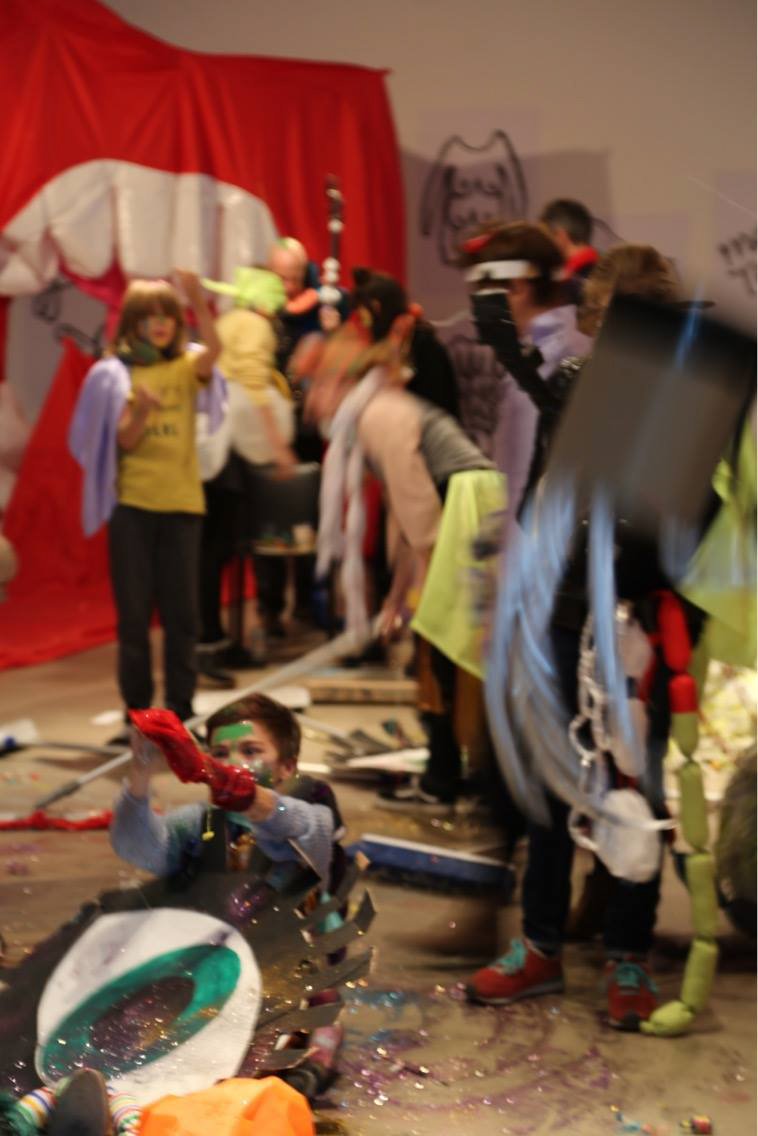
The introduction of party poppers signalled the time for us to stop singing and return to the humming as at the beginning. We removed the various costumes, props and materials we were each wearing, and used the supply of sweeping brushes to gather the glitter and party popper ribbons into a pile. Gradually we all slowed down and took a static position on the floor. Our humming simultaneously became quieter until it stopped completely, marking the end of the performance.
The description above does not do justice to what happened, but I guess that is often the case with art. There was a bond between the performers, even though we had only met as a group less than three hours earlier.
I was surprised to realise the size of the audience that had gathered to witness the performance. Probably the youngest member of the audience (no older than 1 years old) joined in the performance in the latter stages. Not yet able to walk, she shuffled along the floor, thoroughly enjoying covering herself in glitter.

What a wonderful way to begin the weekend. It certainly made me twinkle inside and out! Thanks to all those who made it happen.
Friday, 2 December 2016
Fine tuning the Drone instruments
Over the past few weeks we have been redesigning and modifying some of our existing instruments. In some instances the improvements are being made to make the instruments easier to transport and store, and in other cases the changes are to have an effect on the sound produced by the instrument.
We have been redesigning the tube gurdys so that they do not all need to have their own individual stands which take up lots of space and are difficult to transport. Rather than the wheel being fixed in the stand, we are making some hand-held wheels that can be used on a number of instruments.

Joe has been developing the wheel so as to produce the most consistent and least 'tinny' sound. There have been a number of trials that have not worked which is frustrating, but these have helped us get closer to what we want, so they were not in any way a waste. The wheels we are making at the moment are made from wood which creates a solid and robust sound. The rim of the wheel is covered with a band of felt, and then the felt is covered with fishing wire that has been wrapped in an even layer with no bumps. A layer of special strong glue is applied and then rosin. The wheel is then ready for turning against the strings on an instrument or against a tube on the tube gurdy.
The process of wrapping the fishing line around the wheel was incredibly tricky as my eyes found it difficult to keep track of the edge of the fishing line and ensure that it was not overlapping with the previous thread.

As Charlotte and I tackled the wheel, Joe and Ben were working on the wah-wah contraption. The theory was that by using springs at the bottom of the instrument, when the flap was opened and closed during playing, a kind of wah-wah sound would be made. Unfortunately, in practice this was not the case! iu hjbuu
Thursday, 1 December 2016
No Niceties contributing artist - Kathryn Brame

"Absence, loss, time and memory are all key concerns that influence my practice and after reading Helen’s text ‘A lot can happen in fifteen minutes’, it became clear to me there were similarities between our work. I felt that while the texts described a collection of awkward moments, they also portrayed a real sense of loneliness and isolation and of an individual having to deal with each of these scenarios alone. Sections of text such as: “You opened your eyes. Desperately searching for him. He was not there” and “She avoids you. As much as you avoid her” all spoke to me as moments of struggle and frustration with human connection."

"My work has often involved a single figure placed within a void, removing any clear sense of time or context. The space surrounding the subject and in which the work is shown is integral, serving perhaps as a form of protection, a means of heightening the subject’s importance or space for the viewer to add their own narrative. I submitted two pieces of work in response to Helen’s text – the first was a painting of a small figure looking out of the picture plane into the room, possibly searching for something or someone. I thought this work echoed the sense of loneliness I felt emanating from the texts."
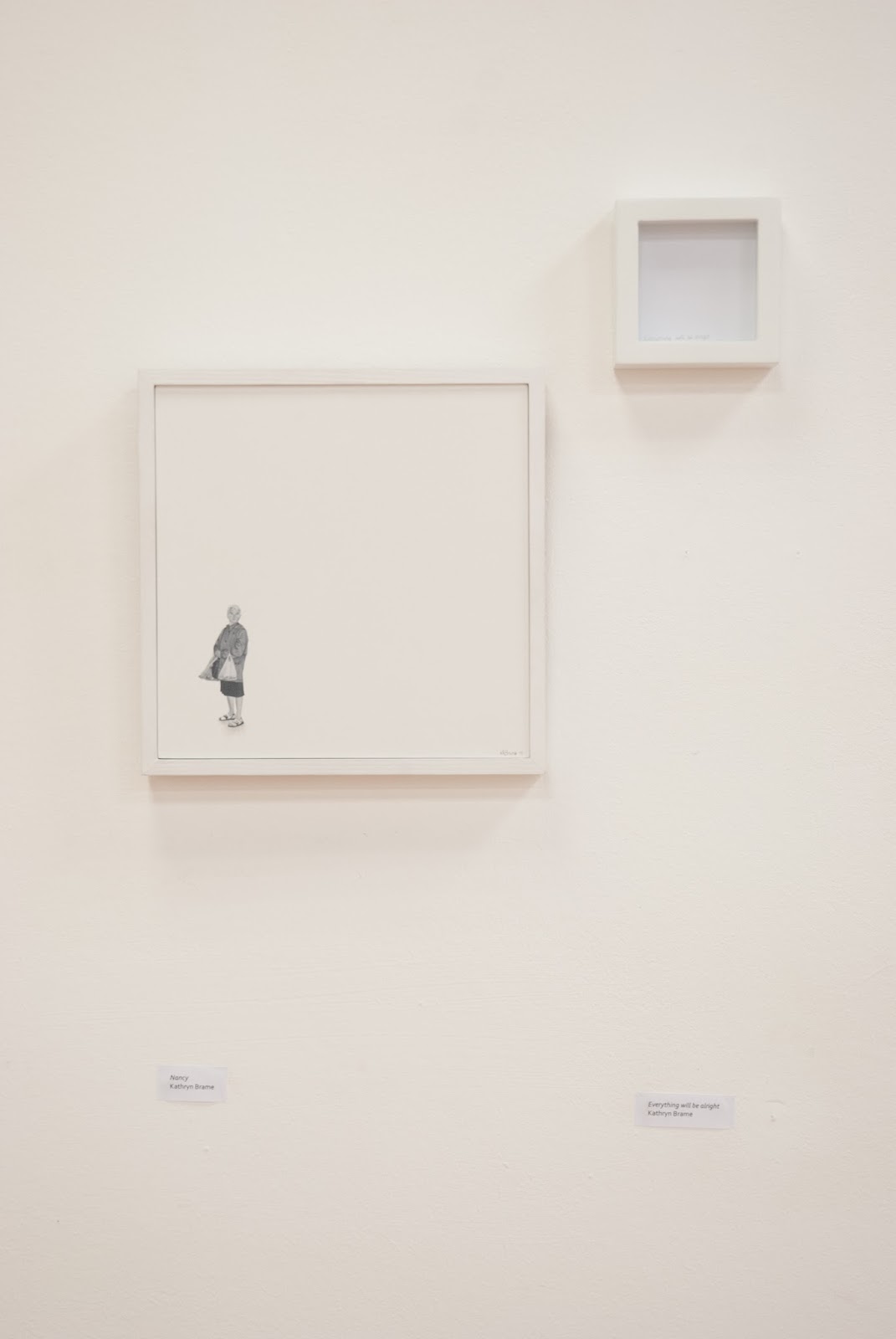
"I also showed a very small text piece called ‘Everything will be alright’. This was a line taken directly from the text ‘You stand at the platform’ but was also a line used by Helen in her MFA Degree show sound piece ‘Everything will be alright’. I felt this line summed up the general feeling of all of the texts - that although these awkward and difficult moments have happened, there is still a sense of hope that everything will be alright."
www.kathrynbrame.com
Tuesday, 29 November 2016
No Niceties contributing artist - Holly Wheeler
Newcastle-based artist Holly Wheeler exhibited 3 photoshopped collages titled Well… this is awkward.

Here she offers us an insight into her ideas leading to the work.

"Initially I wanted to respond to the aesthetic properties of
Helen’s publication. The specific formatting, colour scheme and precision with
which it was assembled, readily caught my attention.
-->

I chose instead, to respond to the awkward silences and
fragmentation that punctuates the work. For me it reveals a shared discomfort
and uncertainty within the narrator and the reader as they are confronted by the
intimacy of the work. ‘Well…this is awkward’ is a light hearted attempt to
voice the internal critic and acknowledge a mutual sense of anxiety the work
might stir within the narrator, reader, author and artist."

layering/collage/photoshop/distance/green/online/advice/repetition/obsess
ive behaviour/repair/self-help/self-care/language/communication/thought/reality/
mental/internal/vanishing/merging/objects/mark
making/projection/distance/temporary/humorous/light hearted/lost/vibrancy/perception/displacement/uncertain
ty/uncontrollable/space/placement/fragile/ incomplete/unfinished/evolving/morphing/reshaped/indeterminate
/stuck

To see and read more about Wheeler's work please visit
No Niceties contributing artist - Sofija Sutton
Brooklyn-based artist Sofija Sutton contributed Sweet, Hold the Bitter to the No Niceties exhibition.
She states, "My current art practice explores the use of flash fiction and folklore in video, painting, collage, and multidiscipline installations. I use narratives and visuals to tell layered metaphors for daily, intimate life. The most common themes I address are belonging and mental health. I particularly enjoy using anamorphism with invertebrate references in magical realism to juxtapose the absurd with the mundane.
Each project’s message dictates the materials of my work. Some meanings require text, while others may be communicated with paint alone. Some works benefit from collaboration and some works require learning new technologies. Allowing the meaning of the work to direct the form it takes allows me to be open to new experiences while maintaining the importance of the story’s message."

Sutton shares some of her initial thoughts that led to the end result:
how i wanted one story to go
- how I want the word playful to be associated in my head. not playful but investigative and introspective and innately human. yes.
(I related too closely)
how it went.
I just wanted one sweet hold the bitter end so I could think you have some sweet hold the bitter moments. but thats not really how feelings are felt in hindsight.
in fifteen minutes my tea can go cold.
-flying pill bug baby, roll and pop!
- you settle into your train seat.
- your friends talk a lot about babies and weddings
- you live a different life than them
ticking clock with an empty desk and chair. plain.
toxic colors, acidic or washed out, jarring. initial impression of joy masking the anxiety and compulsion.

For more information about Sofija's practice, please visit
She has also just launched her new illustration website showcasing watercolor and collage illustrations. Check it out!
She states, "My current art practice explores the use of flash fiction and folklore in video, painting, collage, and multidiscipline installations. I use narratives and visuals to tell layered metaphors for daily, intimate life. The most common themes I address are belonging and mental health. I particularly enjoy using anamorphism with invertebrate references in magical realism to juxtapose the absurd with the mundane.
Each project’s message dictates the materials of my work. Some meanings require text, while others may be communicated with paint alone. Some works benefit from collaboration and some works require learning new technologies. Allowing the meaning of the work to direct the form it takes allows me to be open to new experiences while maintaining the importance of the story’s message."

Sutton shares some of her initial thoughts that led to the end result:
how i wanted one story to go
- how I want the word playful to be associated in my head. not playful but investigative and introspective and innately human. yes.
(I related too closely)
how it went.
I just wanted one sweet hold the bitter end so I could think you have some sweet hold the bitter moments. but thats not really how feelings are felt in hindsight.
in fifteen minutes my tea can go cold.
-flying pill bug baby, roll and pop!
- you settle into your train seat.
- your friends talk a lot about babies and weddings
- you live a different life than them
ticking clock with an empty desk and chair. plain.
toxic colors, acidic or washed out, jarring. initial impression of joy masking the anxiety and compulsion.

For more information about Sofija's practice, please visit
Subscribe to:
Posts (Atom)

 Posts
Posts

