Showing posts with label December 2016. Show all posts

Monday, 9 January 2017

The Hepworth Prize for Sculpture - David Madalla

It is fair to describe David Medalla's practice as varied and expansive. In his 70 year career, the work he has made includes painting, sculpture, participatory work, kinetic art, installation and performance. The different works presented in this exhibition are a good representation of his multidisciplinary approach.

For the exhibition at The Hepworth Gallery, Medalla exhibits one of his so called Auto Creative Sculptures, Cloud Canyons.

Cloud Canyons consists of a number of clear plastic pipes standing in a circular plinth. Foam is forced up and out of the tubes, and as the foam rises, it doubles back on itself and falls down the tubes and the cycle begins again. I find it mesmerizing; rather like watching flames in an open fire. The natural rhythm and movement of nature.


I find the work in the other room far less engaging. Medalla invites the audience to contribute to A Stitch In Time, another work from the sixties that Medalla is exhibiting at The Hepworth. Fabric is suspended in the gallery, and visitors are encouraged to sew any items they wish to onto the fabric. As is often the case with such participatory work, we are left viewing an accumulation of rubbish, used train tickets, shopping lists and chocolate bar wrappers. Surely we've moved beyond this kind of work.

David Medalla, Sand Machine, 1963/2015 from Venus Over Manhattan on Vimeo.


http://www.hepworthwakefield.org/about/hepworth-prize-for-sculpture/the-hepworth-prize-for-sculpture-shortlist-david-medalla/

Wednesday, 4 January 2017

The Hepworth Prize for Sculpture - Helen Marten

Having only seen Helen Marten's work in image form as opposed to the actual thing, I was curious and excited to get to experience it first hand. 


Marten's use of an eclectic mix of materials appeals to me, and I enjoy the way in which she forms relationships between seemingly unconnected objects and surfaces. Materials used in her work on display at The Hepworth Gallery include a tennis ball, dried vegetables, wood, steel, screenprinted leather and fired clay.


Read more at:

http://www.hepworthwakefield.org/news/helen-marten-wins-the-first-hepworth-prize-for-sculpture/

https://www.theguardian.com/artanddesign/2016/nov/17/helen-marten-wins-hepworth-prize-for-sculpture

https://www.a-n.co.uk/news/helen-marten-wins-inaugural-hepworth-prize-for-sculpture

Tuesday, 3 January 2017

The Hepworth Prize for Sculpture - Steven Claydon

Over the next few blog posts I am going to guide you through one of the current exhibitions at The Hepworth Gallery in Wakefield, namely The Hepworth Prize for Sculpture. 

The experience of Steven Claydon's work begins as one walks through a curtain of yellow plastic, the kind that could be found in a factory or supermarket, as the fringe separating the shop floor from behind the scenes in the stockroom. Claydon tests the boundaries of sculpture, making work that often engages multiple senses including smell and sound. In this work Claydon has infused the curtains with citronella, a scent used to repulse mosquitoes and midges. 


He uses materials in inventive and surprising ways, sometimes creating objects that appear to be made from a material such as wood but that are actually made from a substance such as polyurethane. Seemingly historic artefacts are positioned in relation to contemporary objects, prompting the viewer to question what they are looking at and question how they value such things. 


Claydon made use of one of the freestanding walls in the gallery. "He covered it in dark blue magnetic film, then threw pennies at it." From afar it resembles a constellation of stars in a nights sky, but only on closer inspection does it become apparent that it consists of pennies attached to the background.


Of the four artists included in the Hepworth Prize for Sculpture, I felt most distant from Claydon's work. It might be Claydon's use of trickery that I find dissatisfying. A barrier is created between the artist and the audience, the artist being the one with the upper hand and the knowledge, and the audience as those who are being deceived. This has the effect of making the work seem dishonest and cold. If it were not for one of the gallery invigilators who told me a story behind one of the works, I would be unaware of the references to Jurassic Park. Claydon's work seems very impressive and intelligent, but I felt separate from it and found it difficult to engage with on a deeper level. That said, the skill that goes into making the work is evident and it is good to see an artist who obviously enjoys making beautiful objects.


Read more at: 

http://www.yorkshirepost.co.uk/what-s-on/arts/art-on-the-edges-1-8198783

http://theartnewspaper.com/news/news/new-hepworth-sculpture-prize-launches-with-exhibition-in-wakefield/

http://www.wallpaper.com/art/the-inaugural-hepworth-sculpture-prize-nominees-exhibition#177880

Monday, 2 January 2017

The Hepworth Prize for Sculpture at The Hepworth Gallery in Wakefield

During my visit to Yorkshire this Christmas I was keen to check out the The Hepworth Prize for Sculpture at The Hepworth Gallery in Wakefield. The Hepworth Prize for Sculpture is the UK's first Prize for Sculpture. It is a new £30,000 biennial award that recognises a British or UK-based artist of any age, at any stage in their career, who has made a significant contribution to the development of contemporary sculpture.  It is an integral part of The Hepworth Gallery's 5th anniversary celebrations and named in honour of Barbara Hepworth.


The 2016 shortlisted artists are (in alphabetical order):
- Phyllida Barlow
- Steven Claydon
- Helen Marten
Simon Wallis, Director of The Hepworth Wakefield and Chair of the Selecting Panel said: “We are delighted to have such a strong and diverse shortlist for our inaugural Prize and are looking forward to working with these artists and to inspire and engage our audiences with the medium of sculpture. It is particularly fitting that we launch the first Prize of its kind, here in the heart of the Yorkshire Sculpture Triangle.”
He added: “While there is no shortage of prizes in the art world, few specifically recognise sculpture and it is our aspiration to redress that with the launch of one of the UK’s most important new awards. We have based the selection of the four shortlisted artists on the significance of their contribution to sculpture in its broadest definition.”

Monday, 26 December 2016

Happy festive times and here's to a wonderful 2017

I would like to thank you for taking the time and making the effort to read my blog, and I hope that you find it enjoyable.

I would like to take this opportunity to pass on my Christmas greetings to you. I hope that 2017 fills you with happiness.


Over the next few blogs I will be looking back at 2016 and reviewing things that Ive been involved in. I will also be sharing some of what is in store for 2017.

Tuesday, 20 December 2016

Radio 4's 'Something Understood' ponders Is Art Good For Us?

In the latest episode of BBC Radio 4's Something Understood (Sunday 18th December 2016) "the poet Michael Symmons Roberts explores the idea that the arts are good for us - body and soul - and considers whether they can be both tonic and threat to society.
He says, "Art is as various as we are, and its moral weight and status is unstable, unpredictable. In times when people are losing trust in politics and religion, art can start to look like a replacement. But if we put too much of our moral weight and hope into art, we imperil it, and it can imperil us too."
Some of the great Victorian philanthropists thought art would benefit society and used their wealth to make art freely available to the masses. Whether or not the original Turner paintings offered in a Manchester museum,improved the lives of the working class is not evidenced, but the continued idea that the arts are of moral benefit persists.
Roberts offers the example of Ken Loach's groundbreaking film Cathy Come Home as a sign that society can be improved through the arts - along with the way Bob Dylan and others used their music to effect social change in the US during the 1960s.
But he also strikes a note of caution. "The arts can act as the conscience of the state, a challenging force for good. But they can equally be used as an instrument of propaganda. Whenever I hear the arts per se being touted as a positive moral and political force in society, I start to feel uneasy." Using evidence of Nazi propaganda from the Second World War, he also points out that a love of art is not necessarily an indication of a healthy morality.
Roberts concludes that art is not per se a good thing for us, but that he 'couldn't imagine, and wouldn't want to, a life without music or poetry or films or paintings'."

http://www.bbc.co.uk/programmes/b08557zj

Wednesday, 14 December 2016

Liz West featured in FRAME

I was delighted to be able to meet up with artist Liz West while she was in Newcastle. Liz recently invited me to contribute to 'Our Colour Wheel', a new work in a three-person alumni exhibition at Leeds College of Art's Vernon Street Gallery, part of the College's 170's Birthday celebrations. The exhibition opens tomorrow night, Wednesday 14th December 2016 and runs until 27 January 2017. Liz was able to show me a sneak preview of the works that will be in the exhibition, and I will share some of these once the exhibition has opened.


Liz was also excited to show me the latest edition of FRAME magazine. "Frame is the go-to reference for designers and interior architects." Since its inception, the magazine has identified the world’s most innovative interiors, and the December 2016 publication features an article about Liz West and her installation Our Colour Perception.


"Liz West creates vivid environments that mix luminous colour and radiant light. Working across a variety of mediums, West aims to provoke a heightened sensory awareness in the viewer through her works. She is interested in exploring how sensory phenomena can invoke psychological and physical responses that tap into our own deeply entrenched relationships to colour.


West's investigation into the relationship between colour and light is often realised through an engagement between materiality and a given site. Within physical and architectural space, West uses light as a material that radiates outside of its boundaries and containers. She playfully refracts light through using translucent, transparent or reflective materials, directing the flow of artificial and natural light. Our understanding of colour can only be realised through the presence of light. By playing and adjusting colour, West brings out the intensity and composition of her spatial arrangements."


Friday, 9 December 2016

Kayt Hughes - My Five Year Old Could Have Done That - Gallery North, Newcastle


The Woon Foundation Painting and Sculpture Art Prize is open to all UK final year undergraduate Fine Art students via an open submission process.

The first prize is a year long £20,000 Fellowship, based in the Woon Tai Jee, studio located at BALTIC 39 in Newcastle’s city centre. It includes mentoring from staff from Northumbria University and the BALTIC Centre for Contemporary Art and a one person exhibition with catalogue at the end of the Fellowship.

My Five Year Old Could Have Done That is an exhibition of all new work by Kayt Hughes, the 2015-2016 Woon Tei Jee Fellow.


My Five Year Old Could Have Done That is an exhibition of new work by 2015-2016 Woon Tei Jee Fellow, Kayt Hughes. The work has been made as part of her year-long Fellowship.


"The building block is an object designed to take on a narrative; it can become many things and can perform many functions. The gallery evidences an interaction with the objects, using simple directions to instigate an action of chance, with consideration to the properties of the objects and their materials."

Downstairs, four different coloured blobs of plastercine sit on a table, each positioned in one quarter of a table. A long wooden plinth spans the back wall on which a selection of sculptures are placed. Each sculpture consists of a number of smaller wooden blocks, some with painted surfaces. Each sculpture takes a different shape, even though that are made from the same number of blocks.


Two sets of instructions for Gallery Assistants are written opposite the tables, one for the plastercine and one for the building blocks. The Gallery Assistants are asked to follow one instruction per shift. These include things such as "roll the plastercine to a thread as long as possible."


Upstairs, there are lots of wooden boxes in different arrangements. Again, some faces of the blocks and boxes are painted in cheerful, pleasant and complementary colours.

It's very simple, not that there is anything wrong with that, but the questions and statements on the wall in vinyl that accompany the different works seem patronising. I don't want to be told what to think in such a direct way, particularly because the work is so basic. 


At first glance, the forms were aesthetically pleasing, but on closer inspection, I was disappointed to see that they were not particularly well made. When work is so minimal, one can hardly fail to notice the defects.


I must admit that I took pleasure from the colours and shapes, but I'm afraid that the work was lacking originality and risk. It was all very safe, very polite. There was not much to dislike (apart from the lack of polish in the way the boxes have been made), but for me, it was rather underwhelming.

Thursday, 8 December 2016

Our Colour Wheel


In October I received an invite to contribute to Our Colour Wheel, an ongoing project by artist Liz West which will be exhibited as part of a three person exhibition at Leeds College of Art. "Throughout 2016 Leeds College of Art has been celebrating 170 years of art education in Leeds. In recognition of the history of the College and the achievements of alumni, the Vernon Street Gallery in the College’s historic 1903 building is hosting a series of group exhibitions celebrating the diverse and ground breaking careers of past students and staff."

Colour Wheel, the forthcoming exhibition in the programme, features Georgina Starr, Liz West and Georgia Lucas-Going, a triptych of female contemporary artists who all studied at Leeds College of Art.

West is interested in human visual perception, particularly colour perception and how we all see and experience colour differently. For this exhibition she is asking Leeds College of Art alumni and staff to paint her their own interpretation of a traditional colour wheel (a pedagogical tool which has been at the foundation of her practice). Her aim is to illustrate our different perceptions of colour, how it is arranged and how we individually see and interpret colour. This series is part of her ongoing research into colour theory, human perception and light. The resulting collection of paintings will be exhibited together as a series in identical frames. After this exhibition West will open out this invitation to others.

The following instructions were given to the participants:

Paint your own interpretation of a traditional colour wheel.
Please use good quality white paper.
Please mix your own colour using only red, blue, yellow, black and white pigment
Use any type of paint or ink you wish
Annotate the painting if you feel suitable
Your colour wheel should fit the constraints of a 29.5cm x 29.5cm piece of white paper
A minimum diameter of 15cm for the colour wheel is necessary
Do not sign the artwork on the front I found the instructions quite limiting, particularly the rule that states that the colour wheel must be painted. I am very interested to see the range of responses that Liz has received.


Colour Wheel will open on Wednesday 14 December 5-7pm, and takes place at Vernon Street Gallery, Leeds College of Art.

The exhibition is open 15 December - 27 January 2017

For more information visit
http://www.leeds-art.ac.uk/news-events/events-exhibitions/2016/12/15/alumni-exhibition-colour-wheel/

http://www.liz-west.com/

Tuesday, 6 December 2016

A Bodyssey Odyssey Choir

At the weekend I participated in A Bodyssey Odyssey Choir, a singing workshop and performance led by artist Ditte Goard in response to A Bodyssey Odyssey, the current exhibition at BALTIC 39 by Pester & Rossi.


"The event was curated by Gayle Meikle as part of BxNU Respond, an ongoing dialogue between current Northumbria University post-graduate students and PhD researchers and the exhibitions in BALTIC’s Project Space, BALTIC 39.

Newcastle based Ditte Goard was asked to lead a singing workshop resulting in a performance to which members of the public could attend. Ditte works collaboratively with vocal performance and costume to explore ideas of 'folk' - especially folk song and storytelling. Going against our hierarchical and materialistic world, 'folk' traditions belong to no one and yet to anyone who claims it, without authority or regulation. Goard seeks to discover whether this autonomous activity can be used to give agency to both performer and audience, expand our engagement in political ideas and ultimately foster our sense of identity and independence."

There were about 20 people taking part in the workshop, a mixture of male and female, artists and non-artists, singers and non-singers. The presence of children in the group encouraged the adults to lose any inhibitions and enter in the playful spirit of the event.


We began the workshop with some warm-up exercises. Ditte had selected the song 'Women of the world' by Ivor Cutler for us to perform.

"Women of the world take over
'Cos if you don't, the world will come to an end
and it won't take long
and it won't take long"

Once we had learned the song, we decided on the actions that would accompany our singing.

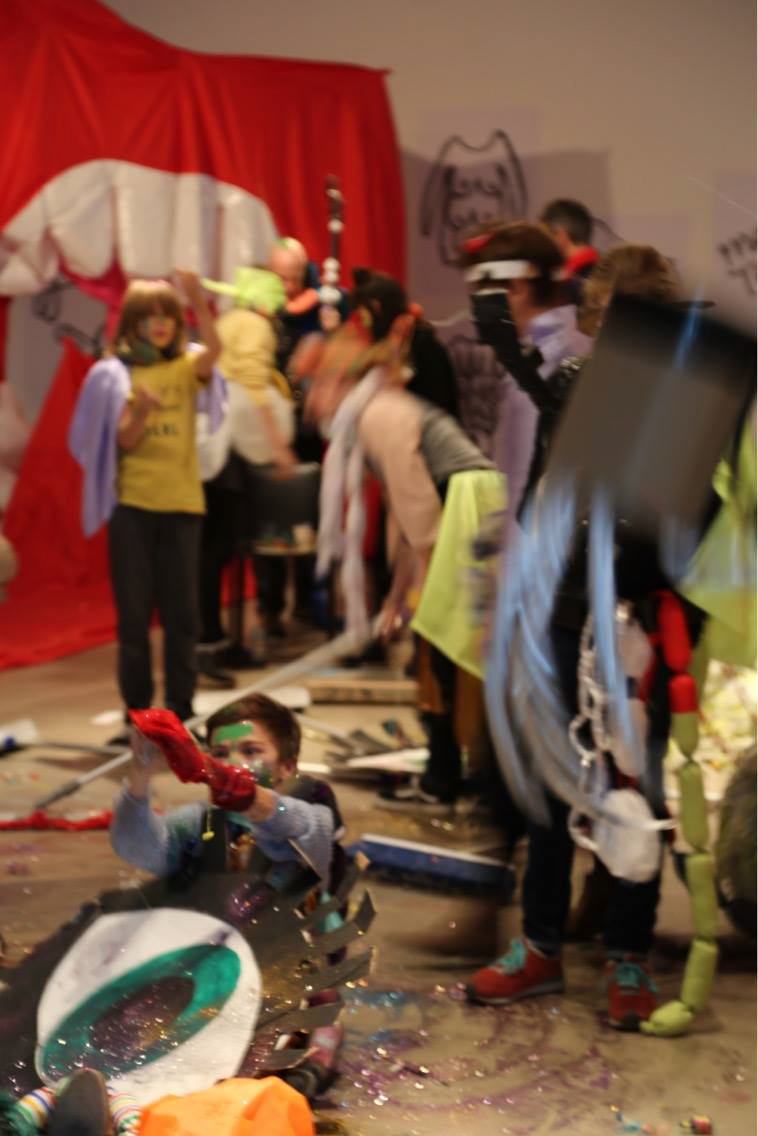
We began stationary and low on the floor, humming. One by one we began singing the Ivor Cutler song, and it was during this that we started to move around the gallery space. Within the performance space we had an array of props and costumes made by Pester & Rossi for the exhibition. As we circulated the space, we began to adorn ourselves and each other with these various items and materials. There was a range of coloured face paints and pots of coloured glitter for us to use. These proved very popular with the children, and the adults were quick to join in. In the next 10 minutes or so the group entered into some kind of ritualistic activity. Although we were all singing the same song, we had started singing at different times, so it was a multilayered round that somehow sounded like a meditative chant. We interacted with each other, painting each others faces, putting garments on each other, scattering glitter over each other and so forth. At one point, one individual laid on the floor and we began walking round them in a circle as if in a form of worship. 


The introduction of party poppers signalled the time for us to stop singing and return to the humming as at the beginning. We removed the various costumes, props and materials we were each wearing, and used the supply of sweeping brushes to gather the glitter and party popper ribbons into a pile. Gradually we all slowed down and took a static position on the floor. Our humming simultaneously became quieter until it stopped completely, marking the end of the performance.

The description above does not do justice to what happened, but I guess that is often the case with art. There was a bond between the performers, even though we had only met as a group less than three hours earlier.

I was surprised to realise the size of the audience that had gathered to witness the performance. Probably the youngest member of the audience (no older than 1 years old) joined in the performance in the latter stages. Not yet able to walk, she shuffled along the floor, thoroughly enjoying covering herself in glitter. 


What a wonderful way to begin the weekend. It certainly made me twinkle inside and out! Thanks to all those who made it happen.