Monday, 18 February 2013

Market Gallery Residency - day 7

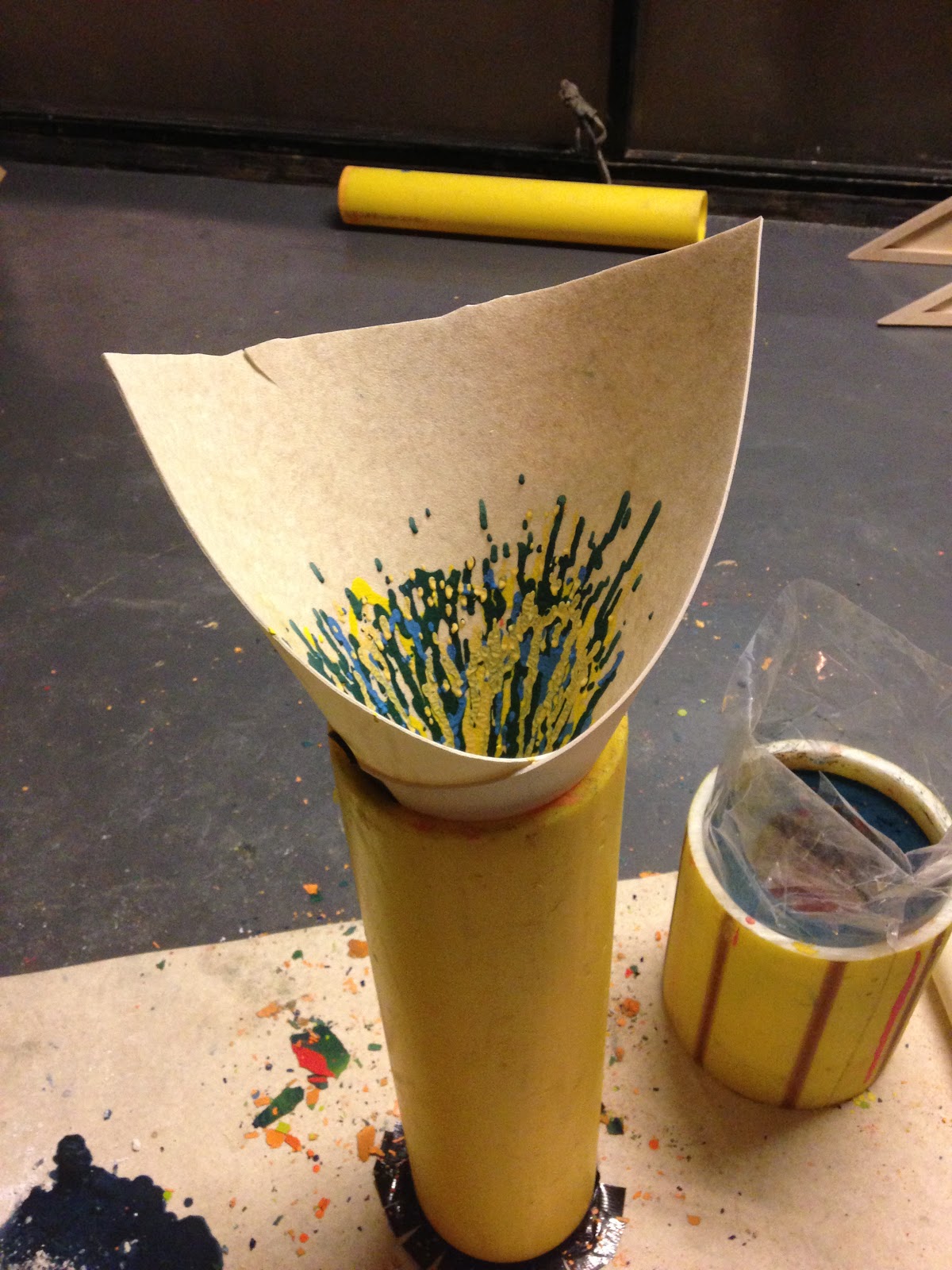
I am very pleased with the funnel shaped plaster casts that I made yesterday.


 The moment of truth (when the mould is removed) is an exciting but nervewracking moment, and it was good to share this with Debbie (one of my wonderful helpers), Tess and Jason, who were walking past and came to look at what we were doing.


I will need
 to think carefully how I install the objects, and will test out alternative modes of display.


I poured the plaster into a shape created with perspex walls, and expect that the plaster will form a thin sheet.


Saturday, 16 February 2013

Market Gallery Residency - Day 6

After yesterday's fiasco with removing the sculpture from the mould, today I did a few experiments to investigate how the plaster reacts to different materials and surfaces.


I wrapped parcel tape around the edges of some cardboard, and poured the plaster into the shape formed by the boundaries of the cardboard pieces.


I also tried pouring the plaster down a piece of perspex and let the dribbles run into the shape formed on the floor by the edges of another 2 pieces of perspex.


I made a cone of cellophane to sit inside the lino funnel.


I dripped layers of coloured plaster into the cellophane cone.

The same method was used for another funnel, and then I filled the cone with plaster.


In another funnel, I dripped the plaster around the mould, and then poured some plaster into the bottom, before swilling this around the mould.


 Once filled and moved around the mould, I left it to rest in a box of polystrene bits in order for it to set in an angled manner.


I am much happier with the range of colours I mixed today as they are less like primary colours, and appear more considered.

Market Gallery Residency - day 5

My first task today was to complete the birch plywood boards that I've been working on. I glued 12mm birch plywood around the edge of the triangular shapes to give them depth. I chose the birch plywood because I like the grain and the layers. Last week I prepared some large triangular structures and had left them in clamps to dry, so today I needed to trim the edges using a very handy piece of equipment called a fez tool. This enabled me to take a thin slice off the outside of the boards so as to create a clean edge.


With the help of my wonderful friend Kev, we transported the boards to the Market Gallery.

I had intended to either collage or print onto the surface of the boards, but now realise how much I like them in their current state, and completely covering the grain would hide some of the characteristics of the wood that I admire.


When Laura arrived to help, we began to remove the pipe mould from one of the pieces I had worked on yesterday. 3 hours later and we still had not managed to get the plaster out of the tube. Even resorting to sawing the mould and dropping the cylinder proved
 unsuccessful.


Lesson learned - don't cast from large pipes unless you have a good system for getting the plaster out of the mould! This has made me seriously reconsider how I am going to change the process of making these type of sculptures, or indeed if I would rather work on other ideas.

I noticed that passers-by were stopping to watch us making, and I hope that this curiosity continues and people enjoy watching the development of work. One man, Des, came into the space to find out what we were doing, and mentioned that the cylinders and colours had made him think about sticks of rock. He also kindly offered to lend his electric saw to help out with removing the mould, an offer I eagerly accepted!


I decided to remove the mould from the funnel cast that I had begun yesterday. I am very intrigued by the outcome of this test, and am going to explore the possibilities further.


Laura raised a very pertinent point when considering the colours used. She picked up on the fact that the colours are those related to the two main football teams in Glasgow, Rangers and Celtic, and the Orange order that exists in the city. I am very conscious that it is not my intention to comment on this situation, but think this can be avoided if I am using a wide range of colours and so the green, blue and orange shades are distributed amongst lots of different colours.


We then began casting a couple more funnel sculptures, one in which I dripped plaster into the mould and want to build up layers of drips, and the other combining dripping with pouring the plaster into the bottom. These different ways of making the sculpture will effect the appearance of the sculpture.


During the casting process Laura, (who had never done this before) commented how she was fascinated by the way the plaster soaks up the colour, and this is something that could be videoed.


Friday, 15 February 2013

Market Gallery Residency - Day 4

I've really enjoyed today; lots of making, some wonderful volunteers (Brogan and Nikki F) helping me, and lots of progress made.


Thursday, 14 February 2013

Market Gallery Residency - Day 3

Today has been one of those days when, despite my best intentions, I seem to have made little progress, and I am therefore rather anxious.

I seem to have spent much of the day dealing with deliveries. Christmas has come early for me!

David from Screenchem delivered my screenprinting equipment, including two beautiful screens and a couple of squeegees. I am really impressed with the service provided by the company. David was ever so helpful when I spoke to him prior to placing an order, and his honesty and generosity do not go unnoticed. Once again, he advised me on how best to care for the equipment in order to prolong its life.


My second delivery was from Special Plasters, another organisation with staff who are happy to answer any queries. I have purchased a wider range of colours of plaster pigments, and look forward to mixing a range of new colours.


Tony, the barber next door, brought round my final delivery - cardboard!


I enjoyed hearing all about Solaris from Pauline and Rebecca. They have such wide range of practices and have done so many interesting projects.

Pauline is a lighting specialist and so I think I will be tapping into her experience when working towards the exhibition.

We were talking about how we want to use the residency as a testing and experimenting time, but we all have the pressure in the back of our minds of the exhibition, and because the residency is so much about playing, we don't really know the end result. But I guess that is the exciting thing!

Rebecca told me of a quote by a theatre group called Goat Island:

"You discover the performance by making it"

I think that is really pertinent to this project.

Good news is that Rebecca has managed to shift her commitment on 15th March and so we are now going to have our exhibition opening on Friday 15th March rather than the 8th. This gives us another week to play with, although looking at my diary I see that I am rather busy with other work commitments. Its good to have a bit of extra time though.


Wednesday, 13 February 2013

Market Gallery Residency - Day 2

As I struggled to open the roller shutter to Gallery 3, the local hairdresser passed and gave me a hand. Note to self: it helps if one is trying to open the correct shutter! My excuse - it's only day 2 and all the shutters look the same!


I met with another couple of volunteers; firstly Brogan, a Fine Art graduate from the University of Cumbria. I am so pleased that so many people are keen to help.


I'm beginning to realise how many events Market Gallery run and things the gallery is involved in. On Tuesday evenings Roos Dijkhuizen leads 'AIRPLAY', inflatable building classes. She came in to set up for the class, and I learned about how the inflatable sculptures will be installed in a local 'Stalled Space'. Stalled Spaces is an initiative run by Glasgow City Council in partnership with Glasgow Housing Association (GHA), in which small grants are given to communities across Glasgow to help them temporarily take on and breathe new life into sites which are currently stalled or unused.

Read more about the Stalled Spaces initiative here:

http://www.glasgow.gov.uk/index.aspx?articleid=5118


Roos is a Printmaking graduate from Grays School of Art, and I told her about my plans to do some DIY screenprinting without exposing the screen. Roos suggested using watercolour on the screen and then pulling emulsion over the screen to transfer the watercolour pattern to the surface below. This is a process she has used, and some of her works made in this way can be seen on her blog:

http://roosmariedijkhuizen.tumblr.com/


This evening I met with Nikki K, (as opposed to Nikki F who I met yesterday!), who is a graduate from Glasgow University's History of Art department. Nikki is unfamiliar with the process of making art, and is interested to experience how work comes into being. She currently works for NVA, the Scottish arts organisation that strives to "make powerful public art articulating the complex qualities of a location through collective action. [Their] practice engages participants physically and creatively in redefining urban and rural landscapes. [They] take the existing landscape as a starting point for uncovering complex underlying realities, revealing how places shape and are shaped by their inhabitants."

Read more about NVA here:

http://www.nva.org.uk/

Following the success of 'Speed of Light' at Edinburgh Art Festival in 2012, NVA will take 'Speed of Light'  to Salford’s waterfront from Thu 21 – Sat 23 March. Nikki has the challenging but fun job of helping to make  this happen!

With so many people to meet I have not really got into making work yet, but am chomping at the bit as they say!

I find it useful to refer back to my proposal that I submitted many months ago in 2012. Key aspects of the proposal are:

"to conduct intensive research into colour and test the possibilities of  combining controlled processes with chance elements when making work."

I "seek to establish a relationship between the sculptural objects, floor and wall", and make the most of the space, enabling me to work on a larger scale and experiment with the installation of work.

I am trying to relax about the exhibition, seeing it as an opportunity to reveal what I have been doing during the residency. Basically, I want to focus on making, PLAYING, and experimenting with material and processes and see what develops!

This is easier said than done as I am always striving to make the best work I can, and it is a challenge for me to loosen up and go with the flow!


I ended my day by making a cardboard structure and am thinking about how I could make the raised surfaces colourful and any elements that are floor-based could be grey.


Tuesday, 12 February 2013

Market Gallery Residency - Day 1

Today felt a bit like the first day at school in the sense that there was lots to take in; a new routine to be followed, new surroundings to adapt to and make your own and new people to get to know. I even had the 'first day back at school' nerves, but this was matched with the excitement I feel about having the time and space to concentrate on my own work.

Yesterday (Sunday) I had moved some of the contents of my studio at South Block to the Market Gallery, but this morning I collected some other materials and equipment that I may also need. With a little unpacking and setting up the space, I already began to feel more at ease.


A while ago I had contacted a number of Market Gallery volunteers about the possibility of helping me with the production of some large scale sculptures. I have been in email correspondence with them, and over the next week, will be meeting them individually and hoping they will still be up for giving me a hand with casting.

It was really interesting to find out about their backgrounds, and I look forward to working with them. I am sure that their varied experience will be very useful.


Laura graduated from Dartington College of Arts where she studied Contemporary Performance and Visual Art. She is just finishing an internship at Six Foot Gallery.


Debbie is from Oban and studied Photography in Glasgow.


Nikki finished her Product Design degree at Dundee University in 2012, and has since participated in New Designers where she won a prize to work with Virgin in London. She is currently working in Visual Merchandising in a retail store. 

For this residency I am based in Gallery 3, but there is another Studio Project residency happening in Gallery 2 over the same time period. Our exhibitions will run concurrently.


The collaborative artist duo, Rebecca Green and Pauline Mccloy, go under the name of Solaris. We met briefly prior to the Market Gallery Committee Meeting, and arranged to 'do lunch' on Wednesday.

The Committee Meeting was useful to go over a few details about the residency and plans for the opening night. Kim Noble's solo exhibition in Gallery 1 is going to open on Friday 15th February, and so the Committee proposed that the Studio Projects exhibition openings also open on the same evening. This will extend my residency by a week, which will be very useful, but it just depends on whether Rebecca can rearrange a commitment that she has on Friday 15th. Fingers crossed!

I also found out about a film screening as part of Glasgow Film Festival, which is happening at the Market Gallery on Friday night, 7-9pm.

Market Gallery Shorts
Featuring work from Jonathan Monaghan, Tessa Power, Max Swinton.
@ Market Gallery, Glasgow.
Friday 15 February 2013 

7pm - 9pm

A programme of curated short films by artist filmmakers at Market Gallery.
Jonathan Monaghan’s short films combine high end computer animation with surreal and fantastical scenes drawn from popular culture and Western history. Tessa Power’s short work fuses ideas about contemporary space travel and humans supposed control over nature with representation of space within cinema. The film is an incongruent montage of borrowed scientific footage, cinematic sounds and the artist’s own footage. Throughout a year, Julie Born Schwartz visited 71 year old Danish author, Niels Rydung, several times at his apartment where he has sought to create an “atmosphere of eroticism” in his rooms. Max Swinton is an artist and film maker based in Scotland. His work is all about how life is a great and terrible thing that should always be approached with humour.

Dauphin 007
Jonathan Monaghan (USA)
2011, 3 mins, English

Sacrifice of the Mushroom Kings
Jonathan Monaghan (USA)
2012, 7 mins, English

Rainbow Narcosis
Jonathan Monaghan (USA)
2012, 10 mins , English

The future is a trailer for a film that doesn’t exist
Tessa Power (UK),
2012, 2.44 mins, English

Leda and the Swan
Julie Born Schwartz (DK)
2009, 10.56 min

Idea for Television Program
Max Swinton (UK)
2012, 1.43 mins, English.

This is a free event, tickets on the door only.
Please note that due to unforeseen technical problems this event will now take place at Market Gallery, 334 Duke Street, as opposed to Veneer Gallery (as originally advertised in the Glasgow Film Festival brochure).
www.glasgowfilm.org


Monday, 11 February 2013

Creative Scotland Or: The Lottery, the Funders and the People by Sarah Lowndes

To say that the relationship between artists in Scotland and Creative Scotland – the national body for the arts, screen and creative industries –has ‘deteriorated’ in recent months is an understatement.1 This deterioration was presaged by a significant shift in Creative Scotland’s funding approach, which can be seen as indicative of a wider shift in funding practices towards mergers and innovation as a response to austerity budgets. As a result, austerity is doubly affecting the arts sector.

Since the spring of 2012 the organisation has been described by leading arts figures as ‘half-baked’,2 ‘damaged at the core’,3 ‘a bulldozer’4 and, perhaps most memorably of all, as ‘a dysfunctional ant-heap’.5 By the end of the first week in December 2012, following eight months of fervent debate on social media sites, letters of protest, broadsheet newspaper coverage and packed public meetings,6 executive director Andrew Dixon had tendered his resignation and the contrite board had pledged major reforms.
 
In November 2003, Creative Scotland was just a twinkle in the eye of then-first minister Jack McConnell, who pledged that the Labour Scottish Government7 would overhaul the existing funding arrangements to put creativity at the heart of their agenda.8 Moving forward to 2010, the Tory-Lib Dem Coalition has taken power at Westminster, while the Scottish National Party preside over the Scottish Parliament, with Alex Salmond as first minister. It is at this moment that Creative Scotland is born, of the merger of Scottish Screen, the film funding body, with the Scottish Arts Council (which also controlled lottery money for the arts). Crucially, the Coalition decide that lottery funds should be used to replace direct government funding for the arts – in a reversal of the position taken by every government since the establishment of the National Lottery in 19939 – a decision endorsed quickly by Salmond. As Ian Bell later noted in The Herald, ‘Creative Scotland was the victim, like everyone else, of public spending cuts and austerity.’10

From 2013, a much smaller proportion of Creative Scotland’s budget came from a government grant and a much larger proportion from lottery funds, which could only be used for one-off projects.11 Using lottery funds meant that Creative Scotland commanded a larger overall budget than the old Scottish Arts Council, but that the funds had to be dispersed differently. The process was overseen by Dixon, who had previously directed the NewcastleGateshead Initiative, under which he repositioned that Northeast English region from post-industrial to cultural with developments including the BALTIC Centre for Contemporary Art, the Norman Foster-designed concert venue Sage Gateshead and Antony Gormley’s twenty-metre high steel sculpture The Angel of the North (1998) overlooking the A1 motorway.

Creative Scotland then, from the outset, was less an arts funding body than a hybrid organisation: part funder, part cultural enterprise agency.

Dixon set to work – together with his chairman, former chief executive of the pensions, insurance, savings and investments firm Standard Life, Sandy Crombie, and their director of creative development, Venu Dhupa – to lay out plans for the distribution of Creative Scotland’s annual £83 million budget. The plan stated that Creative Scotland would be ‘a new model for cultural investment and advocacy’.12 Creative Scotland then, from the outset, was less an arts funding body than a hybrid organisation: part funder, part cultural enterprise agency. The first faint alarm bells began to sound in response to the language their plan was couched in, such as references to ‘delivering services’, ‘franchises’ and ‘outcomes’.
Marked opposition to Creative Scotland did not arise until the spring of 2012, when the body announced they were withdrawing their flexible funding scheme, which had offered basic income security on a two- or three-year cycle to small- and medium- scale arts organisations. This meant that from 2013 onwards, 49 arts organisations, including CCA, NVA, Transmission Gallery and the Common Guild, and theatre companies Vanishing Point and Grid Iron, would have to re-apply for project funding every six months. Dhupa, the architect of the restructuring, was quoted as saying that this would force companies to become more entrepreneurial and commercially orientated. She added there would also be a greater emphasis on finding and cultivating celebrities who could be trained to promote Scotland and Scottish arts and abroad.13 Under the new arrangements, some feared Creative Scotland would have power of veto over exhibitions or performances deemed not innovative or commercially-orientated enough.

Anger at the direction of Creative Scotland gathered pace through social media networks but was first put in print by The Scotsman theatre critic Joyce McMillan on 25 May 2012, when she lambasted their ‘half-baked, hollowed-out, public-sector version of market theory that reduces the language of creativity to a series of flat-footed business-school slogans’.14 On 4 June, seven of Scotland’s leading playwrights (Peter Arnott, Ian Brown, David Greig, David Harrower, Zinnie Harris, Linda McLean and Douglas Maxwell) echoed McMillan’s sentiments in a public letter addressed to Crombie, urging the organisation to reconsider the proposed funding changes. ‘Project funding is a state of constant uncertainty,’ they wrote, and is ‘utterly unsuited to the flourishing of established artists and mature organisations.’15

At the end of August, Creative Scotland attracted further negative publicity by granting £15,000 to a new BBC2 commission for STV Productions, titled The Country Show Cook Off. On 14 September, Scottish poet Don Paterson issued a stinging attack, questioning Creative Scotland’s decision to ‘invest their precious and shrinking resources ... in third-rate cookery programmes’.16 In response to the ongoing criticism, Creative Scotland released a statement trumpeting the 2012 Year of Creative Scotland, the 2014 Year of Homecoming and 2014 Commonwealth Games in Glasgow, and to point out that they had made an additional £8m of Lottery funding available in 2011/12 for more than 100 new projects across Scotland. Their statement finished by drawing attention to the activities of the newly appointed national poet, or Makar, Liz Lochhead.

Embarrassingly, the following month Lochhead was one of the 100 leading arts figures who put their names to a damning letter sent to Crombie, alongside the Master of the Queen’s Music, Peter Maxwell Davies, writers James Kelman, AL Kennedy, Andrew O’Hagan, Don Paterson, Ian Rankin and Alasdair Gray and Turner Prize winners Martin Boyce, Douglas Gordon and Richard Wright, and a further 444 creative practitioners.17 The letter, published in The Herald on 9 October, condemned Creative Scotland’s ‘ill-conceived decision-making; unclear language, lack of empathy and regard for Scottish culture’ and stated that trust between artists and the funder was ‘low and receding daily’. Matters worsened in November when news broke of the all-male jury recruited for the Creative Scotland Awards – an unusual approach for an organisation committed to equal opportunities.

On 4 December, Dixon resigned. Three days later, the board of Creative Scotland released a conciliatory statement, pledging to rectify the key areas of concern raised in the preceding months, notably, that of consulting with artists and staff, an end to ‘strategic commissioning’ and a review to enable as many organisations as possible to receive stable, multi-year funding – which was seen as a major U-turn.18 On the 20th December Venu Dhupa also resigned. Welcome though the proposed changes are, one of the most interesting parts of the statement must be this:

It is essential in our view that lottery funding should never be regarded as a substitute for government sourced grant in aid, but we are working on ways in which we can use both to ensure the creative community thrives.19

The social benefits of the arts are unquantifiable, and the creative community is a small one within the country as a whole. However, in my view, the work carried out by creative practitioners must be allowed to remain unquantifiable and not tied to outcomes and returns. This approach is wholly justifiable from a financial point of view, as the ‘creative industries’ currently support 60,000 jobs and contribute £5billion to the Scottish economy.20

Finally, we must regard the Creative Scotland fracas within the wider political picture, and specifically in relationship to UK Chancellor George Osborne’s proposed ‘fiscal consolidation’.21 The trouble with Creative Scotland really began when the Coalition and SNP agreed to start using lottery money to fund culture, a decision that carries with it a heavy irony. Six out of ten people who will be affected by the cuts proposed by Osborne are those22 carrying out ‘semi-routine’ occupations’23 such as manual work, cleaning, temping in offices, bar and shop work, often on a temporary or part-time basis. Often these so-called ‘shirkers and scroungers’ need to claim housing benefit, working tax credits and other benefits to make up for the fact that their wages are so low they can’t afford to heat their homes24 or to eat properly.25 And, every weekend more of these people than any other socio-economic group buy lottery tickets.26

Yet, most artists in Scotland are even worse off than the people buying the lottery tickets. A recent survey conducted by the Scottish Artist Union (SAU) confirmed that three-quarters of visual artists in Scotland earn less than £5,000 a year, putting them in the lowest socioeconomic group of income earners, alongside pensioners, casual or lowest grade workers, benefit claimants and students.27 For many, protesting against the direction of Creative Scotland forms part of a larger opposition towards the Coalition’s punitive and unfair public spending cuts. The possibility of change affected through their campaign leads therefore to the hope of further protest and wider change.
Footnotes
  1. Statement from the Board of Creative Scotland (07/12/2012) http://www.creativescotland.com/news/statement-from-the-board-of-creative-scotland-07122012↑
  2. Joyce McMillan, ‘Start again, there’s plenty of talent around’, The Scotsman, 25th May, 2012.  http://www.scotsman.com/the-scotsman/scotland/joyce-mcmillan-start-again-there-s-plenty-of-talent-around-1-2316426↑
  3. ‘In Full: Leading Artists' Letter to Creative Scotland Chairman’, The Herald, 9th October, 2012.  http://www.heraldscotland.com/arts-ents/opinion/in-full-leading-artists-letter-to-creative-scotland-chairman.2012103381↑
  4. Luke Fowler, quoted in Charlotte Higgins, ‘Arts body accused of “bulldozing” Scottish culture’, The Guardian, July 9th, 2012.  http://www.guardian.co.uk/uk/2012/jul/09/arts-body-scottish-culture↑
  5. Don Paterson, ‘A Post-Creative Scotland’, Unstated: Writers on Scottish Independence, Scott Hames, ed. (Edinburgh: WordPower Books, 2012).↑
  6. At the end of October, two public meetings were called to create a wider forum for debate.   In Edinburgh, Open Space, was organized by writer and director Jen McGregor, while arts consultant Roanne Dods (vice-chair of Scottish Ballet) organized an event at Tramway, Glasgow called World Café.↑
  7. The Scottish Government is the executive branch of the Scottish Parliament, which was formed in 1999, following the 1997 Scottish referendum on devolution. The Parliament of the United Kingdom at Westminster continues to constitute the supreme legislature of Scotland, but the devolved legislature of the Scottish Parliament was granted the power to pass laws, given limited tax-varying powers and assumed responsibility for education, health, agriculture and justice. There are have been four elections to the Parliament (1999, 2003, 2007 and 2011), the first two were won by Labour.  In 2007 SNP emerged as the largest single party, with Alex Salmond being elected First Minister in May that year, a post he still retains.  In 2011 SNP won with an overall majority.↑
  8. Robert Dawson Scott, ‘Andrew Dixon and Creative Scotland: what went wrong?’, STV Entertainment, 3 December 2012, http://entertainment.stv.tv/showbiz/203966-andrew-dixon-and-creative-scotland-what-went-wrong/↑
  9. The National Lottery is the state-franchised national lottery in the United Kingdom, established in 1993 under John Major’s Conservative government. Of every pound sterling (£) spent on National Lottery games, 28 pence goes to ‘good causes’ administered by The National Lottery Distribution Fund (NLDF), part of the government’s Department for Culture, Media and Sport.  Last year, 8% was given to arts, sports and heritage via government agencies and the remaining 46% was given to charitable, health, education and environment causes.  Source: National Lottery Distribution Fund Account 2010-11 (Report), House of Commons, 15th December, 2011.↑
  10. Ian Bell, “Creative Scotland was a Project Doomed to Failure”, The Herald, 5th December, 2012, http://www.heraldscotland.com/mobile/comment/columnists/creative-scotland-was-a-project-doomed-to-failure.19591337↑
  11. J. McMillan, ‘Start Again’, op. cit. See also Phil Miller, ‘Writers Express Concern over Arts Funding’, The Herald, 4 June 2012, in which Miller reports ‘Lottery funds, which are increasing substantially to £32m by 2014, and the body’s core grant from the Scottish Government, which is to decline to £33.4m’. Available at http://www.heraldscotland.com/news/home-news/writers-express-concern-over-arts-funding.17740241↑
  12. “Investing in Scotland’s Future”, Corporate Plan 2011-2014, http://www.creativescotland.com/resources/our-publications/corporate-plan↑
  13. Severin Carrell, ‘Scottish arts shakeup to concentrate funding on one-off projects’, The Guardian, May 17th 2012. http://www.guardian.co.uk/culture/2012/may/17/scottish-arts-shakeup-funding-one-off-projects↑
  14. J. McMillan, ‘Start again’, op. cit.↑
  15. P. Miller, ‘Writers express concern’, op. cit.↑
  16. Don Paterson, ‘A Post-Creative Scotland”, op. cit.↑
  17.  ‘In full: leading artists' letter’, op. cit. Richard Wright is the author’s husband.↑
  18. Statement from the Board of Creative Scotland (07/12/2012) http://www.creativescotland.com/news/statement-from-the-board-of-creative-scotland-07122012↑
  19. Ibid.↑
  20. See: http://www.creativescotland.org.uk/explore/showcase/creative-industries↑
  21. Shuvo Loha, ‘Britain’s Real Shirkers and Ccroungers, 7 December 2012, available at http://www.guardian.co.uk/commentisfree/2012/dec/07/britain-real-shirkers-scroungers?intcmp=239↑
  22. Ibid.↑
  23. British Gas made £397.5m in profits between March and September 2012, but announced in November that gas and electricity prices would rise by 6% in December, adding £80 to an average bill.↑
  24. In 2009 26,000 people in total relied on food aid. In 2012, food charity FareShare alone is helping to feed 36,500 people every day.↑
  25. A survey for ComRes for the thinktank Theos in 2008 found that 67 per cent of working class skilled manual workers (earning less than £25,000 per annum) were regular participants in draw-based games, against 47 per cent of upper middle class and middle class managers, administrators or professionals (earning above £35,000 per annum). Participants in Scotland and Wales tended to spend more each month (£7.20 and £8.25 respectively) than the national average.↑
  26. ‘Artists forced to survive on £100 a week’, The Scotsman, 13 December 2012, available at http://www.scotsman.com/the-scotsman/scotland/artists-forced-to-survive-on-100-a-week-1-2688530↑