By http://www.heraldscotland.com/news/home-news/creative-tensions.19138785 Russell Leadbetter
In The Herald, Sunday 14th October
A culture of materialism. Trapped in a Gulag of their own making.
Scottish artists and writers have levelled a fierce volley of complaints
at Creative Scotland, after more than 200 signed an open letter
protesting at what they view as the "deepening malaise" within the
national funding body.
Among the leading names who signed the letter last week criticising
the quango's "ill-conceived decision-making and unclear language" and
"lack of empathy and regard" for Scottish culture were playwright David
Greig, authors Ian Rankin and Alasdair Gray and poet Liz Lochhead.
Yesterday hundreds more Scottish artists added their voices to the
chorus of criticism after the Scottish Artists Union – which has nearly
1,000 members – called for more transparency in Creative Scotland's
work. The union claimed there was a feeling of "no confidence" in the
arts body, which has the task of spending more than £83 million of
public and lottery money on supporting the arts annually.
A key point of contention among many artists has been a change from
fixed-term funding to a more project-based approa
ch, while the
commissioning role and structure of the arts body have also been
criticised.
On Friday, Sir Sandy Crombie, chairman of Creative Scotland, admitted
that the body has a major problem in its dealings with artists. Two
inquiries, which will report before Christmas, have been set up to
examine the organisation's operations and its lottery funding.
In a statement, Crombie said: "I want to give my personal reassurance
that all matters brought to our attention will be thoroughly considered
and, where possible and necessary, that improvements will be made."
However, some prominent figures have lent support to Creative
Scotland. Among them is Michael Elliott, chief executive of the Royal
Scottish National Orchestra (RSNO), who said the "continuing relentless
public barrage of criticism" was unjustified and damaging to the
long-term interests of the arts in Scotland.
He said Creative Scotland had supported RSNO initiatives such as the
Astar project, which will offer a classical CD to babies born over the
next year in Scotland to inspire a love of music.
"I have found Creative Scotland to be responsive to creativity,
innovation and achievement, and to have a passion for enabling the arts
and culture across the whole of Scotland to flourish," Elliott said.
"The organisation has admitted mistakes, is learning from them, and is
taking action to improve."
Andrew Dixon, chief executive of Creative Scotland, acknowledged that
more needs to be done to listen to some of the concerns of artists.
However, he added: "We should point out that we have devolved funding
to bodies that work directly with artists across various disciplines,
including the Scottish Book Trust, Playwrights' Studio and Transmission
Gallery.
"While we're keen for artist-led organisations to take decisions
closer to the coal face, we also accept that we need to talk to artists
directly ourselves. Some artists who have voiced concerns are people who
we perhaps have not reached - We have to find lots of formats in which
we can talk to artists."
Dixon said the body had been in talks since June with agencies
including the Federation of Scottish Theatres and the Literature Forum
on how best to engage on policy issues with artists.
He said: "We have cut £1.5 million from our running costs and have
30% less staff in order to put more money into the cultural sector.
"So there are fewer of us, but we are out and about across Scotland."
Tam Dean Burn, actor:
IT was the strength of feeling from the artistic community that made
me sign the letter. I understand that a lot of people declined to sign
because they were understandably reluctant to jeopardise any funding,
even though they felt strongly about CS.
Personally, I've had a growing sense of disbelief and irritation
about the way CS has been operating. I see no need for it, because we
have a very successful Scottish arts community, whereas Andrew Dixon has
come in acting as if there's some big problem that he can solve, and
insisting that we have to learn to operate on a much more business-like
basis.
Some people have suggested this attitude is a Thatcherite or Blairite
hangover, but it is definitely from the era when the market was seen as
the answer to everything. Combine this with CS's dumbing-down approach,
which you can see most clearly in their awards. It's not the job of the
funding body to initiate awards ceremonies – especially when they
charge £110 for tickets. CS seem to think their job also involves
advoca
cy for the arts. That is not how artists see it.
Prof Willy Maley, author, professor of Renaissance Studies at the
University of Glasgow:
EVER since CS came into being, I have heard nothing but bad stories.
There have been stories about people who wanted to speak out and
complain but couldn't, or were not listened to, or were met with a brick
wall.
The situation is remarkably similar to what is happening in our
universities, where there is a tier of management that will not listen,
consult or communicate.
Artists and academics are in a similar, related position. There is
something profoundly un-Scottish about it; I like to think we have a
democratic ethos or principle. For a small, poor country we have an
extremely rich artistic and literary culture. To try to turn this into
something we are going to lose face, and faith, over is absolutely
disastrous.
It has something to do with a culture of managerialism, of
railroading things through, of using business-speak. In terms of the
signatories to the letter, I am something of an outlier: I was asked to
sign, but, from everything I have heard [about CS] I felt that, whatever
its original intentions, it is not working out.
David Harding, former head of sculpture at Glasgow School of Art, now
part of AHM collaborative group:
I HAVE no personal grievance with Creative Scotland but am opposed to
its very being because of the neo-liberal policies and attitudes it is
attempting to impose.
So this is not about its competencies, of trying to make it better,
but one of conflict with the whole ethos. Neither is it about
personalities. Andrew Dixon and Venu Dhupa [CS director of creative
development] may not be the best appointments that could have been made
to carry out the Scottish Government's wishes, but changing them will
not change what CS is being charged to do.
Creative Scotland is a New Labour construct supinely embraced by the
SNP. It should have been fought at the Bill stage, but artists have
little enough time and security to make work, let alone to be able to
take time to fight a Bill going through Parliament. However, since CS
has now shown its teeth, and the cuts bite, artists can react. CS is
damaged goods. As Ian Bell wrote: there are only two words needed –
"art" and "work".
Fiona Robertson, administrator of Sound Festival, Aberdeen:
Following the changes in the funding to Flexibly Funded
Organisations, Sound has been awarded £177,000 by CS over two years.
Under the present circumstances, we're happy to have been awarded that
grant for our projects, and it is slightly more than we had been awarded
for the two previous years.
However, during the review process we were encouraged to articulate a
vision for our development by CS, and this new funding level doesn't
invest enough to achieve that vision. We would have liked to have had a
fuller discussion with CS about our strategy and how their investment
would help us achieve this. We believe this lack of discussion is part
of the current problem, and there needs to be a re-think on how CS
engages with cultural organisations and artists. Creative Scotland has
also developed a business ethos, reflected in the language they use,
including within the application forms. Whilst this may be appropriate
for the creative industries, it feels at odds with the way arts
organisations and artists operate.
Corrina Hewat, harp player, principal Scottish harp tutor at the
Royal Conservatoire of Scotland:
I HAVEN'T had many dealings with CS since it changed from the
Scottish Arts Council, purely because it was becoming bad for my health.
Why? I don't understand the forms, and start to shrivel inside when I
think about having to do any forms. I'm more into writing, collaborating
with other musicians, taking the music to far-flung places, and
teaching.
I seem to be in a never-ending loop – must work to pay the bills,
need someone to help me, can't afford that, but if I just keep working
to raise enough money to get someone to help me ... and so it goes.
I also don't want to complain about CS. I am not a complainer by
nature and the whole ethos of supporting the arts is one I live by. I
want to see the good in everything, and art in all forms is essential
for life. So I'm happier stepping away from the forms and the business
speak.
I have received funding through many ventures – touring and
recording, many albums and many collaborations, none of which would have
happened had it not been for the support we received. The funding
enables us to tour larger groups to outlying areas, in venues that would
not normally have such gigs going on. It enables collaborations, and
enables workshops to be given to kids who are then inspired to keep
listening and learning music
Also I don't want to have to cut down on band members, take less time
rehearsing, or to change the show so it ticks all the boxes. Why should
my art be undermined, and why should I change the way I think to fit?
Shouldn't it fit with me?
I'm co-musical director of the Unusual Suspects. We started as a
32-piece, having to slim down to 22 for the tour as stages weren't big
enough. Getting the band on the road was always an expensive thing and I
was grateful the SAC supported us in those first years. There was a
feeling of trust within the community that the folk working in the
organisation had direct knowledge and interest in the field of expertise
they were funding. But each time we asked for help, it had to be bigger
and better, which was near impossible to do through lack of money.
Surely small arts organisations can be given some kind of assurance
for a two- or three-year funding plan? How can the arts survive if we
are in this constant short-term thinking mode? Art is not just for
Christmas, it's for life.
John Byrne, artist:
I simply signed the letter because I'd heard so many gripes from
people who run small theatre companies. You just pick up the vibe and
think, for God's sake. I have never had any truck with Creative
Scotland; I've no idea what Andrew Dixon or anyone else from the
organisation looks like. I'm self-sufficient, and self-financing, and
have been for many moons. I've no need to go cap-in-hand to them, but it
sounds as if others do. You almost get the impression that it's like
approaching the KGB – you have to queue up, and sign forms in
triplicate. CS don't get out and about much, do they? They almost seem
to be in a Gulag of their own making.
'We need to put artists in charge of the resources'
By Anne Bonnar, who helped to set up Creative Scotland
The current furore over Creative Scotland (CS) is the latest battle
in a long war between the arts community and cultural bodies.
Well-trammelled struggles over ideology and the control and management
of funds have taken on particularly Scottish characteristics since
devolution, with artists challenging funding bodies on fairness, trust,
respect and ethics. The current public intervention by leading artists
about the apparent lack of empathy from those who control the arts
resources has tipped the discontent expressed about changes to funding
streams over into a crisis.
Co-ordinated public intervention by eminent artists has been a
game-changer in every recent battle. Protests from artists when I was
Transition Director for CS influenced changes to the way that body was
set up. CS has had a difficult birth and many of the factors influencing
that have now been addressed. But the lack of a structure which
recognises eminent artists and their contribution to the cultural
leadership of Scotland means that many will continue to feel
marginalised and to limit their contributions to a public attack when
things go wrong.
State support for the arts and culture in Scotland has strengthened
during the last few years after a period of uncertainty. There has been
the appointment of a respected Culture Minister staying the course after
nine short-term predecessors, the legal establishment of Creative
Scotland through the Public Sector Reform Bill, and the appointment of a
board and an experienced and committed CEO.
CS has invested in the arts. The merging of Scottish Screen and the
Scottish Arts Council has reduced annual operating costs by more than
£1m and provided some protection from deeper cuts during this time of
reduced public expenditure.
However, board members of CS are appointed by Ministers and not
remunerated, in contrast with Scottish Enterprise or NHS. Not only does
this signal that culture is less important than enterprise but it
precludes applications from those artists who must prioritise work which
generates income. There is an artist on the board, musician Gary West,
and others who practice art in their spare time but in selecting a chair
closely associated with Scotland's financial services, Fiona Hyslop has
prioritised financial stewardship. Alternative structures involving
artists would signal government recognition of their importance and
reduce the singular focus on what is just one part of the cultural
landscape.
As Makar, Liz Lochhead occupies the sole official position for a
leading Scottish artist. Establishing a national artists' academy with a
role in national cultural leadership could bring artists in from the
cold and allow more balanced and considered setting of cultural policy.
In addition, increased fiscal autonomy could be used to provide a
time-limited allowance for artists and creative workers to develop their
work, either in tax incentives or a creative enterprise allowance. This
would loosen the singular dependence on CS and create a more balanced
system for artistic and cultural leadership in Scotland.
Anne Bonnar was Transition Director of Creative Scotland for the
Joint Board of the Scottish Arts Council and Scottish Screen, and is now
a director of Bonnar Keenlyside, an international arts-management
consultancy.
Published in The Herald, Saturday 13th October
Article by Phil Miller
Sir Sandy Crombie, chairman of Creative Scotland also revealed two
board meetings, on October 22 and December 6, will play a crucial role
in the future of the arts funding body.
Sir Sandy, responding
unexpectedly for the second time in a week to the damning letter from
more than 100 artists asking for change at the body, struck a notably
less combative tone than his letter earlier in the week, which was
described as "inadequate" by artists, with a tone of "patrician
emollience".
His first lengthy response to the artists had said that "in choosing
to be concise, you have of course sacrificed the provision of detail at a
level that my board colleagues and I can investigate" and also stated
"they who provide the money have a right to ask what will result from
that investment". Both phrases, among others, antagonised artists.
However, in his second letter, days after a brusque "sort it" message
from Culture Secretary Fiona Hyslop, Sir Sandy admitted: "A number of
artists and representative groups are taking issue with how we at
Creative Scotland do things and how we relate to them.
"The board and senior management team are hearing these concerns and
right now are taking stock and absorbing what has been said. I want to
give my personal reassurance that all matters brought to our attention
will be thoroughly considered and, where possible and necessary, that
improvements will be made."
Two inquiries, made up of board members, one led by journalist Ruth
Wishart, a columnist for The Herald's Society page, and the other led by
Barclay Price, chief executive of Arts and Business, will look into the
funding body's operations and its lottery funding.
The two committees will report before Christmas and major changes at
the organ
isation, including in personnel, are expected to be prompted by
their work.
Creative Scotland's problems have been prompted by not only the
removal of "flexible funding", or fixed-term funding, for more than 40
organisations, but also its use of business language, its commissioning
role, and its structure.
Creative Scotland is now also considering establishing a new
"consultative forum" to help inform on issues affecting artists and
organisations.
Sir Sandy, former chief executive of Standard Life, said: "It is also
my intention that we will take informal soundings from a range of those
who care deeply about our role, and how we discharge it, about possible
approaches to dealing with issues before final decisions are taken. I
do not want to put pressure on those we consult by calling them
representatives. However, I hope it will be possible to find approaches
that give us confidence the feedback we receive is representative."
Last night, the leading playwright, David Greig, responded: "This is a
very encouraging statement. I get that sense that the specific concerns
have been heard at Waverley Gate [Creative Scotland's offices in
Edinburgh] and a process of practical change is being put in place.
"Rebuilding trust with the sector will be a more difficult matter. It
will take time but, for the moment, this statement feels like a step in
the right direction."
Yesterday, Ms Hyslop told The Herald: "I strongly believe in direct
communication, that there will be a resolution and a way forward.
"I have made it clear to the board what I expect. They are taking it
very seriously and I expect to see results."
The chairman of Scotland's national arts funding body admitted in a
conciliatory letter it has a major problem in its dealing with artists.
Artists
from across the Capital have been invited to a summit to discuss recent
criticism surrounding Creative Scotland – their main funding body.
The publicly-funded arts investor has been condemned
for lacking transparency but a meeting is being held at its Edinburgh HQ
to debate concerns.
Artists from all disciplines including
theatre, music, storytelling, visual arts and film are invited to
attend, and anyone can put forward a topic for discussion. The
discussions will also be written up as reports and posted online so that
conversation can continue.
It is hoped that other open meetings
will be set up, creating a pool of artist-generated information across
Scotland.
The meeting will be held on October 26 between 10am-7pm
on the first floor of Creative Scotland’s offices at Waverley Gate. It
is free to attend and interested parties should visit
http://artistsopenspace.eventbrite.co.uk/ts’%20Open%20Space
LEADING
figures in the campaign against the management of Creative Scotland
have urged culture secretary Fiona Hyslop to begin moves to “unpick” the
flagship arts funding body.
A dramatic overhaul of the fledgling organisation led
by former Standard Life chief executive Sir Sandy Crombie has been
demanded by key cultural figures – with Ms Hyslop insisting she was
taking the criticism levelled at it “very seriously”.
Despite
Creative Scotland having “arm’s-length” status, Ms Hyslop was forced to
make the latest in a series of interventions last night, declaring: “It
is imperative that these issues get sorted.”
It has emerged an
internal review was triggered last month after Ms Hyslop called for
action to be taken to “strengthen relationships and build trust”.
But
critics insist she needs to do much more to tackle unhappiness and
distrust with Creative Scotland, which has an budget of more than £83
million. Sir Sandy, who has offered to meet leading figures in the
campaign, has fuelled anger by insisting “they who provide the money
have a right to ask what will result from that investment”.
Playwright
David Greig condemned the official response to a letter of protest from
100 artists as “totally inadequate” and said artists were being treated
like pupils being summoned to see the headmaster.
He said there
was a growing clamour for Ms Hyslop to order a proper review into the
running of the agency, saying it should be stripped of key
responsibilities to focus on the funding of core arts.
Mr Greig
accused Sir Sandy of using “emollient” and “patrician” language to
dismiss the complaints from the 100 artists.
He added: “The key
issue is that Creative Scotland is not the providers of this funding,
they are merely the administrators of it. They are running it like it is
a business when it
is not.
“Creative Scotland is now completely bound up with the
so-called creative industries and we have an industrial quango. It has
got to the point where somebody within the Scottish Government needs to
start to unpick Creative Scotland. Fiona Hyslop could ensure some good
comes out of this crisis.”
Janice Galloway, winner of the Scottish
Book of the Year award, said: “Sir Sandy’s response to our letter was a
masterpiece of resentful condescension and showed how little Creative
Scotland understand the concerns.
“Nobody is asking Fiona Hyslop
to interfere in artistic decisions, this is purely about policy. This
letter from Sir Sandy is an exemplar of the kind of change needed in
Creative Scotland. It’s not their money they are demanding a return on,
it is public money. And they still refusing to accept the scale of the
problem by trying to use bigger words and insisting artists simply don’t
understand them.”
Ms Hyslop said: “I am taking very seriously the
criticism of Creative Scotland. That is why I have asked the board to
engage directly with the sector, to address the point
s raised and
communicate what action is already being taken.
“The concerns
raised relate to internal workings and wider relationships that need to
be dealt with. The government cannot and does not interfere in Creative
Scotland’s artistic decisions.
“Sir Sandy and I have had
constructive exchanges and I know he understands what I expect of the
organisation.”
Meanwhile, Creative Scotland said it is producing a
“plain English” guide for staff after being accused of using too much
“business-speak and obfuscating jargon”. A spokesman said the guide had
been in the pipeline for months following repeated criticism of official
guidelines and application forms.
Creative Scotland 'must be pulled apart, say campaigners'
SCOTLAND’S
culture secretary has demanded her flagship arts quango sort out
mounting criticisms of the way it is being run - the day after its chief
executive vowed he would not be stepping down.
Fiona Hyslop, who has faced mounting criticism over
her lack of action over the crisis engulfing Creative Scotland, insisted
she was taking the criticisms levelled at it “very seriously.”
She
insisted it was already taking action in response to her request last
month for its board, led by former Standard Life chief executive Sir
Sandy Crombie, to address concerns about the way funding decisions were
taken and levels of transparency.
But Ms Hyslop insisted the
Scottish Government could not “interfere” with artistic decisions taken
by the body, which has an annual budget of more than £83 million.
Her
latest statement, several weeks after the quango’s chief executive
Andrew Dixon appeared before MSPs to respond to criticisms, has been
sparked by the signing of a damning letter of protest about Creative
Scotland by 100 of Scotland’s leading artists.
Mr Dixon has
pledged to remain in the job but admitted mistakes had been made since
Creative Scotland was set up two years ago, saying that the “pace of
change” had been too swift and that those in charge had failed to get
their message across.
But he fiercely denied claims that his organisation was not
listening to artists, pointing out that he and Sir Sandy were meeting a
number of arts organisations when they were passed the letter of protest
on Monday.
Creative Scotland was condemned for “ill-conceived
decision-making, unclear language, and a lack of empathy and regard for
Scottish culture” in a dramatic move by leading Scottish artists.
Sir
Sandy and Mr Dixon have now offered to meet those behind the letter,
including the national poet, Liz Lochhead, author Ian Rankin, artist
Karla Black, playwright David Greig, actor Tam Dean Burn and film-maker
Andrea Gibb.
Mr Dixon, former head of the north-east of England’s
arts body, said: “We are already having discussions, we are in
listening mode and I am travelling the length and breadth of the
country speaking to artists. This is only the start and we know we need
to listen more.
“I made a big commitment moving up here, I am very
committed to Creative Scotland, and to delivering a first-class
cultural infrastructure that the whole country can enjoy.”
Culture
secretary Fiona Hyslop was criticised by a predecessor, Patricia
Ferguson, who accused her of standing by as artists and companies
expressed growing frustration with the running of Creative Scotland.
She
said: “Something is seriously wrong in the culture at the arts body and
the cry for help is clearly directed at her.”
But Ms Hyslop said:
“I am taking very seriously the criticism of Creative Scotland.
“That
is why I have asked the board to engage directly with the sector, to
address the points raised and communicate what action is already being
taken. This process is already under way including a review of
operations by the board.
“The concerns raised relate to internal
workings and wider relationships that need to be dealt with by the
organisation. The Scottish Government cannot and does not interfere in
Creative Scotland’s artistic decisions - as set out in legislation.
“Sir
Sandy Crombie and I have had constructive exchanges about the concerns
of the sector and I know he understands what I expect of the
organisation.
“I recognise that developing new ways of cultural
provision and funding alongside such a wide range of artists and other
partners will inevitably bring challenges. It is now for Creative
Scotland to work with the sector to address these challenges. I have
made it clear it is imperative that these issues get sorted.”
Ms
Lochhead yesterday of a “universal feeling of absolute dismay” about
Creative Scotland. “There is a feeling something has to be said and
something has to be done because a potentially catastrophic set of
initiatives are being put in place all the time that really threaten how
people in Scotland work.”
Meanwhile Creative Scotland said it is
producing a “plain English” guide for staff after being accused of using
too much “business-speak and obfuscating jargon.” A spokesman said the
guide had been in the pipeline for several months following repeated
criticism of official guidelines and application forms.
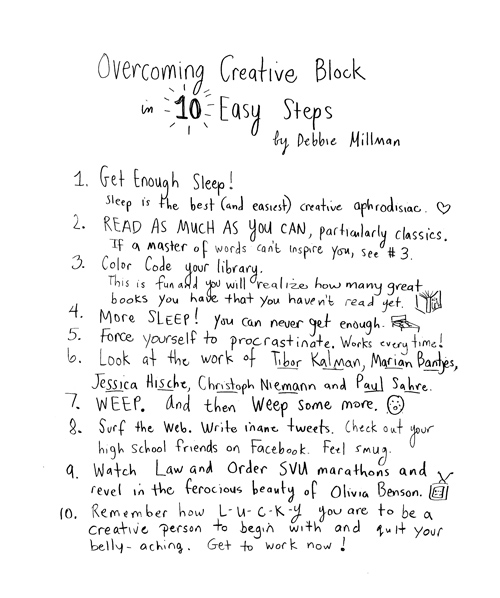
In 2010, designer and musician Alex Cornell found himself stumped by a creative
block while trying to write an article about creative block. Deterred
neither by the block nor by the irony, he reached out to some of his
favorite artists and asked them for their coping strategies in such an
event. The response was overwhelming in both volume and depth, inspiring
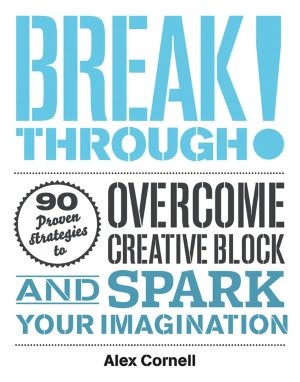
Cornell to put together a collection on the subject. The result is Breakthrough!: 90 Proven Strategies to
Overcome Creative Block and Spark Your Imagination (public library) — a small but potent
compendium of field-tested, life-approved insight on optimizing the
creative process from some of today’s most exciting artists, designers,
illustrators, writers, and thinkers.
First of all, being creative is not summoning stuff ex
nihilo. It’s work, plain and simple — adding something to some
other thing or transforming something. In the work that I do, as a
writer and a metaphor designer, there’s always a way to get something to
do something to do something else. No one talks about work block.
Also, block implies a hydraulic metaphor of thinking.
Thoughts flow. Difficulty thinking represents impeded flow. This
interoperation also suggests a single channel for that flow. A stopped
pipe. A dammed river. If you only have one channel, one conduit, then
you’re vulnerable to blockage. Trying to solve creative block, I imagine
a kind of psyching Roto-Rootering.
My conceptual scheme is more about the temperature of things: I try
to find out what’s hot and start there, even if it may be unrelated to
what I need to be working on, and most of the time, that heats up other
areas too. You can solve a lot with a new conceptual frame.
Pretend. Stop thinking like a designer or writer or
whatever you are for a minute. Pretend you’re a pastry chef. Pretend
you’re an elevator repair contractor. A pilot. A hot dog vendor. How do
these people look at the world?
Musician Alexi
Murdoch, extends an infinitely important, infinitely timely
contrarian critique of creativity-culture:
Beethoven drank buckets of strong, black coffee.
Beethoven was creatively prodigious. (He also went deaf and, perhaps,
mad.) Sound syllogism here? I’d like to think so.
The idea that creativity is some abundantly available resource
waiting simply for the right application of ingenuity to extract,
refine, and pipe it into the grid seems so axiomatic at this cultural
juncture that the very distinction between creativity and productivity
has been effectively erased.
And so it is that, when faced with a decreased flow in productivity,
we ask not what it might be that’s interfering with our creative
process, but rather what device might be quickly employed to raise
production levels. This is standard, myopic,
symptomatology-over-pathology response, typical of a pressurized
environment of dislocated self-entitlement.
At the risk of going off brief here, can I just ask: What’s wrong
with creative block? Might it not just be that periods — even extended
ones — of productive hiatus are essential mechanisms of gestation
designed to help us attain higher standards in our pursuit of creative
excellence?
I don’t believe in writer’s block.
Yes, there may have been days or even weeks at a time when I have not
written — even when I may have wanted to — but that doesn’t mean I was
blocked. It simply means I was in the wrong place at the wrong time. Or,
as I’d like to argue, exactly the right place at the right time.
The creative process has more than one kind of expression. There’s
the part you could show in a movie montage — the furious typing or
painting or equation solving where the writer, artist, or mathematician
accomplishes the output of the creative task. But then there’s also the
part that happens invisibly, under the surface. That’s when the senses
are perceiving the world, the mind and heart are thrown into some sort
of dissonance, and the soul chooses to respond.
That response doesn’t just come out like vomit after a bad meal.
There’s not such thing as pure expression. Rather, because we live in a
social world with other people whose perceptual apparatus needs to be
penetrated with our ideas, we must formulate, strategize, order, and
then articulate. It is that last part that is visible as output or
progress, but it only represents, at best, 25 percent of the process.
Real creativity transcends time. If you are not producing work, then
chances are you have fallen into the infinite space between the ticks of
the clock where reality is created. Don’t let some capitalist
taskmaster tell you otherwise — even if he happens to be in your own
head.
Cheers. Watcha gonna do with a blocked toilet? I mean,
that’s all it is, right? A bung that needs pulling to let the clear
waters of inspiration flow.
Maybe. Or maybe it just takes showing up. Going back again and again
to write or paint or sing or cook.
Some days the genius will be in you, and you will sail. Other days
the lead will line the slippers, and you’ll be staring into the void of
your so-called creative mind, feeling like a fraud. It’s all part of the
big ole cycle of creativity, and it’s a healthy cycle at that.
Digital-media artist and data viz wunderkind Aaron
Koblin, head of the Data Arts Team in Google’s Creative Lab says:
They say an elephant never forgets. Well, you are not an
elephant. Take notes, constantly. Save interesting thoughts, quotations,
films, technologies…the medium doesn’t matter, so long as it inspires
you. When you’re stumped, go to your notes like a wizard to his
spellbook. Mash those thoughts together. Extend them in every direction
until they meet.
Philosopher Daniel
Dennett has a special term for his method:
My strategy for getting myself out of a rut is to sit at
my desk reminding myself of what the problem is, reviewing my notes,
generally filling my head with the issues and terms, and then I just get
up and go do something relatively mindless and repetitive. At our farm
in the summer, I paint the barn or mow the hayfield or pick berries or
cute fire wood to length…. I don’t even try to think about the problem,
but more often than not, at some point in the middle of the not very
challenging activity, I’ll find myself mulling it over and coming up
with a new slant, a new way of tackling the issue, maybe just a new term
to use. Engaging my brain with something else to control and think
about helps melt down the blockades that have been preventing me from
making progress, freeing up the circuits for some new paths. My strategy
could hardly be cruder, but it works so well so often that I have come
to rely on it.
One summer, many years ago, my friend Doug Hofstadter was visiting me
at my farm, and somebody asked him where I was. He gestured out to the
big hayfield behind the house, which I was harrowing for a reseeding.
‘He’s out there on his tractor, doing his tillosophy,’ Doug said. Ever
since then, tillosophy has been my term for this process. Try it; if it
doesn’t work, at least you’ll end up with a painted room, a mowed lawn, a
clean basement.
How can you defeat the snarling goblins of creative
block? With books, of course. Just grab one. It doesn’t matter what
sort: science fiction, science fact, pornography (soft, hard, or merely
squishy), comic books, textbooks, diaries (of people known or unknown),
novels, telephone directories, religious texts — anything and everything
will work.
Now, open it to a random page. Stare at a random sentence.
[…]
Every book holds the seed of a thousand stories. Every sentence can
trigger an avalanche of ideas. Mix ideas across books: one thought from
Aesop and one line from Chomsky, or a fragment from the IKEA catalog
melded with a scrap of dialog from Kerouac.
By forcing your mind to connect disparate bits of information, you’ll
jump-start your thinking, and you’ll fill in blank after blank with
thought after thought. The goblins of creative block have stopped
snarling and have been shooed away, you’re dashing down thoughts, and
your synapses are clanging away in a symphonic burst of ideas. And if
you’re not, whip open another book. Pluck out another sentence. And
ponder mash-ups of out-of-context ideas until your mind wanders and you
end up in a new place, a place that no one else ever visited.
Marvelous.
Creative
Scotland, which has an annual budget of more than £83 million, is
facing open rebellion after being accused of “ill-conceived
decision-making and a lack of empathy and regard for Scottish culture”.
A
stinging letter of protest to its chairman, Sir Sandy Crombie, will
increase the pressure on chief executive Andrew Dixon to quit following
months of criticism over his stewardship. Neither was available for
comment last night.
However, composers James Macmillan and Sir
Peter Maxwell Davies, playwright and artist John Byrne, film-maker
Andrea Gibb, actor Tam Dean Burn, singer-songwriter Karine Polwart and
Scotland’s national poet, Liz Lochhead, are among those artists
demanding “a fresh start” for the body. They have put their names to the
letter claiming trust between Scotland’s artists and those who fund it
was “low and receding daily”.
The artists behind the letter issued
an accompanying statement saying they believe Creative Scotland was now
“damaged at the heart” – but stopped short of calls for sackings or
resignations.
Their dramatic move will also pile pressure on
culture secretary Fiona Hyslop for failing to get a grip of a crisis
which has dragged on for months. Last night, she insisted she still
supported the super-quango for the arts, which was set up just months
after she took over the culture brief.
Despite Creative Scotland’s
“arms-length” status, she was forced to intervene last month to urge
the agency to be more open and responsive to the concerns of artists.
The
letter said Creative Scotland had “a confused and intrusive management
style married to a corporate ethos that seems designed to set artist
against artist and company against company in the search for resources”.
It
makes seven demands, including ending “business speak and obfuscating
jargon” in official communications, redesigning overcomplicated
application forms and ensuring complaints are dealt with quickly.
Writers
Ian Rankin, AL Kennedy, James Kelman and Janice Galloway are among the
others to put their names to the letter, along with Turner Prize winner
Karla Black, and Luke Fowler, who is a finalist in this year’s
competition.
The letter has also been backed by a number of
artists who have previously spoken out against Creative Scotland,
including playwright David Greig and poet Don Paterson.
Creative
Scotland was forced into a climbdown in June following a revolt after 49
groups and organisations were told they would lose regular funding.
The
body later agreed to keep grants running for longer to give groups and
organisations more time to discuss future grant schemes, and also allow
the agency to publish detailed strategies for the dance, theatre, music
and visual arts sectors.
However, it has faced mounting criticism
over the way funding decisions are made, the level of bureaucracy
artists and organisations face and a move by Creative Scotland to set up
its own awards scheme in the face of such criticism.
David Greig,
writer of hit plays Midsummer, Dunsinane and Monster in the Hall, said a
mixture of “concern, disquiet and disbelief” from artists lay behind
the letter.
He told The Scotsman: “We are looking for a clear
acknowledgement of the problems within Creative Scotland and evidence of
a clear change of direction. We have not seen that so far. There is
simply no trust at the moment.”
Creative Scotland last night said
it was “working hard” to restore trust and improve working practices
with the arts and culture sector.
A spokesman said: “We recognise
that we need to build positive, collaborative working relationships with
organisations and artists.
“We are totally committed to working
collaboratively with the arts and culture sector, we are listening very
closely to what that sector is telling us and we are taking positive
action as a result across a number of operational and strategic areas.”
THIS is the full letter sent to Creative Scotland, and signed by 100
Scottish artists
Dear Sir Sandy,
We write to express our dismay
at the ongoing crisis in Creative Scotland. A series of high-profile
stories in various media are only one sign of a deepening malaise within
the organisation, the fall-out from which confronts those of us who
work in the arts in Scotland every day.
Routinely, we see
ill-conceived decision-making; unclear language, lack of empathy and
regard for Scottish culture. We observe an organisation with a confused
and intrusive management style married to a corporate ethos that seems
designed to set artist against artist and company against company in the
search for resources.
This letter is not about money. This letter
is about management. The arts are one of Scotland’s proudest assets and
most successful exports. We believe existing resources are best managed
in an atmosphere of trust between those who make art and those who fund
it. At present, this trust is low and receding daily.
In his
address to Holyrood, Mr Dixon asked why more artists do not address
their concerns to him directly: the answer is straightforward; they
have. Letters of concern have been sent by representative groups from
theatre, dance, the games industry, visual arts and literature.
Individual voices have also been raised from many quarters both
privately and in public. These concerns have gone unanswered or been met
with defensiveness, outright denial, or been ascribed to problems with
“communication”.
It is time for a fresh start. We ask that the
board of Creative Scotland considers the following requests with the
utmost urgency. We ask that you:
1. genuinely acknowledge the
scale of the problem;
2. affirm the value of stable two to three
year funding for small arts organisations;
3. end the use of
business-speak and obfuscating jargon in official communication;
4.
revisit CS policies with an eye to social and cultural as well as
commercial values;
5. collaborate with artists to re-design
over-complicated funding forms and processes;
6. ensure that
funding decisions are taken by people with artform expertise;
7.
establish an effective system of dealing with complaints as swiftly as
possible.
We do not sign this letter lightly but we feel we are in
an unprecedented situation. We call on you to act swiftly to make what
changes are necessary to the organisation to repair trust and restore
communication before any further damage is done to Scotland’s cultural
landscape and international reputation.
Yours sincerely,
Sam
Ainsley, Davey Anderson, Peter Arnott, Clare Barclay, Anne Bevan, Karla
Black, Martin Boyce, Katrina Brown (Dr), Tam Dean Burn, Roddy Buchanan,
John Byrne, Lorne Campbell, Richard Campbell, Jo Clifford, Nathan
Coley, Deborah Crewe, Jeannie Davies, Peter Maxwell Davies (Sir), Chloe
Dear, Finn den Hertog, Ella Hickson, Roanne Dods, Jude Doherty,
Jaqueline Donachie, Joe Douglas, Rob Drummond, Oliver Emmanuel, Catrin
Evans, Rob Evans, Graham Fagen, Andy Field, Pat Fisher, Luke Fowler,
Fiona Fraser, Vivian French, Janice Galloway, Andrea Gibb, Suzy Glass,
Douglas Gordon (Prof), Mickey Graham, Alasdair Gray, Stephen Greenhorn,
David Greig, Kris Haddow, David Harding OBE, John Harris, Zinnie
Harris, Ben Harrison, David Harrower, Lewis Hetherington, Corrina Hewat,
Mark Hope, Philip Howard, Kieran Hurley, Chris Hunn, Callum Innes,
Kathleen Jamie, David Paul Jones, James Kelman, AL Kennedy, Laura
Cameron Lewis, Liz Lochhead, Ali Maclaurin, Linda Maclean, James
Macmillan, Caoihin MacNeill, Aonghas MacNicol, Willy Maley (Prof), Andy
Manley, Michael John McCarthy, Nicola McCartney, Francis McKee, Bernard
McLaverty, Alan McKendrick, Linda Mclaughlin, Becky Minto, Alexander
Moffat OBE, Gerry Mulgrew, Rona Munro, Andrew O’Hagan, Janice Parker,
Don Paterson, Toby Paterson, Mary Paulson Ellis, Aonghas Phadraig
Caimpbeul, Philip Pinsky, Karine Polwart, Lynda Radley, Ian Rankin,
Robin Robertson, Fiona Robson, Muriel Romanes, Lesley Anne Rose, Lisa
Sangster, David Shrigley, Ross Sinclair, Gerda Stevenson, Pete Stollery
(Prof), Richard Wright
I hope you will not mind if I
address this letter to you as a means of reaching all those who put
their names to the letter you distributed yesterday and kindly sent to
me via a colleague. A copy of this letter will be sent to media contacts
after a delay that will allow you to forward it to all of those you can
reach by e-mail.
Before I turn to the points in your letter, let
me put my response in the context of Creative Scotland’s development
and its aspiration to create strong relationships with creative
communities in Scotland.
Creative Scotland is two years old. It
has a broader remit and in total distributes more funds than its
predecessors. We make one third more awards with one third fewer staff. I
think it is fair to say, and unsurprising, that in some cases our
working methods are still developing. Are we perfect? No. Can we do
better in a number of areas? Yes. But equally there is no shortage of
evidence that we can and do perform well across a broad range of our
activities.
Ironically, I saw your letter just after meeting a
group representing a constituency of artists and organisations working
across a range of sectors. The conversation with that group started
after they wrote a letter in June expressing concerns similar to yours.
For my part, I found that conversation positive and productive. I think
it showed that Creative Scotland’s desire to create relationships based
on trust and mutual respect is no less strong than that of those with
whom we engage. Meeting one representative group like this is not
enough, though. We are determined to engage with as many people as are
willing to engage with us, through conversations in a range of places
and formats in the coming months.
Let me turn to your letter. It
is admirably concise, and, as one would expect from those named,
eloquently expressed. Your points are well made. In choosing to be
concise, you have of course sacrificed the provision of detail at a
level that my board colleagues and I can investigate. Nevertheless, I
assure you and all those who joined you in signing your letter that we
do take seriously every issue, complaint or concern made to us, whether
by individuals or groups. We will examine thoroughly every point raised
with us. Two sub groups of our board members are currently working with
staff to probe further into a range of topics that can influence both
how we distribute funds and what artists and organisations experience
when dealing with us.
Your letter coincided with the announcement
of decisions on awards for the previously flexibly funded organisations
that had applied into the first round of the new funding programme. Now
that the decisions are public you will know that funds were generally
awarded for two years, the only exception being the result of a request
for a shorter award period from one applicant. These valuable
organisations will be able to apply again in the future.
You have
commented on the use of language and complications in our forms and
processes. Every professional community – even the arts world – has its
own jargon, but we have no desire to be anything other than clear and
understood by all. I expect that the comments we have received directly
from you and others and the planned conversations I have already
described will help us be better informed of issues and able to test
ways of expressing ourselves.
On processes, we share a desire to
simplify. If applicants find things over-complicated then it is almost
certainly the same for our people. We intend to simplify paperwork
further and reduce processes to the minimum necessary to comply with
audit requirements. We welcome your offer to join in helping to achieve
this.
You have commented, as have others, on who is involved in
funding decisions. As a first move, we are making more information
available on how such decisions are taken. We believe that those taking
decisions have both the knowledge and expertise to do so, but
acknowledge that this can be questioned. One of the board sub-groups is
considering this challenge. This same group will be looking at our
handling of complaints.
In closing, I hope you will trust and
accept that we have a strong desire to perform as an organisation for
the people of Scotland. At current rates of expenditure one thousand
million pounds will pass through Creative Scotland in the course of a
twelve-year period to be used in support of arts and cultural activity.
They who provide the money have a right to ask what will result from
that investment. The return does not rest solely in economic or
commercial benefits, important though those are. It can come through
social, cultural and reputational gains and of course through artistic
excellence. We at Creative Scotland are absolutely committed to playing
our part in producing those gains, but realise we can achieve nothing
without the active participation of artists and companies working across
the whole spectrum of arts and cultural activity. We have every desire
to engage with you, your co-signatories, either individually or
collectively, and indeed any party who shares our aim of doing our very
best for everyone.
I would therefore like to offer to meet
yourself and as many of your co-signatories as you think useful to
listen to your concerns in more detail and to create the foundations for
a constructive dialogue that will help address the issues raised.
It has been difficult for many in the artistic, creative and cultural
community to voice their opinions, experiences and exasperation with
the ongoing crisis at Creative Scotland. A group of people started the
process, and put the letter together in very quick time, and there will
be others who would like to sign up to the letter. If you want to add
your name to the letter please sign up here.
SCOTLAND’S artists are to stage mass meetings in Edinburgh and Glasgow
next month after disquiet over the policies of Creative Scotland, the
national arts funding body.
The events will be the first organised and regular “open space”
rallies of artists from all genres who want their voices to be heard.
Criticism of the funding body’s actions was sparked in May following
the removal of Flexible Funding – fixed-term funding – from more than 40
organisations, and its replacement by Lottery-backed project funding.
However, until now, criticism and debate about Creative Scotland has
been confined to individuals putting their heads above the parapet or
comments and discussions on social media such as Twitter and Facebook.
Fiona Hyslop, the Culture Secretary, has written two letters to
Creative Scotland, stressing its need to communicate better with the
arts world.
Leading poet Don Paterson described the body as a “dysfunctional
ant-heap”, and playwright David Greig has added his criticism.
Now, with a meeting of around 100 artists and commentators at a space
lent by Creative Scotland at its Waverley Gate offices in Edinburgh on
October 26, and another of around 100 people at the Tramway in Glasgow
on October 31, organisers hope a more cohesive voice for artists and
arts companies will be heard in the debate over arts administration and
funding north of the Border.
The organisers of the meetings want artists to attend and provide a
counterweight to, and opinions about, Creative Scotland’s policies and
decisions.
Representatives from Creative Scotland are being invited to the
meetings in Glasgow and Edinburgh. Paterson and Greig are both invited
to the Edinburgh meeting.
Jen McGregor, the writer and director who has organised the Edinburgh
meeting, and Roanne Dods, the producer and former director of the
Jerwood Charitable Foundation, who has organised the Glasgow meeting,
hope the events will be the first of many.
Ms McGregor, who is not funded by Creative Scotland, said: “What I am
really hoping to achieve is to get artists to talk to each other, to
express themselves, and argue their case.”
Today I attended the Scottish Artists Union (SAU) Annual General Meeting, which was held at DCA, Dundee.
It was rather disappointing that despite having over 900 members, there were only about 40 people (including some non-members) at what was an interesting event.
I am pleased that, along with Deniz Üster I was elected onto the new Executive Committee, and look forward to being more involved with the SAU.
A couple of motions were proposed, one coming from a member and the other (made up of 7 component parts all relating to Creative Scotland) from the executive. After in depth debate, both were accepted.
Lorraine Simpson then delivered a superb presentation on the findings of her research into the Public Entertainment License (PEL). The SAU had commissioned Lorraine to carry out this research, and the report will be available on the SAU website within the next few weeks.
Simpson contacted all of the Local Authorities to gain an understanding of their position in relation to the change in the PEL. Only 3 Local Authorities have specified that individuals and organisations hosting free events such as exhibitions, Open Studios, workshops will need to apply for a license. 9 Local Authorities (Glasgow included) have not yet decided upon their stance, and the other Local Authorities are not going to insist upon a PEL for free events. Lorraine reported that most Local Authorities were very reasonable, and that it is worth artists talking to them about their plans.
The next presentation was about the SAU members survey. The results were somewhat grim. 59% of respondents have never received and exhibition payment, over 70% of respondents earned less that £5000 from their practice last year, and 85% have not been issued with contracts.
This lead nicely into Janie Nicol reporting on the WAGE event that happened just over a week ago in Glasgow (see earlier blog post for information about this).
Donald Urquhart was the guest artist speaker, and concluded the day by discussing his work in relation to collaborative practice.
All in all it was a good event, managing to be more than a business report, and marking the start of some exciting investigations.
Today I was lucky enough to attend the first Friday Event of the 2012-2013 academic session. The speaker was Will Self who introduced and read from his new publication "Umbrella", which is on the shortlist for the Man Booker prize.
Cinema 1 at The Gft, Glasgow had a full audience, which the speaker likened to a "field of mushrooms".
Self did not disappoint, his talk was informative, intelligent and entertaining.
Quote of the day courtesy of Will Self
"semi colons are the coalition of punctuation"
Speakers:
Susannah Waters, GSA Archivist
Peter Trowles, GSA Curator
Andrea Kusel - Curator of Art, Paisley Museum
Sarah Lowndes - Studio 58 Curator
Stacy Boldrick - Research and Interpretation Manager at The Fruitmarket Gallery
Sarah Lowndes mentioned that there were a number of sub themes to the exhibition:
1. Still life - Still life as an interior landscape when it was not possible to go outside
2. Artists with illness / handicap
Lowndes was interested in meetings between artists, particularly meetings between two or more artists who had never met before
"I do feel the more you know something, the more you get out of it" Joan Eardley
This afternoon I had a studio visit from Anne-Louise Kieran, the Visual Arts Development Officer for North Lanarkshire Council. Anne-Louise had visited my studio at the recent Open Studio weekend, and got in touch shortly after to offer me an exhibition at one of the spaces that she programmes.
It was really good to talk to her about her background, her role, my work and my forthcoming exhibition. The exhibition will take place at Motherwell Concert Hall and Theatre from Sept 4th 2013 -
October 30th 2013. It seems like I have a lot of time, but I know how quickly time flies, and I am already thinking about making work for the space.
Given the nature of the building, the exhibition will consist of wall based work. I am conscious that the work will predominantly be seen by a non-art audience and I will be mindful of this when producing the work. By this I do not mean to "dumb down" the work, but I need to ensure that the work can be appreciated on a number of levels and is not dependent on having an art background in order to get something from it.
In light of the WAGE RAGE discussion that I attended yesterday, it was pleasing to hear that a small fee will be offered and that they are willing to help with things such as hiring a van to collect the work, assistance with hanging the work, and offering to loan some frames for the duration of the exhibition. Anne-Louise was supportive of the need for some guidelines or legislation around the payments given to artists for exhibiting their work.
Tonight I attended the public meeting to address the need for artists' exhibition fees in
non-profit art institutions in Glasgow and beyond.
The event was introduced by artist Charlotte Prodger and then short presentations were given by Isla Leaver-Yap (Freelance Curator), Corin Sworn
(Artist) and the Scottish Artists
Union. Lise
Soskolne, co-organiser of W.A.G.E (Working
Artists And The
Greater Economy) delivered the main presentation.
Arts funding body Creative Scotland has been scrutinised by MSPs on
the Scottish Parliament's Education and Culture Committee, with
representatives from Scotland's visual arts sector giving evidence.
By Chris Sharratt on a-n news
Published 18th September 2012
Representatives from Scotland’s visual arts sector have given
evidence to MSPs on the Scottish Parliament’s Education and Culture
Committee, as it discussed the work of Creative Scotland, the arts
funding body which replaced the Scottish Arts Council in 2010.
Baker, who is based in Dumfries and Galloway, raised concerns about
the geographical bias of the funding body, accusing it of disregarding
local input: “We’re getting large cultural producers being parachuted
into our areas [by Creative Scotland], swallowing significant amounts of
our local budget,” he said. “That’s left a lot of discord locally and
been very destructive.”
Baker also criticized the organisation for a lack of transparency, a
point picked up on by Francis McKee. He said: “It’s good dialogue
face-to-face [with Creative Scotland], but there’s not enough dialogue
publicly with the arts community, trust is being lost and that’s
dangerous. There’s a communication gap that needs to be bridged – that
communication has to happen.”
Despite the controversy surrounding the organisation’s funding
decisions – Turner Prize nominee Luke Fowler has characterized it as
"New Labour meets the politburo”, while Scottish poet Don Paterson, who
won the Queen's Gold Medal for Poetry in 2010, recently described
Creative Scotland as a "dysfunctional ant-heap" – the mood among the
panel was good natured and professional rather than heated.
Poor communication by the organisation was a recurring theme
throughout the session and on numerous occasions Dixon accepted that the
organisation needed to improve on this: “I’m absolutely committed to
transparency and I admit that we’re not getting it right,” he said.
Flexible funding
On the issue of changes to flexible funding for 49 organisations
across Scotland announced in May, the deadline for which has since been
extended by six months, McKee said: “It’s a fraught process because it’s
change for a start. There have been problems along the way and those
problems are still evolving.”
McKee explained that an organisation like CCA couldn’t operate on a
project-by-project basis, as Creative Scotland's changes initially
required it to, due to the need for long-term and strategic planning. He
acknowledged that Creative Scotland had modified the process in order
to enable the organisation to apply for project funding across a
two-year period.
“There’s been a constant moving of the parameters which are helping
us as we go, and that has been a positive change,” he said. “They’re
changes we need to see."
Baker said that the issues around flexible funding were largely
irrelevant to him. Describing the artist-led organisations and
initiatives that he was involved with, he said: “We’re not expecting
core funding, we’re after advocacy and help from Creative Scotland to
allow us to use the arts for the wider good. And [in that area] quite a
lot of the noises we’re hearing are quite good.”
McKee added that there were concerns among flexibly funded
organisations around the use of Lottery funding. He said: “Perhaps on
behalf of all the flexibly-funded organisations, I should say that
there’s a worry about the relationship to the Lottery. The Lottery looks
as if it’s project funded, and we’re now talking about more sustainable
funding through the Lottery. We all welcome this, but we just want to
know that the Lottery agrees."
"You must not fear, hold back, count or be a miser with your thoughts and
feelings. It is also true that creation comes from an overflow, so you
have to learn to intake, to imbibe, to nourish yourself and not be
afraid of fullness. The fullness is like a tidal wave which then carries
you, sweeps you into experience and into writing. Permit yourself to
flow and overflow, allow for the rise in temperature, all the expansions
and intensifications. Something is always born of excess: great art was
born of great terrors, great loneliness, great inhibitions,
instabilities, and it always balances them. If it seems to you that I
move in a world of certitudes, you, par contre, must benefit
from the great privilege of youth, which is that you move in a world of
mysteries. But both must be ruled by faith."
On Thursday 23 August, Dominoes appeared in Helsinki with more
than 20,000 people in the streets, 10,000 blocks, 250 volunteers and a
feeling of joy and celebration.
Starting on an island of
Helsinki's archipelago, the blocks reached the beach of Meri Rastela,
going through the suburbs, took the metro to go through Kallio and its
famous traditional Sauna. Then made its way through a musican's flat and
fell into the gigantic tunnels that exist under all of Helsinki. It
continued in the streets of the centre and finished on Senat Square.
Another wonderful exhibition at 42 Carlton Place. The paintings, all unframed are simply hung on the wall with pins or resting on nails. This simplicity is matched in the work. Hodgson uses subtle colours, often created through the layering of different shades. These are revealed when Hodgson signs and dates his work, often removing the top layer of paint to show what lies beneath.
Clive Hodgson’s paintings can be lyrical, disarming or mordant. They
evoke emblem, signage and diagram.
Becoming known in the 1980s for anecdotal figuration, he has moved
through alternations and combinations of abstraction and representation,
deploying varied technical means: geometric pattern; stenciling;
apparently casual daubing; stipple and spatter; ornamental calligraphic
design. His diverse strategies build to a concerted interrogation of the
puzzles of art and life.
The current exhibition is largely of recent work in which the signing
(and dating) of the paintings is a significant part of imagery and
content.
Clive Hodgson was born in Nottingham in 1953. He studied at St.
Martin’s School of Art 1971-72 and the Slade School of Art 1972-77. He
had a residency at The British School at Rome in 1998. Recent
exhibitions have included: 2005 ‘Incorrigible, Sentimental’, Filles du
Calvaire Brussels; 2006 Terrace London; 2008 ‘False Friends’, Five Years
London; 2012 Broadbent London; ‘ Ever Since I Put Your Picture in a
Frame’, 42 Carlton Place Glasgow; ‘The Smallest Composite Number’,
Standpoint London.
Scotland Can Make It!
is an exhibition of six souvenir prototypes inspired by the London 2012
Olympic Games and the Glasgow 2014 Commonwealth Games.
The souvenirs, designed and manufactured
entirely in Scotland, aim to offer a lasting material legacy of both
major events whilst expressing a strong message about Scotland’s rich
and imaginative cultural landscape.
The prototypes have been made by the
following artists, designers and companies:
Atelier EB and Marc Camille Chaimowicz with
Begg Scotland and McRostie of Glasgow
Claire Duffy with Tunnock’s
Emlyn Firth and Angharad McLaren with
Johnstons of Elgin
FOUND with Chemikal Underground
Katy West with Highland Stoneware and Rogano
Oyster Bar
Neil McGuire and Marianne Anderson with
Carlton Die Casting and Jewellery Prototyping Services
The souvenirs will be developed for sale as a
part of the cultural programme for the Commonwealth Games. They will be
available to buy in Glasgow and across Scotland in 2014.
A film, Scotland Can Make It!: the making
of six souvenirs presents a series of informal
interviews and a behind the scenes look at the processes involved in
creating the unique prototypes for Scotland Can Make It!
Filmed in the studios, workshops and
factories of the Scotland Can Make It! designers,
artists, musicians and manufacturers, the film highlights the quality
and breadth of Scotland’s creative practitioners and manufacturing
industries.
Scotland Can Make It! is part
of Scotland’s Cultural Programme for London 2012 and Glasgow 2014
I am an artist making work that incorporates installation, video, sound, sculpture, performance, & writing to explore the human condition. I investigate ways to immerse the audience in multi-layered psychological & physical situations.
I trained at Leeds College of Art & Design (Foundation), Glasgow School of Art (BA (Hons) Fine Art: Sculpture & Environmental Art) and Newcastle University (Masters of Fine Art).
My lived experience of eating distress & obsessive compulsive disorder informs the work I create & the way I work. Some of the consequences of living with these conditions are that rigour, routine & attention to detail are fundamental to my way of life, all of which are integral to my creative practice; using the constraints of systems, I allow chance & playful elements to create unexpected results.
My work is regularly exhibited in solo & group exhibitions across the UK, USA, Canada & South Korea & is contained in various public collections. I have a number of public artworks, been commissioned to produce site-specific work & have taken part in national & international residencies, consistently since 2005.
2020-21
Awarded Arts Council England Developing Your Creative Practice funding for a printmaking residency with Charrington Editions
Byre-Group exhibition in which I created a site-specific installation alongside some creative writing
Everything Will Be Alright-an audio installation at Cheeseburn Sculpture, commission by curator Matthew Jarratt
Filling Time-a watercolour calendar-based work, currently exhibited at BALTIC centre for contemporary art
Lockdown Diary-a daily online process since March 2020, that has been acquired by the Wellcome Collection
Home Time-a creative tool for public, inspired by Lockdown Diary, commissioned by New Writing North
Inclusion in a new Alec Finlay publication.
I work in my studio at NewBridge Projects in Newcastle & as well as my solo work I collaborate with David Foggo as marginendeavour; I am often invited to speak to students, artists & facilitate workshops.
Website: www.helenshaddock.co.uk
Blog: https://helenshaddock.blogspot.co.uk/
Twitter: @hshaddock
Instagram: /helenshaddock
Facebook: /helen.shaddock
Vimeo: /hshaddock
YouTube: /helenshaddock
LinkedIn: /helen-shaddock
Education
Master of Fine Art, Newcastle University, 2016
BA (Hons) Fine Art: Sculpture and Environmental Art , Glasgow School of Art, 2008
Diploma in Foundation Studies (Art and Design), Leeds College of Art & Design, 2005






 Posts
Posts

