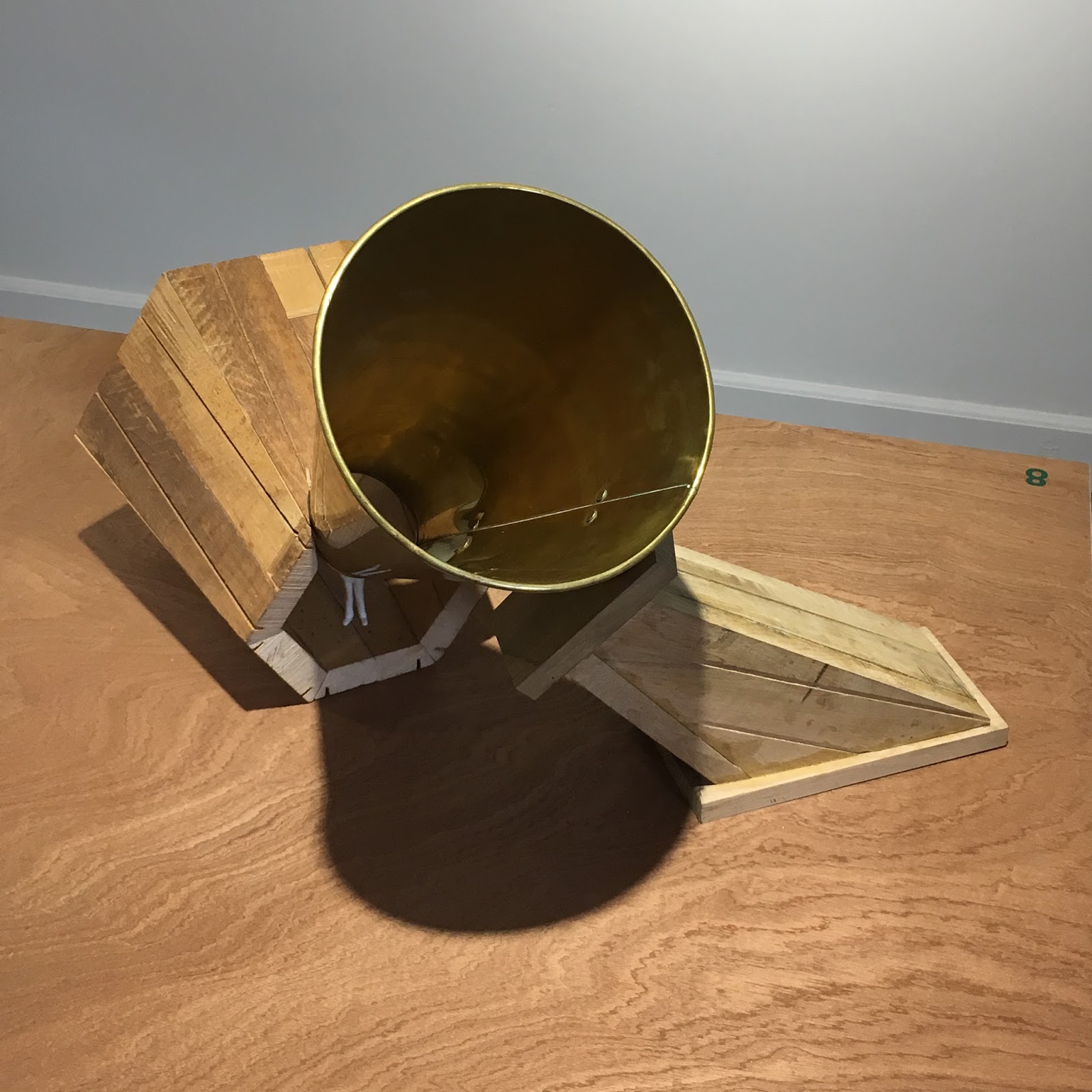
A live improvised performance by David de la Haye and James Davoll marked the beginning of their month-long sound installation in the Long Gallery in the Fine Art Department at Newcastle University.
David de la Haye and James Davoll have captured fields recordings of the bridges that join Newcastle and Gateshead.
"The iconic bridges are a symbol of home to those living in Newcastle and Gateshead and are embedded in our everyday interactions. These recordings explore how the structures resonate during their daily interaction with the ebb and flow of people, transport and the River Tyne."
As the name suggests, the Long Gallery is a relatively narrow but reasonably sized space. Speakers were positioned in a row down the corridor, each playing a different soundtrack.
At the beginning of the live improvisation, all speakers down the corridor were switched off, and the sounds manipulated by the David and James were amplified through a set of speakers at the end of the space. Over the course of the performance, David and James switched other speakers on, adding layers of sounds. I particularly enjoyed walking along the corridor and entering different sonic 'zones' as I heard the sounds from each of the speakers separately. This added a spatial element to the installation which I imagine will become more prominent after the preview when there is less noise. Audience members are encouraged to use bespoke controllers on the speakers to set volume levels and create their own unique soundscape.
Showing posts with label sound installation. Show all posts
Thursday, 9 August 2018
Friday, 30 June 2017
Looking forward to Cheeseburn this weekend
I am working at the July Open Weekends at Cheeseburn Sculpture, and I'm looking forward to seeing the new exhibitions that will be on in the gallery and the Stables project space.

Cheeseburn Stables Gallery - Fred Watson
Fred Watson has 5 stone carvings in the gardens at Cheeseburn and his exhibition at Cheeseburn’s Stables Gallery in July 2017 aims to showcase his fine still life carvings in wood.

Lost Voices; A Sound Installation by Bennett Hogg, using reconstructions by Magnus Williamson, of missing voice parts from sixteenth Century Church Music.
There will, of course, also be the opportunity to see the permanent collection of sculptures within the gardens, Tyne Bridge Hinge by Alexander Devereux and Scurry by Dan Gough.
For more information please visit
Wednesday, 24 May 2017
At Cheeseburn with the squirrels
I spent the weekend at Cheeseburn Sculpture, near Stamfordham, in the company of 2000 squirrels courtesy of artist Dan Gough. Last year Dan won the Gillian Dickinson North East Young Sculptor of the Year competition, and so was supported to realise his proposal and install it in the Cheeseburn Grange grounds.
http://www.chroniclelive.co.uk/whats-on/arts-culture-news/sculptors-2000-squirrels-unveiled-cheeseburn-13062081
This year there are 11 more artists shortlisted for the prize, and once again, the public have been asked to cast their votes to decide the winner.
![]() |
| Anthony Hensman |
![]() |
| Anthony Hensman |
![]() |
| Anthony Hensman |
![]() |
| Lucien Anderson |
Their proposals are exhibited at Cheeseburn in the Gallery and there are numerous other artworks exhibited around the grounds in the gardens and outhouses.
![]() |
| Alexander Devereux |
![]() |
| Alexander Devereux |
![]() |
| Alexander Devereux |
There were a record-breaking 530 visitors on Sunday, and the feedback was excellent.
http://www.chroniclelive.co.uk/whats-on/arts-culture-news/gallery/see-work-young-sculptor-years-13062393
Why not do something different this Bank Holiday weekend and take a trip to Cheeseburn for a cultural adventure. Opening hours are 11am-4pm. There is a cafe on-site. For more information visit the website:
www.cheeseburn.com
Friday, 17 June 2016
KIELDER ONSITE - Opening event
A wonderful day was had by all on our visit to Kielder Water and Forest Park for the opening event of the KIELDER: ONSITE exhibition.
Our first drop off point was the Lewisburn inlet, the site of Simon Court's floating sculpture, Waveform.
Simon explains,
"The idea for this floating sculpture
began on Waiheke Island off the coast of New
Zealand in response to the sea, natural bush and
a working boat yard. This has been translated to
respond to Kielder water. The form can be seen
as a wave, crescent moon, or part of the Yin Yang
symbol."
The coach then drove to Kielder Castle where we begun the walk along the Duchess Trail. The majority of the artworks were located on this route.
The first artwork we came across on this meandering circular route through part of the forest was Eve Kossmann's Forest Clock. This collection of handmade clay mushrooms are displayed in an arrangement resembling that of a sundial.
"This
installation represents a documentation of time
since the artist’s first visit to Kielder as a child. In
an ever-changing environment mushrooms have
remained a small yet beautiful life form on the
forest floor, often overlooked in such a vast site."
Pyramidal Edifice is a copper and steel sculpture by Anthony Hensman.
Anthony explains that "This sculpture suggests the structural order of
the forest. Through use of the golden ratio, the
tower mathematically structures the space at
the edge of vision. Its exterior mass becomes a
paradoxical container for the indeterminacy of
the immaterial. "
A Long Wait by Mirela Bistran is an installation
of three chairs that have been made from
stumps of trees cut to thin the forest. This work
contemplates the very slow regenerative power
of the forest.
Stop When Light Shows Red by Oliver
Hoffmeister & Harry Pickup consists of a pair of traffic lights facing each other and suspended in the trees. As night time sets in, motion sensors detect the movement of people which in turn switch the red lights on the traffic lights.
"In this installation, the dissonance created between the urban traffic lights and the seemingly ‘natural’ landscape helps allude to the forest’s past of villages such as Plashetts."
Mirela Bistran's Tree Shirt consists of a long piece of fabric, shaped in the
form of a half-cylinder, rising from a stump.
The intention for this piece is to resemble a shirt – a plain tree shirt – which reflects a matrix for all the trees in a monoculture forest.
Leina Taylor's "work reflects the forest’s unusual beginnings
as a man-made site.
"Sculptures made up of organic matter sandwiched between layers of plaster occupy the forest space and slowly disintegrate, displaying the effects of the environment on its man-made structure."
Nearly back at the start of the Duchess Trail, we found J J Lloyd's artwork, Being Here. Nestled in a patch of land off the beaten track, a vinyl disc marks the spot.
This is a giant version of the symbol used on the Kielder visitor maps to indicate the location of an artwork. The works explores reality and symbolism.
The group then made our way to the Observatory to see TRIGGER. Pipi and I were gutted to discover that the sound was not playing and the speaker could not be switched on. After all our research, planning and lots of effort, we were disappointed that it was not in the state that we left it. A potential reason why it was not operating is because the solar panel did not have sufficient solar energy to charge the speaker. However, there are many variables and reasons why it was not playing and so we will go up and investigate further. We are thinking of other solutions to enable the audience to hear the sound whilst standing under the structure. One possibility is to install a MP3 player and a set of headphones within the inside of the box.
A little way down the road is James Turrell's Skyspace, the venue for the Sarah Grundy's performance.
The voice
was employed to depict a possible future for the
forest. Water was the focus of the performance
using actions linked to ritual.
It was a great day celebrating the completion of a variety of works made by students at different stages of their Fine Art education at Newcastle University.
Thanks to those who came along. I hope that you enjoyed it.
The works will be installed until 30th September 2016, so there is still plenty of time to see them for yourself!
Wednesday, 8 June 2016
TRIGGER Install at the Observatory, Kielder Water and Forest Park
After much preparation, today was the big day; installing TRIGGER at our chosen site by the Observatory at Kielder Water and Forest Park.
On arrival we surveyed the ground where we had planned to site the work. The area around had become rather overgrown with grass and cotton plants, but we were surprised to find that the exact spot that we had marked out previously for TRIGGER was pretty much the same. Even the 4 twigs we had put in place to mark where the structure was to go were still in place!
We began by measuring out the area where the posts were to be instead, and dug the holes for the poles to be inserted into. The ground was very soft, and we were able to scoop out the material (it can hardly be described as earth!) with our hands. The smell was overpoweringly disgusting, and I dread to think what it was that was producing such a pungent smell!
Having already determined which pole needed to go into each hole, our next task was to insert each pole into each hole. Thankfully we had a very willing and able troop of helpers at hand!
Once the posts were meeting at the top, we inserted the bolts into the holes we had drilled in the posts on our last visit to Kielder.
Amazingly, the bolts fitted into the holes with very little difficulty, and the structure was rather secure. With a little bit of wiggling and readjusting, we were able to get the structure upright and level.
We then unwrapped the box which already contained the speaker and USB. The solar panel had been attached.
We hoisted the box up inside the legs, and tightened the jubilee clips to hold the box onto the posts in the correct place.
Before we tighten the jubilee clips securely, we ensured that all levels were even and that the box was in the correct place and at the right angle. We also tested that the audio was working properly to ensure that we wouldn't need to take the box off the posts. All was good to go!
We poured water into each of the holes in the ground and poured postcrete into the holes and waited for about 20 minutes for it to solidify.
We tightened the jubilee clips and bolts and then applied the finishing touches such as the bands of coloured tape at the top and bottom of the posts. We also added a couple of additional stripes to the box to make it more eye catching.
We spent some time adjusting the volume of the audio. After a good wipe over and few last touches of black paint we were able to stand back and enjoy the results!
On arrival we surveyed the ground where we had planned to site the work. The area around had become rather overgrown with grass and cotton plants, but we were surprised to find that the exact spot that we had marked out previously for TRIGGER was pretty much the same. Even the 4 twigs we had put in place to mark where the structure was to go were still in place!
We began by measuring out the area where the posts were to be instead, and dug the holes for the poles to be inserted into. The ground was very soft, and we were able to scoop out the material (it can hardly be described as earth!) with our hands. The smell was overpoweringly disgusting, and I dread to think what it was that was producing such a pungent smell!
We then measured the each pole and marked the place of the pole that should be at ground level. We also measured the depth of each hole and calculated how much of the bottom of the tree pole we needed to saw off in order for the post to be the right size.
Having already determined which pole needed to go into each hole, our next task was to insert each pole into each hole. Thankfully we had a very willing and able troop of helpers at hand!
Once the posts were meeting at the top, we inserted the bolts into the holes we had drilled in the posts on our last visit to Kielder.
Amazingly, the bolts fitted into the holes with very little difficulty, and the structure was rather secure. With a little bit of wiggling and readjusting, we were able to get the structure upright and level.
We then unwrapped the box which already contained the speaker and USB. The solar panel had been attached.
We hoisted the box up inside the legs, and tightened the jubilee clips to hold the box onto the posts in the correct place.
Before we tighten the jubilee clips securely, we ensured that all levels were even and that the box was in the correct place and at the right angle. We also tested that the audio was working properly to ensure that we wouldn't need to take the box off the posts. All was good to go!
We poured water into each of the holes in the ground and poured postcrete into the holes and waited for about 20 minutes for it to solidify.
We tightened the jubilee clips and bolts and then applied the finishing touches such as the bands of coloured tape at the top and bottom of the posts. We also added a couple of additional stripes to the box to make it more eye catching.
We spent some time adjusting the volume of the audio. After a good wipe over and few last touches of black paint we were able to stand back and enjoy the results!
We would like to thank everyone who helped with the install, and everyone who assisted us on the way. It has been a pleasure working with you and we hope that you enjoy the resulting artwork.
More details of the launch and exhibition duration will be issued shortly.
Tuesday, 7 June 2016
TRIGGER progress in preparation for install C
With the TRIGGER install date confirmed for tomorrow, Tuesday 7th June, Pipi and I have been finishing off as much of the structure as we can prior to install.
Over the past week we have spent hours applying layer after layer of white paint, sanding each layer to create a smooth brilliant white solid surface on which the fluorescent paint would lie.
When we were working on the piece for the KIELDER OFFSITE exhibition, the fluorescent paint had proved to be difficult to work with. It dries incredibly quickly making it very hard to blend strokes into each other.
Unfortunately, despite our efforts to create an ultra smooth white surface on which to apply the fluorescent paint, the paint did not apply evenly and we were unhappy with the quality of the finish. It appeared patchy, and was not very fluorescent.
We therefore decided to change the base colour of the box to black instead of the fluorescent yellow. We would add fluorescent yellow and orange tape to the box to brighten it up and make it more eye-catching.
We placed the equipment on a shelf and sealed the speaker and cabling into the top of the box.
We then added the solar panel to the top and side of the box in order to catch as many rays as possible.
Fingers crossed!
Subscribe to:
Posts (Atom)