Showing posts with label cast. Show all posts

Wednesday, 9 September 2015

Skimmer

Brass Skimmer
Rice Paper

This is probably the most minimal artwork that I've ever made. I saw the skimmer in an Asian supermarket and felt an urge to buy one and admire its beauty. I had also picked up some rice paper, and so cut it into strips and soaked them in water prior to then laying them over the dome of the skimmer, ensuring that they neatly cover the surface. When it was dry I carefully removed the cast from the mould. I hung the skimmer on wall and then balanced the rice paper on the wire skimmer part. Over time the rice paper moulded itself around the skimmer, and as it dried out it began to crack.

Here it is in stages


Saturday, 13 December 2014

Spumoni

I've been trying to think of a title (I groan as I find this very difficult!) for a recent piece of work, and was thinking about the associations that people make when they look at my work.

Often people comment on how they want to eat the casts as they look so edible and delicious! The types of food that the sculptures bring to mind are usually sweets and desserts such as sherbet, liquorice all sorts, Yorkshire mixture, pear drops, Edinburgh rock, rosey apples, ice cream and sorbet.


http://www.thetraditionalsweetshop.co.uk/section.php/9/3/boiled-sweets


I remember having neapolitan ice cream when I was a child.


"Neapolitan ice cream, sometimes known as harlequin ice cream,[2] is made up of blocks of vanilla, chocolate, and strawberry ice cream side by side in the same container (typically with no packaging in between). Some brands intermix the flavors more, though the separate flavours are still clearly visible."

http://en.wikipedia.org/wiki/Neapolitan_ice_cream

Neapolitan ice cream is closely related to spumone.

"Spumone (from spuma or "foam"), plural spumoni, is a molded Italian ice cream made with layers of different colors and flavors, usually containing candied fruits and nuts.

Typically it is of three flavors, with a fruit/nut layer between them. The ice cream layers are often mixed with whipped cream. Cherry, pistachio, and either chocolate or vanilla are the typical flavors of the ice cream layers, and the fruit/nut layer often contains cherry bits—causing the traditional red/pink, green, and brown color combination."

http://en.wikipedia.org/wiki/Spumoni


http://lovelyreveries.blogspot.co.uk/2011/07/dreaming-in-colorspumone-napoletano.html


http://www.alajmo.it/dett.asp?id_doc=36506&lingua=ita


http://www.mayphoto.net/index.php#mi=2&pt=1&pi=10000&s=1&p=3&a=0&at=0

Tuesday, 2 December 2014

Masking part of the surface

This is an experiment into putting straight, angular lines and solid colour onto an organic patterned surface.


By masking some areas to hide what lies beneath is a way of disrupting the pattern and adding another layer. 

Sunday, 30 November 2014

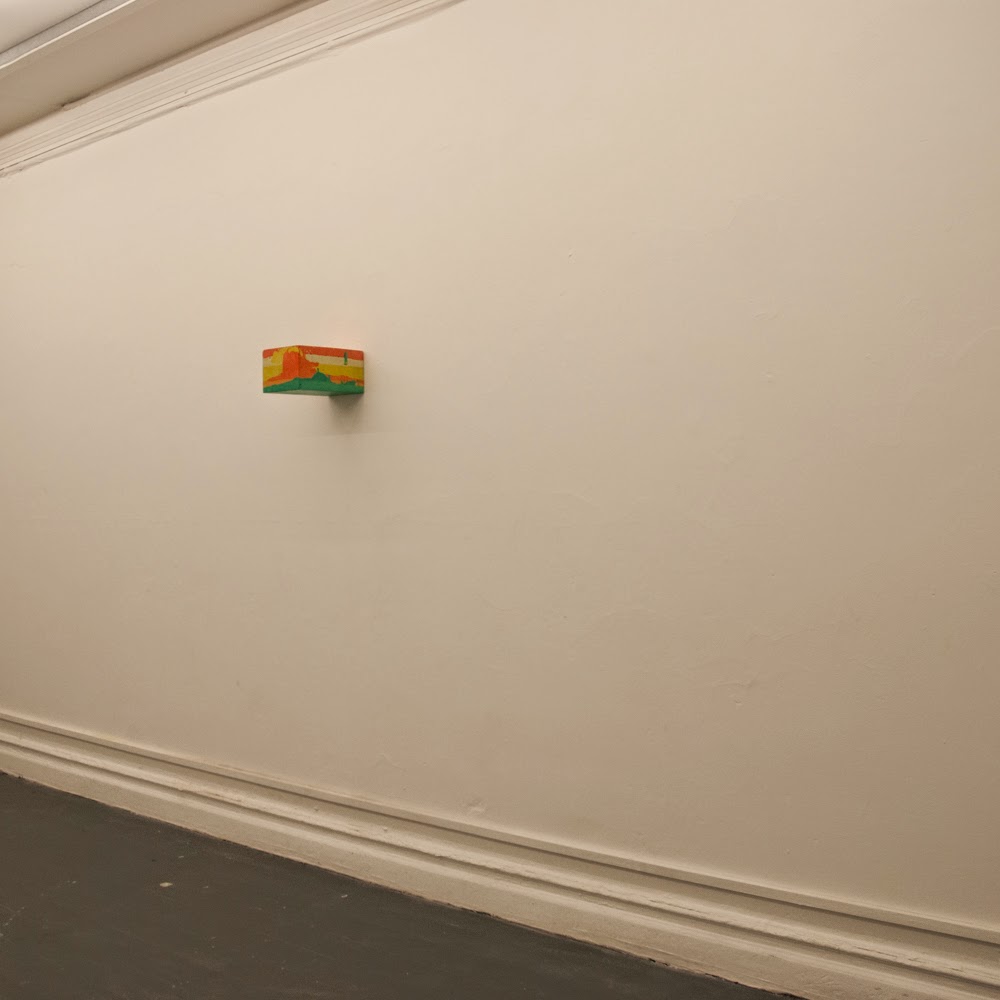
It's on the wall!

I've spent the last week hopping between the metal, wood and casting workshops, learning new skills and processes in order to achieve my aim of installing one of my sculptures on the wall.


I wanted the block to be flush against the wall without the presence of any brackets or shelves. In order to do this, I needed to have two steel rods sticking out of the wall to be inserted into the block and hold it above the floor. 


The rods were welded to a steel plate, and two holes were drilled into the plaster block for the steel rods to fit into. A countersink was made to accommodate the raised welded sections.


I chiselled a recess into the block for the steel plate to fit into, so as the block would fit flush against the wall.


The steel plate was drilled onto the wall, and then the block was slotted onto the rods.


It has been a time consuming process in order to get the block on the wall, but now I feel a sense of achievement, and am glad that I have learned some new skills. The technicians, Joe (woodwork), Steve (metal) and Burnie (casting) were all extremely helpful.


Saturday, 22 November 2014

Slicing casts

I feel it is important to work with the rectangular casts so as to turn them into something other than coloured bricks. I started making rectangular casts when I had my residency at 1 Royal Terrace. I made them specifically to fit the inbuilt bookcase, and this gave them a context. Without that context the blocks become much less interesting, hence why I need to do add another element to them or do something with them to give them a new context.

I have begun to slice into the blocks, creating new shapes and revealing unseen surfaces.


All of the faces of this block are black, but the inside is made from coloured layers. Now that I have sliced the block, the coloured layers are visible on this one side. I plan to carve into this side, moving it from the solid block into a more interesting and surprising form. I want to keep the other faces black so that the viewer gets a surprise when they see the coloured side.


Sunday, 16 February 2014

Completely coloured cast

Thanks to everyone who sent me colours and types of line for the stripes to my cast, and thanks to Nicola for helping me cover the cast in colour. 


Here's how these turned out on the cast


And here's how it looks like on paper


Apologies to Julie - dogtooth pattern was not possible as the cast is very difficult to draw onto


Saturday, 15 February 2014

Colouring up my cast

Thanks to everyone who has suggested colours and types of line for my cast. I have followed the suggestions in the order that they were suggested.


It is proving quite difficult to do intricate designs, and the pens react differently to the various fabrics that the cast is made from.

I will continue with more of your suggestions tomorrow.