Showing posts with label September 2018. Show all posts

Tuesday, 25 September 2018

Making ceramic discs for Lyres of Lemnicate

On Friday Bex and I made real progress making the ceramic discs. We loaded 6 shelves worth of discs into the kiln and left them to fire over the weekend. The discs are extremely fragile, and even transferring them from the work surface to the kiln shelf can break them. Inevitably, we lost a few during this process.


In the evening I got mastered the art of untangling guitar strings. I then looped them at the end and attached them to the lyres.


We then spent a long time attempting to get the e-bows in the correct position so that they would create the vibrations necessary for the Humbukkers to pick up the sound. Unfortunately by 10pm we had not succeeded, and we decided to call it a day, hoping that we would be fresher in the morning after some sleep.

Tuesday, 18 September 2018

Working on the Lyres with Drone Ensemble

Last night Drone Ensemble had a studio visit from Paul from Workplace Gallery and Lee from TUSK. We showed them the lyres and talked through where we are at in terms of making the ceramic discs, the film and our plans for the curation of the exhibition.


Afterwards, we worked on getting the e-bow mechanism positioned correctly so that when it is in contact with the string, it is activated and makes a sound. 


Jamie showed us the system he is building that will enable manipulation of the signals going to each speaker. This introduces an aspect of interaction, and the audience will be able to use a joystick to control the vibrations of the different speakers.


We tested different ways in which the ceramic discs could be installed so that they vibrate over the speakers enough so as to make a sound and have the potential to fall off, but not too much so as to immediately fall off and smash. This is something that requires further thought and experimentation!

Friday, 14 September 2018

In Every Dream Home - David Foggo - System Gallery

It is not uncommon to find less than tasteful wall art in pubs, and that makes System Gallery an appropriate venue for David Foggo's current exhibition. 


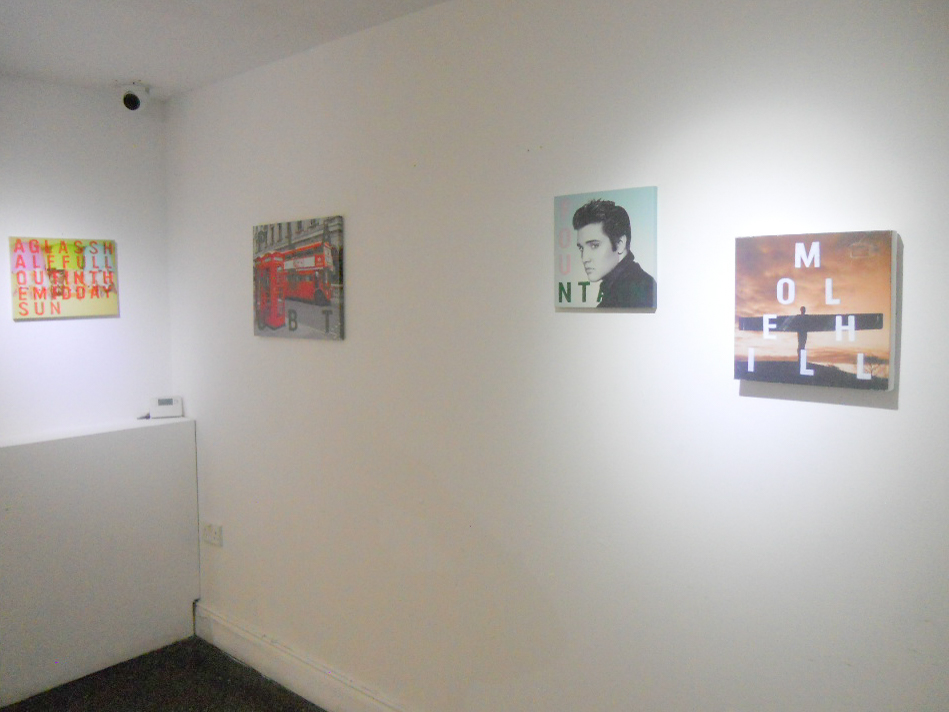
In Every Dream Home is a text/image series that utilises a cross-section of wall art archetypes/stereotypes, encompassing, amongst others, representations of love, spirituality, nature, patriotism, gender, food, music and film, travel, animals, sport and childhood. 


David usefully provides a definition of Wall art in the gallery:

Wall art noun. Bland, decorative, reproduction canvases, normally acquired from household furnishing stores by individuals or organisations with no taste or imagination and then hung in their homes or place of business. Often used as a way of covering up the cracks...


But these are no ordinary examples of Wall art. Foggo has worked onto each of the canvases, subverting their decorative function by overlaying them with a variety of unsettling texts. The alterations are minimal so that the canvases maintain their commonplace identity.


"This process could be seen as an act of reclamation, where the ornamental is transported into the realm of fine art.

The self-authored texts; simultaneously pithy and poetic, and underpinned by the use of word play, incorporate skew-whiff philosophies, dystopian statements, aphorisms and repetitive narratives.

The canvases are all sourced from charity shops, where their once idealised purpose has been dismantled by being discarded and offered up for recycling." 

David Foggo 

The exhibition has been carefully curated so that the images relate to, or take some meaning from their positioning. 


For example, the 'Bound' canvas is constrained between two windows, barely having enough room to breathe.


An iconic image of Elvis has 'fountain' painted on, and is positioned slightly above and to the left of an image of the Angel of the North which bears the word 'molehill'. Could this be a playful take on the familiar saying "make a mountain out of a molehill"?


The exhibition is open until 15th September, so I encourage you to pop along tomorrow to ensure you see it. It certainly put a smile on my face! 


Thursday, 13 September 2018

What I'm reading

I am really looking forward to getting stuck in to the latest additional to my personal library; Diary Drawings, Mental Illness and Me by Bobby Baker.


In 1996 the artist Bobby Baker was diagnosed as having borderline personality disorder. Her subsequent struggle to overcome severe mental and later physical illness lasted for 11 years, and was unknown to anyone outside her close family, friends and colleagues. The book contains 158 drawings and watercolours that were selected by Bobby from the hundreds more that she created daily as a private way of coming to terms with her experience.

Monday, 10 September 2018

Great & Tiny War featured on BBC Look North (North East & Cumbria)

Tonight (Monday 10th September) BBC Look North (North East & Cumbria) featured Bobby Baker's Great & Tiny War.


Sharuna Sagar visited the Great & Tiny War house today.


She was given a tour by one of my fellow hosts, Hannah.


Like everyone who does the tour, she ended in the kitchen where she was offered a cup of tea (other beverages available!) and a biscuit


If you missed the live version at 6:30pm, fear not as it is available on BBC iplayer

https://www.bbc.co.uk/iplayer/episode/b0bjcgpt/look-north-north-east-and-cumbria-evening-news-10092018

Monday, 3 September 2018

VR is Helping Solve Schizophrenic Auditory Hallucinations

https://www.hcanews.com/news/vr-is-helping-solve-schizophrenic-auditory-hallucinations-Tom Castles

About 65% of patients with schizophrenia experience verbal auditory hallucinations, which are characterized by harsh voices that emanate from body-less “others.” Usually, these “others” fit a common profile – they're domineering, derogatory and unremittingly hostile, making an already-burdensome condition even more painful for those who suffer from it.

Current treatments for schizophrenia like psychosocial therapy and antipsychotic medications help to ease hallucinations in many patients, but for roughly a quarter of people with psychotic conditions, available treatments just aren’t enough. What’s worse, many antipsychotic medications can lead over time to serious side effects like Parkinson disease and tardive dyskinesia, 2 debilitating movement disorders.

But a new therapy moving through the clinical trial pipeline could provide hope for patients who aren’t getting the results they need from conventional therapies, and so far, it hasn’t shown any adverse safety events. It’s called AVATAR therapy, an aptly-named acronym that stands for Audio Visual Assisted Therapy Aid for Refractory auditory hallucinations.

AVATAR therapy first garnered attention when it was pilot tested as a treatment for patients with auditory hallucinations between 2009 and 2011 by the UK’s National Institute for Health Research. The hypothesis driving the therapy is novel, but based on an old cliché: face your fears. Study authors hypothesized that if patients could confront the voice in their heads by virtually personifying it through a software program and challenging their punitive and domineering tendencies, the patient could either overcome the voice, learn to live with it, or eliminate it entirely.

In AVATAR therapy, patients build a customizable visual representation of the voice in their heads, known as the “persecutor.” The avatar has an appearance and tone of speech that closely matches the pitch and tone of the hallucinated persecutory voice. Suddenly, the hallucination enters the realm of reality.

Patients are then encouraged to engage in a dialogue with the avatar, who is remotely controlled by a therapist. Rather than propagating a relationship where the persecutory voice dominates a submissive patient, the therapist controls the avatar so that slowly, over time, it yields control to the patient.

Results of the pilot study were encouraging. Patients who underwent the novel AVATAR therapy showed mean reductions in total Psychotic Symptom Rating Scale (PSYRATS) auditory hallucinations of 8.75 (P = .003), and in the Omnipotence and Malevolence subscales of the Revised Beliefs About Voices Questionnaire (BAVQ-R) of 5.88 (P = .004). On the other hand, the control group experienced no changes during the study period.

Researchers behind a recent follow up study published in The Lancet set out to recreate those results in a larger, powered, randomized controlled trial, and again found that patients experienced favorable outcomes, with 83% meeting the primary end point – a reduction in auditory verbal hallucinations at 12 weeks.

The study’s lead author Tom K J Craig, PhD, FRCP, emeritus professor of social psychiatry at King’s College London (pictured), was surprised by the study’s positive results. But he said the evidence was compelling, and that he was most impressed by the number of patients who clearly improved with therapy.

“Most dramatic were the people for whom voices stopped entirely. Although Julian Leff had found this in his first pilot work, we did not really expect to see it repeated in our larger [powered, randomized] controlled study,” Craig told MD Magazine, a sister publication of Healthcare Analytics News™. “While that was the most striking outcome, the wider reductions in frequency and severity of voices reported by many people was also striking.”

In the follow up study, Craig and colleagues described the significance behind the transition of power from persecutor to patient.

“The operation of power within this relationship is viewed as crucial…the voice-hearer assum[es] a submissive role characterized by feelings of inferiority and powerlessness that can reflect social relationships more generally,” researchers wrote. “The therapist (switching between speaking as therapist and as avatar) facilitates a dialogue in which the voice-hearer gradually gains increased power and control within the relationship, with the initially omnipotent voice loosening its grip over the hearer by becoming more conciliatory over time."

The results are especially encouraging because the trial involved a sample of people suffering from persistent psychoses who reported unremitting and distressing auditory hallucinations for at least the previous year, despite regular supervision and continuing pharmacological treatment. Moreover, more than a third of all patients across both therapy groups had a clinical record of treatment resistance and were prescribed clozapine before the start of the study.

In the follow-up study, the reduction in PSYRATS total score at 12 weeks was significantly greater for AVATAR therapy than for supportive counseling, with a mean difference of -3.82 [SE 1.47], 95% CI -6.70 to -0.94; (P<.0093). Moreover, there were no apparent adverse events attributable to the therapy.

According to the authors, the study “corroborated the primary hypothesis concerning clinical efficacy by showing a rapid and sustained reduction in the severity of auditory verbal hallucinations by end of therapy at week 12 that was significantly superior to that achieved by supportive counseling…Our second and third hypotheses were also largely supported, in that AVATAR therapy had a positive and significant [effect] on omnipotence, and that these positive effects on voices were sustained at 24 weeks. However, it had no significant effect on the reported malevolence of voices.”

The authors acknowledged limitations, including the absence of a treatment-as-usual control condition. They also noted that the results could reflect regression to the mean in both groups, but considered that unlikely because participants were selected for persistent symptoms and were not recruited in crisis.

“The participants were all people who had suffered for many years with troubling auditory hallucinations and all had diagnoses of major psychoses (schizophrenia spectrum disorders mainly, but also psychotic depression). The auditory hallucinations were just one symptom among the several that make up these diagnoses. All were taking medication,” Craig said. “So using that to put AVATAR into perspective, I would say we have a promising add on treatment.”

Craig emphasized that the study did not provide any evidence that AVATAR therapy could replace medication or be provided instead of a wider cognitive behavioral treatment for psychosis, although there is potential for it to form part of a longer therapy of that type in the future.

Follow-up research is required before AVATAR therapy could be instituted widely across clinics, he added. Craig first recommended a future multi-center replication to test whether the therapy is effective across different service settings and cultures, and secondly, further work to unpack the active ingredients to strengthen the size and duration of positive outcomes.

“I think the next step is probably the multicenter study. There is considerable national and international interest, so I am hopeful we will have more definitive results within the next 5 years. Once we have this, it should be possible to see AVATAR therapy as a recommended treatment in clinical guidelines with wide availability,” Craig said.

Saturday, 1 September 2018

Jill McKnight - The Many-Limbed Machine of my Ancestral Makers - as part of Life in a Northern Town - NewBridge Project

For the final exhibition of Life in a Northern Town, Leeds-based artist Jill McKnight has been paired with Newcastle-based artist Rene McBrearty. Both artists draw upon their individual and family history and experiences to explore themes such as identity, memory, family, women and gesture.

McKnight has created a sculptural installation in which a number of large scale mixed media sculptures are accompanied by a spoken text that visitors can listen to on telephone headsets. Through listening to the text, we are provided with a potted version of McKnight's family history. 


"McKnight’s ancestors emigrated from Ireland to Liverpool, then Sunderland, where they found employment in Northern industries, including shipyards, fish shops and a telephone factory. Born in Sunderland, McKnight now lives in Leeds, which is characterised by buildings that were once major sites of production, prior to deindustrialisation."

As we walk around the gallery listening to the spoken text and looking at the sculptures we are introduced to anecdotes that explain the significance of some of the elements featured within the sculptures. For example, the fact that McKnight's nana opened and ran a popular fish and chip shop that sold wet fish by day and takeaway fish and chips by night influenced her decision to make a sculpture using giant laser cut acrylic fish and chip shop disposable forks.


The dedication, commitment and hard-working nature of McKnight's ancestors has certainly been passed onto the artist. This is evidenced in the spoken text and is directly visible in one of the sculptures. In the spoken text she gives a detailed account of some of the time consuming menial tasks such as arranging economical transport for the work from Leeds to Newcastle and ordering materials online, that she does as part of her art-making process. I'm sure that many an artist listening to this will let out a groan in sympathy or nod their head in agreement as they hear about McKnight's exhaustion, and frustration with online shopping.

If visitors need further proof of McKnight's artistic work ethic they will find it in a sculpture made from printed CV's and job applications. Again, McKnight reveals the reality of being an artist - the need to have paid employment to be able to afford to practice as an artist.


I hope that I haven't given the impression that this is a 'doom and gloom' exhibition. The text is humorous and the sculptures are bright and playful. They clearly demonstrate that along with the hard work that goes into making the work, the artist gains pleasure and satisfaction from what she does. Long may that continue!

For more information please visit
https://thenewbridgeproject.com/events/rene-mcbrearty-jill-mcknight-life-northern-town/

Rene McBrearty - How to Remove a Single Strand Knot - as part of Life in a Northern Town - NewBridge Project

For the final exhibition of Life in a Northern Town, Newcastle-based artist Rene McBrearty has been paired with Leeds-based artist Jill McKnight. Both artists draw upon their individual and family history and experiences to explore themes such as identity, memory, family, women and gesture.


How to Remove a Single Strand Knot is Rene McBrearty's contribution to the exhibition.

McBrearty has created a new sculptural installation, presenting familiar McBrearty elements such as drawing, poetry, a riso printed zine, found objects and handmade sculptural forms alongside her first moving image work.

The setup reminds me of a domestic space with a comfy settee at the heart. Her sculptural forms are made from ceramic, leather and found materials. Ceramic shirt collars are draped over a clothes horse, and leather threads are piled on the floor. A number of other sculptures sit on a blouse that has been opened out on the floor. It is a casual arrangement with the suggestion that the process of making these objects took place in situ.

The video piece is situated in an old-fashioned larder. McBrearty and a number of other women of colour are sat round a kitchen table carrying out repetitive domestic actions such as polishing the table and kneading lumps of clay. The occasional subtitle reveals some of the conversations that take place as the women engage in their work.


The title refers to the fact that a single strand knot is found in afro hair and can prove difficult to remove. The removal of the knot becomes a metaphor for processing daily micro-aggressions and practicing self-care.

"The work thinks about the hidden labour carried out by women of colour while experiencing micro-aggressions which are everywhere, non-negotiable and relentless. The work explores the labour, productivity and the learning and unlearning of personal histories alongside the importance of sisterhood and community resilience in surviving. It is informed by her own experience, conversations with friends, her grandmother and the novel ‘Sula’ by Toni Morrison."

How to Remove a Single Strand Knot has been produced with the help of: Jola Olafimihan, Hannabiell Sanders, Wanjiru Mugo, Miles McBrearty, Matthew Pickering, Heather Bonnie Reid and Janina Sabaliauskaite.

For more information please visit