Sunday, 10 November 2013

Plaster Casting workshops at St David's and St Patrick's Primary schools

Last month I spent a couple of days in 2 different Primary Schools doing plaster casting workshops with the pupils. The workshops formed part of North Lanarkshire's Cultural Festival, Encounters. They were developed to coincide with my exhibition at Motherwell Theatre and Concert Hall.

The children were great to work with, full of ideas, enthusiasm and were very well behaved. At the end of each day we had a group discussion about the work they had made, what they had learned, what ideas they now would like to pursue and so on. Everyone had enjoyed the activities and had done something they had never done before. I felt a real sense of achievement knowing that it had been such a positive experience for them, and I was really proud of the work they made.


At the beginning of the day I talked to the groups about the process of casting, and showed them examples of other artists who make work by casting.


Pupils made their moulds using cardboard covered in parcel tape, and then created a boundary with clay and poured the coloured plaster into the shape.


Everyone was eager to get their hands in the mixing bowl!


They watched attentively as I showed them how to do each stage of the process.


I hope that I get the opportunity to do more workshops of this kind, and so please do get in touch if you are interested.

Projects: Manchester – a space for artists to test and experiment | News | a-n

Projects: Manchester – a space for artists to test and experiment | News | a-n


Monday, 4 November 2013

New figures reveal the true extent of the London/regions divide

http://www.artsprofessional.co.uk/news/new-figures-reveal-true-extent-londonregions-divide

An ongoing funding bias towards London is denying huge proportions of England’s population fair access to the arts, according to a new independent report by three senior arts figures.

Central Government spending per head on culture in London was nearly fifteen times greater than in the rest of England in 2012/13, and successive governments and Arts Council England (ACE) have failed to deliver on their own policy rhetoric about redressing the balance between London and the regions, according to a new report, ‘Rebalancing our Cultural Capital’. Last year 51% of ACE’s £322m public funding budget was spent on London, and of the further £450m used by the DCMS to direct-fund 16 major cultural organisations, an estimated 90% went to London. As a result, Londoners benefited from £69 of cultural spending per head, compared with just £4.50 in the rest of England. In addition, ACE committed 45% of its £317m arts Lottery funding to London, meaning that Lottery players across the country funded the arts to the tune of £17.41 per person in London, but only £3.90 in the rest of England.

Report authors Christopher Gordon, David Powell and Peter Stark, all senior arts professionals with both UK and international experience in research and cultural policy, insist that a balance needs to be struck “between the inevitable attractions for talent in all spheres of what a great global capital city can offer, and its function as the capital for a whole nation.” Calling for “stronger and more sustainable production resources for cultural production” to be based in the regions, they propose that a process of redressing the balance should begin with a fair 'per capita' share of arts Lottery funding being spent in the regions over a five year period, and that a £600m budget should effectively be ring-fenced for “a National Investment Programme to support the arts outside London.”

The report is based on a detailed analysis of figures dating back over twenty years, and points out that 75% of public funding of the arts is in the hands of ACE and the DCMS – a proportion that is set to increase as local authority spending on culture is squeezed in response to public funding cuts. The allocation of central Government money is seen to be at the heart of the national arts funding imbalance, but the distribution of Lottery funding to the arts has done little to improve the picture. Since Lottery distribution began in 1995, ACE has favoured London significantly more than have the equivalent distributors for heritage, sport and the Big Lottery, and the average value of an arts Lottery grant in London has been double that of the average for the rest of the country.

The uneven playing field described in the report is exacerbated by other factors. The £69m invested in the arts by the City of London and the London boroughs is supplemented by the Mayor’s expenditure on cultural and creative projects totalling over £27m; around 90% of giving to the arts by individual philanthropists goes to London-based organisations; and over two-thirds of business sponsorship is in London, as is nearly three-quarters of support from trusts and foundations. 61% of the first £30.5m of arts endowment funding under ACE’s Catalyst Programme is also going to London. Couple this with the significant contribution of the commercial arts sector in the capital, and the impact of the specialist institutions for professional art, music, dance, film and drama training, 90% of which are London based, then the bias towards London is all the more evident. David Powell commented: “As a Londoner, my instinct has long been that there was inequity between London and the rest of England, but on close inspection, the historical and current record looks pretty shocking even when making due allowance for the additional investment in national and international infrastructure proper to a capital which is one of the world’s great cities.”

Rejecting the arguments that London-based cultural organisations are in a position to benefit the rest of the nation, the report argues that the travel and accommodation costs of attending arts activity in London “render access unaffordable for a very high proportion of England’s more distant populations.” And the arguments that digital developments redress the London funding bias are similarly dismissed: “Digital access… is a two-way street and should be considered as such in national policy and investment decisions. If the Lindisfarne Gospels can be adequately accessed digitally from the North East (where they belong and where well over 95,000 people paid to see them ‘on loan’ during the summer of 2013), then such digital access to them from London – were they to be returned to the North East – would also be ‘adequate’ and the added value to these dispersed locations would be immense.”

The research and report have been self-funded by the authors, with the aim of stimulating policy debate on the issue of regional imbalance. Christopher Gordon told AP: “…the UK’s combination of local government with few effective constitutional guarantees, and cultural funding being predominantly decided by ‘arm’s length’ bodies, results in both strategy and equity being off the political agenda in England. Who takes responsibility for, or makes sense of, ‘the big picture’? Answer: nobody. Having no policy is not a justifiable policy.” Peter Stark believes the lack of debate on the issue is partly due to the public silence of those who are or aspire to be funded: “That is why this research is self-funded and independent of any interest group. That is why we have sought to make it sufficiently authoritative for it to require debate.” Both Melvyn Bragg and David Puttnam have already signalled their approval of the report, which Lord Bragg described as “timely, urgent and damning of an increasingly centralised funding process.” He said: “London is simply eating up the resources which are limited and therefore starving the rest of the country. This is wrong, short-sighted and undoubtedly unfair. I think it is time that the rest of England fought back…”. Lord Puttnam said that the report: “leaves no doubt about the wholly unjustifiable scale of bias towards London in the distribution of public and lottery funding of the arts… at a time when there is rising anger about policies that allow London – most especially affluent Londoners – to be underwritten at the expense of the rest of the country."

The authors are offering to make themselves available to the regional What Next? meetings and appropriate national forums to answer questions and engage in discussion

Tuesday, 29 October 2013

Liz West: An artist with extra Spice By Ian Youngs Arts reporter, BBC News

Liz West, a fellow artist, lover of colour, Glasgow School of Art alumni, and my ex-flatmate, talks about how her collection of Spice Girl memorabilia has helped fund her art practice.

Liz West: An artist with extra Spice
Liz West is known for her artworks that use bright coloured light
 
Artist Liz West is gaining a glowing reputation for her colour-drenched light installations - but her art career might not have taken off if it were not for her world-record collection of Spice Girls memorabilia. Art and pop can go hand-in-hand, she explains.
 
West is taking part in two exhibitions this week - one featuring her strips of coloured light radiating from the corner of an old warehouse, which is in the Synthesis exhibition as part of Manchester Science Festival.

She has a growing reputation as a contemporary artist thanks to her arrangements of lights in precise, pleasing patterns and her collections of objects bathed in bright, bold hues.
For the other exhibition, she has lent some of the 5,000 Spice Girls items she has amassed since the age of 11, including branded clothes, crisp packets and a clock, to an exhibition celebrating 40 years of Virgin Records in London.

As well as being an artist, West holds the Guinness World Record for the largest collection of Spice Girls memorabilia.

Liz West  
 
The Spice Girls collection comprises 5,000 items of clothing and merchandise
"The way I see it is that installation art is high culture and Spice Girls is pop culture," she says. "Although the two hold hands, they're separate."

When looking to launch her art career, West's Spice Girls obsession came in useful when she found she could get paid for loaning her girl-powered pop collection to museums, film crews and events.

"Because I was given that financial boost to start with, my art practice has been able to roll and roll," she says.

"Now I'm able to fund my art practice through my art. I don't have to work in Starbucks part-time. A lot of artists do have to work part-time, and I think that would kill any creativity for me. It really would."

West was born into the art world - almost literally - almost born on the floor of the Whitworth Gallery in Manchester, she says, when her mother Jenny was artist in residence there 28 years ago.

A five-day-old West attended the opening of her mother's exhibition.

Liz West exhibition  
 
West recently staged a solo exhibition in an empty office unit in Manchester.
 
When she was seven years old, West remembers putting nail varnish bottles on a bedroom shelf in line according to their colour. It is not difficult to spot a link between her love of colour as a child and the artworks she now creates.

Then when she was 11, the Spice Girls arrived.

"A very impressionable age, I think," she says. "I was hooked. The colour, the energy, the different personalities. That appealed - more so probably than the music."

When the Spice Girls' second album came out in 1997, West decided to collect any and every recording and item of memorabilia she could get her hands on.

"I'd go to the pound shop and buy bags of things as a 13- or 14-year-old. They brought out the dolls and I went to London to the Hamleys sale.

"Of course, when eBay appeared when I was 18, I had a student loan, went a bit mad, and it just continued."

Spice Girls at the Brit Awards 1997  
 
West owns Emma Bunton's 1997 Brit Awards dress - but not Geri Halliwell's
 
Influenced by her parents (her father Steve is also an artist), West attended the prestigious Glasgow School of Art.

"When I was a student, I'd go into the studio all day and then I'd go into the library in the evening and just bid and bid and bid [on eBay]," she says. "I'd have a day of art and an evening of Spice."

West says she has spent "tens of thousands" of pounds on her collection, which also includes outfits from the Brit Awards, the Spiceworld movie and the jacket Mel B wore to meet Nelson Mandela.

But it does not include the most iconic Spice outfit of them all - Geri Halliwell's union jack dress from the 1997 Brit Awards. That was bought by the Hard Rock Cafe in Las Vegas for £41,000.

"That's the holy grail," West says. "And it's in storage. That's quite upsetting."

Now, West's art career is taking off thanks to her luminous installations that look like she has dismantled and rearranged a rainbow.

Liz West exhibition  
 
West has been in exhibitions at Manchester's Cornerhouse and Blankspace
 
"Did you see the rainbow the other day over Manchester?" she says excitedly at the mention of rainbows. "This was a double one and it was a proper arch. I stopped in the street for about five minutes and stared at it.

"I thought, forget James Turrell and Olafur Eliasson and all the artists that I absolutely love - this is true absolute beauty. There's something in that that I could never create, even if I tried."

West says she is not worried about her Spice Girls obsession undermining her reputation as an artist.

"It's completely in keeping with my personality," she says. "And because I've got such a passion for it, I win people over with that passion. It's not just about T-shirts and dollies.
"As a serious artist, this is my career. I want to be nominated for the Turner Prize.

"If you look at other artists, there are quite a few that have quirky collections out there and haven't hidden them. I don't have a problem with it."

What do other artists say when they find out about the collection? "They think it's quite funny," West replies.

"You know, it would be really boring if I didn't do anything else. People tend to think that it's a quirk, and quite a nice one."

For the original article and to watch a video of Liz West on the BBC news, please visit

http://www.bbc.co.uk/news/entertainment-arts-24655947

Monday, 28 October 2013

Some thoughts on future work

I'm working towards an exhibition I have lined up at the beginning of next year (official announcement to be made soon), and today met with one of the gallery committee to talk through ideas and get some technical advice.

It's all very exciting, and I have some ambitious plans, but the next step is to get some funding in order for me to be able to turn the ideas into reality.

Any private donations would be more than welcome!


Sunday, 27 October 2013

Farrow and Ball

I enjoy looking in shop windows, seeing how products and clothes are displayed, and how decoration and interior design is used. I get inspiration and form ideas in relation to colour schemes, means of display, designs and patterns.

Today I walked past the Farrow and Ball shop and was attracted to they way in which they combined neutral colours with small selected areas of intense colour.


Friday, 25 October 2013

Jude Kelly calls for an overhaul of arts education

Jude Kelly calls for â€Å“overhaul” of arts education

The Reith Lectures: Grayson Perry: Playing to the Gallery

In this episode, artist Grayson Perry asks whether it is really true that anything can be art.

He draws upon different theorists to ponder what art is.

Philosopher George Dickie said an artwork is “a candidate for contemplation or appreciation.”

Arthur Danto, another philosopher, said an artwork is about something, has a point of view,  and it uses rhetorical ellipsis - i.e. that it engages the audience to sort of
fill in the gaps. So call and response; you know you have to respond to the
artwork.

Danto also said, it needs an art historical context. This is a kind of institutional definition of art. It needs to be in the context where you might find art  .


We live in an age when many contemporary artists follow the example of Marcel Duchamp, who famously declared that a urinal was a work of art. It sometimes seems that anything qualifies, from a pile of sweets on a gallery floor to an Oscar-winning actress asleep in a box. How does the ordinary art lover decide?


In a lecture delivered amidst the Victorian splendour of St. George's Hall in Liverpool, Perry analyses the common tests to help determine whether something is art.

1. is it in a gallery or an art context?

2.  is it a boring version of something else?

3. is it made by an artist?

4. photography

5. limited edition test -  if something is endless, it’s giving away part of its qualification as art. 

6. the people that are around looking at it

7. The "rubbish dump test". “Throw it onto a rubbish dump. And if people walking by notice that it’s there and say “Oh what’s that artwork doing on that rubbish dump”, it’s art.

8. Art is able to detain and suspend us in a state of frustration and ambivalence and
to make us pause and think rather than simply react.

He concludes that in his opinion, the quality most valued in the art world is seriousness.

To listen to the Reith Lecture and find out more information, please visit

http://www.bbc.co.uk/programmes/galleries/p01j9rwb

Tuesday, 22 October 2013

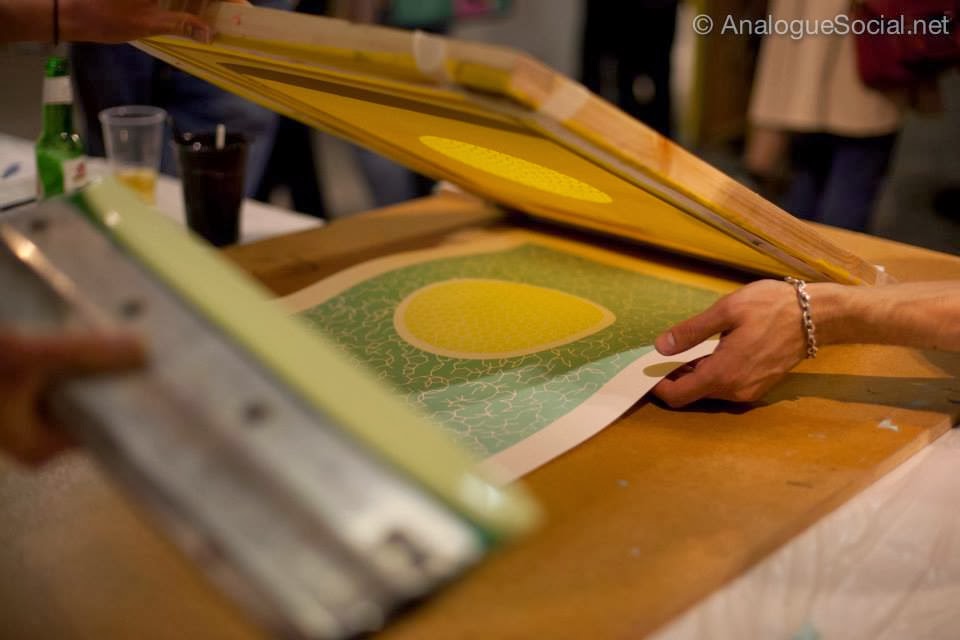
Screenprints from AnSo Live Screenprinting event

The Analogue Social Live Screenprinting Event in Dundee seems like a long time ago, so it was a lovely treat today to be given a batch of prints that we made back in August, which had been in the exhibition following the live event.

The selection included some prints that consisted of both my circular and rectangular image,


some prints that had my circular image and a rectangular image by another of the artists


and some prints that had my rectangular image and a circular image by another of the artists.


The other artists screenprinting were: Nils Aksnes, Nikki McWilliams, Petra Scherer, Ross McAuley and Michael Corr.

Saturday, 19 October 2013

A couple of recommendations for your ears

There have been some excellent arts radio programmes recently, and so here are a couple of recommendations.

Democracy Has Bad Taste

BBC Radio 4
Tuesday 16th October 

The Reith Lectures,

Grayson Perry: Playing to the Gallery: 2013

In the first of four lectures, recorded in front of an audience at Tate Modern in London, the artist Grayson Perry reflects on the idea of quality and examines who and what defines what we see and value as art. He argues that there is no empirical way to judge quality in art. Instead the validation of quality rests in the hands of a tightknit group of people at the heart of the art world including curators, dealers, collectors and critics who decide in the end what ends up in galleries and museums. Often the last to have a say are the public.

Perry examines the words and language that have developed around art critique, including what he sees as the growing tendency to over-intellectualise the response to art. He analyses the art market and quotes - with some irony - an insider who says that certain colours sell better than others. He queries whether familiarity makes us like certain artworks more, and encourages the public to learn to appreciate different forms of art through exploration and open-mindedness.

Perry was awarded the Turner Prize in 2003, and is known for his ceramic works, printmaking, drawing, sculpture and tapestry as well as for his cross-dressing and alter-ego, Claire.


A masterpiece in a primary school classroom; 

Front Row

BBC Radio 4

Thursday 17th October

In this Front Row episode Mark Lawson visits a Luton primary school, as the children get to see a Frank Auerbach painting, on loan for the day. The work came from the Ben Uri Gallery as part of the Masterpieces in Schools programme, a partnership between the Public Catalogue Foundation and BBC Learning. Mark joins the children as they prepare to see a masterpiece first-hand, many of them for the very first time, and hears their thoughts about Auerbach's Mornington Crescent, Summer Morning II.


Wednesday, 16 October 2013

Mark Devereux Projects announce Projects: Manchester

Last month I became a member of Mark Devereux Projects, an artist production-development organisation established to help increase the national and international profile of early-career visual artists.

With each practitioner’s artistic and career development paramount, emphasis is placed upon mentoring and helping the individual to place themselves within the industry through concentrated critical engagement and promotion.

Mark Devereux Projects have just announced it's latest project:

Mark Devereux Projects are delighted to announce the launch of
PROJECTS: MANCHESTER
AND BEYOND MERELY ASSEMBLING EXHIBITION
FRIDAY 8 NOVEMBER 2013

Launching this November, Projects: Manchester is a new pop-up space dedicated to nurturing and developing the work of emerging artists. Responding to the current ecology and Mark Devereux Projects’ ongoing ambition to help nurture the best up and coming talent, we are excited to offer creatives a new test space. Emphasising Manchester’s reputation for its support to early-career artists, the space will be available to trial new ideas.
 
Taking residence in one of the eight floors of former office space at the Co-Operative’s major Federation House in central Manchester and as part of Castlefield Art Gallery’s New Art Spaces initiative, the venue will offer artists the opportunity to showcase, develop and experiment.
 
To launch Projects: Manchester, Mark Devereux Projects will be showcasing the work of ten of the organisation’s associate members responding to the title ‘Beyond Merely Assembling’. With works considering the way in which we respond to the environment around us, the spaces we occupy and how we often try to make-do with what we have, the exhibition includes the mediums of installation, painting, sculpture, video and performance.

Selected by Kerry Harker (Director The Tetley, Leeds), Gill Park (Director Pavilion, Leeds), Tony Charles (Director Platform-A, Middlesbrough) and Mark Devereux, each artist is given dedicated one-to-one developmental and critical support from Mark Devereux Projects, helping to nurture their ongoing careers.

Beyond Merely Assembling features the work of; Bettina Amtag, Tom Beesley, David Bethell, Phoebe Eustance, Charles Gershom, Aylwin Greenwood-Lambert, Mark Houghton, Katrien van Liefferinge, Kit Mead, Darren Nixon and Zervou-Kerruish.
Beyond Merely Assembling launches on Friday 8 November, 6-9pm and continues until Wednesday 20 November. There will also be a special event on Sunday 17 November, with further information to be announced shortly.


FURTHER INFORMATION:

Projects: Manchester, 1st Floor, Federation House, Federation Street, Manchester, M60 0AF
Opening times: 1-7pm Tues-Fri | 12-4pm Sat-Sun | Closed Mon
markdevereuxprojects.com

Saturday, 12 October 2013

Recent drawings


I use drawing for many different purposes, and regard it as an immediate and accessible means to express ideas.

I find drawing to be an excellent way to problem solve and work things out.

In this instance I used drawing to document my current 'Groovings' installation at Motherwell Concert Hall.

The exhibition is on until the end of October, so you have a bit of time still to go and see the work up front and for real!

Wednesday, 9 October 2013

Glasgow International art festival launched - by Brian Ferguson in The Scotsman

Glasgow International art festival launched

by BRIAN FERGUSON

MORE than 40 different sites around Glasgow are to be part of the city’s flagship visual art celebration in the run-up to the Commonwealth Games.

Around 80 artists from around the world will have their work showcased during the biannual Glasgow International, which will be staged for the sixth time in 2014.

Organisers say more than 90 per cent of the work on display during the 18-day spring event will either be brand new or will be on display for the first time in the UK.

Although galleries across the city centre will be hosting the majority of the show solo and group shows, artists will be transforming two sites near the Emirates Arena in the east end - at Dalmarnock and Bridgeton - as well as the old Govanhill Baths, which will be taken over by inflatables.

Shows will be inspired by the historic collections at the city’s Kelvingrove museum, the impact of television and the Empire Exhibitions.

Other exhibitions at the festival include one which will feature a fully-functioning nail bar and another showcasing works of art which jump out of their frames.

Extra funding has been secured for next year’s festival - which will run from 4-21 April - which will see it be part of the programmes for both the 2014 Year of Homecoming and the Glasgow 2014 cultural programme.

Artists bringing major shows to the city include Aleksandra Domanovic, from Serbia, Germany’s Michael Stumpf, and Americans Michael Smith, Jordan Wolfson and Avery Singer.

Festival director Sarah McCrory said: “Glasgow International will continue to show the strength of the renowned and exceptional production from within Glasgow, as well as invite artists into the city to embed into its museums and alternative spaces, encouraging discourse around multifarious topics ranging from new technologies and museum taxonomies to the use of humour.

“Once again the festival will provide a focus on the wealth of its arts organisations and communities, whilst embracing input to these discussions from international practitioners.”

Source: http://www.scotsman.com/lifestyle/arts/visual-arts/glasgow-international-art-festival-launched-1-3131088

Sunday, 6 October 2013

Plaster Caster workshops as part of Encounters Festival

October is the month of North Lanarkshire's cultural festival, Encounters. I was asked to develop and lead a plaster casting workshop for school children in conjunction with my exhibition at Motherwell Concert Hall and Theatre.


Over the past couple of days I have been leading the workshops, first based at St David's Primary School, Airdrie and another day at St Patrick's Primary School, Coatbridge. I was working with children in P6/P7 classes, and had just under 20 students each day.


Both days went really well; the children were well behaved and all immersed themselves fully into the activities, producing some excellent work.

I began the workshop by introducing myself and talking a little about my art practice. I then explained what we would be doing in the workshop, showed examples of the materials we were going to be using, and handed round some of my work. I showed them documentation of other artists who have used casting, and simply explained the process.

The children were given a square of corregated cardboard and asked to cover it with parcel tape. They then used clay to make a boundary wall to form the shape of their mould. Working in small groups, the students made different colours of plaster and poured the plaster into their moulds.
The students made a variety of colours of plaster, and they all got a chance to engage in ever stage of the casting process. In addition to pouring the plaster into their cardboard and clay moulds, I had also given them a range of plastic containers for them to fill and had covered some tables with sheets of baking paper for them to pour and drip plaster onto in a more freestyle fashion. I showed them all how to remove the cast from the mould as they would need to do it the next day once the plaster had dried properly.


I ended the session with a question and answer session where we discussed what they had learned, how they had found the workshop, whether they had enjoyed it and so on. They also asked me questions about being an artist.

I am delighted that the children responded so well to the workshop, and the teachers were also very pleased with the workshop.

I am looking forward to receiving an email from the teachers with photos of the children holding their casts once they had been removed from the mould.


Thursday, 3 October 2013

Recordings of the speakers from the inaugural CPG on Culture meeting are now available online

Recordings of the speakers from the inaugural CPG on Culture meeting are now available online.

Aclaimed author Janice Galloway opened the meeting with a reading of Don Paterson’s poem ‘We, the Scottish people’ (2005). Following on from the reading, Creative Producer and Company Director of Synchronicity Films Ltd, Claire Mundell followed David Greig as the second speaker of the evening.

To listen to the recordings visit this website:

http://www.cpgonculture.com/videos-podcasts/?dm_i=FES,1UHB9,81M3WZ,6M0HW,1 


Tuesday, 1 October 2013

Liza Lou: Colour Field at Museum of Contemporary Art San Diego

For twenty years, the glass bead has been Liza Lou’s primary art-making material. Lou transforms the possibilities of this tiny unit of color and embellishment just as she expands the meaning of the objects she recreates.  


Color Field (2010-2013), her newest floor-bound sculpture, features an expansive prism of color. The gridded rainbow is composed of uniform lengths of wire, each threaded with a single shade of beads. The sheer expanse of the piece conveys exuberance, underscored by the work’s bounty: its multitude of colors, beads, and touch. Pulsing and pixelated, Color Field’s complex mosaic foregrounds its construction and the network of hands which helped shape it.
 
Liza Lou: Color Field is organized by the Museum of Contemporary Art San Diego.

https://www.mcasd.org/exhibitions/liza-lou-color-field