
Sunday, 31 March 2019


Saturday, 30 March 2019

Friday, 29 March 2019
Making Art with Frances Morris: Sophie Calle
I recognise that I like to be in control. I often find it easier to respond to instructions or a set of restrictions than I do to be given complete free-reign. Within my art practice (as well as in life), I often devise my own set of rules to follow. For instance, only use the colour white, fill the entire frame with pattern, only use materials that are edible.
 |
| https://www.culturewhisper.com/r/visual_arts/the_artist_dining_room_sophie_calle_supper_club/7618 |
It is these tendencies that initially introduced me to the work of Sophie Calle, an artist who is famously controlling and who devises and implements "rules of the game". 'Sophie works with real life experiences we can all relate to – the death of a parent, the end of a relationship. Her work resonates with her preoccupations - death, absence, the mourning of the passing of life. "Growth is a series of mournings."
Calle recently produced an album of songs by 40 international musicians, in memory of her dead cat Souris. There’s Jarvis Cocker, Juliette Armanet, Bono, Michael Stipe to name a few. She’s made work out of her mother dying or her boyfriend ditching her. She’s had a job as a stripper, made a crazy road movie called No Sex Last Night. She's contacted everyone in a lost address book she found on the street. She’s asked people to describe their most exquisite pain, invited strangers to attend the funeral of their secrets. She’s asked museum staff to remember stolen paintings, blind people to describe the most beautiful thing they’ve seen. And although the work seems apparently dry - images and texts, books - it's deeply personal for those involved, and for us - the viewer.
In this BBC Radio 4 programme, Frances Morris, Director of Tate Modern, meets French artist Sophie Calle in her studio in south west Paris.
Thursday, 28 March 2019

Wednesday, 27 March 2019

Tuesday, 26 March 2019
Grayson Perry: En Garde
In this episode of Archive on Four (BBC Radio 4) Grayson Perry goes backwards in the archive in search of the moment the avant-garde died.
'It's a century since Marcel Duchamp submitted his artwork called Fountain to an exhibition staged by the Society of Independent Artists in New York. Fountain was a urinal -- not a painting of a urinal or a sculpture, just a urinal, bought from a Manhattan hardware store and signed R.Mutt.
The Society of Independent Artists rejected Duchamp's provocation and the original object was lost. Nowadays Duchamp's urinal is canonised as the fountainhead of conceptual art and the high water (closet) mark of the avant garde. Replicas of the Fountain grace museums around the world - emblems of the avant-garde spirit of experimentation and confrontation. Somewhere in the intervening years though, something changed - contemporary art lost its ability to shock and critique. We're still hopelessly drawn to the idea of art that's 'cutting edge', 'ground-breaking', 'revolutionary'. But is that possible at this point -- haven't we seen it all before?

Maybe the death knell was sounded when the Saatchi Gallery opened on the South Bank? Or with the advent of protest and radical chic in the 1960s? Maybe it was when the CIA funded the abstract expressionists? Or when the post-war art market began to reign supreme? Or when the Museum of Modern Art opened its doors in 1927? Or maybe it was all a matter of style the very moment Duchamp's Fountain was conceived?'
Perry questions whether the avant garde over emphasises the importance of the individual at the expense of valuing the collective.
Can people be accidentally avant garde? One tends to think that people have somehow made a set of conscious decisions to 'break the mould' and do something groundbreaking, but quite often they have simply done something that they find interesting and have not considered the notion of the avant garde.
This episode features Brian Eno, Kenneth Goldsmith, Nnenna Okore, Cornelia Parker, and Sarah Thornton.
Producer: Martin Williams.
https://www.bbc.co.uk/programmes/b090v482
'It's a century since Marcel Duchamp submitted his artwork called Fountain to an exhibition staged by the Society of Independent Artists in New York. Fountain was a urinal -- not a painting of a urinal or a sculpture, just a urinal, bought from a Manhattan hardware store and signed R.Mutt.
 |
| (c) Succession Marcel Duchamp/ADAGP, Paris and DACS, London 2017 / Photo (c) Tate |
The Society of Independent Artists rejected Duchamp's provocation and the original object was lost. Nowadays Duchamp's urinal is canonised as the fountainhead of conceptual art and the high water (closet) mark of the avant garde. Replicas of the Fountain grace museums around the world - emblems of the avant-garde spirit of experimentation and confrontation. Somewhere in the intervening years though, something changed - contemporary art lost its ability to shock and critique. We're still hopelessly drawn to the idea of art that's 'cutting edge', 'ground-breaking', 'revolutionary'. But is that possible at this point -- haven't we seen it all before?

Maybe the death knell was sounded when the Saatchi Gallery opened on the South Bank? Or with the advent of protest and radical chic in the 1960s? Maybe it was when the CIA funded the abstract expressionists? Or when the post-war art market began to reign supreme? Or when the Museum of Modern Art opened its doors in 1927? Or maybe it was all a matter of style the very moment Duchamp's Fountain was conceived?'
Perry questions whether the avant garde over emphasises the importance of the individual at the expense of valuing the collective.
Can people be accidentally avant garde? One tends to think that people have somehow made a set of conscious decisions to 'break the mould' and do something groundbreaking, but quite often they have simply done something that they find interesting and have not considered the notion of the avant garde.
This episode features Brian Eno, Kenneth Goldsmith, Nnenna Okore, Cornelia Parker, and Sarah Thornton.
Producer: Martin Williams.
https://www.bbc.co.uk/programmes/b090v482
Sunday, 24 March 2019
Another wunderful evening with team Wunderbar (and Caitlin Merrett-King)

Glasgow-based artist Caitlin Merritt-King is currently doing a residency at the Newbridge Project in which she is wanting to record a new podcast exploring:
- methods of collaboration
- the political nature of working with friends
- friendship as emotional and feminised labour
- how we exercise care and love within art practice.
The podcast is going to serve as an informal archive that will aim to be a useful tool for experimenting for Newbridge now and in the future.
When I saw the 'Call for Ideas' I thought it could be an opportunity for us to share some of the Great & Tiny War experience. I was not necessarily thinking of it as a podcast just about Great & Tiny War, but more about the experience of all of us working together.
So, I arranged for us to meet (well, as many of us as were available), and we spent the evening talk about collaboration, working together, being friends, being women, caring for each other, caring in the art world, the nature of feminine work, Great and Tiny War, Bobby Baker and so on. Caitlin is going to edit the footage and the podcast will be available online in the near future.
Friday, 22 March 2019
The Occasion Collective - SLOW at Durham Castle
Last Saturday evening I had the pleasure of experiencing SLOW, an immersive live sound performance and promenade held in the majestic grandeur of Durham Castle, hosted by The Occasion Collective (TOC).
"TOC is a curatorial and practice-based artist-led collective which provides artists with the opportunity to exhibit, develop and collaborate.with a focus on engaging new audiences with spectacular and speculative creative practice. TOC champions transdisciplinary collaboration, and creates a much-needed platform for artists of varied disciplines for mutual benefit."

SLOW by Jamie Cook, looks to explore the possibilities of acoustic/electronic collaboration through large-scale, immersive, meditative, promenade performance and installation. Cook’s work often utilises mixed media collaboration, exploring the relationships between art/music/dance/film and how the lines between these practises can be blurred to create new and interesting possibilities.


SLOW - Composed by Jamie Cook
Performed by
Jamie Cook (electronics)
Will Hammond (vibraphone)
Merle Harbron (fiddle)
Ceitidh Macleod (cello)
Adam Sams (bass clarinet)

https://youtu.be/YSlu5WpGZJQ
"TOC is a curatorial and practice-based artist-led collective which provides artists with the opportunity to exhibit, develop and collaborate.with a focus on engaging new audiences with spectacular and speculative creative practice. TOC champions transdisciplinary collaboration, and creates a much-needed platform for artists of varied disciplines for mutual benefit."

SLOW by Jamie Cook, looks to explore the possibilities of acoustic/electronic collaboration through large-scale, immersive, meditative, promenade performance and installation. Cook’s work often utilises mixed media collaboration, exploring the relationships between art/music/dance/film and how the lines between these practises can be blurred to create new and interesting possibilities.

In response to Cook's work, the history and heritage of Durham Castle and it's surrounding research, TOC artists Bex Harvey, James Pickering and Adam Goodwin displayed a number of audio-visual installations.

As the musicians played in the Castle's Great Hall, the complex, poly-rhythmic, surround-sound textures created were channelled throughout the winding stairs and underground chapel and a number of other hidden locations within the Castle grounds. The Castle came alive and there was a really special vibe as people bustled round trying to find all that was to be seen.

I thoroughly enjoyed the experience and was not expecting for it to be as extensive as it was. The only slight downsides were that it was very difficult to hear the audio from the videos as the audio from the Great Hall was so well circulated throughout the entire Castle.

My other mildly critical comment would be that it would have been useful to know how many video works or other artworks there were to find. A map would have guided us round, but I appreciate that the artists may have wanted for things to be less obvious and add to the sense of discovery as one wanders around.
SLOW - Composed by Jamie Cook
Performed by
Jamie Cook (electronics)
Will Hammond (vibraphone)
Merle Harbron (fiddle)
Ceitidh Macleod (cello)
Adam Sams (bass clarinet)
https://youtu.be/YSlu5WpGZJQ
Thursday, 21 March 2019

Monday, 18 March 2019
Mark Bradford - Los Moscos
Mark Bradford
Los Moscos 2004
Mixed media on canvas


Los Moscos 2004
Mixed media on canvas

I am blown away by the intensity of this work, and am attracted to the complexity of the surface. There is so much depth and detail, and I could look at it for hours. I am paying particular attention to the composition and the colours, and am considering such things in relation to the experiments that marginendeavour have been doing with our collage work.

This large-scale collage includes materials found by the artist on the streets around his studio in Los Angeles, USA. Visually suggestive of aerial maps of sprawling, urban areas, the collage is constructed entirely from paper fragments which, the artist believes, 'act as memory of things pasted and things past. You can peel away the layers of paper and it's like reading the the streets through the signs'. The work takes its title from a derogatory slang term for migrant day labourers in the San Francisco Bay Area, reflecting the artist's long-standing interest in the sub-cultures of the inner city.

Friday, 15 March 2019

Wednesday, 13 March 2019

Monday, 11 March 2019
Art of listening
Listening is central to projects such as Great and Tiny War and My quest to find a shaddock, and it is a skill that I have been made aware of more recently. It seems that it is a difficult skill to develop and one that perhaps is becoming less so as we become more reliant on technology.

https://www.theguardian.com/commentisfree/2019/mar/07/art-of-listening-bbc-listening-project?fbclid=IwAR0NJt0DoJbYSBPTKqsn1VbOjkSgkRK3Qqy-LBczIxSz3O6u5DQcod3YWgc
https://www.theguardian.com/lifeandstyle/2016/nov/25/how-to-be-a-good-listener-the-experts-guide

https://www.theguardian.com/commentisfree/2019/mar/07/art-of-listening-bbc-listening-project?fbclid=IwAR0NJt0DoJbYSBPTKqsn1VbOjkSgkRK3Qqy-LBczIxSz3O6u5DQcod3YWgc
https://www.theguardian.com/lifeandstyle/2016/nov/25/how-to-be-a-good-listener-the-experts-guide
Thursday, 7 March 2019


Wednesday, 6 March 2019
Boustrophedon style writing
Just came across an article about boustrophedon style writing, and think it will be interesting in relation to the work I am doing for an exhibition in a barn on the outskirts of Hexham.
'Boustrophedon means something like "as the ox turns." Today we write in stoichedon style, in which all the letters face the same direction, like soldiers standing in formation. Boustrophedon is based on an agricultural, not a military ideal:the writer writes as a farmer plows. Write to the end of the line, and then, rather than returning to the left side of the page, turn the letters to face the opposite direction and write from right to left. When you read boustrophedon, your eye follows a zig-zag across the page -- or the stone.
Have a look at this close-up of the engraving at Gortys and look at the way letters like "E," "K," and "S" face in adjacent lines:
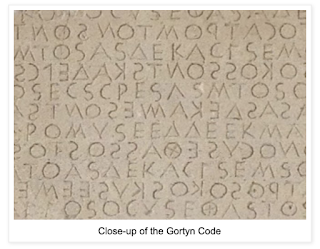
'Boustrophedon means something like "as the ox turns." Today we write in stoichedon style, in which all the letters face the same direction, like soldiers standing in formation. Boustrophedon is based on an agricultural, not a military ideal:the writer writes as a farmer plows. Write to the end of the line, and then, rather than returning to the left side of the page, turn the letters to face the opposite direction and write from right to left. When you read boustrophedon, your eye follows a zig-zag across the page -- or the stone.
Have a look at this close-up of the engraving at Gortys and look at the way letters like "E," "K," and "S" face in adjacent lines:

Tuesday, 5 March 2019
Penelope by Anthony Howell
I have been listening to the Heroine episode of Words and Music on BBC Radio 3,

and the following poem grabbed my attention
PENELOPE
To do what you undid
The night before
To undo what you did
The day before
The night before
To undo what you did
The day before
To undo what you undid
Again the next night
To do what you did
As you do the next day
Again the next night
To do what you did
As you do the next day
Only to undo it again
Just as you did
The night before
In order to do it again
Just as you did
The night before
In order to do it again
Just as you did
The day before
The day before
Just as you did
The day before
The day before
Just as you did
In order to do it again
The night before
Just as you did
Only to undo it again
The night before
Just as you did
Only to undo it again
As you do the next day
To do what you did
Again the next night
To undo what you undid
To do what you did
Again the next night
To undo what you undid
Anthony Howell

Monday, 4 March 2019

Saturday, 2 March 2019
marginendeavour work in progress

The background of this artwork is made up of a collage of different samples of white that have been cut out from magazines. It is when the samples are displayed close together in such a manner that one recognises the variations in tones.

Friday, 1 March 2019

Wednesday, 27 February 2019
Ongoing studio experiments - month to view

I have been experimenting with using pre-existing patterns and structures to provide me with a basic framework to work with.
I used a sheet from my month to view calendar as the basis for this watercolour.
Tuesday, 26 February 2019
Ongoing studio experiments - dotted paper
I have been experimenting with using pre-existing patterns and structures to provide me with a basic framework to work with.
I used a sheet of dotted paper to as the basis for this watercolour.


I used a sheet of dotted paper to as the basis for this watercolour.


Monday, 25 February 2019
Ongoing studio experiments
I have been experimenting with using pre-existing patterns and structures to provide me with a basic framework to work with.
I used a sheet of gridded paper to as the basis for this watercolour. I left the gridded lines unpainted.


I used a sheet of gridded paper to as the basis for this watercolour. I left the gridded lines unpainted.


Sunday, 24 February 2019

Tuesday, 19 February 2019

Monday, 18 February 2019

Friday, 15 February 2019
Silence - Episode 2 - BBC Radio 4
“We live in the age of noise. Silence is almost extinct.”

Philosopher and adventurer Erling Kagge, the first person to reach the ‘three poles’ of North, South and the summit of Everest, explores the power of silence. Struck by a vague angst about his constant need for distraction and reluctance to hold still for a single moment, the explorer asks how we lost silence and where we might go to find it again.
Some of the main points of discussion in this second episode were the following.
Silence can be boring, uncomfortable, scary, a sign of loneliness or sorrow
We experience silence when we keep quiet when there is something that one does not want to talk about
Silence can also be a friend and comfort, reassuring
It can be daunting, one may rather do anything else as opposed to filling the silence with oneself
The problems faced by humanity stem from man's inability to sit quietly in a room alone
One searches for fresh purposes that draw our attention outwards, away from ourselves
Such opportunities for interruption have increased dramatically over the last century
We live in the age of noise
Noise comes in the form of distracting sounds and images and as ones own fleeting thoughts
The more we are inundated with noise, the more we seek to be distracted
A chemical in the brain called opioid is meant to create the feelings of happiness that one gets when one has completed ones goals.
Dopamine is a chemical that helps regulate movement, attention, learning, and emotional responses. It also enables us not only to see rewards, but to take action to move toward them.Dopamine is stronger than opioid, and is the reason why one is never content that they have fulfilled their desires.
It is more fulfilling to anticipate and seek rather than to value and appreciate the fact that you have fulfilled your desires
This form of noise engenders anxiety and negative feelings.
The basic business model of social networks such as twitter is to create a need for you to use an app, which the same app should then fill, but only temporarily
FOMO - Fear of Missing Out or fear of missing a special moment
Silence is the opposite of all of this. It is about experiencing rather than overthinking, allowing each moment to be big enough, shutting out the world and creating your own silence

Philosopher and adventurer Erling Kagge, the first person to reach the ‘three poles’ of North, South and the summit of Everest, explores the power of silence. Struck by a vague angst about his constant need for distraction and reluctance to hold still for a single moment, the explorer asks how we lost silence and where we might go to find it again.
Some of the main points of discussion in this second episode were the following.
Silence can be boring, uncomfortable, scary, a sign of loneliness or sorrow
We experience silence when we keep quiet when there is something that one does not want to talk about
Silence can also be a friend and comfort, reassuring
It can be daunting, one may rather do anything else as opposed to filling the silence with oneself
The problems faced by humanity stem from man's inability to sit quietly in a room alone
One searches for fresh purposes that draw our attention outwards, away from ourselves
Such opportunities for interruption have increased dramatically over the last century
We live in the age of noise
Noise comes in the form of distracting sounds and images and as ones own fleeting thoughts
The more we are inundated with noise, the more we seek to be distracted
A chemical in the brain called opioid is meant to create the feelings of happiness that one gets when one has completed ones goals.
Dopamine is a chemical that helps regulate movement, attention, learning, and emotional responses. It also enables us not only to see rewards, but to take action to move toward them.Dopamine is stronger than opioid, and is the reason why one is never content that they have fulfilled their desires.
It is more fulfilling to anticipate and seek rather than to value and appreciate the fact that you have fulfilled your desires
This form of noise engenders anxiety and negative feelings.
The basic business model of social networks such as twitter is to create a need for you to use an app, which the same app should then fill, but only temporarily
FOMO - Fear of Missing Out or fear of missing a special moment
Silence is the opposite of all of this. It is about experiencing rather than overthinking, allowing each moment to be big enough, shutting out the world and creating your own silence
Thursday, 14 February 2019
Bodies publication available from Etsy

The texts are a collection of prose and poetry from various practitioners that were edited together by Ragna Amling, who conceptualised the zine. Design and Illustrations by Steven Affleck.

https://www.etsy.com/uk/listing/602692566/bodies-zine?ref=shop_home_active_1&fbclid=IwAR1lnVqQgjcnLHqE_eiFJOCYi-ggJLb9V9i_8Qvcj6RjexZHucZkYB7H7wk

Saturday, 9 February 2019
RSA Winter Newsletter 2019
I feel very honored to be included in the RSA Winter Newsletter 2019, alongside friends, former tutors and colleagues such as Stuart Mackenzie and Ross Sinclair.


Having just graduated from The Glasgow School of Art in 2008, it was a huge confidence boost
to be selected to exhibit in New Contemporaries 2019 at the RSA. I used the opportunity to
make new work which proved more challenging than anticipated as I no longer had access to
the facilities and space at Art School. At the time I was doing a full-time, voluntary internship
at Glasgow Sculpture Studios and, in order to be able to afford food and rent, I had an evening
and weekend job, meaning that I had very little time to make artwork. It was a great
introduction to the realities of being a Fine Artist, and ten years on, I am as busy as ever, juggling employment and self-employment with valuable studio time.
Following the RSA New Contemporaries exhibition, I secured myself a studio in Glasgow, and
spent five more years making artwork, exhibiting, leading workshops and doing residencies.
In 2014 I moved to Newcastle to pursue a Master of Fine Art Postgraduate Degree at
Newcastle University. In 2016 I graduated with a Distinction, was the recipient of the Hatton
Award and was awarded with a Graduate Studio at The NewBridge Project, Newcastle, where I continue to have a studio.
I really benefitted from exhibiting in the prestigious location of the RSA and believe the support from the curatorial team has contributed to my further successes. In 2017 I was
awarded an Arts Council England Grant for the Arts for a new body of work investigating the
experience of auditory and visual hallucinations. One of the highlights was participating in a
Spoken Word residency at Banff Centre for Arts and Creativity in Canada where new work was created and presented.
I share the development of my work via my blog (https://helenshaddock.blogspot.co.uk/) and
website (www.helenshaddock.co.uk). I continue to work in a multidisciplinary manner,
through installation, performance, sound, video, writing and sculpture. Over time I have
become more confident about making work that is rooted in contemporary experience in both an emotional (feelings and thoughts) and physical (materials and situations) sense. My work addresses the complex struggle to achieve equilibrium and balance in society today. My research examines how it can immerse an audience in multi-layered psychological and physical situations. Recently, language, in all its forms, has become more central to my practice and I am excited about how my work will continue to evolve.
Subscribe to:
Posts (Atom)

 Posts
Posts

