Projects: Manchester – a space for artists to test and experiment | News | a-n
Sunday, 10 November 2013
Monday, 4 November 2013
New figures reveal the true extent of the London/regions divide
http://www.artsprofessional.co.uk/news/new-figures-reveal-true-extent-londonregions-divide
An ongoing funding bias towards London is denying huge proportions of England’s population fair access to the arts, according to a new independent report by three senior arts figures.
Central Government spending per head on culture in London was nearly fifteen times greater than in the rest of England in 2012/13, and successive governments and Arts Council England (ACE) have failed to deliver on their own policy rhetoric about redressing the balance between London and the regions, according to a new report, ‘Rebalancing our Cultural Capital’. Last year 51% of ACE’s £322m public funding budget was spent on London, and of the further £450m used by the DCMS to direct-fund 16 major cultural organisations, an estimated 90% went to London. As a result, Londoners benefited from £69 of cultural spending per head, compared with just £4.50 in the rest of England. In addition, ACE committed 45% of its £317m arts Lottery funding to London, meaning that Lottery players across the country funded the arts to the tune of £17.41 per person in London, but only £3.90 in the rest of England.
Report authors Christopher Gordon, David Powell and Peter Stark, all senior arts professionals with both UK and international experience in research and cultural policy, insist that a balance needs to be struck “between the inevitable attractions for talent in all spheres of what a great global capital city can offer, and its function as the capital for a whole nation.” Calling for “stronger and more sustainable production resources for cultural production” to be based in the regions, they propose that a process of redressing the balance should begin with a fair 'per capita' share of arts Lottery funding being spent in the regions over a five year period, and that a £600m budget should effectively be ring-fenced for “a National Investment Programme to support the arts outside London.”
The report is based on a detailed analysis of figures dating back over twenty years, and points out that 75% of public funding of the arts is in the hands of ACE and the DCMS – a proportion that is set to increase as local authority spending on culture is squeezed in response to public funding cuts. The allocation of central Government money is seen to be at the heart of the national arts funding imbalance, but the distribution of Lottery funding to the arts has done little to improve the picture. Since Lottery distribution began in 1995, ACE has favoured London significantly more than have the equivalent distributors for heritage, sport and the Big Lottery, and the average value of an arts Lottery grant in London has been double that of the average for the rest of the country.
The uneven playing field described in the report is exacerbated by other factors. The £69m invested in the arts by the City of London and the London boroughs is supplemented by the Mayor’s expenditure on cultural and creative projects totalling over £27m; around 90% of giving to the arts by individual philanthropists goes to London-based organisations; and over two-thirds of business sponsorship is in London, as is nearly three-quarters of support from trusts and foundations. 61% of the first £30.5m of arts endowment funding under ACE’s Catalyst Programme is also going to London. Couple this with the significant contribution of the commercial arts sector in the capital, and the impact of the specialist institutions for professional art, music, dance, film and drama training, 90% of which are London based, then the bias towards London is all the more evident. David Powell commented: “As a Londoner, my instinct has long been that there was inequity between London and the rest of England, but on close inspection, the historical and current record looks pretty shocking even when making due allowance for the additional investment in national and international infrastructure proper to a capital which is one of the world’s great cities.”
Rejecting the arguments that London-based cultural organisations are in a position to benefit the rest of the nation, the report argues that the travel and accommodation costs of attending arts activity in London “render access unaffordable for a very high proportion of England’s more distant populations.” And the arguments that digital developments redress the London funding bias are similarly dismissed: “Digital access… is a two-way street and should be considered as such in national policy and investment decisions. If the Lindisfarne Gospels can be adequately accessed digitally from the North East (where they belong and where well over 95,000 people paid to see them ‘on loan’ during the summer of 2013), then such digital access to them from London – were they to be returned to the North East – would also be ‘adequate’ and the added value to these dispersed locations would be immense.”
The research and report have been self-funded by the authors, with the aim of stimulating policy debate on the issue of regional imbalance. Christopher Gordon told AP: “…the UK’s combination of local government with few effective constitutional guarantees, and cultural funding being predominantly decided by ‘arm’s length’ bodies, results in both strategy and equity being off the political agenda in England. Who takes responsibility for, or makes sense of, ‘the big picture’? Answer: nobody. Having no policy is not a justifiable policy.” Peter Stark believes the lack of debate on the issue is partly due to the public silence of those who are or aspire to be funded: “That is why this research is self-funded and independent of any interest group. That is why we have sought to make it sufficiently authoritative for it to require debate.” Both Melvyn Bragg and David Puttnam have already signalled their approval of the report, which Lord Bragg described as “timely, urgent and damning of an increasingly centralised funding process.” He said: “London is simply eating up the resources which are limited and therefore starving the rest of the country. This is wrong, short-sighted and undoubtedly unfair. I think it is time that the rest of England fought back…”. Lord Puttnam said that the report: “leaves no doubt about the wholly unjustifiable scale of bias towards London in the distribution of public and lottery funding of the arts… at a time when there is rising anger about policies that allow London – most especially affluent Londoners – to be underwritten at the expense of the rest of the country."
Saturday, 2 November 2013
Tuesday, 29 October 2013
Liz West: An artist with extra Spice By Ian Youngs Arts reporter, BBC News
Liz West, a fellow artist, lover of colour, Glasgow School of Art alumni, and my ex-flatmate, talks about how her collection of Spice Girl memorabilia has helped fund her art practice.
West is taking part in two exhibitions this week - one
featuring her strips of coloured light radiating from the corner of an
old warehouse, which is in the Synthesis exhibition as part of
Manchester Science Festival.
She has a growing reputation as a contemporary artist thanks to her arrangements of lights in precise, pleasing patterns and her collections of objects bathed in bright, bold hues.
For the other exhibition, she has lent some of the 5,000 Spice Girls items she has amassed since the age of 11, including branded clothes, crisp packets and a clock, to an exhibition celebrating 40 years of Virgin Records in London.
As well as being an artist, West holds the Guinness World Record for the largest collection of Spice Girls memorabilia.
When looking to launch her art career, West's Spice Girls obsession came in useful when she found she could get paid for loaning her girl-powered pop collection to museums, film crews and events.
"Because I was given that financial boost to start with, my art practice has been able to roll and roll," she says.
"Now I'm able to fund my art practice through my art. I don't have to work in Starbucks part-time. A lot of artists do have to work part-time, and I think that would kill any creativity for me. It really would."
West was born into the art world - almost literally - almost born on the floor of the Whitworth Gallery in Manchester, she says, when her mother Jenny was artist in residence there 28 years ago.
A five-day-old West attended the opening of her mother's exhibition.
When she was seven years old, West remembers putting nail
varnish bottles on a bedroom shelf in line according to their colour. It
is not difficult to spot a link between her love of colour as a child
and the artworks she now creates.
Then when she was 11, the Spice Girls arrived.
"A very impressionable age, I think," she says. "I was hooked. The colour, the energy, the different personalities. That appealed - more so probably than the music."
When the Spice Girls' second album came out in 1997, West decided to collect any and every recording and item of memorabilia she could get her hands on.
"I'd go to the pound shop and buy bags of things as a 13- or 14-year-old. They brought out the dolls and I went to London to the Hamleys sale.
"Of course, when eBay appeared when I was 18, I had a student loan, went a bit mad, and it just continued."
Influenced by her parents (her father Steve is also an artist),
West attended the prestigious Glasgow School of Art.
"When I was a student, I'd go into the studio all day and then I'd go into the library in the evening and just bid and bid and bid [on eBay]," she says. "I'd have a day of art and an evening of Spice."
West says she has spent "tens of thousands" of pounds on her collection, which also includes outfits from the Brit Awards, the Spiceworld movie and the jacket Mel B wore to meet Nelson Mandela.
But it does not include the most iconic Spice outfit of them all - Geri Halliwell's union jack dress from the 1997 Brit Awards. That was bought by the Hard Rock Cafe in Las Vegas for £41,000.
"That's the holy grail," West says. "And it's in storage. That's quite upsetting."
Now, West's art career is taking off thanks to her luminous installations that look like she has dismantled and rearranged a rainbow.
"Did you see the rainbow the other day over Manchester?" she
says excitedly at the mention of rainbows. "This was a double one and it
was a proper arch. I stopped in the street for about five minutes and
stared at it.
"I thought, forget James Turrell and Olafur Eliasson and all the artists that I absolutely love - this is true absolute beauty. There's something in that that I could never create, even if I tried."
West says she is not worried about her Spice Girls obsession undermining her reputation as an artist.
"It's completely in keeping with my personality," she says. "And because I've got such a passion for it, I win people over with that passion. It's not just about T-shirts and dollies.
"As a serious artist, this is my career. I want to be nominated for the Turner Prize.
"If you look at other artists, there are quite a few that have quirky collections out there and haven't hidden them. I don't have a problem with it."
What do other artists say when they find out about the collection? "They think it's quite funny," West replies.
"You know, it would be really boring if I didn't do anything else. People tend to think that it's a quirk, and quite a nice one."
For the original article and to watch a video of Liz West on the BBC news, please visit
http://www.bbc.co.uk/news/entertainment-arts-24655947
25 October 2013
Liz West: An artist with extra Spice
By Ian Youngs
Arts reporter, BBC News

Liz West is known for her artworks that use bright
coloured light
Artist
Liz West is gaining a glowing reputation for her colour-drenched light
installations - but her art career might not have taken off if it were
not for her world-record collection of Spice Girls memorabilia. Art and
pop can go hand-in-hand, she explains.
She has a growing reputation as a contemporary artist thanks to her arrangements of lights in precise, pleasing patterns and her collections of objects bathed in bright, bold hues.
For the other exhibition, she has lent some of the 5,000 Spice Girls items she has amassed since the age of 11, including branded clothes, crisp packets and a clock, to an exhibition celebrating 40 years of Virgin Records in London.
As well as being an artist, West holds the Guinness World Record for the largest collection of Spice Girls memorabilia.
The Spice Girls collection comprises
5,000 items of clothing and merchandise
"The way I see it is that installation art is high culture and
Spice Girls is pop culture," she says. "Although the two hold hands,
they're separate."When looking to launch her art career, West's Spice Girls obsession came in useful when she found she could get paid for loaning her girl-powered pop collection to museums, film crews and events.
"Because I was given that financial boost to start with, my art practice has been able to roll and roll," she says.
"Now I'm able to fund my art practice through my art. I don't have to work in Starbucks part-time. A lot of artists do have to work part-time, and I think that would kill any creativity for me. It really would."
West was born into the art world - almost literally - almost born on the floor of the Whitworth Gallery in Manchester, she says, when her mother Jenny was artist in residence there 28 years ago.
A five-day-old West attended the opening of her mother's exhibition.
West recently staged a solo exhibition
in an empty office unit in Manchester.
Then when she was 11, the Spice Girls arrived.
"A very impressionable age, I think," she says. "I was hooked. The colour, the energy, the different personalities. That appealed - more so probably than the music."
When the Spice Girls' second album came out in 1997, West decided to collect any and every recording and item of memorabilia she could get her hands on.
"I'd go to the pound shop and buy bags of things as a 13- or 14-year-old. They brought out the dolls and I went to London to the Hamleys sale.
"Of course, when eBay appeared when I was 18, I had a student loan, went a bit mad, and it just continued."
West owns Emma Bunton's 1997 Brit Awards
dress - but not Geri Halliwell's
"When I was a student, I'd go into the studio all day and then I'd go into the library in the evening and just bid and bid and bid [on eBay]," she says. "I'd have a day of art and an evening of Spice."
West says she has spent "tens of thousands" of pounds on her collection, which also includes outfits from the Brit Awards, the Spiceworld movie and the jacket Mel B wore to meet Nelson Mandela.
But it does not include the most iconic Spice outfit of them all - Geri Halliwell's union jack dress from the 1997 Brit Awards. That was bought by the Hard Rock Cafe in Las Vegas for £41,000.
"That's the holy grail," West says. "And it's in storage. That's quite upsetting."
Now, West's art career is taking off thanks to her luminous installations that look like she has dismantled and rearranged a rainbow.
West has been in exhibitions at
Manchester's Cornerhouse and Blankspace
"I thought, forget James Turrell and Olafur Eliasson and all the artists that I absolutely love - this is true absolute beauty. There's something in that that I could never create, even if I tried."
West says she is not worried about her Spice Girls obsession undermining her reputation as an artist.
"It's completely in keeping with my personality," she says. "And because I've got such a passion for it, I win people over with that passion. It's not just about T-shirts and dollies.
"As a serious artist, this is my career. I want to be nominated for the Turner Prize.
"If you look at other artists, there are quite a few that have quirky collections out there and haven't hidden them. I don't have a problem with it."
What do other artists say when they find out about the collection? "They think it's quite funny," West replies.
"You know, it would be really boring if I didn't do anything else. People tend to think that it's a quirk, and quite a nice one."
For the original article and to watch a video of Liz West on the BBC news, please visit
http://www.bbc.co.uk/news/entertainment-arts-24655947
Monday, 28 October 2013
Some thoughts on future work
I'm working towards an exhibition I have lined up at the beginning of next year (official announcement to be made soon), and today met with one of the gallery committee to talk through ideas and get some technical advice.
It's all very exciting, and I have some ambitious plans, but the next step is to get some funding in order for me to be able to turn the ideas into reality.
Any private donations would be more than welcome!
It's all very exciting, and I have some ambitious plans, but the next step is to get some funding in order for me to be able to turn the ideas into reality.
Any private donations would be more than welcome!
Sunday, 27 October 2013
Farrow and Ball
I enjoy looking in shop windows, seeing how products and clothes are displayed, and how decoration and interior design is used. I get inspiration and form ideas in relation to colour schemes, means of display, designs and patterns.
Today I walked past the Farrow and Ball shop and was attracted to they way in which they combined neutral colours with small selected areas of intense colour.
Friday, 25 October 2013
The Reith Lectures: Grayson Perry: Playing to the Gallery
In this episode, artist Grayson Perry asks whether it is really true
that anything can be art.
He draws upon different theorists to ponder what art is.
Philosopher George Dickie said an artwork is “a candidate for contemplation or appreciation.”
Arthur Danto, another philosopher, said an artwork is about something, has a point of view, and it uses rhetorical ellipsis - i.e. that it engages the audience to sort of
fill in the gaps. So call and response; you know you have to respond to the
artwork.
Danto also said, it needs an art historical context. This is a kind of institutional definition of art. It needs to be in the context where you might find art .
We live in an age when many contemporary artists follow the example of Marcel Duchamp, who famously declared that a urinal was a work of art. It sometimes seems that anything qualifies, from a pile of sweets on a gallery floor to an Oscar-winning actress asleep in a box. How does the ordinary art lover decide?
In a lecture delivered amidst the Victorian splendour of St. George's Hall in Liverpool, Perry analyses the common tests to help determine whether something is art.
1. is it in a gallery or an art context?
2. is it a boring version of something else?
3. is it made by an artist?
4. photography
5. limited edition test - if something is endless, it’s giving away part of its qualification as art.
6. the people that are around looking at it
7. The "rubbish dump test". “Throw it onto a rubbish dump. And if people walking by notice that it’s there and say “Oh what’s that artwork doing on that rubbish dump”, it’s art.
8. Art is able to detain and suspend us in a state of frustration and ambivalence and
to make us pause and think rather than simply react.
He concludes that in his opinion, the quality most valued in the art world is seriousness.
To listen to the Reith Lecture and find out more information, please visit
http://www.bbc.co.uk/programmes/galleries/p01j9rwb
Tuesday, 22 October 2013
Screenprints from AnSo Live Screenprinting event
The Analogue Social Live Screenprinting Event in Dundee seems like a long time ago, so it was a lovely treat today to be given a batch of prints that we made back in August, which had been in the exhibition following the live event.
The selection included some prints that consisted of both my circular and rectangular image,
some prints that had my circular image and a rectangular image by another of the artists
and some prints that had my rectangular image and a circular image by another of the artists.
The other artists screenprinting were: Nils Aksnes, Nikki McWilliams, Petra Scherer, Ross McAuley and Michael Corr.
Labels:
2013,
Analogue Social,
AnSo,
august,
August 2013,
Dundee,
live Screen Printing event,
Michael Corr,
Nikki McWilliams,
Nils Aksnes,
October,
October 2013,
Petra Scherer,
Ross McAuley,
screenprinting
Saturday, 19 October 2013
A couple of recommendations for your ears
There have been some excellent arts radio programmes recently, and so here are a couple of recommendations.
Tuesday 16th October
The Reith Lectures,
Grayson Perry: Playing to the Gallery: 2013
In the first of four lectures, recorded in front of an audience at Tate Modern in London, the artist Grayson Perry reflects on the idea of quality and examines who and what defines what we see and value as art. He argues that there is no empirical way to judge quality in art. Instead the validation of quality rests in the hands of a tightknit group of people at the heart of the art world including curators, dealers, collectors and critics who decide in the end what ends up in galleries and museums. Often the last to have a say are the public.
Perry examines the words and language that have developed around art critique, including what he sees as the growing tendency to over-intellectualise the response to art. He analyses the art market and quotes - with some irony - an insider who says that certain colours sell better than others. He queries whether familiarity makes us like certain artworks more, and encourages the public to learn to appreciate different forms of art through exploration and open-mindedness.
Perry was awarded the Turner Prize in 2003, and is known for his ceramic works, printmaking, drawing, sculpture and tapestry as well as for his cross-dressing and alter-ego, Claire.
Democracy Has Bad Taste
BBC Radio 4
Tuesday 16th October
The Reith Lectures,
Grayson Perry: Playing to the Gallery: 2013
In the first of four lectures, recorded in front of an audience at Tate Modern in London, the artist Grayson Perry reflects on the idea of quality and examines who and what defines what we see and value as art. He argues that there is no empirical way to judge quality in art. Instead the validation of quality rests in the hands of a tightknit group of people at the heart of the art world including curators, dealers, collectors and critics who decide in the end what ends up in galleries and museums. Often the last to have a say are the public.
Perry examines the words and language that have developed around art critique, including what he sees as the growing tendency to over-intellectualise the response to art. He analyses the art market and quotes - with some irony - an insider who says that certain colours sell better than others. He queries whether familiarity makes us like certain artworks more, and encourages the public to learn to appreciate different forms of art through exploration and open-mindedness.
Perry was awarded the Turner Prize in 2003, and is known for his ceramic works, printmaking, drawing, sculpture and tapestry as well as for his cross-dressing and alter-ego, Claire.
A masterpiece in a primary school classroom;
Front Row
BBC Radio 4
Thursday 17th October
In this Front Row episode Mark Lawson visits a Luton primary school, as the children get to see a Frank Auerbach painting, on loan for the day. The work came from the Ben Uri Gallery as part of the Masterpieces in Schools programme, a partnership between the Public Catalogue Foundation and BBC Learning. Mark joins the children as they prepare to see a masterpiece first-hand, many of them for the very first time, and hears their thoughts about Auerbach's Mornington Crescent, Summer Morning II.
Wednesday, 16 October 2013
Mark Devereux Projects announce Projects: Manchester
Last month I became a member of Mark Devereux Projects, an artist production-development organisation
established to help increase the national and international profile of
early-career visual artists.
With each practitioner’s artistic and career development paramount, emphasis is placed upon mentoring and helping the individual to place themselves within the industry through concentrated critical engagement and promotion.
Mark Devereux Projects have just announced it's latest project:
Mark Devereux Projects are delighted to
announce the launch of
FURTHER INFORMATION:
Projects: Manchester, 1st Floor, Federation House, Federation Street, Manchester, M60 0AF
Opening times: 1-7pm Tues-Fri | 12-4pm Sat-Sun | Closed Mon
markdevereuxprojects.com
With each practitioner’s artistic and career development paramount, emphasis is placed upon mentoring and helping the individual to place themselves within the industry through concentrated critical engagement and promotion.
Mark Devereux Projects have just announced it's latest project:
Mark Devereux Projects are delighted to
announce the launch of
PROJECTS: MANCHESTER
AND BEYOND MERELY ASSEMBLING EXHIBITION
FRIDAY 8 NOVEMBER 2013
Launching this November, Projects: Manchester is a new pop-up space
dedicated to nurturing and developing the work of emerging artists.
Responding to the current ecology and Mark Devereux Projects’ ongoing
ambition to help nurture the best up and coming talent, we are excited
to offer creatives a new test space. Emphasising Manchester’s reputation
for its support to early-career artists, the space will be available to
trial new ideas.
Taking residence in one of the eight floors of former office space at
the Co-Operative’s major Federation House in central Manchester and as
part of Castlefield Art Gallery’s New Art Spaces initiative, the
venue will offer artists the opportunity to showcase, develop and
experiment.
To launch Projects: Manchester, Mark Devereux Projects will be
showcasing the work of ten of the organisation’s associate members
responding to the title ‘Beyond Merely Assembling’. With works
considering the way in which we respond to the environment around us,
the spaces we occupy and how we often try to make-do with what we have,
the exhibition includes the mediums of installation, painting,
sculpture, video and performance.
Selected by Kerry Harker (Director The Tetley, Leeds), Gill Park (Director Pavilion, Leeds), Tony Charles (Director Platform-A, Middlesbrough) and Mark Devereux, each artist is
given dedicated one-to-one developmental and critical support from Mark
Devereux Projects, helping to nurture their ongoing careers.
Beyond Merely Assembling features the work of; Bettina Amtag, Tom Beesley, David Bethell, Phoebe Eustance, Charles Gershom, Aylwin Greenwood-Lambert, Mark Houghton, Katrien van Liefferinge, Kit Mead, Darren Nixon and Zervou-Kerruish.
Beyond Merely Assembling launches on Friday 8 November, 6-9pm and
continues until Wednesday 20 November. There will also be a special
event on Sunday 17 November, with further information to be announced
shortly.
FURTHER INFORMATION:
Projects: Manchester, 1st Floor, Federation House, Federation Street, Manchester, M60 0AF
Opening times: 1-7pm Tues-Fri | 12-4pm Sat-Sun | Closed Mon
Saturday, 12 October 2013
Recent drawings
I use drawing for many different purposes, and regard it as an immediate and accessible means to express ideas.
I find drawing to be an excellent way to problem solve and work things out.
In this instance I used drawing to document my current 'Groovings' installation at Motherwell Concert Hall.
The exhibition is on until the end of October, so you have a bit of time still to go and see the work up front and for real!
Wednesday, 9 October 2013
Glasgow International art festival launched - by Brian Ferguson in The Scotsman
Glasgow International art festival launched
by BRIAN FERGUSONMORE than 40 different sites around Glasgow are to be part of the city’s flagship visual art celebration in the run-up to the Commonwealth Games.
Around 80 artists from around the world will have their work showcased during the biannual Glasgow International, which will be staged for the sixth time in 2014.
Organisers say more than 90 per cent of the work on display during the 18-day spring event will either be brand new or will be on display for the first time in the UK.
Although galleries across the city centre will be hosting the majority of the show solo and group shows, artists will be transforming two sites near the Emirates Arena in the east end - at Dalmarnock and Bridgeton - as well as the old Govanhill Baths, which will be taken over by inflatables.
Shows will be inspired by the historic collections at the city’s Kelvingrove museum, the impact of television and the Empire Exhibitions.
Other exhibitions at the festival include one which will feature a fully-functioning nail bar and another showcasing works of art which jump out of their frames.
Extra funding has been secured for next year’s festival - which will run from 4-21 April - which will see it be part of the programmes for both the 2014 Year of Homecoming and the Glasgow 2014 cultural programme.
Artists bringing major shows to the city include Aleksandra Domanovic, from Serbia, Germany’s Michael Stumpf, and Americans Michael Smith, Jordan Wolfson and Avery Singer.
Festival director Sarah McCrory said: “Glasgow International will continue to show the strength of the renowned and exceptional production from within Glasgow, as well as invite artists into the city to embed into its museums and alternative spaces, encouraging discourse around multifarious topics ranging from new technologies and museum taxonomies to the use of humour.
“Once again the festival will provide a focus on the wealth of its arts organisations and communities, whilst embracing input to these discussions from international practitioners.”
Source: http://www.scotsman.com/lifestyle/arts/visual-arts/glasgow-international-art-festival-launched-1-3131088
Sunday, 6 October 2013
Plaster Caster workshops as part of Encounters Festival
October is the month of North Lanarkshire's cultural festival, Encounters. I was asked to develop and lead a plaster casting workshop for school children in conjunction with my exhibition at Motherwell Concert Hall and Theatre.
Over the past couple of days I have been leading the workshops, first based at St David's Primary School, Airdrie and another day at St Patrick's Primary School, Coatbridge. I was working with children in P6/P7 classes, and had just under 20 students each day.
Both days went really well; the children were well behaved and all immersed themselves fully into the activities, producing some excellent work.
I began the workshop by introducing myself and talking a little about my art practice. I then explained what we would be doing in the workshop, showed examples of the materials we were going to be using, and handed round some of my work. I showed them documentation of other artists who have used casting, and simply explained the process.
The children were given a square of corregated cardboard and asked to cover it with parcel tape. They then used clay to make a boundary wall to form the shape of their mould. Working in small groups, the students made different colours of plaster and poured the plaster into their moulds.
The students made a variety of colours of plaster, and they all got a chance to engage in ever stage of the casting process. In addition to pouring the plaster into their cardboard and clay moulds, I had also given them a range of plastic containers for them to fill and had covered some tables with sheets of baking paper for them to pour and drip plaster onto in a more freestyle fashion. I showed them all how to remove the cast from the mould as they would need to do it the next day once the plaster had dried properly.
I ended the session with a question and answer session where we discussed what they had learned, how they had found the workshop, whether they had enjoyed it and so on. They also asked me questions about being an artist.
I am delighted that the children responded so well to the workshop, and the teachers were also very pleased with the workshop.
I am looking forward to receiving an email from the teachers with photos of the children holding their casts once they had been removed from the mould.
Thursday, 3 October 2013
Recordings of the speakers from the inaugural CPG on Culture meeting are now available online
Recordings of
the speakers from the inaugural CPG on Culture meeting are now available
online.
Aclaimed author Janice Galloway opened the meeting with a reading of Don Paterson’s poem ‘We, the Scottish people’ (2005). Following on from the reading, Creative Producer and Company Director of Synchronicity Films Ltd, Claire Mundell followed David Greig as the second speaker of the evening.
To listen to the recordings visit this website:
http://www.cpgonculture.com/videos-podcasts/?dm_i=FES,1UHB9,81M3WZ,6M0HW,1
Tuesday, 1 October 2013
Liza Lou: Colour Field at Museum of Contemporary Art San Diego
For twenty years, the glass bead has been Liza Lou’s primary art-making
material. Lou transforms the possibilities of this tiny unit of color
and embellishment just as she expands the meaning of the objects she
recreates.
Color Field (2010-2013), her newest floor-bound
sculpture, features an expansive prism of color. The gridded rainbow is
composed of uniform lengths of wire, each threaded with a single shade
of beads. The sheer expanse of the piece conveys exuberance, underscored
by the work’s bounty: its multitude of colors, beads, and touch.
Pulsing and pixelated, Color Field’s complex mosaic foregrounds
its construction and the network of hands which helped shape it.
https://www.mcasd.org/exhibitions/liza-lou-color-field
Saturday, 28 September 2013
Anne-Marie Watson
This afternoon I had the pleasure of introducing Anne-Marie Watson to the First year Painting and Printmaking students at Glasgow School of Art. She delivered an excellent lecture about 'Drawing', referencing a wide range of historical and contemporary artists and covering drawing in it's many forms.
Anne-Marie Watson is an independent Curator, Writer and Artist. Like me, she went to Leeds College of Art and Design to do an Art Foundation course, before moving to Glasgow to study Environmental Art at Glasgow School of Art.
After graduating Watson co-ran an organisation in Glasgow called SEAM (2003 - 2005) where they organised a programme of exhibitions with young Glasgow-based artists including Camilla Low, Charlie Hammond, Nick Evans and Lynn Hynd.
She then became Assistant Curator (2004 - 2006) at Dundee Contemporary Arts, Scotland, followed by Curator (2006 - 2007), working with artists including Johanna Billing, David Shrigley, Ahlam Shibli, Christopher Orr, Ilana Halperin, Bridget Smith and Jordan Baseman.
In 2007 she relocated to London where she was Exhibitions Programmer at Camden Arts Centre, London until April 2013. In this role, Watson worked closely with a number of artists on solo exhibitions including Claire Barclay, Allen Ruppersberg, Chantal Akerman, Anya Gallaccio, Christine Borland, Mathilde Rosier and Haroon Mirza. In 2009 she worked with Paulina Olowska on her selected group exhibition Head-Wig.
HOUSE is a series of collaborations between artists, dwellers,
curators and writers taking place in domestic settings across London.
Through public facing interventions into these private, lived spaces,
HOUSE thinks through the relationships between people, spaces they
inhabit, art and process.
HOUSE developed after an invitation from a friend to use their home for an exhibition. In response, co-curators Alex McDonald and Anne-Marie Watson were interested in instigating an on-going, open ended creative process involving artists and others in discussions around the spaces and places of their life and work. Over plates of food, on studio visits and in coffee shops around the city, conversations have taken place where diverse subjects have been tossed around from Inuit throat singing to rats living under the floor-boards.
Three houses were selected for the project in three diverse areas of the city; Clapton, Forest Gate and Notting Hill and six artists were chosen to take part. Through these relationships with different places, spaces and people a narrative begins to emerge which draws individuals’ stories of living in London into a shared public experience.
The six artists, through their work, are interested in space in different ways; environmental, the space of the body, intimacy, non-space, undefined spaces, exotic, hidden spaces, memory, affect and psychological effect of spaces on people.
HOUSE, in opening up these intimate places for living and working, creates imaginative spaces of vulnerability, risk and the unknown for dwellers, artists and audiences.
HOUSE 1: Anne Hardy & Stephen Setford
Preview Sat 14 Sept 6 – 8pm / Sat 14 & Sun 15 Sept 2013, 11am-6pm
19 Kinnoul Mansions, Rowhill Rd. Hackney. E5 8EB
Hallway – Anne Hardy, Soundtrack (Fieldwork), a work in progress (2013)
Living room – Stephen Setford, Torrent (2013)
Clapton (Mat Jenner) is in the midst of the regeneration of Hackney. This is a shared house, occupied by different people, differing in life-style and age.
HOUSE 2: Angus Mill & Jo Addison
Preview Fri 4 Oct 6 – 8pm / Sat 5 & Sun 6 Oct 2013, 11am-6pm
62 Cranmer Rd. Forest Gate. E7 0JL
Forest Gate (Anne-Marie Watson) is on the edge of Epping Forest in the outer borough of Newham. This house is a typical terrace occupied by four people who are connected via threads of friendship and art.
HOUSE 3: Rachael Champion & Renee Vaughan Sutherland
Closing Sun 20 Oct 4 – 6pm / Sat 19 & Sun 20 Oct 2013, 11am-6pm
2 Londsdale Rd. Nottinghill. W11 2DE
Notting Hill (Daniel Fitzpatrick) is in West London. This house, traditionally built for railway workers and their families has subsequently been owned and occupied by a variety of people who have changed along with the transforming area.
Anne-Marie Watson is an independent Curator, Writer and Artist. Like me, she went to Leeds College of Art and Design to do an Art Foundation course, before moving to Glasgow to study Environmental Art at Glasgow School of Art.
After graduating Watson co-ran an organisation in Glasgow called SEAM (2003 - 2005) where they organised a programme of exhibitions with young Glasgow-based artists including Camilla Low, Charlie Hammond, Nick Evans and Lynn Hynd.
She then became Assistant Curator (2004 - 2006) at Dundee Contemporary Arts, Scotland, followed by Curator (2006 - 2007), working with artists including Johanna Billing, David Shrigley, Ahlam Shibli, Christopher Orr, Ilana Halperin, Bridget Smith and Jordan Baseman.
In 2007 she relocated to London where she was Exhibitions Programmer at Camden Arts Centre, London until April 2013. In this role, Watson worked closely with a number of artists on solo exhibitions including Claire Barclay, Allen Ruppersberg, Chantal Akerman, Anya Gallaccio, Christine Borland, Mathilde Rosier and Haroon Mirza. In 2009 she worked with Paulina Olowska on her selected group exhibition Head-Wig.
Now working as an independent Curator, Writer and Artist, Watson has been busy with a project called HOUSE.
HOUSE developed after an invitation from a friend to use their home for an exhibition. In response, co-curators Alex McDonald and Anne-Marie Watson were interested in instigating an on-going, open ended creative process involving artists and others in discussions around the spaces and places of their life and work. Over plates of food, on studio visits and in coffee shops around the city, conversations have taken place where diverse subjects have been tossed around from Inuit throat singing to rats living under the floor-boards.
Three houses were selected for the project in three diverse areas of the city; Clapton, Forest Gate and Notting Hill and six artists were chosen to take part. Through these relationships with different places, spaces and people a narrative begins to emerge which draws individuals’ stories of living in London into a shared public experience.
The six artists, through their work, are interested in space in different ways; environmental, the space of the body, intimacy, non-space, undefined spaces, exotic, hidden spaces, memory, affect and psychological effect of spaces on people.
HOUSE, in opening up these intimate places for living and working, creates imaginative spaces of vulnerability, risk and the unknown for dwellers, artists and audiences.
HOUSE 1: Anne Hardy & Stephen Setford
Preview Sat 14 Sept 6 – 8pm / Sat 14 & Sun 15 Sept 2013, 11am-6pm
19 Kinnoul Mansions, Rowhill Rd. Hackney. E5 8EB
Hallway – Anne Hardy, Soundtrack (Fieldwork), a work in progress (2013)
Living room – Stephen Setford, Torrent (2013)
Clapton (Mat Jenner) is in the midst of the regeneration of Hackney. This is a shared house, occupied by different people, differing in life-style and age.
HOUSE 2: Angus Mill & Jo Addison
Preview Fri 4 Oct 6 – 8pm / Sat 5 & Sun 6 Oct 2013, 11am-6pm
62 Cranmer Rd. Forest Gate. E7 0JL
Forest Gate (Anne-Marie Watson) is on the edge of Epping Forest in the outer borough of Newham. This house is a typical terrace occupied by four people who are connected via threads of friendship and art.
HOUSE 3: Rachael Champion & Renee Vaughan Sutherland
Closing Sun 20 Oct 4 – 6pm / Sat 19 & Sun 20 Oct 2013, 11am-6pm
2 Londsdale Rd. Nottinghill. W11 2DE
Notting Hill (Daniel Fitzpatrick) is in West London. This house, traditionally built for railway workers and their families has subsequently been owned and occupied by a variety of people who have changed along with the transforming area.
For more information please visit
housemcdonaldwatson.wordpress.com
Labels:
Anne-Marie Watson,
artist,
Camden Arts Centre,
Curator,
DCA,
drawing,
Dundee,
Environmental Art,
exhibition,
Glasgow School of Art,
House,
lecture,
leeds college of art and design,
London,
Writer
Thursday, 26 September 2013
Scottish Artists Union Members Survey results
As promised, here are a selection of findings from the Scottish Artists Union's (SAU) Members survey:
65% of respondents earn
£5000 or less per year (after tax)
20%
of respondents earn between £5000 - £10000 per year (after tax)
56%
of respondents consistently get less than the Scottish Artists Union's
Recommended Rate of Pay (RRP)
51% of respondents seldom
get contracts for work they do
74% of respondents seldom
or never receive exhibition payment
fees
Wednesday, 25 September 2013
Changin Scotland - Scotland’s alternative festival of ideas, culture and politics
This event sounds very interesting...
Changin
Scotland
Scotland’s alternative festival of ideas,
culture and politics
Friday
1st November - Sunday 3rd November 2013
Newbattle Abbey College, by
Dalkeith
This November Gerry
Hassan and Jean
Urquhart are at Newbattle Abbey College just South of Edinburgh
for a
weekend on how to do social change, activism and campaigning in a
different
way!
This
weekend will be a departure in feel, style and setting
– and is facilitated and led by Stephen
Duncombe and Steve
Lambert of the Centre
for Artistic Activism who are based at New York University.
This
will be a participatory weekend bringing
together
community politics with cultural and civic engagement. It will look at
how to
be a creative kind of activist, build alliances, and beyond tactics and
strategy,
start to envision a different kind of politics and world!
We
cannot promise to change the world in a
single weekend
but we can make a start! The weekend will address how cultural activists
and
practitioners can develop a better political intelligence, and political
campaigners nurture a more informed cultural awareness, and the two
influence
and cross-fertilise each other.
This weekend will be stimulating, demanding
and
challenging,
enjoyable and fun. We ask that people come rested, open minded and
willing to
collaborate with others.
Weekend
Details:
The weekend runs
from Friday 1st
starting
with a meal at 6.30pm, all day Saturday and Sunday
concluding 4.00pm.
Extra attractions include an intimate gig with acclaimed folksinger Karine
Polwart on Saturday
night.
Tickets for the weekend are £60 (accommodation
and food
extra). Please contact for booking: Newbattle Abbey College Reception:
0131
6631921.
What previous participants say about the Centre
for Artistic
Activism:
‘It’s
magical. Recalibrating reality.’ ‘It made me rethink my politics and
challenge
people who say, “I am not political”’. ‘Culture is everywhere. We all do
it and
this helped me embrace how to do a more creative politics’.
What
they say about Changin Scotland: ‘The alternative Davos’ National
Collective
We
have a
limited number of places so book early!
Next Changin Scotland dates: March 28-30 at The Ceilidh Place, Ullapool
Sunday, 22 September 2013
Scottish Artists Union AGM - Dovecot Studios, Edinburgh
I find it hard to believe that it is a year since I became a member of the Scottish Artists Union Executive Committee, and there has been a lot of activity in that past year, as reported at yesterday's AGM.
After a few of the formalities, Financial Report, Election of new Executive Committee and Proposed motions, SAU Secretary Chris Kelly presented the results from the 2013 Members Survey.
This major piece of research is highly useful evidence to support some of the points that the SAU are 'fighting for'. There are too many results to discuss them all here, but will reveal some of these findings in later posts so keep checking my blog!
After a short comfort break (i.e. a chance to catch up with fellow SAU members), SAU Vice President Janie Nicoll delivered a brief presentation about her recent participation in the engage International Summer School held in Padua, Italy. The Summer School was focused on 'Leadership and Resilience in gallery education.
About engage
engage
is a membership organisation representing gallery, art and education
professionals in the UK and over 20 countries worldwide. engage promotes
access to, enjoyment and understanding of the visual arts through
gallery education.
More information about engage and the Summer School can be seen on the engage website:
The AGM closed with a great presentation by guest speaker Richie Cumming who discussed his work with Creative Stirling and the '14OURZERO2014' project
1NE4OURZERO2014 is the second incarnation of Creative Stirling’s Freedom Versions
In summer of 2012 the yard of the Old Town Jail in Stirling was transformed by a large-scale collaborative installation of visual art, musical performance and printed written word exploring the themes of freedom, independence, colonisation and alienation.
The project created a
process where Scots people could reflect on the question of independence
beyond polarised political debate and through the lens of Scottish
culture and heritage. They wanted to create a platform to explore the role
of artists and thinkers in Scotland on the question of our contemporary
cultural identity.
One of the outcomes of the project was an exhibition of 40 hand screen-printed poster works consisting of
the most considered, inspired and powerful statements, poetic/prosaic
lines, comments and ideas concerning the landscape of a post-referendum
Scotland as submitted by the public; artists, plumbers, engineers, housewives,
students and people from all walks.
The installation included a working print studio run by artists
and designers employing traditional print methods and the content for
the exhibition grew and evolved over the six week installation as responses were gathered.
The project lives on and more information can be found on the website http://1ne4ourzero2014.tumblr.com/
Saturday, 21 September 2013
New national audience development agency for Scotland
‘Culture Republic’ will be the name for Scotland’s new, national cultural engagement hub, which combines the work of Culture Sparks in Glasgow and The Audience Business in Edinburgh. The new audience-focused agency will provide cultural organisations with support for engaging with the public and developing audiences. While the individual services offered by the two organisations will still be offered, the new agency will bring their partners and clients the advantage of wider data sets and full national reach.
Friday, 20 September 2013
What Is Creativity? Cultural Icons on What Ideation Is and How It Works by Maria Popova
In a recent newsletter from Brain Pickings, Maria Popova looked at the notion of creativity.
Brain Pickings has a free weekly interestingness digest. It comes out on Sundays and offers excellent articles from the week. The original article can be read at http://www.brainpickings.org/index.php/2013/09/06/what-is-creativity/
Bradbury, Eames, Angelou, Gladwell, Einstein, Byrne, Duchamp, Close, Sendak, and more.

“Creativity” is one of those grab-bag
terms, like “happiness” and “love,” that can mean so many things it runs
the risk of meaning nothing at all. And yet some of history’s greatest
minds have attempted to capture, explain, describe, itemize, and dissect
the nature of creativity. After similar omnibi of cultural icons’ most
beautiful and articulate definitions of
art, of
science, and of
love, here comes one of creativity.
For Ray Bradbury, creativity was the art of muting the rational mind:

Twenty years later, creative icon and original Mad Man George Lois echoed Koestler in his influential tome The Art of Advertising: George Lois on Mass Communication (public library):

But perhaps, after all, we should heed Charles Eames’s admonition:
Brain Pickings has a free weekly interestingness digest. It comes out on Sundays and offers excellent articles from the week. The original article can be read at http://www.brainpickings.org/index.php/2013/09/06/what-is-creativity/
Bradbury, Eames, Angelou, Gladwell, Einstein, Byrne, Duchamp, Close, Sendak, and more.
“Creativity” is one of those grab-bag
terms, like “happiness” and “love,” that can mean so many things it runs
the risk of meaning nothing at all. And yet some of history’s greatest
minds have attempted to capture, explain, describe, itemize, and dissect
the nature of creativity. After similar omnibi of cultural icons’ most
beautiful and articulate definitions of
art, of
science, and of
love, here comes one of creativity.For Ray Bradbury, creativity was the art of muting the rational mind:
The intellect is a great danger to creativity … because you begin to rationalize and make up reasons for things, instead of staying with your own basic truth — who you are, what you are, what you want to be. I’ve had a sign over my typewriter for over 25 years now, which reads “Don’t think!” You must never think at the typewriter — you must feel. Your intellect is always buried in that feeling anyway. … The worst thing you do when you think is lie — you can make up reasons that are not true for the things that you did, and what you’re trying to do as a creative person is surprise yourself — find out who you really are, and try not to lie, try to tell the truth all the time. And the only way to do this is by being very active and very emotional, and get it out of yourself — making things that you hate and things that you love, you write about these then, intensely.Long before he was became the artist we know and love, a young Maurice Sendak full of self-doubt wrote in a letter to his editor, the remarkable Ursula Nordstrom:
Knowledge is the driving force that puts creative passion to work.In writing back, Nordstrom responded with her signature blend of wisdom and assurance:
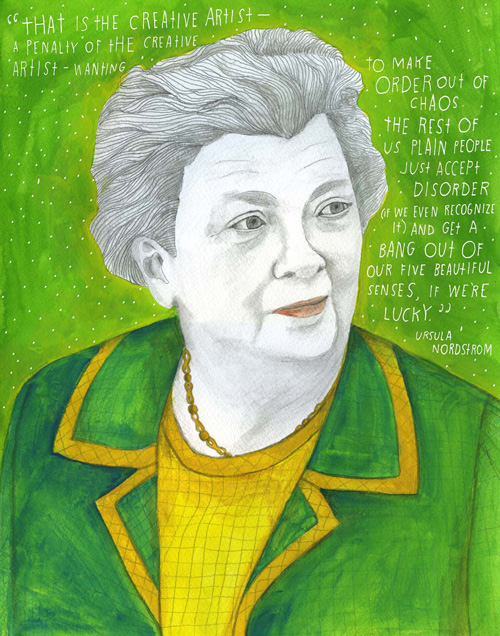
That is the creative artist — a penalty of the creative artist — wanting to make order out of chaos.Bill Moyers is credited with having offered a sort of mirror-image definition that does away with order and seeks, instead, magical chaos:
Creativity is piercing the mundane to find the marvelous.For Albert Einstein, its defining characteristic was what he called “combinatory play”. In a letter to a French mathematician, included in Einstein’s Ideas and Opinions (public library), he writes:
The words or the language, as they are written or spoken, do not seem to play any role in my mechanism of thought. The psychical entities which seem to serve as elements in thought are certain signs and more or less clear images which can be “voluntarily” reproduced and combined.For Maya Angelou, a modern-day sage of the finest kind, the mystery and miracle of creativity is in its self-regenerating nature. In the excellent collection Conversations with Maya Angelou (public library), which also gave us her poignant exchange with Bill Moyers, Angelou says:
There is, of course, a certain connection between those elements and relevant logical concepts. It is also clear that the desire to arrive finally at logically connected concepts is the emotional basis of this rather vague play with the above-mentioned elements. But taken from a psychological viewpoint, this combinatory play seems to be the essential feature in productive thought — before there is any connection with logical construction in words or other kinds of signs which can be communicated to others.
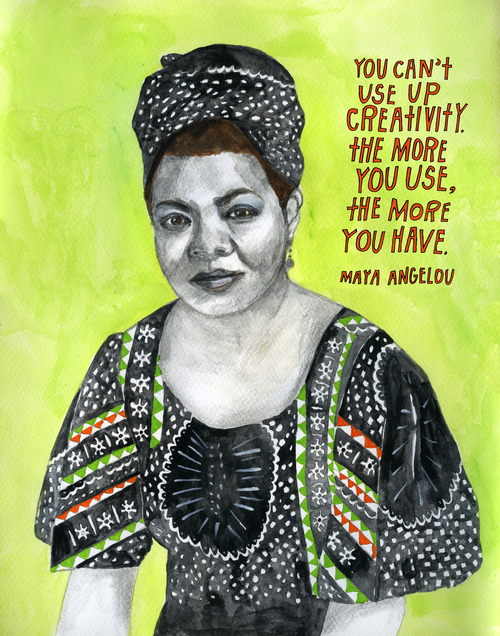
Creativity or talent, like electricity, is something I don’t understand but something I’m able to harness and use. While electricity remains a mystery, I know I can plug into it and light up a cathedral or a synagogue or an operating room and use it to help save a life. Or I can use it to electrocute someone. Like electricity, creativity makes no judgment. I can use it productive or destructively. The important thing is to use it. You can’t use up creativity. The more you use it, the more you have.Tom Bissell, writing in Magic Hours: Essays on Creators and Creation, also celebrates this magical quality of creativity:
To create anything … is to believe, if only momentarily, you are capable of magic. … That magic … is sometimes perilous, sometimes infectious, sometimes fragile, sometimes failed, sometimes infuriating, sometimes triumphant, and sometimes tragic.But there might be something more precise and less mystical about the creative process. In Uncommon Genius: How Great Ideas Are Born (public library), the fantastic collection of interviews with MacArthur “genius” grantees by Denise Shekerjian, she recapitulates her findings:
The trick to creativity, if there is a single useful thing to say about it, is to identify your own peculiar talent and then to settle down to work with it for a good long time.Shekerjian interviews the late Stephen Jay Gould, arguably the best science writer of all time, who describes his own approach to creativity as the art of making connections, which Shekerjian synthesizes:
Gould’s special talent, that rare gift for seeing the connections between seemingly unrelated things, zinged to the heart of the matter. Without meaning to, he had zeroed in on the most popular of the manifold definitions of creativity: the idea of connecting two unrelated things in an efficient way. The surprise we experience at such a linkage brings us up short and causes us to think, Now that’s creative.This notion, of course, is not new. In his timelessly insightful 1939 treatise A Technique for Producing Ideas (public library), outlining the five stages of ideation, James Webb Young asserts:
An idea is nothing more nor less than a new combination of old elements [and] the capacity to bring old elements into new combinations depends largely on the ability to see relationships. The habit of mind which leads to a search for relationships between facts becomes of the highest importance in the production of ideas.Three years later, in 1942, Rosamund Harding added another dimension of stressing the importance of cross-disciplinary combinations in wonderful out-of-print tome An Anatomy of Inspiration:
Originality depends on new and striking combinations of ideas. It is obvious therefore that the more a man knows the greater scope he has for arriving at striking combinations. And not only the more he knows about his own subject but the more he knows beyond it of other subjects. It is a fact that has not yet been sufficiently stressed that those persons who have risen to eminence in arts, letters or sciences have frequently possessed considerable knowledge of subjects outside their own sphere of activity.Seven decades later, Phil Beadle echoes this concept in his wonderful blueprint field guide to creativity, Dancing About Architecture: A Little Book of Creativity (public library):
It is the ability to spot the potential in the product of connecting things that don’t ordinarily go together that marks out the person who is truly creative.Steve Jobs famously articulated this notion and took it a step further, emphasizing the importance of building a rich personal library of experiences and ideas to connect:
Creativity is just connecting things. When you ask creative people how they did something, they feel a little guilty because they didn’t really do it, they just saw something. It seemed obvious to them after a while. That’s because they were able to connect experiences they’ve had and synthesize new things. And the reason they were able to do that was that they’ve had more experiences or they have thought more about their experiences than other people. Unfortunately, that’s too rare a commodity. A lot of people in our industry haven’t had very diverse experiences. So they don’t have enough dots to connect, and they end up with very linear solutions without a broad perspective on the problem. The broader one’s understanding of the human experience, the better design we will have.Musician Amanda Palmer puts this even more poetically in her meditation on dot-connecting and creativity:
We can only connect the dots that we collect, which makes everything you write about you. … Your connections are the thread that you weave into the cloth that becomes the story that only you can tell.Beloved graphic designer Paula Scher has a different metaphor for the same concept. In Debbie Millman’s How to Think Like a Great Graphic Designer (UK; public library), she likens creativity to a slot machine:
There’s a certain amount of intuitive thinking that goes into everything. It’s so hard to describe how things happen intuitively. I can describe it as a computer and a slot machine. I have a pile of stuff in my brain, a pile of stuff from all the books I’ve read and all the movies I’ve seen. Every piece of artwork I’ve ever looked at. Every conversation that’s inspired me, every piece of street art I’ve seen along the way. Anything I’ve purchased, rejected, loved, hated. It’s all in there. It’s all on one side of the brain.But Arthur Koestler, in his seminal 1964 anatomy of creativity, The Act Of Creation (public library), argues that besides connection, the creative act necessitates contrast, or what he termed “bisociation”:
And on the other side of the brain is a specific brief that comes from my understanding of the project and says, okay, this solution is made up of A, B, C, and D. And if you pull the handle on the slot machine, they sort of run around in a circle, and what you hope is that those three cherries line up, and the cash comes out.
The pattern underlying [the creative act] is the perceiving of a situation or idea in two self-consistent but habitually incompatible frames of references. The event, in which the two intersect, is made to vibrate simultaneously on two different wavelengths, as it were. While this unusual situation lasts, [the event] is not merely linked to one associative context, but bisociated with two.He differentiated between cognitive habit, or merely associative thought, and originality, or bisociative ideation, thusly:
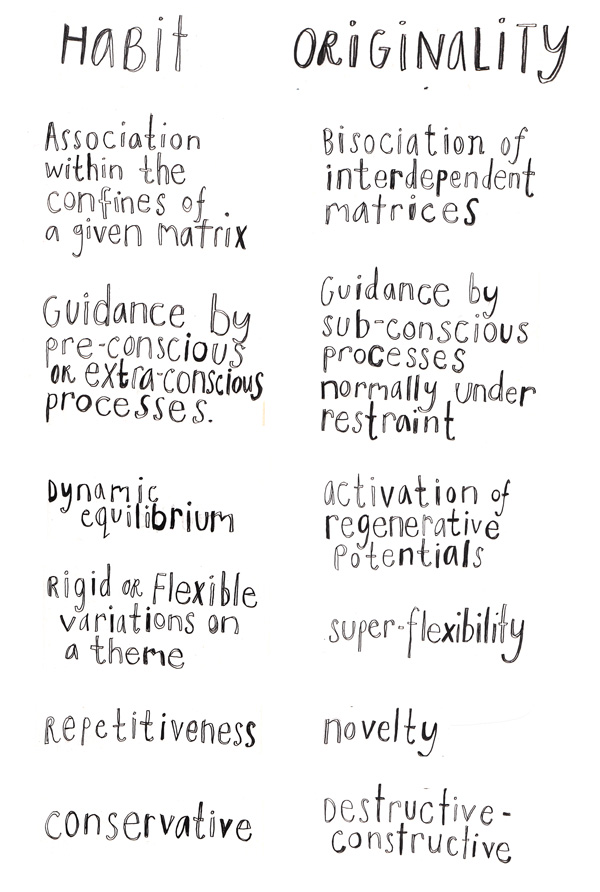
I have coined the term ‘bisociation’ in order to make a distinction between the routine skills of thinking on a single ‘plane,’ as it were, and the creative act, which … always operates on more than one plane. The former can be called single-minded, the latter double-minded, transitory state of unstable equilibrium where the balance of both emotion and thought is disturbed.

Twenty years later, creative icon and original Mad Man George Lois echoed Koestler in his influential tome The Art of Advertising: George Lois on Mass Communication (public library):
Creativity can solve almost any problem. The creative act, the defeat of habit by originality, overcomes everything.For Gretchen Rubin, however, habit isn’t the enemy of creativity but its engine. In Manage Your Day-to-Day: Build Your Routine, Find Your Focus, and Sharpen Your Creative Mind, she writes:
Anthony Trollope, the nineteenth-century writer who managed to be a prolific novelist while also revolutionizing the British postal system, observed, “A small daily task, if it be really daily, will beat the labours of a spasmodic Hercules.” Over the long run, the unglamorous habit of frequency fosters both productivity and creativity.In 1926, English social psychologist and London School of Economics co-founder Graham Wallas penned The Art of Thought, laying out his theory for how creativity works. Its gist, preserved in the altogether indispensable The Creativity Question (public library), identifies the four stages of the creative process — preparation, incubation, illumination, and verification — and their essential interplay:
[…]
You’re much more likely to spot surprising relationships and to see fresh connections among ideas, if your mind is constantly humming with issues related to your work. … By contrast, working sporadically makes it hard to keep your focus. It’s easy to become blocked, confused, or distracted, or to forget what you were aiming to accomplish.
[…]
Creativity arises from a constant churn of ideas, and one of the easiest ways to encourage that fertile froth is to keep your mind engaged with your project. When you work regularly, inspiration strikes regularly.
In the daily stream of thought these four different stages constantly overlap each other as we explore different problems. An economist reading a Blue Book, a physiologist watching an experiment, or a business man going through his morning’s letters, may at the same time be “incubating” on a problem which he proposed to himself a few days ago, be accumulating knowledge in “preparation” for a second problem, and be “verifying” his conclusions on a third problem. Even in exploring the same problem, the mind may be unconsciously incubating on one aspect of it, while it is consciously employed in preparing for or verifying another aspect. And it must always be remembered that much very important thinking, done for instance by a poet exploring his own memories, or by a man trying to see clearly his emotional relation to his country or his party, resembles musical composition in that the stages leading to success are not very easily fitted into a “problem and solution” scheme. Yet, even when success in thought means the creation of something felt to be beautiful and true rather than the solution of a prescribed problem, the four stages of Preparation, Incubation, Illumination, and the Verification of the final result can generally be distinguished from each other.But Malcolm Gladwell, in reflecting on the legacy of legendary economist Albert O. Hirscham in his review of Worldly Philosopher: The Odyssey of Albert O. Hirschman, doesn’t think the creative process is so deliberate:
Creativity always comes as a surprise to us; therefore we can never count on it and we dare not believe in it until it has happened. In other words, we would not consciously engage upon tasks whose success clearly requires that creativity be forthcoming. Hence, the only way in which we can bring our creative resources fully into play is by misjudging the nature of the task, by presenting it to ourselves as more routine, simple, undemanding of genuine creativity than it will turn out to be.But David Byrne is skeptical of this romantic notion that creativity is a purely subconscious muse that dances to its own mystical drum. In How Music Works (public library), one of the best music books of 2012, he writes:
I had an extremely slow-dawning insight about creation. That insight is that context largely determines what is written, painted, sculpted, sung, or performed. That doesn’t sound like much of an insight, but it’s actually the opposite of conventional wisdom, which maintains that creation emerges out of some interior emotion, from an upwelling of passion or feeling, and that the creative urge will brook no accommodation, that it simply must find an outlet to be heard, read, or seen. The accepted narrative suggests that a classical composer gets a strange look in his or her eye and begins furiously scribbling a fully realized composition that couldn’t exist in any other form. Or that the rock-and-roll singer is driven by desires and demons, and out bursts this amazing, perfectly shaped song that had to be three minutes and twelve seconds — nothing more, nothing less. This is the romantic notion of how creative work comes to be, but I think the path of creation is almost 180º from this model. I believe that we unconsciously and instinctively make work to fit preexisting formats.For John Cleese, creativity is neither a conscious plan of attack nor an unconscious mystery, but a mode of being. In his superb 1991 talk on the five factors of creativity, he asserts in his characteristic manner of laconic wisdom:
Of course, passion can still be present. Just because the form that one’s work will take is predetermined and opportunistic (meaning one makes something because the opportunity is there), it doesn’t mean that creation must be cold, mechanical, and heartless. Dark and emotional materials usually find a way in, and the tailoring process — form being tailored to fit a given context — is largely unconscious, instinctive. We usually don’t even notice it. Opportunity and availability are often the mother of invention.
Creativity is not a talent. It is a way of operating.In Inside the Painter’s Studio (public library), celebrated artist Chuck Close is even more exacting in his take on this “way of operating,” equating creativity with work ethic:
Inspiration is for amateurs — the rest of us just show up and get to work.In his short 1957 paper The Creative Act, French surrealist icon Marcel Duchamp considers the work of creativity a participatory project involving both creator and spectator:
The creative act is not performed by the artist alone; the spectator brings the work in contact with the external world by deciphering and interpreting its inner qualifications and thus adds his contribution to the creative act. This becomes even more obvious when posterity gives a final verdict and sometimes rehabilitates forgotten artists.Meanwhile, artist Austin Kleon, author of the wonderful Steal Like an Artist, celebrates the negative space of the creative act in his Newspaper Blackout masterpiece:
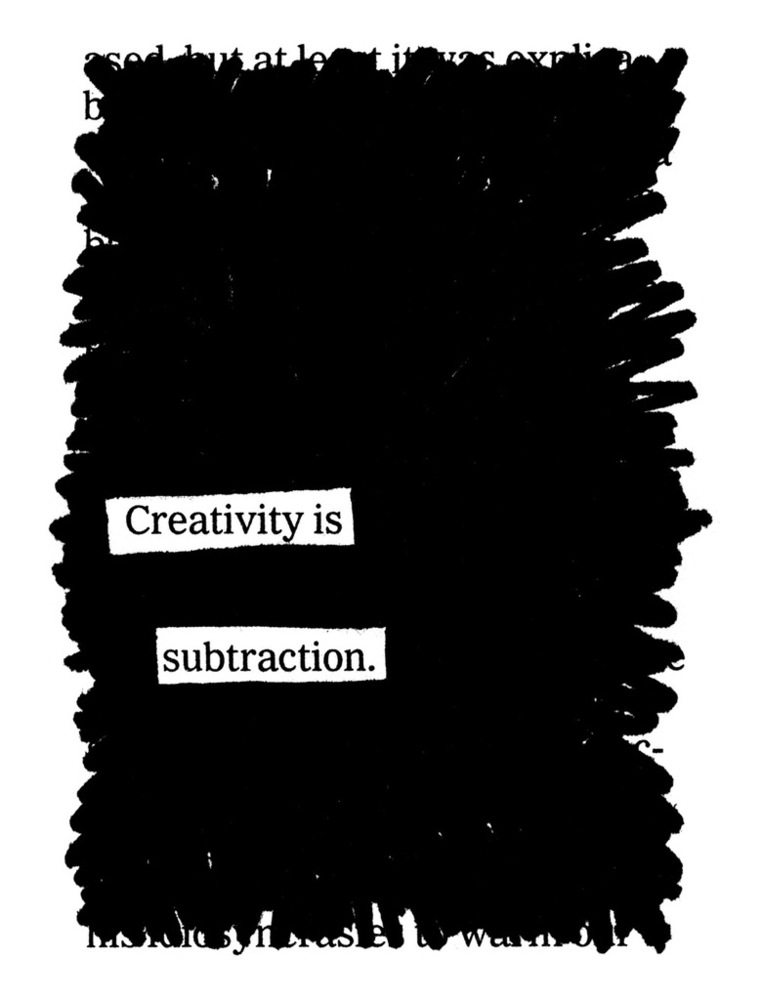
But perhaps, after all, we should heed Charles Eames’s admonition:
Recent years have shown a growing preoccupation with the circumstances surrounding the creative act and a search for the ingredients that promote creativity. This preoccupation in itself suggests that we are in a special kind of trouble — and indeed we are.
Subscribe to:
Posts (Atom)