Tuesday, 15 September 2015

Wabi sabi

I have been attracted to Japanese design for a number of years, and curious about Japanese culture, but, regrettably, never really delved into the subject in a thorough manner. I recently came across the term wabi sabi, and have begun to look into this concept further.

"A blend of Eastern wisdom, feng shui, and the movement toward simplicity, Wabi Sabi is a Japanese expression meaning "wisdom in natural simplicity." Wabi Sabi helps us to see the beauty in imperfection, to discover that our unique flaws also can lead us to our greatest strengths and treasures.No one is perfect--in fact, we all are perfectly imperfect.

What is Wabi Sabi? 

A universal ideal of beauty, Wabi Sabi celebrates the basic, the unique, and the imperfect parts of our lives. Wabi Sabi is the comfortable joy you felt as a child, happily singing off key, creatively coloring outside the lines, and mispronouncing words with gusto. On a deeper level, Wabi Sabi is the profound awareness of our oneness with all life and the environment. It includes a deep awareness of the choices we make each day, the power we have to accept or reject each moment of our lives, and to find value in every experience. Appreciate this and every moment, no matter how imperfect, for this moment is your life. When you reject this moment, you reject your life. You don't have to settle for this moment, you are free to steer a different course, but for now, this moment is yours, so be mindful to make the most of it." 


"Wabi sabi is a state of consciousness. Its beauty hidden in the aesthetic or feeling experienced between you and something in the world."

"Wabi sabi has many different meanings. Wabi was originally associated with sadness and loneliness. However today it means living a simple and modest lifestyle; one which is peaceful, balanced and in tune with nature. 
Sabi originally meant ‘to be desolate’ but now it is associated with ‘growing old’, the natural progression of time, transitory or short-lived beauty and enjoying objects which are aged, fading or weathered.
It's about just ‘being’. Enjoying the moment and life’s simple pleasures and bringing more of these into our lives." 

"Together wabi sabi provides a way of life which helps us to connect with our true essence; the place within us where peace, serenity and harmony reside."

"Wabi sabi is:
• Unconventional
• Unassuming
• Unpretentious
• Understated
• Underplayed
• Undeclared
• Unencumbered 
• Unmaterialistic."

Sunday, 13 September 2015

Wish list books

Whilst in London last Sunday I enjoyed perusing the shelves of a few specialist art bookshops. It is always a treat to have the opportunity to discover new books, and I certainly found a few that are now on my wish list:


Wednesday, 9 September 2015

Skimmer

Brass Skimmer
Rice Paper

This is probably the most minimal artwork that I've ever made. I saw the skimmer in an Asian supermarket and felt an urge to buy one and admire its beauty. I had also picked up some rice paper, and so cut it into strips and soaked them in water prior to then laying them over the dome of the skimmer, ensuring that they neatly cover the surface. When it was dry I carefully removed the cast from the mould. I hung the skimmer on wall and then balanced the rice paper on the wire skimmer part. Over time the rice paper moulded itself around the skimmer, and as it dried out it began to crack.

Here it is in stages


Some thoughts on my first year of the MFA

Yesterday I took down my exhibition and continued to sort out my studio space. As I look at all of the things I have in my studio, I realise how much work I made over the past year, and the wealth of materials that I have collected. I'm trying my best to reduce the amount of things I keep in my studio so as not to clutter it, but it is challenging given that I work in such a varied way and make use of lots of materials, both found and made. I often have materials in my studio for a while before I decide what I am going to use them for. It is almost like I am getting to know them and try to understand their properties before I make use of them.

Going through my year's work also made me realise how much I have embraced the course and really challenged myself, and I feel as though my work has moved in a different direction, and into the a place of possibilities. I have grappled with the notion of play and playfulness. I started out thinking that in order for artwork to be playful, it had to be fun and look cheery. I now realise that this is not the kind of work I want to make as it often appears childish and is very literal. What interests me much more is how artists can be playful in their approach and process. These ideas are going to be explored further in my dissertation.

My work started out brightly coloured and made of art materials such as plaster. Over time I begun to move away from what had become a somewhat familiar way of working, into the unknown. I introduced found materials, and begun to use materials not usually associated with art such as jelly. This made the work less predictable. Who knows where my work will be in another year?!

Monday, 7 September 2015

Incidental compositions

Yesterday I had a trip to London to visit a couple of specific exhibitions, namely Agnes Martin at Tate Modern, and Carsten Holler: Decision at the Hayward Gallery (more about the exhibitions in later blog posts).

The exit from the Agnes Martin exhibition leads visitors to a cafe and viewing platform. Some maintenance work was being carried out to the cafe, and amongst the chaos I found some beautiful incidental compositions.


Sunday, 6 September 2015

Sally Madge - How Can I Tell What I Think Till I See What I Say - Customs House, South Shields

It was a week ago that I was stood in the Main Gallery at Customs House listening to Nick Kennedy talk about his latest work. 


It is hard to imagine that the current exhibition, How Can I Tell What I Think Till I See What I Say by Sally Madge was assembled in less than a week. Included in the exhibition was a process-driven wall drawing in which the artist covered the entire wall in charcoal, turning the wall from white to black. This was then washed with cleaning fluid so as to turn the wall an inconsistent light grey. During the installation of the other artworks in the gallery, Sally realised that the wall drawing was too dominant, and therefore decided to use white emulsion paint to cover part of wall. 


The press release reads:

"Not so much an exhibition of drawings, more an installation about drawing. Sally takes her inspiration from a child's picture of a house and asks questions concerning the nature and significance of drawing as activity and event. The installation might be interpreted partly as a personal archive but also a 'design for living', and aims for a playful yet serious approach to the subject.

The title for this exhibition is taken from Aspects of the Novel (1927), a treatise on writing by the English novelist EM Forster – Sally came across it when reading Marion Milner's 1950s classic study of the nature of creativity and the forces which prevent its expression, On Not Being Able To Paint. The quotation has been used as part of a discussion of Milner's ideas about the interplay of inner and outer reality in art and everyday life. 
Taking her inspiration from a child's drawing of a house, her aim is to weave a series of visual narratives through the space of the gallery, and so this is less an exhibition of her drawings or an exercise in drawing virtuosity than an installation about drawing. The intention is to explore the nature and potential of the medium, the way being able to do it or not being able to do it is indicative of received cultural norms and practices (as in "I can't draw a straight line", and the notion of 'genius'), as well as how the defining principles of drawing might be reformulated to fit a range of creative needs and aims.
So, the main gallery becomes the site for an experiment in 'interior design', and the walls are marked, papered and hung with a selection of artist-produced, found and collected drawings. A large, sculptural piece which takes centre stage engages with the child's drawing and references various art historical precedents. 'How To Draw' manuals spanning several decades are laid out for reference, and the small anteroom off the gallery operates as a more intimate and unformulated 'studio' space. The installation might thus be interpreted as part museum, part personal archive and part 'design for living'."

This exhibition is part of:
drawing?
Exploring the Creative process in Art, Culture and the Everyday

Launched from the end June 2015 to January 2016, drawing? an extensive region-wide programme of exhibitions, events and activities which aims to celebrate, explore and consider the role of drawing in art and design, science, technology and the everyday.
drawing? is curated by Esen Kaya (The Customs House) and Mike Collier (University of Sunderland) in partnership with mima (Teesside University), Newcastle University and Northumbria University. The project is a unique collaboration between some of the North East’s universities, galleries (both public and private), museums, archives, artist-led groups, artists and makers.

Thursday, 3 September 2015

Newcastle University MFA 2015 Summer Exhibition - Mirela Bistram

Mirela Bistran
is a Romanian artist living in the UK.
In her “
Unfolded Dowry
” she explores the cultural significance of objects
.
The imagined space of the installation is a layerin
g of references alluding to
Romanian cultural heritage and veiling Bistran’s ow
n memories.
In seeming together old and new fabrics - hand fini
shed and machine fabricated –
the past and the present, the real and the artifici
al combine.
The installation is a journey out of time, it is ab
out past traditions – though traditions
which have become increasingly alien – and it is th
rough memory: but it is a memory
re-imagined, remembered and manufactured.
Mirela Bistran is a Romanian artist living in the UK.


In her “Unfolded Dowry” she explores the cultural significance of objects.

The imagined space of the installation is a layering of references alluding to Romanian cultural heritage and veiling Bistran’s own memories.
In seeming together old and new fabrics - hand finished and machine fabricated – the past and the present, the real and the artificial combine.


Mirela Bistran
is a Romanian artist living in the UK.
In her “
Unfolded Dowry
” she explores the cultural significance of objects
.
The imagined space of the installation is a layerin
g of references alluding to
Romanian cultural heritage and veiling Bistran’s ow
n memories.
In seeming together old and new fabrics - hand fini
shed and machine fabricated –
the past and the present, the real and the artifici
al combine.
The installation is a journey out of time, it is ab
out past traditions – though traditions
which have become increasingly alien – and it is th
rough memory: but it is a memory
re-imagined, remembered and manufactured.

The installation is a journey out of time, it is about past traditions – though traditions which have become increasingly alien – and it is through memory: but it is a memory re-imagined, remembered and manufactured.


Newcastle University MFA 2015 Summer Exhibition - Sofija Sutton


Sofija Sutton has created a large installation utilizing the room’s architecture to construct an oversized diagram linking multiple short stories. 


"Text, audio, space, and video unite through flash fiction to express various notions of ‘low mood’ and, in contrast, combatant methods. Ticks consuming bus passengers, dawn and dusk as lovers, a bear with a yellow tongue, a woman bleaching her hair, and other fantasies each use absurdities with the mundane as metaphors for mental health shortcomings. "


Sutton writes "I hope my work will compel the viewer to physically interact with the mind map, so that the story points may thread together a work that is both thought-provoking and entertaining."

http://www.srlsutton.com

Wednesday, 2 September 2015

Newcastle University MFA Summer Exhibition 2015 - Nigel Morgan - Hiraeth

"In Welsh the word hiraeth offers a way into understanding our yearning for the elusive something that nature and landscape means to us; analogous to an unattainable longing for a place, or perhaps a person, the language of landscape becomes metaphoric to an emotional language of the soul. The language of landscape is a language of loss, of distance, of longing, and the more we try to define it the less clear it becomes."


"Landscape is made and it is the mediator by which nature has been perceived as something other. This continues to be a cultural problem:the measurement and technological representation of landscape reinforces an anxiety over our distancing from nature; however now, in the Anthropocene, everything is landscape and landscape can re-connect us to nature, it is a real material connection."


"This work is an attempt to understand this longing, through the use of nature, the matter of landscape."


Being Landscape: The Landscape is a creation of and by ourselves and our imagination. It is ‘the peculiar moment of being present to perception [the] ‘matter of experience’… the materiality of what is otherwise an ephemeral and contingent snatch of lived experience.’ J. J. Marshall, p202, Landscape Theory. 2008.

Monday, 31 August 2015

Newcastle University MFA Summer Exhibition 2015 - Sarah Dunn

Sarah Dunn is an artist whose practice focuses very clearly upon the observation and consideration of her immediate cultural and natural landscape. Through a process of careful documentation and patient archiving a catalogue of elements is built, within this, its many indexes may now evolve and shift. This ‘catalogue’ may be regarded as an accumulation of stimuli, one in which objects transmute sensibilities; buildings become new habitats, patterns become language and books become birds.


The work uses drawing and writing to begin, it is sculptural, sensitive to changes, personal, social, political, but firmly rooted in the traditions of form, craft and observational relationships.


In Between Fear and Mother Love is an entry into the index of observation. It uses the three totemic birds, the Bittern, the Woodcock and the Nightjar as symbolic chapter headings into which the objects, textiles and elements within the work are placed. These objects carry more than the sum of their parts. However, The canny observer will also find memories, emotions and experiences. The library of these birds is an echo chamber, a place of responses.


Newcastle University MFA 2015 Summer Exhibition - Paul Martin Hughes


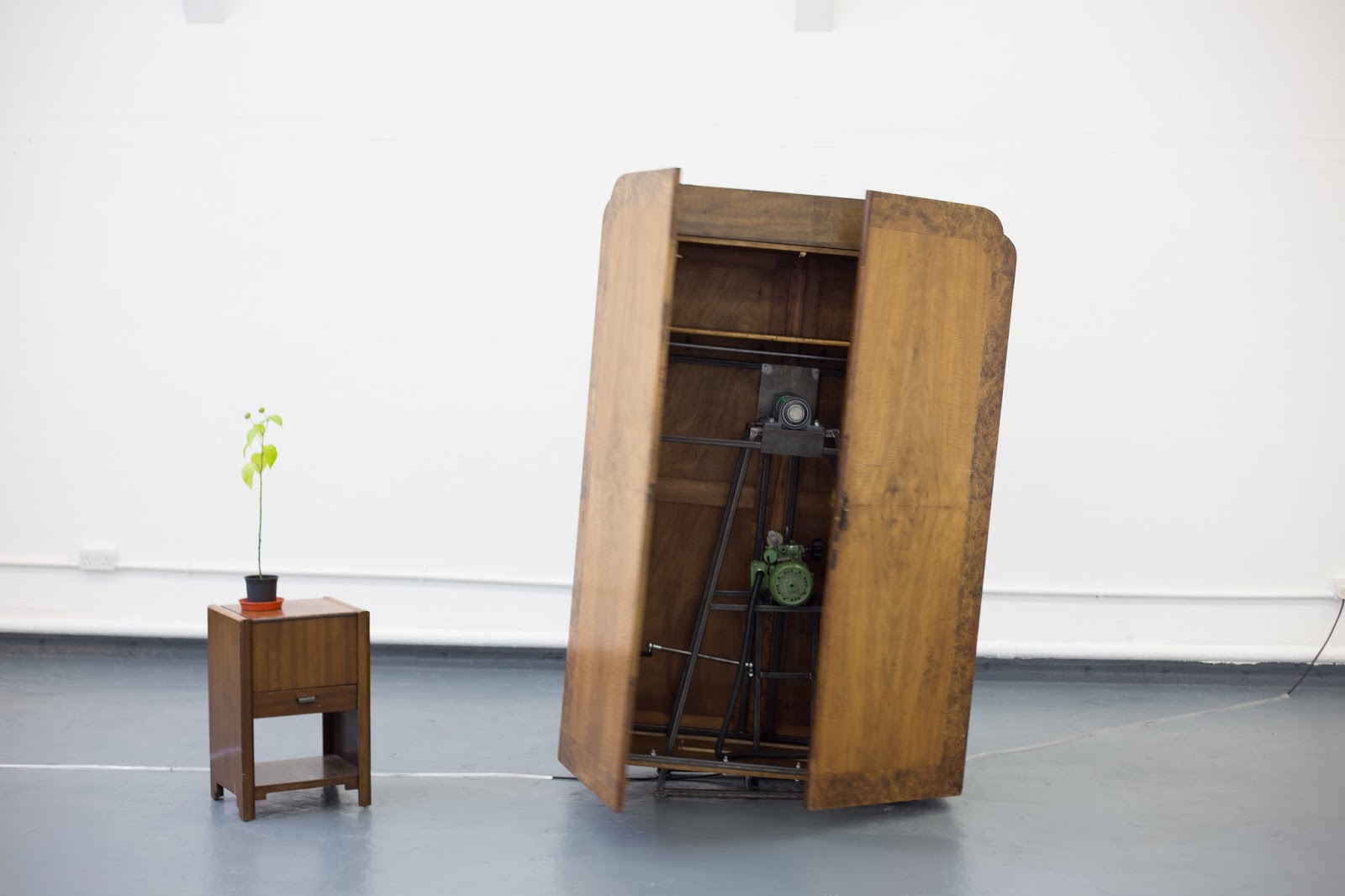
"My current work explores the interactive qualities of kinetic sculpture. I am interested in creating a direct interactive response that is individual, rather than generic, exploring themes surrounding childhood fantasy and the limits of an imagination long since lost to adulthood.My work relies heavily on pre-existing relationships with objects associated from my own and the viewers past. Writing fictional stories combined with pictorial narratives and producing simple CAD designs, my studio work has evolved to focus on precise draughtsmanship and experiments with new media and technology." 
Paul Martin Hughes


Newcastle University MFA 2015 Summer Exhibition - Soonwon Hwang


Leaves, thread, light installation