Friday, 12 December 2014

Instructions to disrupt usual walking patterns

The purpose of these instructions is to prompt you to think about moving in a different way. Each instruction should be followed for at least 5 minutes*

You decide:
How many instructions you follow each day
The order in which the instructions are followed
How many times you follow the instruction

Walk backwards

Skip to work

Change direction every time you walk on a different surface

Stride

Walk barefoot

Notice the different surfaces that you step on

Hop

Walk to work an hour later than usual and notice the difference

Move at the same pace as the person next to you

Walk round the perimeter of buildings as opposed to through open space

Shuffle

Close your eyes and let someone else to give you directions of where to go

Every time you cross a road, alter the pace of your walk

Move without your feet leaving the ground

Wear a pair of shoes that are too big for you

Walk sideways

Tip-toe

Stop and look up after every 10 steps

Notice the colours

Change direction every time you pass a red car

Walk to work an hour earlier than normal and notice the difference


Jump

* Please note that I am not responsible for you being late to work, getting injured, or for you receiving funny looks when carrying out such instructions!

Wander|n


I was one of a group of students who have been involved in 'The Art of Straying', a research fellowship organised by Bridget Kennedy.

We have been on a number of journeys, including a walking meditation in the atrium at the University, urban rambles, a 'big adventure' and a trip to Cheeseburn.

Wander|n was an event; a group response to our engagement on the fellowship, and an opportunity to share our experiences with others.

We began in the XL gallery with a 15 minute walking meditation, and then were lead downstairs and along a corridor to a damp spiral staircase. At the top of these stairs, Simon handed out cups with tomato soup and a biscuit to enjoy as he told us a story about one of the urban rambles and then read a couple of T.S. Eliot poems.

We then meandered to Zoe's studio space where she presented an installation featuring an assortment of objects such as stones and branches that she found whilst on our journeys in combination with various other objects that she has collected over years. The origins and information about such items were contained within a concertina book which she passed around.

Franziska and Michael then took us to a couple of viewpoints in the university pointing out the way that the old building is often engulfed by the new building, with both styles of architecture being on view. They compared this with their Art School in Munich.

Once in the atrium space I recited my instructions to disrupt usual walking patterns, reading them like a poem. I handed out the instructions for people to take away and try out in their own time. This idea stemmed from my experience of the walking meditation, and how this exercise had made me consider the way in which we move and being more conscious of the journeys we take.

Before reaching the XL gallery agin, we stopped at the 2 statues at the entrance to the Hatton Gallery and Charlotte read us a story about the figures.

The event closed with a picnic, with homemade edibles and warming drinks.                                                       


Thursday, 11 December 2014

Romanesco

There are certain shapes and forms that I instinctively find pleasing to the eye, romanesco being a good example of one of these. The following article gives an explanation of why this may be so.


I would like to work with this kind of form, or create forms that fit into each other. These would not necessarily be the identical, but could be of different sizes and proportions.


Wednesday, 10 December 2014

Harold Fisk's 'Ancient Courses Mississippi River Meander Belt' maps

"Ancient Courses Mississippi River Meander Belt is a map created by cartographer and geologist Harold Fisk for the U.S. Army Corps of Engineers. Each plate shows a different portion of the Mississippi river and its various courses through time between Cape Girardeau, MO and Donaldsonville, LA—some of these channels date back thousands of years.


The maps were part of his report Geological Investigation of the Alluvial Valley of the Lower Mississippi River completed in 1944. The study was made to learn about the formation of the valley over time, and about the major factors that dictate its flow and flooding in the modern era. The data was collected by creating approximately 16,000 borings so that layers of soil and deposits of sediment from the river's prior courses deep underground could be analyzed.

Fisk drew more than geographic data—he also found the river’s heart in this jumble of loops and purls. The river finds its personality reflected in this explosive, autumn-colored palette, its constantly churning rhythm shaping the soil, digging out a constantly changing place so distinctively its own. From prehistory to the 20th century, these maps are made for the ages."

Tuesday, 9 December 2014

Artists' Book Market at BALTIC

Yesterday I visited the BALTIC for the Artists' Book Market. There was a good variety of artists, bookmakers, small press publishers, artist’s groups, zine artists and bookbinders exhibiting and selling a range of artists' books, including traditional hardbound books printed by hand, paper cut books, folded books, musical books and sculptural books.

It was lovely to bump into some familiar faces from Glasgow International Artists Bookfair, and meet other artists bookmakers whose artists books I had not previously seen.

I attended Dean Pavitt's talk in which he explained how he, as a designer, works with others to produce photo-books, and the stages to follow.


Sunday, 7 December 2014

Thomas Sopwith's wooden geological teaching models

Thomas Sopwith was an engineer and surveyor. He used his experience of being the son of, and apprentice to a builder and cabinet maker, and produced a number of wooden geological teaching models. 


Wooden geological model (number VIII from the 4 inch set), for illustrating geological rock structures


The different types of wood represent different geological formations, highlighting the orientation of mineral veins and coal seams under the ground. The models are based on measurements of mining districts from the North of England.

http://www.hps.cam.ac.uk/whipple/explore/models/geologicalmodels/


Friday, 5 December 2014

Bedrock Geology


Nigel (one of the 2nd year MFA students) and I share a love of maps, and we have had some great discussions about our work in relation to the landscape, rock formations and natural and manmade materials.

He brought in a type of map that I have never seen before, and introduced me to the wonders of Bedrock Geology.


Bedrock geology (formerly known as 'solid' geology by British Geological Survey) is a term used for the main mass of rocks forming the Earth and present everywhere, whether exposed at the surface in outcrops or concealed beneath superficial deposits or water. The bedrock has formed over vast lengths of geological time ranging from ancient and highly altered rocks of the Proterozoic, some 2500 million years ago, or older, up to the relatively young Pliocene, 2.6 million years ago.

http://www.bgs.ac.uk/products/digitalmaps/digmapgb_solid.html

The key to the map is a beautiful thing, let alone the map.


The colour schemes within the map are uncanningly similar to the colours used within some of my forms.


Wednesday, 3 December 2014

Wooden blocks

Yein, one of the other MFA students on my course has made herself a desk tidy. 

I am attracted to the shapes, colours and forms. 


Simple things!

Tuesday, 2 December 2014

Masking part of the surface

This is an experiment into putting straight, angular lines and solid colour onto an organic patterned surface.


By masking some areas to hide what lies beneath is a way of disrupting the pattern and adding another layer. 

Monday, 1 December 2014

Ouseburn Open Studios

I thoroughly enjoyed my trip around The Biscuit Factory, The Holy Biscuit, Northern Print and 36 Lime Street, all of which were taking part in Ouesburn Open Studios.

There was a lovely atmosphere in all venues, with hundreds of people making the most of the opportunity to have a sneak peak into artists studios and admire (and purchase) some of their creations. There was even the chance to make your own artwork at some of the venues.

A selection of my favourites were

Ceramics by Maria Wojdat 


Ceramics by Rachel Foxwell


Printed fabrics by The Store Hus


Fine Art by Paul Merrick


Fine Art by Louise Bradley


Sunday, 30 November 2014

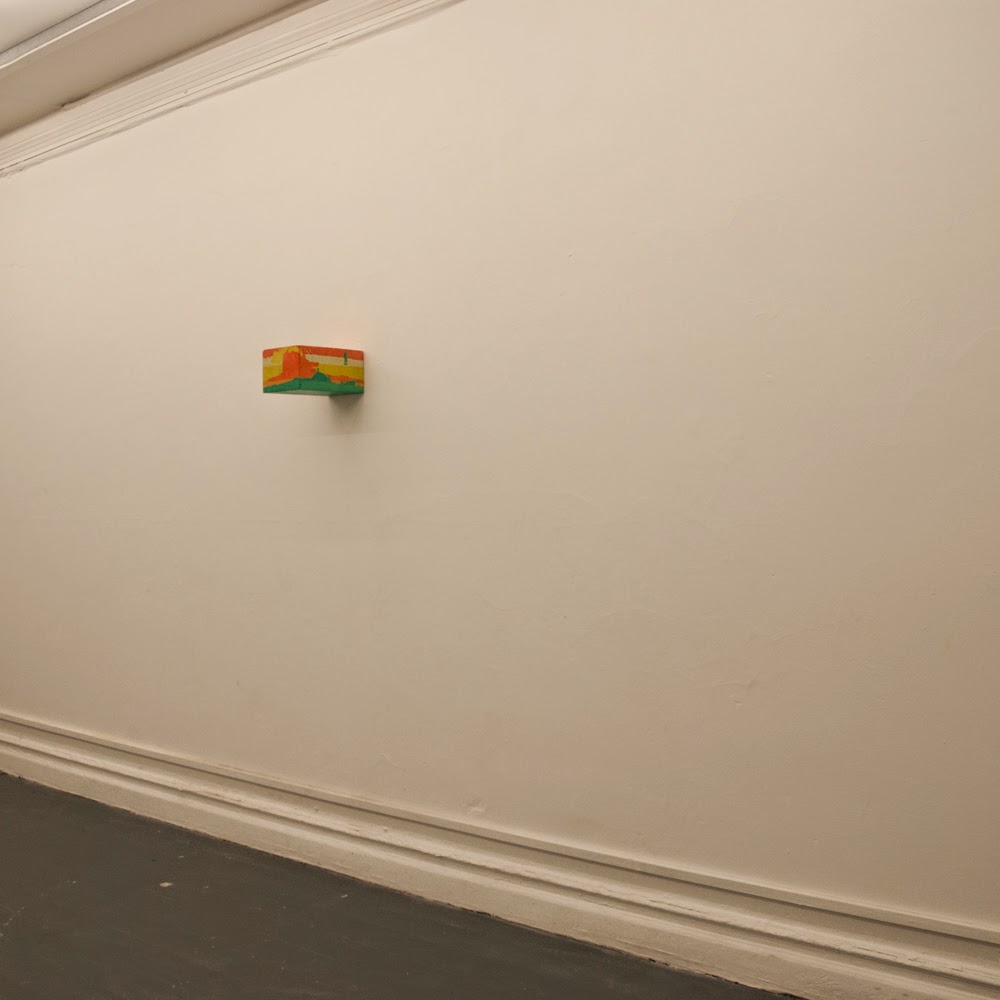
It's on the wall!

I've spent the last week hopping between the metal, wood and casting workshops, learning new skills and processes in order to achieve my aim of installing one of my sculptures on the wall.


I wanted the block to be flush against the wall without the presence of any brackets or shelves. In order to do this, I needed to have two steel rods sticking out of the wall to be inserted into the block and hold it above the floor. 


The rods were welded to a steel plate, and two holes were drilled into the plaster block for the steel rods to fit into. A countersink was made to accommodate the raised welded sections.


I chiselled a recess into the block for the steel plate to fit into, so as the block would fit flush against the wall.


The steel plate was drilled onto the wall, and then the block was slotted onto the rods.


It has been a time consuming process in order to get the block on the wall, but now I feel a sense of achievement, and am glad that I have learned some new skills. The technicians, Joe (woodwork), Steve (metal) and Burnie (casting) were all extremely helpful.


Saturday, 29 November 2014

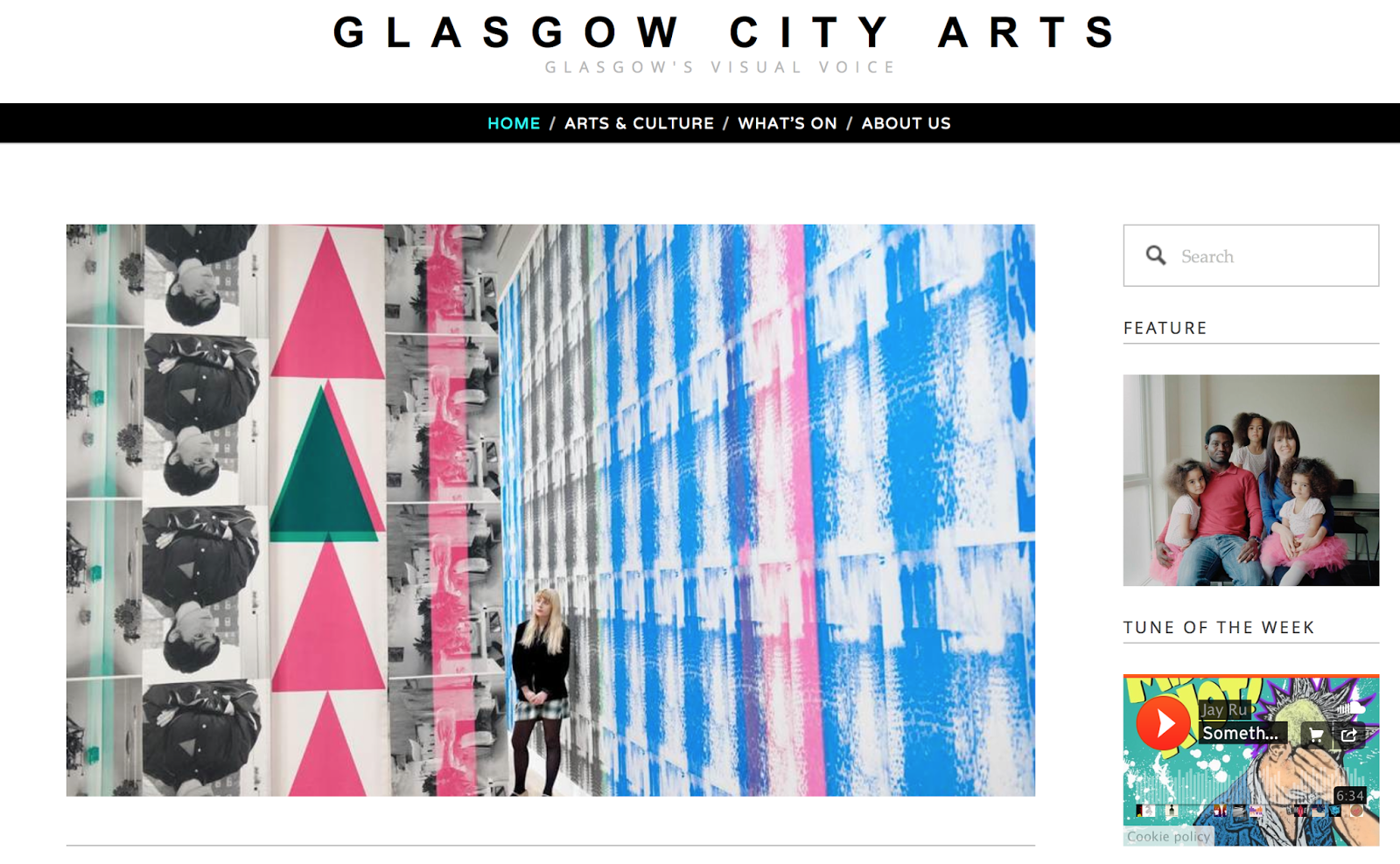
Glasgow City Arts


I'm delighted to see that there is now a website that 

"promotes all things arty within [Glasgow]. Glasgow City Arts provides a voice for Glasgow's abundant arts scene creating an equal platform for artists, galleries, arts organisations, theatres, musicians, and much more, generating exposure for everyone while boosting Glasgow's profile as the creative capital of Scotland!"


The website includes featured artists, a guide to what is on in Glasgow (including open calls), and a tune of the week. 


http://www.glasgowcityarts.com

https://www.facebook.com/glasgowcityarts

https://twitter.com/glasgowcityarts


Friday, 28 November 2014

UnstapledPress launch - NewBridge Books

Last night was the launch of UnstapledPress, a new publishing house set up by seven artists currently studying at Newcastle University with an aim of publishing creative work involving text. Founded in May 2014, UnstapledPress have so far released three publications with a fourth, Interval II being produced especially for the launch event.  


Interval II is a collection of arts writing by a variety of people, from a variety of backgrounds, writing in a variety of mediums. Including  poetry, critical text and short stories.

At the launch event there were two spoken word performances of extracts from Interval II, personally read by the authors Sophia Sutton and James Linton.

All UnstapledPress publications are available at NewBridge books.

Wednesday, 26 November 2014

Bringing out the colour

Throughout the drying process, plaster tends to lose its vibrancy, and the colours become paler and chalky.

I have found that adding polymer to the mix of pigment, water and plaster helps retain the intensity of the coloured plaster. 

After hours of sanding, the surfaces have turned cloudy. I now wish to bring out the strength of the colour. In the past I have coated the plaster with diluted polymer. Although this seals the surface and helps prevent the plaster from fading, this method doesn't really give a sense of depth of colour. I am therefore experimenting with other processes.

I am testing out using clear shellac varnish. For optimum results, thin layers need to be applied, gradually building up the depth of colour.


2 faces of the cast have been coated in varnish, showing the contrast between the chalky non-treated surface and the vibrant treated surface


Tuesday, 25 November 2014

Art School, Smart School on BBC Radio 4

This pertinent radio programme addresses some of the current challenges to face Universities, and Art Schools in particular.

'British art schools have produced some of the world's most successful artists, designers, filmmakers and musicians. Britain has built up a strong reputation for creativity around the world and politicians are interested in capitalising on our creative brand.

Brian Eno was at art school at a particularly exciting time. In the sixties, art colleges were independent and experimental; students were challenged to rethink what art and art education were about. Brian relates his memories of Ipswich College of Art under the radical educationalist Roy Ascot, and reflects on the importance of this experience. But he also sounds a warning note - he says art schools are under huge pressures and the effects are threatening creativity.

This programme brings together artists, musicians, art tutors and archive recordings to explore the last half century of art education and the state of Britain's art schools today.

We hear the perspectives of high profile figures in art and design - Grayson Perry, Richard Wentworth, Eileen Cooper, Peter Kindersley, and Jay Osgerby to name a few.

Britain depends on its art schools if it's to sustain its reputation for creativity. But are art schools becoming too much like universities and excluding those very people who will produce the innovations of the future?'

http://www.bbc.co.uk/programmes/b04pr1w2

Sunday, 23 November 2014

Mirela Bistran: Interior Garden

Interior Garden 
Exhibition by Mirela Bistran at St Oswald's Church, Durham

Today I visited St Oswald's Church in Durham to see an exhibition of paintings and prints made by one of my colleagues on the Master of Fine Art course at Newcastle University.


Mirela Bistran moved to England from her Romanian home in 2008, and one can see the influence that her culture has on the art she produces.

Often using warm, earthy colours, I find Mirela's work comforting and welcoming. I liken this feeling to being wrapped in a blanket, and when speaking with Mirela she explains that she is inspired by the Romanian tapestries that are often displayed on the walls. One of the purposes of these tapestries is to provide a warm surface when someone leans against the wall.

I know all your corners

Just as tapestries sometimes depict a narrative, Mirela's work often has a story behind it, or is related to personal experience. Her soft and peaceful personality is echoed in her work. The series of three paintings titled Embrace were made shortly after she married, and when creating these works she was thinking about how two pine trees grow and interconnect or intertwine with each other.


Above the rain

Mirela speaks of how she wants her work to reference "encounters; sometimes timid, sometimes explosive, close to recalling prayer.” I believe that she creates these contrasting emotions through her use of material, tone and colour. Pale, fluid washes are made with watercolour, giving a gentle and calm atmosphere. In other areas, layers are build up with more opaque, bolder colours, adding intensity and depth to the paintings. Similarly, she contrasts empty, or sparse spaces with highly detailed areas that draws one's attention into her inner world within the painting.

I admire Mirela's ability to represent the figure, and enjoy the spontaneity and freeness within her work. One can sense the connection that she has with the act of mark-making. In contrast to the fluidity of working with watercolours, Mirela also makes lino prints. This form of printmaking involves carving into a sheet of linoleum to produce a relief print. The linoprints in her current exhibition are monotone, black and white images. Whereas I previously thought of linoprints being rather hard and bold, Mirela manages to create flowing lines, and by removing lots of the lino, she creates space within the image. 


http://www.durhamtimes.co.uk/news/11607099.Art_inspired_by_prayer_on_show_at_church/

http://www.thenorthernecho.co.uk/news/11607099.Art_inspired_by_prayer_on_show_at_church/

Saturday, 22 November 2014

Is this the end of the British art school?

Art schools used to be a place where the socially and intellectually marginal could distinguish themselves. Now, with unattainable entry requirements and a hefty price tag, they’re becoming a dwelling place for commercial interests and the children of the international elite.

by Isabel Sutton 
Published 20 November, 2014
New Statesman


The old Central Saint Martins building in central London. Photograph: Getty Images.


When the Great Exhibition opened its doors in 1851, Britain’s reputation as the workshop of the world was on the wane. Few visitors would have known it at the time, but the exhibition signified the high watermark of British manufacturing. French design and Prussian engineering were already edging ahead. In 2012, London hosted another event designed to present Britain to the world – one which referenced the upheaval of the Industrial Revolution by featuring towering smoke stacks and beating drums.

Danny Boyle’s Olympic opening ceremony represented British history as a creative blossoming that started in the nineteenth century but seemed to reach its zenith in the twentieth century when fashion, film and pop music boomed. And yet it seems to me that Boyle’s Olympic opener – just like the Great Exhibition – was telling a story about Britain that had already ceased to be true. The circumstances which made it possible for artists to thrive in Britain during the twentieth century are rapidly disappearing. And perhaps one of the most essential changes is in our art schools.

Name any one of the UK’s most famous designers or musicians, never mind artists, and they are likely to have set foot in an art school at one time or other: David Bowie, Pete Townsend, Brian Eno, Vivienne Westwood, John Galliano. I could go on and on. Economist Hasan Bakhshi [3] of innovation charity Nesta says that he is frequently asked about how we run our art schools by educationalists abroad. Art schools are perceived by many as the key to our creative success.

Yet art schools have changed dramatically over the last 20–30 years, causing many to question whether they will, in the future, cultivate the innovators we so badly need. Art schools used to be havens for students who, for whatever reason, had not found their niche in the traditional academic system. Now prospective art students very often have to prove their academic credentials to compete for a place at the most prestigious colleges. Once on the course, art students have to submit an increasing volume of written work, arguably a distraction from practical skills and craft.

Tuition fees have made higher education in Britain more expensive than anywhere else in Europe, and art schools are no exception. This means that the social and economic mix is disappearing (students from poorer backgrounds being less inclined to take out a loan for a non-vocational subject such as fine art). What’s more, art schools are going out of their way to attract foreign students for the extra income they bring. Unsurprisingly, there is deep concern among many artists and teachers that the age of the art school is – to quote Sir Christopher Frayling – “over”.

Frayling was, until 2009, dean of one of Britain’s most venerable art schools, the Royal College (RCA). But as I walked its corridors with him recently, he admitted that even this renowned institution has suffered from the same damaging developments as art schools around the country: workshops for ceramics, printing, and metalwork have been replaced by computer rooms, digital expertise is prioritised before craft; student numbers are rocketing and teaching hours are sinking.

Designer Jay Osgerby [4] graduated with a Masters in architecture from the Royal College of Art. He’s one of a generation of British designers who are now leading design practice around the world, in every field from fashion to technology. The head of Burberry, Christopher Bailey, was in the same year as Jay and his partner Edward Barber; Thomas Heatherwick was another who attended the RCA around the same time; and Apple’s Jonathan Ive was an industrial design student at Newcastle Polytechnic.

Osgerby remembers the RCA as a place where people were constantly making things. The lift was continuously crammed with half-made dresses and furniture being ferried up and down. The RCA, he believes, still manages to hold on to this highly practical ethos, but everywhere he sees the rise of computers taking the place of the hand-made: computers, he says “make you look like an innovator rather than a throw-back to the industrial revolution, but I think that’s a really big mistake.”

The truth is that workshops are expensive and that’s a good enough reason to get rid of them. As education is effectively privatised, art school managers are more interested in business models than the experience of students. An art school such as Central Saint Martins (part of the University of the Arts London) recruits around 40 per cent of its BA students from overseas. It also runs short courses for members of the public. This extra income allows the art school to do a few “special things”, says its head Jeremy Till, such as putting on two degree shows so splendid they attracted almost 50,000 people earlier this year. He says the new building at Kings Cross (where the art school moved from its West End site in 2011) makes the art school a “cultural destination”. Never mind the fact that some staff and students feel uncomfortable with the monolithic, anonymous architecture (one tutor told me that there’s never enough studio space for everyone, you can’t open windows, and you no longer meet people from other courses despite the fact that everyone is now on the same premises.)

So is it necessary to impress the public with a dazzling building and exciting brand? Jeremy Till would tell you that it’s exactly this kind of self-presentation that’s encouraged Google to locate its European offices right next door to Central Saint Martins’ new building at Kings Cross in North London. And maybe he’s got a point. Google might offer jobs to some of the young “creatives” who step out of Saint Martins’ sliding doors. But there’s a balance to be struck. If Central Saint Martins isn’t concentrating attention – above all – on the experience of students within its walls, then the shiny exterior will become just that – a façade, a front, a shop window. Nothing more.