Thursday, 20 July 2017

Manchester International Festival - Day 2

We began our day of Manchester International Festival exhibitions at the Centre for Chinese Contemporary Art (CFCCA) where there was an impressive audio-visual installation by Samson Young.

'One of Two Stories, or Both (Field Bagatelles) is a newly commissioned radio series and gallery installation inspired by tales of Chinese migrants. Sound artist and composer Samson Young took visitors and listeners on a journey inspired by the myths and legendary tales of 17th-century Chinese travellers making their way to Europe on foot.'


'The work began with a five part radio series performed by a cast of actors, artists and musicians. Following the radio series, the gallery presents a multi-layered installation incorporating material from the radio performances to provide another intriguing perspective to these stories, and investigate how journeys are remembered and retold.' 

A curtain rail with translucent curtains spans the perimeter of the gallery, and these are operated manually, periodically moving around the space. As the blinds opened and closed automatically, the changing light conditions reminded me of the daily cycle of light conditions and the passage of time.

In the back gallery space was a group exhibition, From Ocean to Horizon, a group exhibition featuring artists presenting unique perspectives on living and working in present-day Hong Kong.

http://www.cfcca.org.uk/

I then ventured to two galleries that I had never visited before: Paper Gallery and PS Mirabel, both located on Mirabel Street close to Victoria train station.

'PAPER is an artist-led, commercial gallery based in Manchester and represents a range of emerging and mid-career artists whose practice is based around the medium of paper. This ranges from drawing, painting, and printmaking to artist's books, video, and performance. The gallery opened in August 2012 and has a regular programme of exhibitions, presenting the work of gallery artists as well as providing a platform for outside curatorial projects. In 2013 PAPER instigated an Artist-in-Residence programme, Exploring PAPER, and in 2014 a mentoring scheme for artists based in the North-West of England, funded by Arts Council England.'


The current exhibition, The Surface of Things, is produced in collaboration with LA-based Durden & Ray and was part of the Manifest festival. It is an exhibition exploring contemporary Abstract painting.


Featured artists: Lisa Denyer / Frances Disley / EC / Brendan Fletcher / Roni Feldman / Jenny Hager / Sharon Hall / Vincent Hawkins / David Leapman / Mali Morris / Max Presneill


http://www.paper-gallery.co.uk/

Next door to Paper Gallery, PS Mirabel is another artist run project and exhibition space. Small world is the gallery's open call exhibition in which all the works need to be no larger than 20x20x20cm.


http://www.psmirabel.co.uk/


My next destination was Castlefield Gallery. The gallery has a strong commitment to developing emerging contemporary artists and practice. 'Its ambitious curated exhibitions programme responds to national and international trends, promoting artists at key stages of their careers. Central to CG’s activities is an artist development programme that has launched major commission-winning artists.

Castlefield Gallery’s vision is for the North to be a place where artists can live and produce work, while presenting their work in national and international contexts. Its mission is to nurture talent, explore cultural trends and deepen the audience’s relationship to contemporary art.

The current exhibition presents a new body of work by Manchester-based painter Lindsey Bull, alongside a new mixed media installation and performance by London-based collective Plastique Fantastique.'

http://www.castlefieldgallery.co.uk/


We then met a couple of Manchester based artists, Chris and Kelvin who took us to Title Date Duration. 


This space has been created to focus on the relationship between the art work and the viewer. The artist's name does not appear until the viewer has seen the exhibition, therefore avoiding the reading of the work being determined or influenced by the artist's reputation or image. I think this is a really genuine way to help ensure that the discussion around the work focuses on the work. 'It allows the art work presented to only be concerned with the act of viewing, and the will of the individual to view it. The programme intends to provide an opportunity for reflection and discussion.'

http://titledateduration.com/


The group then called at HOME where the exhibition, La Movida was presented in the main gallery space.

“It’s difficult to speak of La Movida and explain it to those who didn’t live those years. We weren’t a generation; we weren’t an artistic movement; we weren’t a group with a concrete ideology. We were simply a bunch of people that coincided in one of the most explosive moments in the country.” – Pedro Almodóvar

'This pioneering contemporary visual art group exhibition takes the artistic and socio-cultural movement La Movida (literally “the movement”) of post-Franco Spain as its thematic heart. Suddenly the forbidden arenas of politics and sexuality are open season for public debate and creative communities. Excess, clubbing, drugs, artistic freedom, gay rights, pornography and more all collided in an outpouring of freedom from suppression and a desire for making up on lost time in the early 80s in Madrid.'

Upstairs, Eden Kötting & Anonymous Bosch presented work.


The paintings and collages in this exhibition were inspired by the Edith Walks project which itself was inspired by the life of Edith Swan Neck. Eden Kötting was born in 1988 with Joubert Syndrome, a rare genetic disorder. She grew up in London and developed a keen interest in drawing and painting. In 1996 she appeared in her father’s experimental feature film Gallivant along with her great grandmother Gladys.

Anonymous Bosch produces work that 'fulfills the important post-medieval role of witness/chronicler to Andrew Kötting’s troubadour band on their long march in the spectral footsteps of King Harold, from one grave in Waltham Abbey via another in Battle to a sculpture at St Leonards-on-Sea (during production of Kötting’s latest film-essay, Edith Walks).'

https://homemcr.org/

My final gallery for the day was the Whitworth Gallery, where I literally had a whistlestop tour of the current exhibitions including No End to Enderby by Graham Eatough and Stephen Sutcliffe, Cornelia Parker: Verso and John Akomfrah's film Vertigo Sea.

http://www.whitworth.manchester.ac.uk/


Wednesday, 19 July 2017

Colin Stetson at MIF as part of Dark Matter, curated by Mary Anne Hobbs

I am a regular BBC Radio 6 Music listener, and one of my favourite DJs is Mary Anne Hobbs, who hosts a morning programme every Saturday and Sunday as well as the Thursday edition of 6 Music Recommends. It was a few months ago I that first heard Mary Anne Hobbs play the music of the American saxophonist and multireedist, Colin Stetson.


"Over the years Stetson has worked extensively live and in studio with a wide range of bands and musicians including Tom Waits, Arcade Fire, Bon Iver, TV On The Radio, Feist, Laurie Anderson, Lou Reed, Bill Laswell, Evan Parker, The Chemical Brothers, Animal Collective, Hamid Drake, LCD Soundsystem, The National, Angelique Kidjo, Fink, and David Gilmore. Meanwhile he has developed an utterly unique voice as a soloist, principally on saxophones and clarinets, his intense technical prowess matched by his exhilarating and emotionally gripping skills as a songwriter.

Stetson’ s astounding physical engagement with his instruments (chiefly bass and alto saxophones) produces emotionally rich and polyphonic compositions that transcend expectations of what solo horn playing can sound like. 


Stetson is equally at home in the avant jazz tradition of players who have pushed the boundaries of the instrument through circular breathing, embouchure, etc. (i.e. Evan Parker, Mats Gustafsson) and at the nexus of noise/drone/minimalist music that encompasses genres like dark metal, post-rock and contemporary electronics (i.e. Tim Hecker, Ben Frost – both of whom have mixed or remixed Stetson recordings)."

http://www.colinstetson.com/bio-1/

As part of the Manchester International Festival, Mary Anne Hobbs curated Dark Matter, "eight immersive shows from pioneering national, international and Manchester-based musicians." I was very fortunate that my visit to Manchester coincided with Colin Stetson's Dark Matter gig.


It was like nothing I have ever experienced before. The sounds produced felt like they were coming from an unearthly being, and Stetson has a way of making it seem like the instruments are part of his own anatomy. Using specialist circular breathing, he is able to sustain notes for a long period of time. I was really close to the front of the stage and was entranced by the strength it took just to hold the instruments, let alone play them in such an intense and prolonged fashion.


I would urge anyone who is on board for a totally unique sonic experience to check out Colin Stetson play live - it is something very special. But choose who you go with carefully - it is not easy listening and will challenge the ears!

To listen to highlights from Dark Matter at Manchester International Festival, including live tracks from Kojey Radical, Holly Herndon, Colin Stetson, Paleman and The Haxan Cloak, click the link below.

http://www.bbc.co.uk/programmes/b08xkzh5

Tuesday, 18 July 2017

Trip to Manchester International Festival - Day 1

I joined the NewBridge Project on a trip to Manchester to visit the Manchester International Festival.

We spent Friday afternoon in Salford visiting a number of artist run spaces.

Our first stop was The International 3 where the directors Laurence Lane and Paulette Terry Brien gave us an introduction to the organisation.

The International 3 is an exhibition and project space in Salford who work with emerging and established artists, independent curators, galleries and organisations to produce a programme of new commissions, solo shows, group exhibitions and events both on and off-site. The International 3 also works with and represents a core group of artists, exhibiting and selling their work at national and international art-fairs; brokering exhibition and private commission opportunities.
http://www.international3.com


We then headed to Islington Mill for a cuppa and a look around with Stina Puotinen.

Islington Mill is a leading independent UK arts organisation based in Salford, in the NW of England. Structured around an organic network of independent artists, Islington Mill runs innovative inter-disciplinary public arts programmes and artist residencies alongside studio spaces and an artists’ B&B. Drawing on the radical and subversive creative energy running through its arts activities, Islington Mill also has a reputation for putting on legendary experimental gatherings, events and parties.
http://www.islingtonmill.com


Our final art space visit was to Paradise Works where we met Hilary and Chris.


Paradise Works is a new artist-led initiative on the border of Salford and Manchester.


Established in April 2017, Paradise Works provides studio space to to 26 contemporary artists working across the disciplines of sculpture, installation, painting, drawing, film, audio, performance, photography and curation.


It draws together artists from studios that were under threat or recently closed such as Rogue Studios.

Sunday, 9 July 2017

Climate Symphony

I was invited to participate in Climate Symphony, an event devised by Disobedient in collaboration with Jamie Perera. It was co-produced by Forma Arts and Disobedient, and supported by Arts Council England and Sculpt the Future Foundation. The event was held at Culture Lab, Newcastle University. Climate Symphony was a live music performance that turned data into a four part symphony to tell the story of what climate change means for humans and their environment through sound.

Some questions we thought about included

Can we use sound as a narrative and reporting tool?

Can we engage and inspire and maintain factual rigour?

The lab brought together scientists, artists, journalists and members of the public to interrogate some of the ideas behind the project and as part of a workshop/lab, we created some initial works to communicate some of the data to a new and wider audience.

The lab was intended as a research and development vehicle to answer key practical and artistic questions around the process by which we can transform data into a narrative symphony.

Schedule

LEARN

Birth of a Climate Dataset: Artists, scientists and data analysts delivered talks on field recording and climate data collection.


Jim Lloyd gave an introduction to his work as a scientist and artist, and discussed some of the challenges he faces with science that led him to art.


Jez Riley French described his approach to field recording and shared some examples of his work.


PLAY

What is the Sound of a Dying Planet? We split into two groups and each group selected a set of climate data and turned that into sound.


This is the data set that we chose (kindly provided by Erin in our group).


We found the averages of points along the timeline and plotted this data into the computer. We used the trends to alter the recordings that Jez from our group had provided.


CHALLENGE

Each group explained the decisions made throughout the process of making the work, discussed the challenges faced, what worked, and what didn’t work. This led to a broader debate about role of sonification in communicating narratives of climate change.


Here is the presentation about the work that I was involved with making.


In the evening we were treated to two performances, one by Kate Carr and the next by Jez Riley French.

It was a really interesting and stimulating day, working with such a range of experts in their field and sharing lots of ideas and raising lots of questions. Thank you to Forma Arts and Disobedient for making it happen and for inviting me to be part of it.

Saturday, 8 July 2017

Rory Pilgrim: Software Garden as part of World Is Sudden: Summer Lab

World Is Sudden: Summer Lab is a project by Giles Bailey & CIRCA Projects. They invited international artists, performers, musicians, designers and dancers to make artworks in the urban and natural environments of the Northeast region and to propose new ways of discovering the area as a continuum, without divisions between nature and culture, city and countryside, street and path, local and foreigner, human and animal, day and night. Invited artists have created a series of day-long projects which fuse interdisciplinary experiences to each reflect upon a different host venue and their different role as a cultural producer in our region. Participants of the Summer Lab were invited to discover other forms of being, hearing, touching, tasting and seeing the world.

As part of World Is Sudden: Summer Lab, Rory Pilgrim presented an evening performance at BALTIC based on the work he had done during the day with participants from the summer school.


"Inspired by collaborative forms of quick action, improvisation and group making, the performance invites people to encounter a space of joy as a form of resistance and collective experience."

Rory Pilgrim explores questions of time and connections between activism, spirituality, music and performance. His recent work has explored the relationship between words, age and inter-generational dialogue as a radical proposition.

"Unfolding somewhere between Kabuki theatre, a pop concert and a political social space of action, this performance attempts to bring together a variety of people from different ages, backgrounds, human and robotic, to propose the creation of an embodied system of care and kindness as a software garden.

Exploring connections between technology, disability and care as a way of looking at larger political framework, the performance interweaves poetry, speech, song and choreography as part of a new growing experimental music album."


Despite only having a day together to learn the performance, the Summer Lab participants performed in such a natural and assured manner that it appeared that they had been working on the piece a lot longer than a day. There is a fine line between being prepared and being either over or under prepared, and on this occasion that balance was just right.

The combination of all the different elements, maintained my interest in what was rather a long performance considering that the participants only had a day together to rehearse. They seemed to be working as a team, responding well to each other and mirroring each other's actions. No one in particular seemed to be the 'leader' as such, but they all had a good awareness of each other and their movement on an individual and collective basis.

http://www.rorypilgrim.com/

Wednesday, 5 July 2017

Some studio experiments with Melinda McGarry

Artist Melinda McGarry and I spent a productive afternoon in my studio drawing and experimenting with some found materials.


We had been discussing our approaches to making work, identifying the similarities and differences and strengths and weaknesses. We agreed that it would be useful to spend some time in the studio together, responding to each other, working with each other and supporting each other in the creation of some new work.


Melinda's background is in painting, and it is only recently that she has begun incorporating sculptural elements in her work. I really admire her drawings, her use of colour and line.


After the month of paperwork that I have just had, it was particularly good to get drawing and playing with materials again.


Friday, 30 June 2017

Lost Voices by Bennett Hogg at Cheeseburn Sculpture

Lost Voices; A Sound Installation by Bennett Hogg, using reconstructions by Magnus Williamson, of missing voice parts from sixteenth Century Church Music


It may be nothing more than a coincidence that some of the greatest English religious
music from a period when thousands of voices were silenced – through imprisonment, enforced hiding, or burning at the stake – has come down to us with one or more of its original voices missing. A coincidence, perhaps, a highly suggestive, poetic one.

Musical practice in the sixteenth century was for each voice to have their own copy of
the music containing only their particular part. The music for Robert White’s Lamentations of Jeremiah, one of the pieces used in Lost Voices, would have originally consisted of six separate “part books” but only five survive; the book containing the music for the tenor voice has been lost.

Magnus Williamson has recomposed many of these missing voices, and it is these
recovered voices that form the basic materials of Bennett Hogg’s installation Lost 
Voices. The piece recombines the music into a new polyphony, using digital sound
processing to extend and transform the sounds. Voices emerge from different places, always hidden, always on the move, and as the listener walks around different
combinations can be found.


As a counterpoint to this texts by the French philosopher Gaston Bachelard meditate on
how intimate spaces – our homes, isolated cabins in the forest, priestholes perhaps -
connect in the imagination with sound, memory, and voice.

Cheeseburn, as a recusant house, may well have hidden persecuted Catholics. As we
enjoy our rights and freedoms in the present, we might reflect on these different lost voices, and on the renewed appetite in some places to persecute one another based on our religious affiliations, or, indeed, our lack of them.

Credits:
Soprano – Daisy Gibb
Tenor – Magnus Williamson
Bass – Patrick Owston
Reader – Martin Eccles
Recording engineer – David de la Haye

The spoken texts are from Gaston Bachelard’s book The Poetics of Space, first published in French in 1958.

Fred Watson in the Stables Gallery at Cheeseburn Sculpture

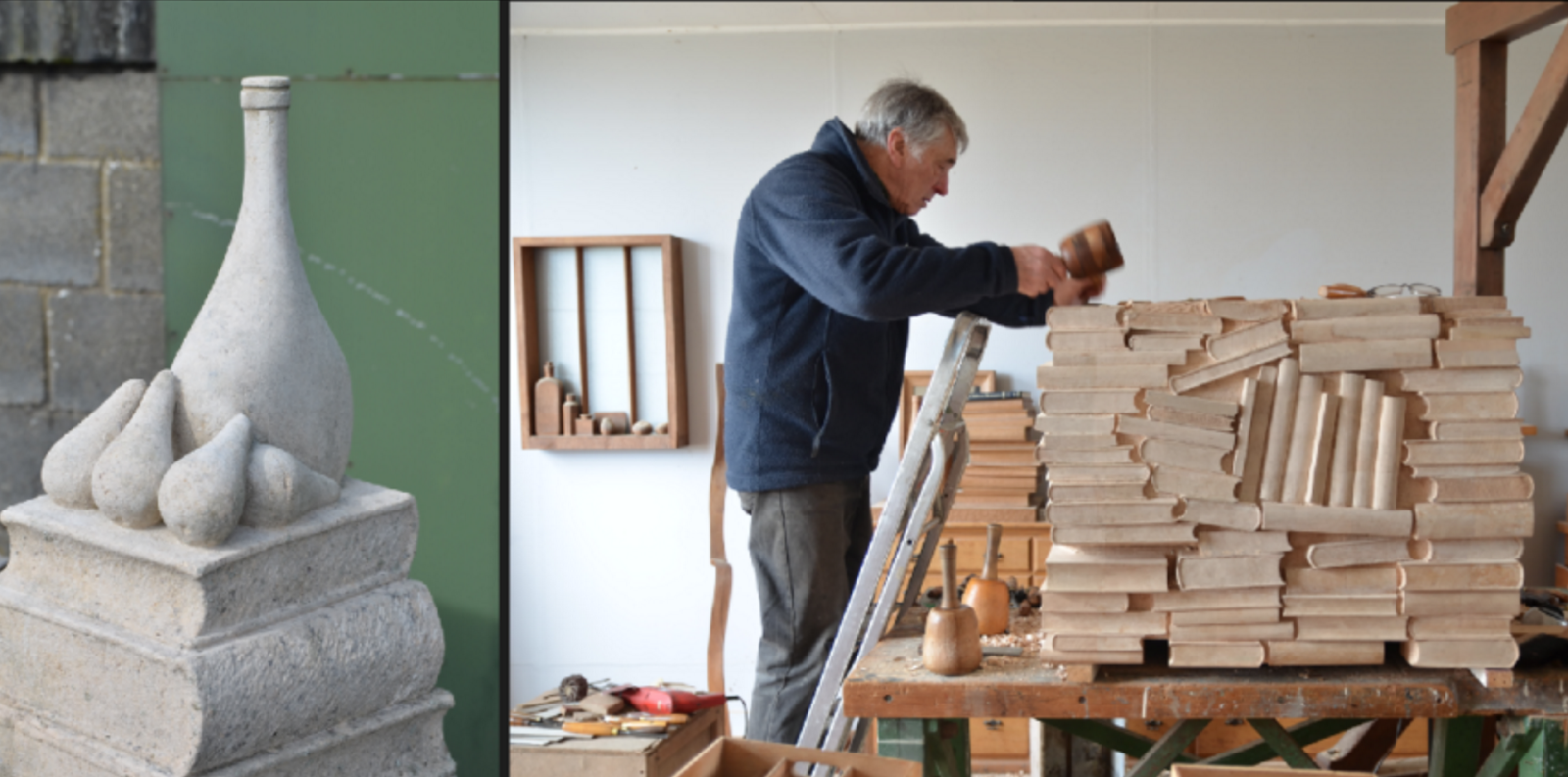
Fred Watson has 5 stone carvings in the gardens at Cheeseburn and his exhibition at Cheeseburn’s Stables Gallery in July 2017 aims to showcase his fine still life carvings in wood.


Fred has worked for many years from a large studio in rural Northumberland where he has built a strong reputation for thoughtful carvings, producing gallery pieces in wood and in stone for public commissions.

“I find a complicity between Still Life and the practice of carving. Time is the essence of them both. The long, patient, solitary practice of carving reflects the long, silent indifference of the objects. Stone and Wood belong to time. Many of my tools have been used by generations of craftsmen. Carving is a rewarding solitude, which is what impels my work. I carve the most ordinary of objects because the ordinary is rich enough. Familiar objects that can be moved at will become fixed in a timeless matrix.


Still Life is common in painting but not in sculpture. Carving creates a dialogue between form and function and when ordinary objects are rendered in wood or stone they assume a different reality. The sculpture becomes distanced from the objects it represents, which become more remote, secluded and potentially meaningful.”
Fred Watson

http://cheeseburn.com/events/fred-watson/

Looking forward to Cheeseburn this weekend

I am working at the July Open Weekends at Cheeseburn Sculpture, and I'm looking forward to seeing the new exhibitions that will be on in the gallery and the Stables project space.


Cheeseburn Stables Gallery - Fred Watson


Fred Watson has 5 stone carvings in the gardens at Cheeseburn and his exhibition at Cheeseburn’s Stables Gallery in July 2017 aims to showcase his fine still life carvings in wood.


Lost Voices; A Sound Installation by Bennett Hogg, using reconstructions by Magnus Williamson, of missing voice parts from sixteenth Century Church Music. 

There will, of course, also be the opportunity to see the permanent collection of sculptures within the gardens, Tyne Bridge Hinge by Alexander Devereux and Scurry by Dan Gough.

For more information please visit


Wednesday, 28 June 2017

Primal Speech by Liz Magic Laser at Jupiter Artland

PRIMAL SPEECH

Liz Magic Laser
Primal Speech, an immersive mixed media installation produced by Brooklyn, NY based artist Liz Magic Laser is currently being exhibited in the Tin Roof Gallery at Jupiter Artland.

Before entering the gallery, visitors are asked to remove their shoes. The gallery has been transformed into "Laser’s futuristic version of a primal scream room with soft grey padded walls and therapeutic devices such as punching pillows and a screaming vase. The artist has created sculptural pillows that reflect regional political emblems and for the installation at Jupiter Artland the collection includes symbols for the Scottish National Party’s thistle, Scottish Labour Party’s rose and the Scottish Liberal Democrat’s bird of liberty."


Laser’s therapeutic video and environment guide viewers to express and exorcise their sociopolitical and personal frustrations. For the video, Laser assembled a pseudo therapy group composed of actors with opposing political convictions about Brexit and the upcoming U.S. presidential election. The artist encouraged them to revisit and conflate childhood traumas with their current political frustrations. Laser collaborated with Certified Professional Life Coach, Valerie Bell, trained in Primal Therapy techniques, to elicit connections between traumatic experience and political beliefs."


I felt that the work has the potential to be much more open and expansive, but because the video specifically focuses on Brexit and the U.S. presidential election, it is restricted in its scope. For reasons I am yet to fully identify and understand, there was a rather negative tone to the work, and I came out feeling as though I had been made to feel angry about something defined by someone else (i.e. Trump and the current Brexit situation). Don't get me wrong, I do not think favourably of either Trump or the decision for the UK to leave the EU, but I felt channeled and free from thinking about other situations that 'are bothering me', and therefore felt frustrated that I had not been encouraged to bring my own direction to the work. 

Tuesday, 27 June 2017

Jupiter Artland

At the weekend I visited Jupiter Artland, a sculpture park and art gallery in the grounds of Bonnington House, a 19th-century country house near Edinburgh.

"Visitors to Jupiter Artland are given a map indicating the location of the artworks within the grounds. But there's no set route. Clockwise or anticlockwise is your choice, as is the retracing of steps for a second look. The artworks are land marks, events, confrontations on a journey of discovery; an open-ended journey."


Although there are a few artworks situated indoors, the vast majority are outside, and so it really is a place to be visited in good weather. There is plenty to see, and it is easy to spend 2-3hours wandering round the artworks. Even the cafe is filled with art. It was recently extended and transformed by artist Nicholas Party, into Cafe Party. 


CAFE PARTY

Nicolas Party

"Cafe Party features decorative wall painting, hand painted tables, custom designed furniture, servery and screen printed crockery. Party’s work examines classical genres and motifs explored throughout art history and painting such as still life and portraiture as well as how these are presented. The expansive mural acts as a framing device and a fantastical stage set for a series of pastel compositions delivered in Party’s unique aesthetic language.

The wall murals also tie to the artist interest in art history which are often executed in styles that retaining parameters by honouring traditional processes and materials. Recently this has expanded into the use of trope l’oiel which is used throughout Café Party in the malachite surfaces.

CAFE PARTY

Nicolas Party

Through Party’s distinctive paintings and drawings Café Party directly responds to the surrounding woodland of Jupiter Artland, borrowing imagery from the landscape to furnish the restaurant and the vibrancy of the collection is celebrated in the vivid colour palette. Patters repeat throughout with tropical shrubbery that line the foreground, whilst clashing skinny twigs and wall climbers reach for the light overall producing a fantastical, almost psychedelic scene."

In future blog posts I will give more details about a selection of the artworks, but here are a few photos to give you a taster of what there is to see.

A FOREST

Jim Lambie

A FOREST

Jim Lambie


CELLS OF LIFE 
Charles Jencks


THE LIGHT POURS OUT OF ME

Anya Gallaccio


ANIMITAS

Christian Boltanski


SARA BARKER

Separation in the Evening (a celestial blossom before the yellow house)


WEEPING GIRLS

Laura Ford


OVER HERE

Shane Waltener


BRENNER

Michael Sailstorfer


YOU IMAGINE WHAT YOU DESIRE

Nathan Coley


https://www.jupiterartland.org/

https://www.visitscotland.com/info/see-do/jupiter-artland-p245431