Thursday, 6 November 2014

Visit to The Mining Institute and Lit and Phil Society

As part of our Professional Practice or Exhibition module, this morning we went to visit The Mining Institute and The Literary & Philosophical Society (Lit & Phil). Both of these could be potential venues for our group exhibition which will take place at the beginning of next year.

"The North of England Institute of Mining and Mechanical Engineers is often abbreviated to “the Mining Institute”.


The Mining Institute owns one of the finest buildings in Newcastle, Neville Hall, a Victorian building built at the time when high-Gothic architecture was coming into fashion. The outside of the building is known to hundreds of thousands of people, it is next to the Central Station, but few people realise what is inside. Neville Hall houses the memorial to the Institute's first President, Nicholas Wood, an outstanding Victorian Library resplendent filled with superb stonework, redolent with exquisite carved stone, wood and paintings with a beautifully decorated ceiling, a vast glass roof and filled with furniture designed for the library in 1872. Below the Library is the Edwardian Lecture Theatre, modeled on the Royal Institution in London and constructed in deep red Cuban Mahogany."


The librarian was ever so helpful and was enthusiastic about working with Art students from the University. She mentioned that the building had been used in the past for exhibitions and once a circus had a trapeze in the library.

We then went to The Literary & Philosophical Society (Lit & Phil); the largest independent library outside London, housing over 150,000 books. A wide selection of current fiction and non-fiction can be found alongside historical collections covering every field of interest.


The music library is without equal in the North of England, including 8,000 CDs and 10,000 LPs.

The Grade II* listed building was opened in 1825 and the magnificent reading rooms remain largely unchanged. The collection is coupled with an extensive set of periodicals.

When thinking about making work in such loaded spaces, I have a feeling of dread as I feel as though there are already so many existing things of interest in the building, that I feel as though my work would be overlooked, and question whether it would have a meaningful presence. 

One way of tackling this would be to create an event in which something happens, emphasising the qualities of the space, or drawing upon what happens in the space.

For example, Irene told me that the Lit and Phil society used to hold events called 'The Philosophical Table' at which members of the Lit and Phil would discuss ideas. The only topics which were banned were religion and politics. Unfortunately these discussions no longer happen, and one idea that I have is to reinstate them. I would want to add my own take on the 'Philosophers Table', in order to differentiate it from what used to happen.

I was taken by the fairly large group of readers who were sat eating their sandwiches whilst reading books and chatting as a group. There was a little kitchenette in the library at which one could purchase tea, coffee and biscuits, creating a warm, welcoming atmosphere. I imagine that there is a regular group of individuals who spend hours in the library, and it could be interesting to hear about their lives and experience of the library.

Perhaps I could hold a 'Philosophers Table' event at which members are invited to talk about one book in the library that particularly interests them. Rather like a show and tell event, this could be a great way of getting to know both the individuals and the content of the library.

Playing with bricks


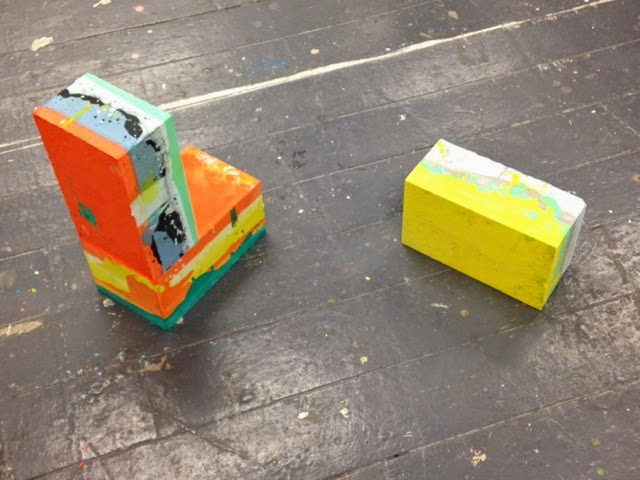
I do not regard the singular brick forms as finished, and have a number of ways that I want to change them and work with them. Although they are still too wet to carve into, saw or polish, they are ok to be moved around and so I can play with how they are placed.


Hovering above the floor


Monday, 3 November 2014

BBC Radio 3's Free Thinking at Sage Gateshead

The Limits of Knowledge - Radio 3's Festival of ideas at the Sage Gateshead


With so many options of interesting events to go to as part of the Festival of Ideas programme at The Sage, Gateshead, I initially decided to choose one that would give me an insight into many of the 'thinkers' of today. 

Listed as, 'Speed Dating' with New Generation Thinkers, the programme took the format of a speed dating night. There were 8 tables, at which 8 thinkers were sat, one at each table. Audience members were asked to sit at a table with a 'New Generation Thinker', so all of the thinkers had at least one member of the audience to converse with. The thinker was given 1 minute to explain their idea to the member(s) of the audience sat with them at the table. A noise was made to signal the end of the first minute, and then the audience were given 2 minutes to ask questions to the thinker about their idea. The beat of a drum signalled the end of the allotted time, and then the audience were asked to move in an anti-clockwise direction to the next table where the same process happened. We made our way round the 8 tables, and at the end had to vote for the thinker that we believed had the best idea. It was a really interesting exercise, and there were a varied collection of ideas. Here they are (in the order that I encountered them in):


1. Alasdair Cochrane - get rid of predators

2. Tiffany Watt-Smith - get rid of the term love, and break it down into its 6 constituent parts like the ancient greeks:
Eros, or sexual passion
Philia, or deep friendship
Ludus, or playful love
Agape, or love for everyone
Pragma, or longstanding love
Philautia, or love of the self
The rationale behind this idea is that there would be more love if we accepted or recognised love in all these parts rather than focusing purely on romantic love, and the notion that if you are single, it means there is something wrong with you.

3. Tom Charlton - Books on bikes (a mobile library)

4. Alun Withey - re-introduce public humiliation as a form of punishment i.e. criminals have to make a public apology to the masses

5. Will Abberley - get rid of all rules of English spelling so that misspelled words are not frowned upon, but merely seen as a creative way of spelling a given word. 

6. Naomi Paxton - give a free moon cup and training on how to use it to every female adolescent

7. Preti Taneja - ban public funding being spent on exporting Shakespeare as an English cultural icon, and allow other countries to have their own interpretation of the Shakespeare text

8. Jo Cohen - teach children manners in primary schools


More casts revealed


Saturday, 1 November 2014

Artists Union England AGM

Today I attended the 1st Artists Union England (AUE) AGM, held in the Fine Art Lecture Theatre at Newcastle University.

I recently became a member having moved to England, and am excited to be part of this very important union. It was lovely to meet such a committed group of artists from all over the UK.

There are currently over 500 AUE members, but this is continually increasing and the power of the union will grow with more members, so please do sign up if you are not already a member!

Emily Porter delivered an inspiring and breathtaking presentation about how she set up a union in Iraq. Sadly it became of Saddam's regime.

A number of motions were proposed and agreed, and then reports were given from the various working groups already established.

Current issues that are being raised in the working groups include

The impact of Universal Credit on artists
Student membership and membership criteria to join AUE
Rates of pay
Ageism in the Arts
Conditions of Studios

The event closed with Wajid Jussain giving a wonderful performance of his own poem, It is What We Do

Lots to get our teeth into, but with more members we will have more effect, so please read more and sign up for only £30 per year.

http://www.artistsunionengland.org.uk


Thursday, 30 October 2014

Art Lending Library on tour

Today I took part in the launch of the Art Lending Library in Peterlee, East Durham.


The Art Lending Library is a project by 
Market Gallery and Walker & Bromwich.


The ambitious commission by Zoë Walker and Neil Bromwich takes the form of an experimental library and public procession. Originally conceived and curated by Market Gallery for Glasgow International Festival of Visual Art 2012, it provides the unique opportunity for the people of the town or city in which it is exhibited to borrow works of art and enjoy them within their homes, work places and community centres.

The Art Lending Library brings together over 50 works by a diverse range of artists working across the broad spectrum of formats available within contemporary visual arts practice. The project has been made possible through the generosity of participating artists in gifting their works into the care of the library, to be made available to loan for the duration of the exhibition.


The library structure is made up of multi-functional wooden crates. Each crate houses an artwork and is detachable and ready for transport to people's homes. On returning to the library the crate is re-attached to the body of the library and again operates as a display case. This modular design creates a constantly changing sculptural form that maps the user's borrowing. As people borrow or return an artwork they will also physically shape the library, becoming a part of an on going social sculpture.

The project stands in resistance to the tide of narrowing access to the arts and education by creating an egalitarian space where art can be borrowed and enjoyed by all sectors of society. Art Lending Library follows the model of a public lending library which members of the public can join free of charge.


Following its success in Glasgow, the Art Lending Library is going on tour, and today it was launched in as part of the inaugural East Durham Creates Festival. Here are the details:

Peterlee
Peterlee Memorial Methodist Church 29 Oct – 1 Nov 2014

Thornley
Thornley Village Centre 7 – 10 Nov 2014

South Hetton
Robin Todd Centre, South Hetton 13 – 16 Nov 2014

Artworks from artists based in Durham have been chosen for the Art Lending Library in this venue.

Artists that have been exhibited in Art Lending Library include Penkiln Burn, Graham Fagen, Joanne Tatham and Tom O'Sullivan, Mark Vernon, Ellie Harrison, Katie Cuddon, Henna Rikka Halonen, Oliver Braid, Elpida Hadzi-Vasileva, Mark McGowan, Karen Guthrie and Nina Pope, James McLardy, Stephen Hurrel, Alec Finlay, Laura Eldret, Calum Stirling, Andrew Burton, Laura Aldridge, David Sherry, Chris Biddlecombe, Stuart Murray, David Faithfull, Yu-Chen Wang, Jonathan Owen, Nick Fox, Andros Semieko, Kate V Robertson, Peter Evans, Beagles and Ramsay, Jemima Brown, Ally Wallace, Dean Hughes, Fernando Arias, Salome Oggenfuss, Roos Dijkhuizen, Kevin Hunt, Clara Ursitti, Tessa Lynch, Helen De Main, Sandy Grant, Jasmina Cibic, Pilvi Takala, Razan Akermay, Rachel Maclean, Pester & Rossi, James Stephen Wright, Romany Dear, Jacqueline Donachie and Roddy Buchanan, Tim Savage, Ciara Phillips, Catrin Jeans, Chris Mackenzie, Ross Frew, Ewan Manson, Rachel Barron, Sarah Laing, John Vella, Tom Nolan, Kate Murphy, Deborah Kelly, Michael Needham, Ashley McCormick, Annie O'Donnell, Dryden Goodwin, Gayle Chong Kwan, Iacopo Seri, Juan Pablo Echeverri, Margaret Harrison, Nick Kennedy, Nicky Peacock, Kraig Wilson

Designers Sophie Dyer & Sebastian Gorton Kalvik continue to deliver the design work for Art Lending Library.

The project is accompanied by a programme of free participatory events that are open to everyone.


Being involved in the parade was a really positive, fun and moving experience. A group of students from the Fine Art department at Newcastle University volunteered, and we were kitted out with librarian and art-handler outfits. The procession took us from the Methodist Church where the library is based, along the High Street and through the local shopping centre, leading back to the church.


Some of us were carrying flags, there was an art handler carrying an artwork which was then handed over to a librarian, other librarians were using the crates as drums, and we were handing out the Art Lending Library cards. An excellent brass band brought up the rear of the parade and added a crucial tuneful element to the memorable event.


Having seen the Art Lending Library in Glasgow, back in 2012, I was very keen to be involved in it here, and the experience truly enhanced my appreciation of this wonderful participatory artwork.

Walking down the grim, grey High Street lined by shops to let, value shops and bookies could have been a rather depressing experience, but the Art Lending Library brought a cheer to the streets and it was amazing to witness the light that people had in their eyes when we passed.

I gave a couple of lads some library cards, and a moment later they were helping hand out a bundle of these cards to others as they walked with us to the church.

Already there have been 4 items loaned out of the library, hopefully a sign of things to come.

At the briefing we were given some rather startling figures about the lack of arts and culture provision in this area, and I really hope that having such high quality artwork in Peterlee gives the community a sense of what contemporary art is and can be, and helps create a curiosity and desire for more.

For more information please visit
http://www.artlendinglibrary.org.uk/about/east-durham/

Visiting Artist Lecture - Stephen Hurrell

This week's Visiting Artists Lecture was given by Glasgow-based artist, Stephen Hurrel.


Tuesday, 28 October 2014

Erratic Landscapes by Matthew Smith at Vane

For his second solo exhibition at Vane, Matthew Smith has conceived a multi-layered landscape of works, a hybrid of the manmade and natural environment that examines the intersections between these two polarities.


The series of Corporate Landscape drawings, shown here together for the first time, are made up of various actual corporate logos that depict snow-capped mountains. These images are regularly deployed in advertising to connote ruggedness, nature and immovable permanence, in order to sell us all manner of products from financial services to chocolate. The drawings link together individual logos to create a graphic mountain range, a horizon line, a synthetic topography that rises and falls creating its own peaks, valleys and ravines. Reminiscent of a graph plotting the financial progress of a business or the stock market, they become a metaphor of the corporate world.


The ‘Erratic Landscape’ sculptures are placed as if randomly scattered throughout the gallery, a series of boulder-like objects constructed from bits and pieces of chipboard. The faceted forms created are reminiscent of the abstracted rock shapes that might be seen in one’s peripheral vision in a computer game. A rough, pixilated abstraction, convenient shorthand to denote terrain, they never pretend to be anything but abstracted approximations, hollow copies. Each surface of the sculptures is a different shade of grey, thus the forms are not easily resolved from a single viewpoint; the viewer pieces them together by moving around them. In geology ‘erratic’ is a term for a stone transported by a glacier and deposited far from its point of origin: an object profoundly out of place. In a similar way these erratic forms are deposited within the space of the gallery, a counterfeit sculptural landscape for the viewer to negotiate.


In the series of Cloud drawings Smith again uses corporate logos, this time depicting cartoon-like fluffy clouds. These logos represent various companies – mainly in the field of computer technology – mostly offering to store information in ‘clouds’. Through the simple use of the word ‘cloud’ in conjunction with the image, we are encouraged to think of our information and documents as ethereal, not having any physical presence. However, this information is physically supported on servers housed in large warehouses consuming enormous amounts of energy to the detriment of the environment.


Made using hundreds of different cloud logos that are repeatedly traced in graphite, the faint lines overlapping and gradually building up a looming cloud of information, Smith’s drawings are not immediately recognisable as simple archetypal trademark images. This makes the finished drawings much more akin to a real cloud: an amorphous form in a constant state of flux.


Smith carefully layers together these bodies of work, immersing the viewer in a landscape of representation, a terrain to be negotiated both physically and conceptually.

http://vane.org.uk/erratic-landscapes

Lithography workshop

Today I had an introduction to aluminium lithography, a new process for me.

"Lithography, 
planographic printing process that makes use of the immiscibility of grease and water.

In the lithographic process, ink is applied to a grease-treated image on the flat printing surface; nonimage (blank) areas, which hold moisture, repel the lithographic ink. This inked surface is then printed—either directly on paper, by means of a special press (as in most fine-art printmaking), or onto a rubber cylinder (as in commercial printing)."

http://www.britannica.com/EBchecked/topic/343748/lithography

I applied pencil crayons, marker pens, cut up pieces of card and cut up pieces of tracing paper onto a shape that I had torn from tracing paper.


Lithography plate prior to inking or printing

I then exposed this imagery onto the aluminium plate, and printed the plate using the offset press.


Lithography plate after inking


My first lithographs