Friday, 19 July 2013

Rana Begum

I enjoy discovering new artists, and love it when friends recommend an artist to investigate.

Here's one artist that Sukaina recently came across:

 http://www.ranabegum.com/


Thursday, 18 July 2013

Seasonal colours

Just as the gloriously sunny and warm weather makes me feel happy, the bright colours of the blooming plants also make me cheerful.

As I was walking through Kelvingrove Park today, I admired the beautiful combination of colours and plants, and thought about how planting could almost be compared to making a sculpture, thinking about the interaction of colours, forms, shapes, height, and where the viewer will be positioned when looking at the plants.


Monday, 15 July 2013

Drying yarn

I rinsed all of the plant debris out of my yarn samples, and then hung them up to dry in my studio window.

The colour stayed in most of the yarns, but the pattern and colour made from using beetroot did not remain in the silk.


Sunday, 14 July 2013

Fabric dyeing at the Whisky Bond

Coinciding with the opening of the new exhibition, Liquid Assets, by Danish artist Nina Beier, Glasgow Sculpture Studios had programmed a range of artist-led workshops. I was delighted to get a place on the Fabric Dyeing workshop, lead by textile practitioner Kathy Beckett.

I had no idea what to expect, and thought it would be a great opportunity to learn about something I had never done before.

Kathy is an avid colourist, and the interaction / psychology of colour has always been intrinsic to her work as a textile practitioner. Recently she has been learning about the impact that the production of colour can have on our environment. One of her particular concerns is the need for ecodesign. She hopes to encourage other designers, artists and creative practitioners to be aware that their choices have consequences and that they can be and are part of the universal need for a more ecological economy. Her blog, www.colour-ecology.co.uk gives more information on this work, and her website http://cargocollective.com/kathybeckettdesign covers all aspects of her textile practice.


We learned about natural methods of dyeing fabric. A variety of yarns were provided, and we made hanks from these. We then mordanted the hanks so that the dyes take to the fabric.


Kathy had foraged a variety of plants from the local area from which we could dye the yarns. We used meadowsweet, ragwort, ivy, comfrey and cow parsley. The plants were added to boiling water, simmered, and the yarns were added into the pans, and left.


We also did some cold dyeing, using beetroot and cabbage.


We wrapped silk round wooden blocks, and then  wrapped yarn around the silk.


These were dipped into the beetroot/cabbage liquid and left for a while before removing and washing under cold water. The yarn was removed and silk opened out to reveal the unique patterns made on the fabric.

Even though we did not have much time to leave the fabric in the dyes, I was surprised at how vibrant the colours of the fabric were.

It was a really enjoyable couple of hours, and something I would like to do more of.

Friday, 12 July 2013

New magazine to look at interns within the creative industries

I have mixed feelings about internships within the Creative Industries.

The Summer after graduating from from Glasgow School of Art with a first class Hons Degree, was spent job hunting. Job hunting is a full time job in itself and my thoughts go out to everyone who is job hunting at the moment as it is an utterly tedious, demoralising and time-consuming task.

After months of searching, I was fortunate enough to be chosen for an internship at Glasgow Sculpture Studios. The internship was managed by Project Scotland, an organisation that provided a range of internship opportunities in different fields.

The internship lasted 6 months, and I worked 4 full days per week. I was paid £55 per week from Project Scotland (equivalent to job seekers allowance at the time).

I strongly believe that the internship helped me in many ways, and I do not think I would have got to where I am today without that experience. However, I also remember how much of a struggle it was to survive financially. Having just graduated, I needed to earn in order to be able to pay the rent and stay in Glasgow. I got an evening and weekend job whilst working at GSS, and so was pretty much working 7 days a week, leaving my flat at 8:30am and not getting back until after 10pm.

I am concerned that interns are being used as 'free staff', and that it is almost expected of Art graduates to undertake an internship before they are considered for paid work.

Alec Dudson is launching a publication tackling this inflammatory issue.

http://www.itsnicethat.com/articles/intern-magazine


Monday, 8 July 2013

Silt

The annual Transmission Summer exhibition gives each member the opportunity to exhibit a piece of work in the gallery.

As with most other members exhibitions of this kind, one never really knows how the works will sit with each other, and creating a sense of cohesion is incredibly difficult given the unpredictability of what members choose to present.

I decided to take the opportunity to exhibit one of the pieces that I made while on my residency at Market, but changed the way it is displayed.


Sunday, 7 July 2013

New Wave - A Collaborative Installation by Janie Nicoll at The Old Hairdressers

In her current exhibition at The Old Hairdressers, Janie Nicoll is inviting visitors to add to the installation by sharing a word or sentence that relates to 'Angst'.

Over the past few days, Janie and Rachel have been sticking newspaper cuttings and extracts from magazines onto the wall of The Old Hairdressers, creating a wave design.

This process was captured in a stop motion animation.

Now it is up to visitors to the exhibition to continue developing the work.


'New Wave - What's On your Mind?'
A Collaborative Installation 
by Janie Nicoll at The Old Hairdressers, Stereo, Renfield Lane, Glasgow G2 6PH.  


Drop in daily 2-4pm 4th-11th July 2013.
 
Opening Event 7-9pm, Saturday 6th July, 

Performance with Harry Wilson, 8pm, Closing event 7-9pm , 11th July, ALL WELCOME.

Visual Artist Janie Nicoll will be creating a large scale evolving collaborative installation from 3rd - 11th July at the Old Hairdressers, Stereo, Glasgow.

Using Hokusai's "Wave" as a starting point, combining paint and assemblage, she will be inviting artists and the public to contribute text, image or objects on the theme of 'Angst', to a wall sized installation. Contributions will be added into the installation over the course of the week in a large scale public outpouring, and will contribute to a closing event in collaboration with sound artist Harry Wilson, on Thursday 11th July.

Nicoll uses spontaneity, interaction, and collaboration as a working method while building on recent collaborative residencies in the form of a Rough Mix Residency at Tramway, for Magnetic North Theatre Company and a CCA Creative Lab for Counterflows Music Festival, with experimental Sound Artist Annette Krebs.

Saturday, 6 July 2013

AT LAND - AN EXHIBITION OF CONTEMPORARY SCOTTISH URBAN LANDSCAPE PAINTING, Market Gallery

In the last few months since my residency and exhibition at Market Gallery, the committee have been busy sprucing up the gallery spaces, and effort that fully paid off for the current exhibition, AT LAND, which opened tonight.

It was unusual to see all three galleries being used for a single exhibition, and to see the spaces being used in different ways. For instance up until my residency, I had only ever seen video works being presented in gallery 3, and so it was refreshing for some other types of work to occupy the space.

I thought that the paintings chosen worked very well against the breezeblocks, and it was fascinating to see a range of artists work throughout their career, from recent graduates, to mid-career artists and established artists.


.
AT LAND:

AN EXHIBITION OF CONTEMPORARY
SCOTTISH URBAN LANDSCAPE PAINTING

MARKET GALLERY, GLASGOW
6TH OF JULY – 16TH OF AUGUST 2013
OPENING 5TH OF JULY 6-9PM

In landscape, one searches for memory. One searches for the traces that connect the familiar with the visible, moulding and making palpable the interstice between our own locality and the distant place.

- Sinead Dunn, July 2013
Market Gallery presents the exhibition AT LAND this summer, a survey exhibition presenting paintings by artists who depict a view of urban life in Scotland through the genre of the Urban Landscape. AT LAND will exhibit ten artists’ paintings that explore ways in which the inhabitants of Scotland occupy and populate the built environment, interact within communities and exist within local industries.
AT LAND will display paintings by: Steven Campbell, Aimi Ferrier, Helen Flockhart, Marianne Greated, Mabel Halliday, Katrin Jaberg, Lindsey Mclean, Carol Rhodes, Alastair Strachan and Mary Wintour. Presenting a varied approach to style, method, composition and genre within the history and tradition of painting, this exhibition will map ten artists’ view of urban life in Scotland today in a time of political, economic, cultural and social transition.
AT LAND will be a unique opportunity for visitors and locals to view paintings by a carefully chosen variety of emerging, mid-career and established painters, whose work responds to urban life and the landscape of Scotland in a non-white cube gallery space in the East End of Glasgow.

Opening Times: Thursday - Sunday 11am - 5pm

Market Gallery
334 Duke Street
Glasgow
G31 1QZ

This exhibition is supported by Glasgow City Council, Glasgow Life, Creative Scotland and The Steven Campbell Trust.

Thursday, 4 July 2013

Creative Lab and Centre for Modern Thought Public Seminar: Creative Work

My role of Project Researcher for the Higher Education Academy funded project, Anatomy of Employability, at Glasgow School of Art has resulted in me meeting lots of very interesting people. Today was no exception. I met with Jen Clarke who is working with the Scottish Government to investigate the nature of creativity within education. She would like to refer to the research that I have been carrying out, and so we met to discuss the findings.


Jen is involved in a workshop to be held at the CCA on Saturday 13th July 2013 from 1pm-4pm.

As part of Echo Chamber's Creative Lab Residency, this workshop will explore philosophical and critical questions around “creative work”.

Engaging with cultural policy and research, we will examine how creative work is variously understood by artists, academics, and government, opening out to a conversation with the workshop participants. What is at stake when creative work is approached in terms of either innovation or improvisation? What is the difference between work and labour? Is collaboration necessarily creative? Working away from economic frameworks for art and research, we move towards “creative work” understood in terms of our relations with others.

The event brings together policy makers from the Scottish Government, artists, researchers and the public to confront questions at stake in the cultural and public sector amidst the noise of artists experimenting in the Creative Lab with visiting guest Alana Jelinek.
This event is a collaboration between CCA Creative Lab Residency and Centre for Modern Thought, Aberdeen.

Tuesday, 2 July 2013

Visual Arts Glasgow

Visual Arts Glasgow is a new mobile-responsive webspace for Glasgow’s visual arts, launched today by Culture Sparks. The press release below provides full information about the new webspace, its features and its purpose.

PRESS INFORMATION
For immediate release: 1 July 2013
 
Mobile social media image aggregator brings Glasgow’s museums & galleries to life
Launched today, Visual Arts Glasgow (http://visualartsglasgow.co.uk/) is a new mobile-responsive webspace that draws together the exhibitions, commentary and other stories from Glasgow’s vibrant visual arts scene, providing an image-led portal where tourists and locals can engage with visual arts news and events on the move.
Drawing Facebook, twitter, YouTube and vimeo content direct from over 40 museums, festivals, galleries and studios across the city, the new space aggregates the images and film clips that the organisations share through social media to create a constantly updated feed of visual content. From major destinations on the tourist circuit, like Kelvingrove Art Gallery & Museum, The Hunterian or The Burrell Collection, to lesser-known gems such as the Virginia Gallery, Mary Mary or Project Ability, the site sets the city’s visual arts destinations on an equal footing with each organisation’s profile defined exclusively by the style and extent of its social media activity. A dedicated hashtag, #VisArt, allows multi-arts venues to contribute images to the live stream, showcasing the full scope and variety of every genre of Glasgow’s thriving visual arts.
“The site makes you feel like you really are in that organisation’s space. So The Lighthouse profile page feels like The Lighthouse; the Riverside Museum feels like the Riverside; each organisation’s page is uniquely its own, whilst the homepage presents visitors with a rich fusion of the full spectrum of visual arts activity taking place across the city and extends the life of their social media content.”
Dianne Greig, Culture Sparks (WhiteNOISE project leader).
With an emphasis on connecting visual arts organisations directly with their online audiences, the site provides each organisation with a dedicated profile page that draws together its own Facebook, twitter, YouTube and vimeo content, alongside a short introduction, logo, profile picture and location map. Visitors can like, share, retweet and favourite content without leaving the webspace, or navigate directly from any post to the social media stream from which it originated to interact directly with Glasgow’s galleries, museums and studios. All interactions will be closely tracked, to create an unique and groundbreaking insight into the activity and interests of the online audience for Glasgow’s visual arts.
Designed with mobile technology in mind, the webspace is optimised for browsing on the move via smart phone or tablet (iOS and android compatible), and is equally accessible via desktop. Intuitive touch-screen navigation and a simple site structure provide a seamless user experience that brings the city’s art scene to life, setting original imagery alongside news, commentary and visitor opportunities.
Visual Arts Glasgow has been developed as part of WhiteNOISE, a Creative Scotland-funded project to define and grow audiences for the visual arts in Glasgow. Designed and developed by Culture Sparks, the WhiteNOISE project launched in 2012 with a major research phase that wove together findings from over 1,500 visitor interviews with in-depth feedback from representatives of visual arts communities; data drawn from digital and social media sources and detailed demographic information, to create an unique overview of Glasgow’s visual arts audience and the issues associated with growing it.
The Visual Arts Glasgow website responds directly to collective issues raised through the WhiteNOISE research phase, providing a portal through which visual arts organisations will connect directly with local audiences and cultural tourists.
 
- ENDS -

Saturday, 29 June 2013

PRISMISM - Transmission Gallery

PRISMISM

Transmission Annual Members Show

Preview 29th June 2013

6-9pm

Exhibition runs 2nd - 27th July

Tues - Sat

11am - 5pm

www.transmissiongallery.org


Friday, 28 June 2013

I can see my studio floor again!

Since destalling my exhibition from the Market Gallery, I have barely been able to move in my Studio due to the amount of artwork and materials that I have had to store there. Some of the sculptures have been installed in other exhibitions, giving me a bit more space, but in order to be able to do more casting in the studio, I needed to clear a large space on the floor.

Over the last few weeks I have gradually been sorting through what I could throw away, what I need in my studio, and what I could move into storage, both in Glasgow and in Yorkshire (courtesy of my Granny's garage!)

This afternoon Andy and Emma helped me load up their car with things to be taken to the dump, and then we had a major re-organisation of my storage space. We pulled out the sculptures that I will take to Yorkshire for storing, left them in a relatively easy place to be collected soon, and then we moved lots from my studio into the storage facility that we just emptied.


Thankfully, after all the hard work, my studio is looking much clearer now and I will be able to start casting again.

Watch this space...

Tuesday, 25 June 2013

What are artists really worth? Funding, friction and the future of art


As artists find themselves at the end of the cultural food chain, Susan Jones suggests a new activism to reaffirm their status

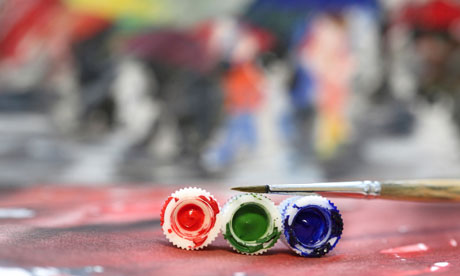
Three coloured tubes of acrylic paint 
 

The so-called golden age of arts funding has given way to debilitating austerity, particularly for artists who find themselves at the end of a long food chain, divorced from arts funding and policy decision making. But when did these divisions start and how can artists use activism to create meaningful change for the future?

The millennium saw arts funding increased through imaginative strategies and policies. Artists and the artist-led flourished. With the lottery-financed arts buildings came a new wave of curatorial positions – and in 2006, the advent of cultural leadership roles designed to "nurture and develop dynamic and diverse leaders to equip them for the challenges of the 21st century" (although scant few of these went to practitioners). Divisions between artists and the public were apparent too.

In 2013, the widening divide between rich and poor is manifesting itself clearly in the arts. Contributing to debates on more imaginative ways to measure cultural value, Louis Barrabas says: "The creative sector is full of scuttling scavenging bottom-feeders." What he's describing are the middle people whose infrastructural preferences over recent years have by default resulted in a steady nibbling away at budgets, resources and recognition factors – things that used to be the territory of artists.

In the arts infrastructure developed since the early noughties, artists weren't invited around the table with the curators, directors and consultants. Peer review was abandoned by Arts Council England as it was deemed too expensive, long-winded and subjective. In the arts ecology of today, it's almost as if artists have to be held in suspended animation, waiting for someone to need them.

Where has all the money gone?

In 1989 the salary of an artform officer in what was then a regional arts association pretty much matched the sum offered for an artist's fellowship, which in those days tended to be for a year. By 2004, the salaries of arts officers in the funding system (when index-linked) were 41% higher than those in 1989/90. Advertised in May 2013, an Arts Council England salary for a relationship manager in its London office is £31,623 – 8% higher than the equivalent pay in 2004 when index-linked. Consider this against an example of an artist's fellowship, such as the Stanley Picker Fellowship in Design & Fine Art 2013, which is paying £12,000.

Published in May 2013, Arts Council England's economic impact report by the Centre for Economics and Business Research shows that full-time earnings in the arts have risen by 6.8% in the past five years, while part-time earnings – one might surmise these to include freelancers and artists – have decreased by 5.3%. As Mark Robinson, a former ACE director and now arts consultant, asks: "Are we squeezing our key nutrients – the artists and creative freelancers – and widening inequality in our own sector?"

Our own a-n research indicated that in 2004, the exhibition fee for artists holding a solo exhibition in a major gallery was £1,000. In 2013, a new survey from AIR indicates that less than a third of artists exhibiting in publicly-funded flagship galleries in Arts Council portfolios are getting any fee at all – with £200 being the most likely figure. While the majority want to share their work with the public, nearly half the artists surveyed reported that it's simply too expensive to exhibit.

Another of our surveys, this time on openly offered jobs and opportunities for artists in 2012, revealed a steady decline in the volume of paid work for artists. In 2012, the overall value of work on offer to artists was £5m (20%) less than in the pre-recession year of 2007. Only 39% of jobs and opportunities in 2012 offered to pay anything to artists, in comparison with 57% in the recession year of 2008. And the value of residencies has dropped to an all time low, amounting to just over 1% of the value of all work offered in 2012. These paid an average fee of £2,600, in contrast to a £7,354 average in 2011 and £6,342 in 2007.

Art feeds the soul but who feeds the artist?

Artists are at the very end of the arts food chain. For artists and their practice, the future is littered with uncertainty for a variety of reasons:

• The variable length and terms of contracts and commissions
• The unpredictability of work offers and variable income
• The short notice of engagements and commissions
• The delays in the start of a production
• The sequential stop/start patterns of employment
• Managing concurrent projects and contracts
• The need to be available at all and/or unsociable hours for work
• Unpredictable locations of work
• Changes in fashion, cultural trends and market preferences

Artists seemingly love their practice so much that it's assumed they will be delighted with any opportunity they get to gift it to others. Increasingly, artists find themselves shoe-horned (through financial necessity or the arts PR machine) into making art or delivering projects, the efficacy of which are measured in terms of their instrumental powers – how well they serve the needs of others (achieve social improvement such as regeneration; uplift the lives of disadvantaged people; fill the 'arts gap' in school curricula; contribute to the economy).
As Hans Abbing commented in Why are artists poor?: "Although the arts can operate successfully in the marketplace, their natural affinity is with gift-giving rather than with commercial exchange. People believe that artists are selflessly dedicated to art, that price does not reflect quality and that the arts are free."

Negotiating your status and practice

So how might artists prepare for a different kind of role in determining the status of their art and their profession? Researching the conditions for collaboration, Chris Fremantle comments: "Artists very often see themselves without much power – is collaboration the context for a new dynamic between artists and those they seek to have relationships with, or at least a signal of hope for that?"
A symposium held in Stoke-on-Trent in 2011 explored working contexts for artists in an age of austerity. A manifesto was drawn up by artists and arts workers present, designed to create strength of purpose and solidarity amongst practitioners. The manifesto stated:

1) Be active: support each other
2) Be active: be an activist
3) Be active: be an artist.
4) Value yourself, your time and your skills
5) Share your knowledge and resources
6) Focus, strategise and plan.
7) Be critical, be fair
8) Know your rights

Reporting on the event, artist Nikki Pugh said: "It was notable that all the rules seemed to be independent of the current economic climate. The issues of prime concern to us were to keep making work of high quality; to be rewarded (financially or otherwise) fairly for our work; and to be part of wider, mutually and innovatively generous networks."

When only extended by the artist , however, this generosity can result in exploitation. Artists continually report lower or no fee offers from commissioners and employers. But institutional budgets exist to enable arts programmes to deliver 'great art' to audiences. Surely how they are constructed can be open to review, negotiation and reallocation?

For the sake of future arts, we really do need to demonstrate how much we value artists. The following statement (though made more than three decades ago and many miles from the UK) sums up why mutuality is vital: "Artists stand at the centre of all arts practice. Without the artist's ability to practice his/her own art, there is no literature, no music, no dance, no painting, no theatre, no film-making – no art of any kind."

http://www.guardian.co.uk/culture-professionals-network/culture-professionals-blog/2013/jun/24/pay-artists-funding-friction-future?INTCMP=ILCNETTXT3487

Thursday, 20 June 2013

Patternity

Regardless of whether one is in the heart of a busy city, in the depth of a forest, in a barron desert or in the comfort of one's own home, we are surrounded by patterns, both natural and man-made. I am visually attracted to patterns, and over the years have developed an extensive catalogue of patterned materials.

In my ongoing research I came across Patternity, "an award-winning creative organisation that specialises in the exploration and application of pattern. Founded by photographer/art director Anna Murray and surface/textiles designer Grace Winteringham with a united drive to push the awareness and understanding of pattern. Their unique research archive, design studio and events go beyond the surface, using pattern as a vehicle to engage, educate
and inspire."

At the heart of everything Patternity does "is the fundamental belief that pattern is a powerful tool with which to educate and engage".

I will be exploring their website in more detail soon, but here is a wee taster to whet the appetite!

Check out the website : http://patternity.org


Tuesday, 18 June 2013

Thinking about new work for Motherwell exhibition

I'm thinking about the work I am going to make for my forthcoming exhibition in Motherwell, and would like to develop some of the work that I made during my residency at Market Gallery. The nature of the gallery space means that the work I produce will have to be wall-based.

I am keen to do some more screenprinting onto birch plywood, and also want to experiment with displaying a number of smaller works in a grid so as to make one work.


Monday, 17 June 2013

Albert Einstein on learning

"...The way to learn the most is when you are doing something with such enjoyment that you don’t notice that the time passes."

Saturday, 15 June 2013

Summing up the Sessions

By Pat Kane

http://www.csopensessions.com/pat-kanes-blog/summing-up-the-sessions/

It was quite a tour, travelling to eight widely distant towns and cities of Scotland, setting up in grand venues and low ceilings, new build and old town, nestled in housing schemes and perched on island promontories – to meet, in a concentrated burst, the kind of people I’ve mostly ever wanted to spend my time with: artists, creatives, troublemakers and mark-makers, and those who enable, support and enjoy them.

And once there, to find myself facilitating a genuinely open space of reform in an important public institution – with all attending bearing the responsibility to seize the moment, under the most public and freely-mediated of conditions. From all sides, we heard concrete plans, evocative language, instructive tales, critical concepts, undervalued histories and experiences.

What we did is all up here, on the bountiful Net: a considerable mentation on the purpose and direction of the support of cultural and creative activity in Scotland – something to be mined and utilised in the future, as we all have the time to spare. I hope the process we started builds and builds. And that “open” is a door that never, to be honest, needs to be locked shut again.
                                         
However, I would like to take the blogger’s and facilitator’s right to attempt a summary of the CSOpen process. This will be shaped and selected no doubt by my own predilections and commitments – though I will try to feel the whole of the material. Regard this as one final, showboating riff at the end of a long, furrow-browed but rewarding session.

For me, one of the obvious findings from the CSOpen sessions is that the language, and thus the policy, around the distribution and usage of Creative Scotland’s resources must change. The greatest and most common anxiety was that a “financialised” and “corporatised” language – “investment”, “value/outcome” and “strategic commissioning”, rather than, say, “funding”, “quality/excellence” and “artistic support” – had become too dominant in the operations of Creative Scotland.

Independently and separately from several of the speakers, with a considerable positive response from the hundreds attending the sessions, the analysis was offered that an ill-considered (or lazily adopted) “creative industries” paradigm had gripped both the preparation stages for, and the early years of, Creative Scotland.

The absurdity that CS, in exercising its responsibility for “arts, screen and creative industries”, might be responsible for every one of the activities in that third term, was regularly and widely noted. (The standard 1997 DCMS definition includes advertising, art and antiques, design, designer fashion, software/electronic publishing, digital/entertainment media and architecture – areas hardly or ever touched by CS, which mostly deals with the CI categories of publishing, film/video/photography and music/visual/performing arts).
There was one consistently expressed worry from most participants. How could the classic DCMS definition of creative industries – “those industries which have their origin in individual creativity, skill and talent and which have a potential for wealth and job creation through the generation and exploitation of intellectual property” – ever happily sit within the same decision-process that deals with “non-public-facing”, “experimental” or tradition-based artists in fine arts, literature, film or music?

Let alone accept and support, in good faith, the “creative disloyalty”, (Richard Holloway’s still-resonant words) which might motivate artworks that question or trouble the basic goals of “wealth”, “job creation”, and the “exploitation of intellectual property” in the first place?
David Hume
“Truth springs from argument amongst friends” – David Hume

Yet what might have threatened to be an all-too-predictable gulf between “art for art’s sake, money for god’s sake” – and one that several voices from the floor warned about – turned out to be, in retrospect, a much more constructive and fertile discussion. “Truth springs from arguments amongst friends”, as Dumfries-based sculptor Matt Baker inspiringly quoted from David Hume. Some fascinating ideas emerged from exchanges in a room over a few hours between those self-identifying as “arts”, and those as “creative industries”.

But before outlining them, what should be briefly noted is the way the process and experience of the “sessions” themselves are themselves a model for the kind of organisational changes Creative Scotland needs to consider for itself (and maybe other public organisations too).

These were properly resourced, yet freely-attended conversations (within the limits of each venue); conducted widely across the country’s geography, with the content and value of each sessions properly honored, recorded and disseminated. For friends to argue (and the truth to spring forth), “friendly” conditions – meaning convivial spaces, evident mutual respect, and open-ended dialogue – must exist to begin with.

I am a commercial musician and writer, whose creative life has always involved grappling with technology, aesthetics/values and market conditions. So for me, one of the most fascinating strains in the CSOpen dialogue between “arts”, “screen” and “creative industries” was how the impact of “the digital and internet revolution” pointed to new ways of thinking about old cultural-policy conundrums.
  • The massive “convergence” of media across screens, devices and networks was a huge commercial opportunity – but in order to be original, interactive content creators needed the kinds of zones for non-market experimentation that the more conventional arts get from their public support. How could we build those?
  • Those alive to the contributory nature of much networked culture and behaviour – whether crowd-creation, or crowd-funding – reached out to traditional companies and artists, hoping to share tips about community or motivation. What new kinds of collective art could be made?
  • Films were now being viewed everywhere – mobile device, HDTV, laptop, on pay-per-view and open web – and not just in commercial “theatrical release” (its commercial strictures too high a bar for most Scottish filmmakers to get over). Could a new justification for an “arts” approach to film-funding be derived from this new “convergent” age. Where (in May Miles Thomas’ words) “all films are equal”, on a myriad of screens? And where supporting a film culture for variety and impact would produce more fertile results, in terms of films made, than a hard-nosed “return-on-investment” model?
These ideas resonated in the rooms of CSOpen, bringing forth their own refinements and responses (in the best Humean spirit). There were, both from attendees and speakers, some strong voices in favour of CS’s strategy around the promotion of arts and culture to audiences – for example, its ability to curate and sponsor events and competitions which provide a public platform for Scottish artists, creators and creative communities (Tartan Week, Creative Scots awards, Creative Places, the SAY Awards, the various Fèis or Gaelic Arts organisations).

Yet in my assessment, these voices were surpassed by a deep and consistent scepticism about Creative Scotland itself becoming too much the “news” in these kinds of activities, rather than the news being the artists and creatives they should be supporting. Connected to this was another charge; that the often arcane funding categories of CS’s recent years, and the even more labyrinthine and jargon-laden forms that came with them, were in some degree driven by pressure from the Scottish Government, wanting to demonstrate that arts and culture could produce “outcomes” contributory to national indicators of progress or prosperity.

This bureaucratic anxiety bespoke a corrosion of Creative Scotland’s “trust” (a huge word in the lexicon of these events) in what artists might decide for themselves was a proper “outcome” or “impact” of their art – which itself might be universal, inimitable or unmeasurable by the usual “indicators”.

So a regular call was for simplicity in the organisation’s discourse around funding and support: a clear recognition of, and respect for, what artists wanted to do with their artforms and institutions, by their own lights and energies. And an official language which recognised that reality – the autonomy and ultimate self-direction of artists and creatives.
So yes, CSOpen expresses a strong majority resistance (though not total, and with many subtleties) to a market-friendly language for arts – indeed, the polar opposite to the Coalition minister Maria Miller’s injunction that “art is a commodity”. But I would claim, on another register, that there was a broad, rich and sophisticated yearning for a new framework and vocabulary, by which the “social” and “civic” value of arts could be developed and extended.

Maria Miller

Maria Miller – Secretary of State for Culture, Media and Sport.

Certainly, terms like “networks”, “local” and “ecology” were used as readily as terms like “project” or “sector” or “organisation”. David Greig the playwright tweeted eloquently during the process that “permaculture” might well be the best metaphor for how a national arts organisation related to its artists: “Work with what you’ve got, minimal intervention, encourage interlinked systems, create conditions where the whole begins to look after itself.”
From as far afield as Eigg and Dumfries, and given voice from Inverness to Edinburgh, the importance of respecting and fostering peer-to-peer structures of artists and creatives, and finding some way for their expertise and experience to have an increased input into funding decisions, was stressed in every session. This took various forms – from as lofty as a few paid positions for working artists on the Creative Scotland board, to as local as CS semi-voluntary representatives in most counties in Scotland.

But it certainly seemed from these sessions as if many artists and creatives were willing to countenance an increase in their involvement in the administration and strategy of arts policy and resources – if that policy and resource was truly responsive to actual and existing arts practice.

An element of this desire for participation in the structures of arts funding and support was expressed in a frustrated way, as a regular railing against the Creative Scotland Board. It was clear to many that the secretive, corporate process involved in selecting a new CEO for Creative Scotland was in a different universe to the discursive, exploratory space of the Open Sessions. And a regularly expressed worry was that the messages and mood captured by CSOpen might not be properly taken into account by either the selection process, or the new Chief Executive her- or himself.

Macro-level strains on public budgets of all kinds, and the shadow of Moray Council’s cancellation of all arts funding, hung over many conversations in CSOpen. Another regular call was for a new and distinct public role of Creative Scotland. It should become an informed and confident national advocate for the value and worth of the arts, on their own terms; and taking that argument to politicians and managers who might regard it as an “easy” or “soft” target for cuts.

This is a quite different role from a Creative Scotland that, as many noted, seemed at times confused about the idea of the “arms-length principle” between government and arts policy. The organisation got caught up in all manner of thematised Scottish Government “celebrations” of national culture. This confused curation with nation-branding; the self-confidence and diverse strength of Scottish arts should not be regarded as an automatic resource for cultural diplomacy and “brand Scotland”.

Related to this was another regular call for CS to up its research game, and help provide strong intellectual, historical and factual arguments for the value of the arts to society. Yet as many of those bloggers, tweeters and salon organisers whose activism impelled the Creative Scotland “stushie” in the first place regularly said – often speaking within the sessions themselves – this research had to be diverse, supporting critical perspectives as well as more conventional social-economic accounts.

On a personal note, one of the glories of the last year, and something leant on heavily by CSOpen, is the strong, internet-enabled “democratic intellect” around cultural policy (and beyond) that clearly thrives in our artistic communities. How these thinker-practitioners feed their insight and wisdom into CS’s operations requires some complex considerations.
Perhaps we could reimagine the “civic” dimension of support for publishing. There are arguments abroad (and I’ve made them) that journalism – a safeguard of democracy under threat, as its business model collapses – is a “public good” that may need new kinds of public support. Couldn’t independent cultural critique also fall within that argument? Or, would it necessarily then lose its real independence?

And in this pre-Independence-referendum moment, it was inevitable that an open discussion about the purpose, operation and direction of a major public institution in Scotland would touch on wider, more political and structural issues. Our debates encompassed more, much more, than “just knowing what to do and getting on with it”, as one Edinburgh attendee bluntly requested.

Yet while there was one plebiscite taken during CSOpen – a majority decision that Open Sessions should happen again, next year! – it would be accurate to say that most of the political energies expressed here fell short of any explicit constitutional position, and occupied a more fruitful ground around core issues. The troubling deficiencies in our practice of democracy in Scotland; the legacy (and out-datedness) of “neo-liberal” language and analysis, particularly as it relates to the value of culture and the arts; the need to nurture local traditions, grass-roots activity and non-urban communities; and finally, the ambition for artists and creatives to participate in our great societal debates about “sustainability”, “prosperity”, “success”, “wellbeing”, even a “living wage”, drawing on the particularity of their own practice & experience.

No matter what happens at the more momentous levels of self-determination and autonomy, for me CSOpen was a heartening experience. This is what it might be like to live in a small country where power amends and corrects itself when it’s gone in the wrong direction – and does so according to the strength and persistence of an informed, committed discussion between peers and equals. The political theorists call it, rather beautifully, “concertation”. It’s the great promise of living here: that we can face each other open, argue as friends, and then take the next well-founded, collective step.

Of course, let’s see – and please, in any case, keep watching in the meantime. But I now declare the Creative Scotland Open Sessions closed…for necessary repairs, as it were. The doors should be open again, though, soon enough.

**Addendum: this blog was written days before Fiona Hyslop MSP, the Scottish Government’s Cabinet Secretary for Culture and External Affairs, made her speech at the annual David Talbot Rice Memorial Lecture on 5 June, 2013. So much to say about it – and more than happy to, in the comment box below. But suffice to say for now, that it’s nice to see that a minister and her team reads widely, deeply – and openly – in the Scottish blogosphere… Let the conversation continue, and deepen!**

Arts blog: I’m writing about creative scotland again, sorry


As reported in this newspaper yesterday, Creative Scotland has just announced it is planning to spend £45,000 of public money on an “opinion survey to better understand our customers”.

There are so many worrying things about this that it’s difficult to know where to start. Let’s take them one by one.

1. “Customers”? This is an organisation that has just gone through a year of painful self-examination in the wake of widespread and damning criticism from artists – hundreds of whom signed an open letter expressing serious concern about the organisation’s “corporate ethos”. The writer and musician Pat Kane, who has just spent several months chairing a series of Open Sessions for artists to air their concerns, wrote in his summing up on Monday that “the greatest and most common anxiety was that a ‘financialised’ and ‘corporatised’ language … had become too dominant in the operations of Creative Scotland”.

And yet despite all this – and despite a speech last week from culture minister Fiona Hyslop that made a point of saying “this Government does not look at our cultural life and heritage as if they are merely products that can be bought and sold” - Creative Scotland is still talking as if was a bank rather than a public funding body. This has not, it’s fair to say, gone down very well.

2. £45,000? Really? To “monitor changes in perceptions of Creative Scotland and satisfaction with our services?” Immediately after Creative Scotland has spent significant amounts of time and money on a substantial, nationwide consultation exercise? The purpose of this new survey, we’re told, is to “better understand the views of the public and stakeholder organisations on the arts and creativity”. In other words, this one is to find out what the general public think, rather than what people who work in the arts think. I think. “Stakeholder organisations” sort of suggests they’re going to be talking to artists again.
Anyway, the unfortunate implication of all this is that people who work in the arts, or people interested enough in the arts to attend one of the recent Open Sessions all across the country, or contribute to any of the debate about Creative Scotland so far (in numerous public meetings, Facebook groups etc etc) don’t count as members of the general public. This is not a good message to be sending.

3. Another purpose of the Creative Scotland survey, we’re told, is to “improve our intelligence on the media impact of our communications”. Sorry, isn’t that the day-to-day job of Creative Scotland’s PR team?

I’d love to believe that Fiona Hyslop’s speech last week, and the appointment of Janet Archer, pictured left, as Creative Scotland’s new chief executive, signalled a fresh start for this troubled organisation. Perhaps it will. Hyslop’s speech was properly brave, inspiring stuff – and such a contrast with the dreary philistinism of her Westminster counterpart, Maria Miller, that it is being talked about as excitedly in London as it is up here. Janet Archer, meanwhile, seems to be a popular choice – she is well respected in Scotland and elsewhere, and it’s refreshing to see a woman in a job previously occupied by, how can we put this, a man with a bit too much swagger for his own good.

Disasters like this, though, suggest Archer is going to spend her first weeks in the job doing damage limitation. Not a good start.

http://www.scotsman.com/news/arts-blog-i-m-writing-about-creative-scotland-again-sorry-1-2963927

Friday, 14 June 2013

AIR's UK-wide Paying Artists Survey

The first results of AIR's UK-wide Paying Artists Survey – which focuses on artists' experiences of publicly-funded galleries – reveal low earnings, miniscule or no fees at all for exhibiting, and shrinking production budgets.
The first set of results of a survey by AIR: Artists Interaction and Representation reveal that the majority of artists receive no fee at all for exhibiting work and most earn less than £10,000 a year from their practice.

Over 1000 artists took part in the UK-wide survey exploring artists’ experiences of exhibiting in publicly-funded venues in the UK. The survey was developed by DHA Communications within a wider campaign to highlight the need to pay and value artists for their vital contribution to arts and culture. The results will inform the next research stages which include discussions with galleries, professional networks and arts funders.

Key findings from the survey include some sobering figures on the income artists earn from their practice:

- 72% of artists earn up to £10K a year
- 17% earn between £10K and £20K
- Only 12% earn more than £20K

Sales, teaching and commissions were the key sources of income for artists, with most citing 'sharing their work with the public' as the most important reason for exhibiting. 

However, nearly half of all artists reported that exhibiting their work is prohibitively expensive.  

Key findings in relation to exhibiting include:

- 71% of artists surveyed had not received any fee at all for exhibiting. Of those who were paid a fee, over a third received less than £200. Over half expressed dissatisfaction with their fee when set against their experience and status

- 63% of artists have turned down an offer to exhibit for reasons including unsuitability of venue, lack of fees, or non-payment of expenses

- 62% of artists have exhibited in a publicly-subsidised gallery in the last three years

- Only 16 of 134 publicly-funded UK galleries were cited by artists as providing exemplary support for exhibiting artists

- Less than half received production support (technical assistance, etc) from the gallery and less than a third got expenses, such as covering the cost of transporting their work to a gallery

AIR Council member Caroline Wright said: “The aim of the survey is to generate advocacy including knowledge of good practice frameworks, and to shape positive policy change for artists. We hope the campaign will empower artists and galleries to work together to improve the current state of affairs.”

An infographic of the key survey findings can be viewed at www.a-n.co.uk/paying_artists.

Jack Hutchinson

Wednesday, 12 June 2013

MFA exhibition at the Glue Factory

Today I visited the Glue Factory to see this year's MFA exhibition. This exhibition marks the end of the student's two year postgraduate degree at Glasgow School of Art. As is the usual case with such exhibitions at the Glue Factory, some work is enhanced by the gritty, dirty surroundings, while other works would be better suited to a 'white cube' gallery context.

Fraser Sim has embraced the individual features of the space by, for instance, using the fireplace in the wall as a focal point for his installation titled UNITS.


The variety of coloured blocks become like 'coffee-table books'. 


Each block is exquisitely handmade and individual, but I believe that when displayed as a collective group such as in this exhibition, they become so much more interesting as we are asked to consider them as part of a whole rather than individual pieces.


Saturday, 8 June 2013

Glasgow School of Art Degree Show

It's hard to believe that 5 years ago I was exhibiting in the Glasgow School of Art Degree Show. There has been lots of change in those 5 years, but the annual degree show continues to raise interesting debate and attracts newspaper coverage.

Here is one article
http://local.stv.tv/glasgow/going-out/articles/228285-glasgow-school-of-art-degree-show-at-garnethill-campus-and-skypark/

The age of austerity and mankind's indifference to goats will be explored in the Glasgow School of Art's Degree Show.

Work from 123 students will take over the Mackintosh Building for the School of Fine Art's showcase.

The collection of painted canvases, video pieces, sculptures, multi-media installations, photography and performance works will be open to the public from June 8 until 15 at the Garnethill campus.

Sculpture and Environmental Art student James MacEacheran will be bringing live goats into his installation which challenges the US military's act of shooting animals to allow soldiers to practice binding wounds.

The 22-year-old explained the importance of the event: “It’s the final hurdle of the year and it’s a good opportunity to show your interests.

“My installation is quite unusual, for one of the days there will be goats there as part of it and for the rest it will just be really messy and smelling of goats. There's a lot of indifference to goats in the world, they are not really livestock and not really pets.

“Mostly, I just want people to be able to connect to goats and to understand they are not just a funny internet phenomenon. I don't come from a farming background, I'm more taking it from a military perspective but I also wanted to do something fun. There's more to goats than people think.”

Artists from the Painting and Printmaking, Sculpture and Environmental Art and Fine Art Photography programmes will exhibit their work side by side for the week.

Kenyersel, real name Gordon Andrew McKerrow, has brought together two figures from the Glasgow music scene for a video portrait.

And there's a particular poignancy to the project after the death of one of the subjects, Dave Wilson, in May following a long battle with cancer.

Gordon said: “I wanted to look at these two Glasgow musicians; Dave Wilson, from the Uptown Shufflers, and Greg Aitken, a classical and jazz guitarist who busks on Ashton Lane. They may have been separated by generations but were such big characters that they had a lot in common.

“I wanted to connect them in a way, they've both grown up in different times but had the same attitudes and passion towards music. It's been interesting to draw their stories together. I recorded a video when they met each other but I've kept that out of the installation because I wanted the connection to be more implicit.”

In other parts of the building visitors can find Glenn Kennedy's paintings examining recent disruptions in Belfast and Rosie O'Grady's multi-media project involving a camel which takes a fun look at the institution's past where 100 years ago staff would bring in live animals for students to draw.

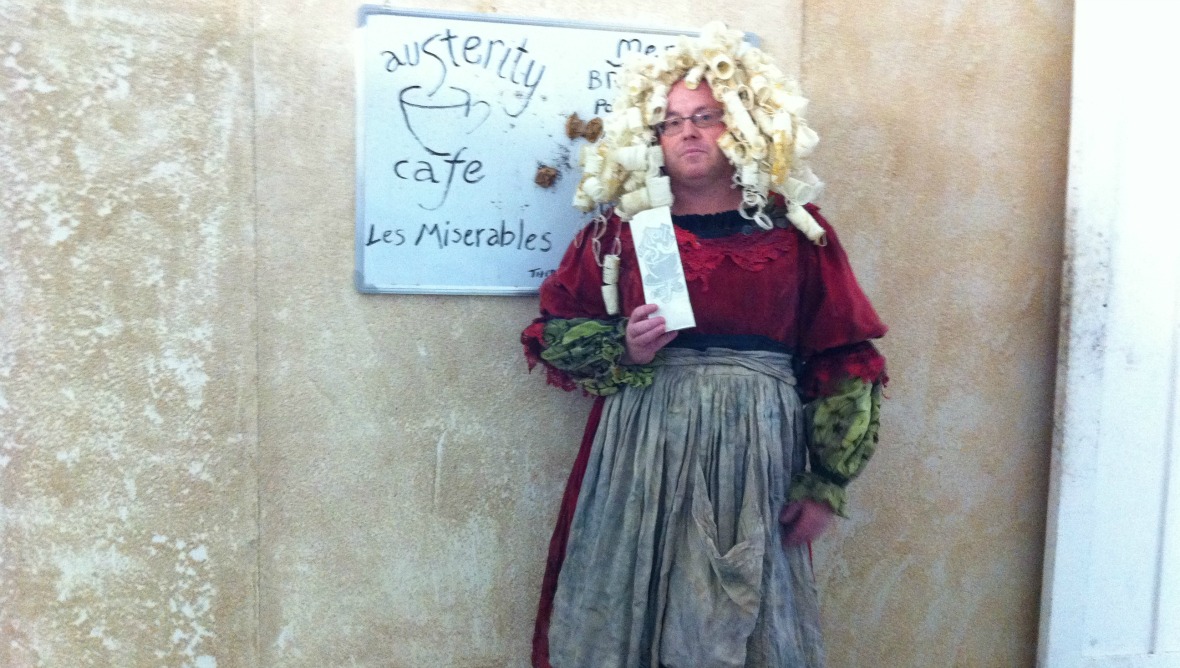
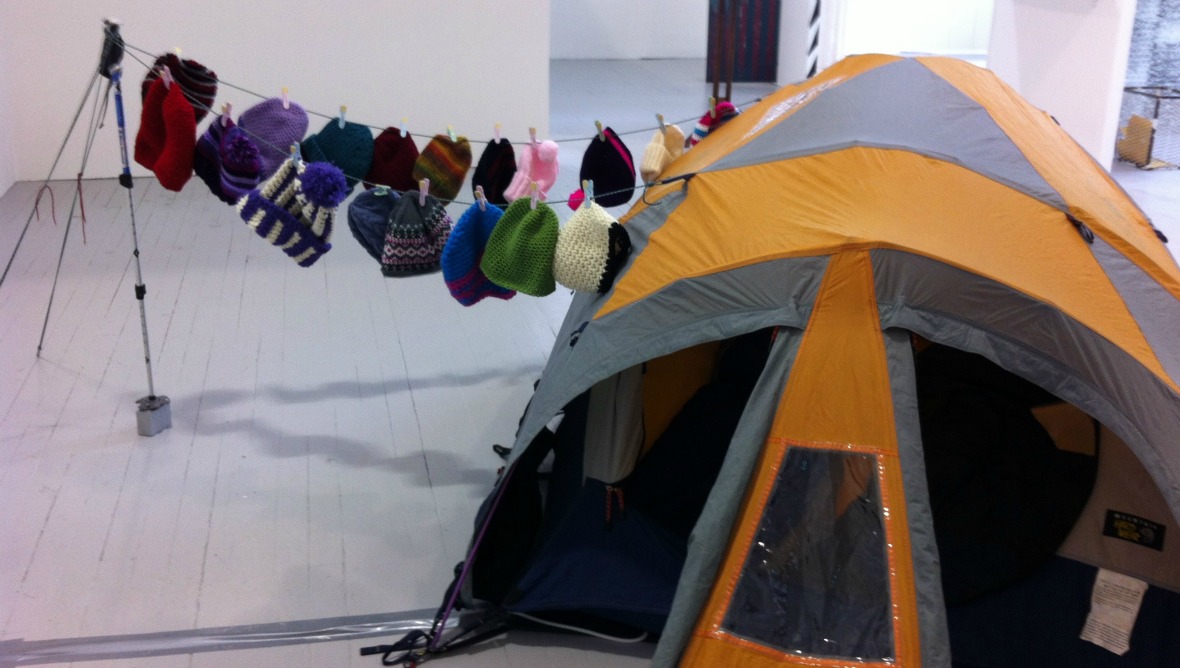
The diversity of the showcase is further highlighted by an Austerity Cafe which Chris Silver will be running throughout the exhibition.

Austerity Cafe Chris Silver at the Austerity Café
Chris will be dressing up and coordinating morning and afternoon performances during the run. He said: "I started the project to try to make sense of austerity and what it meant. I decided to go on a porridge diet and use art in a way to reflect it and I've now ended up eating porridge for the last 138 days.

"When I started researching I found out that the chancellor George Osborne actually studied Modern History, so I thought maybe if I got a 2:1 in this it would qualify me to be a minister or a cultural secretary because it's a bit more relevant than George's background.

"Marie Antoinette was a natural link to the subject of austerity and I'm looking at it through the character Les Mis. I'll be performing and giving out goody bags containing things like porridge and once I've given everything out and there's no more bags to give away people can take the pegs from the walls so in the end there will be nothing else to give.

“I wanted to do something that people would either love or hate. I didn't want there to be an indifference, for this final show I wanted it to be memorable and for the Austerity Cafe to create a legacy of sorts."

Spread out over various sites, members of the public can also check out three floors of design displays by more than 140 students at the Skypark Campus.

The Design School output includes work by Ross Hogg, whose short film The Man Who Mistook His Wife for a Hat has been selected for a screening at the Edinburgh International Film Festival, and Francesca MacDonald's Raviolo Lavorio cookbook.

The Skypark will feature projects from the Silversmithing and Jewellery, Interior Design, Fashion and Textiles, Product Design, Communication Design and Product Design Engineering courses.

Elsewhere, work from 24 postgraduates will be on display at the Glue Factory until June 15.
Work at the Degree Show

Jim Birrell head of painting and printmaking at the Glasgow School of Art says the Degree Shows are a unique opportunity to see up-and-coming artists.

He explained: "At the School of Fine Art there's a lot of focus on social conditions and austerity, much of it deals with the impact of the environment and every year it's interesting to see what the students will come up with.

"They are encouraged to be completely individual and have the scope to do whatever they want within their discipline. The studios are completely transformed for the shows and there's a lot of hard work that goes into the shows.

"It's an opportunity for people to see what goes on at the Glasgow School of Art. No doubt a few of these students will be well known in the future."

The Glasgow School of Art Degree Show is open 10am until 5pm Saturday and Sunday, 10am until 9pm Monday to Thursday, and on Friday from 10am until 7pm at the Garnethill Campus and Skypark Campus.

The MFA show at the Glue Factory is open daily between 11am and 6pm. For more go to the Glasgow School of Art website.